
Ukraine Launches Largest Drone Strike on Moscow Since War Began, Hitting Refinery and Halting Flights
Almost 200 Ukrainian drones struck the Russian capital and surrounding areas, igniting a major oil refinery and forcing the temporary closure of Moscow's airports in an unprecedented tactical escalation.
By Factlen Editorial Team
- Ukrainian Defense Advocates
- Views the strikes as a necessary and legitimate tactic to degrade Russia's war machine and bring the cost of the conflict home to Moscow.
- Western Security Observers
- Analyzes the strike as a significant technological and psychological milestone, while remaining wary of the potential for severe escalation.
- Russian State Narrative
- Frames the assault as a desperate act of terrorism aimed at civilians, claiming air defenses successfully neutralized the primary threat.
What's not represented
- · Local Moscow residents experiencing the immediate aftermath
- · Global energy market analysts assessing the long-term impact on Russian refining capacity
Why this matters
This unprecedented strike shatters the illusion of safety in the Russian capital and demonstrates Ukraine's rapidly expanding long-range strike capabilities. The disruption to Moscow's airspace and energy infrastructure marks a significant strategic shift that could provoke severe retaliatory measures while degrading Russia's domestic war machine.
Key points
- Nearly 200 Ukrainian drones targeted the Moscow region in the largest strike of the war.
- A major oil refinery in the southeastern suburbs was struck and caught fire.
- Vnukovo, Domodedovo, and Sheremetyevo airports were temporarily forced to halt all flights.
- Russia claims its air defenses intercepted most drones, blaming damage on falling debris.
- The strike demonstrates Ukraine's growing capability to bypass Russian electronic warfare and radar.
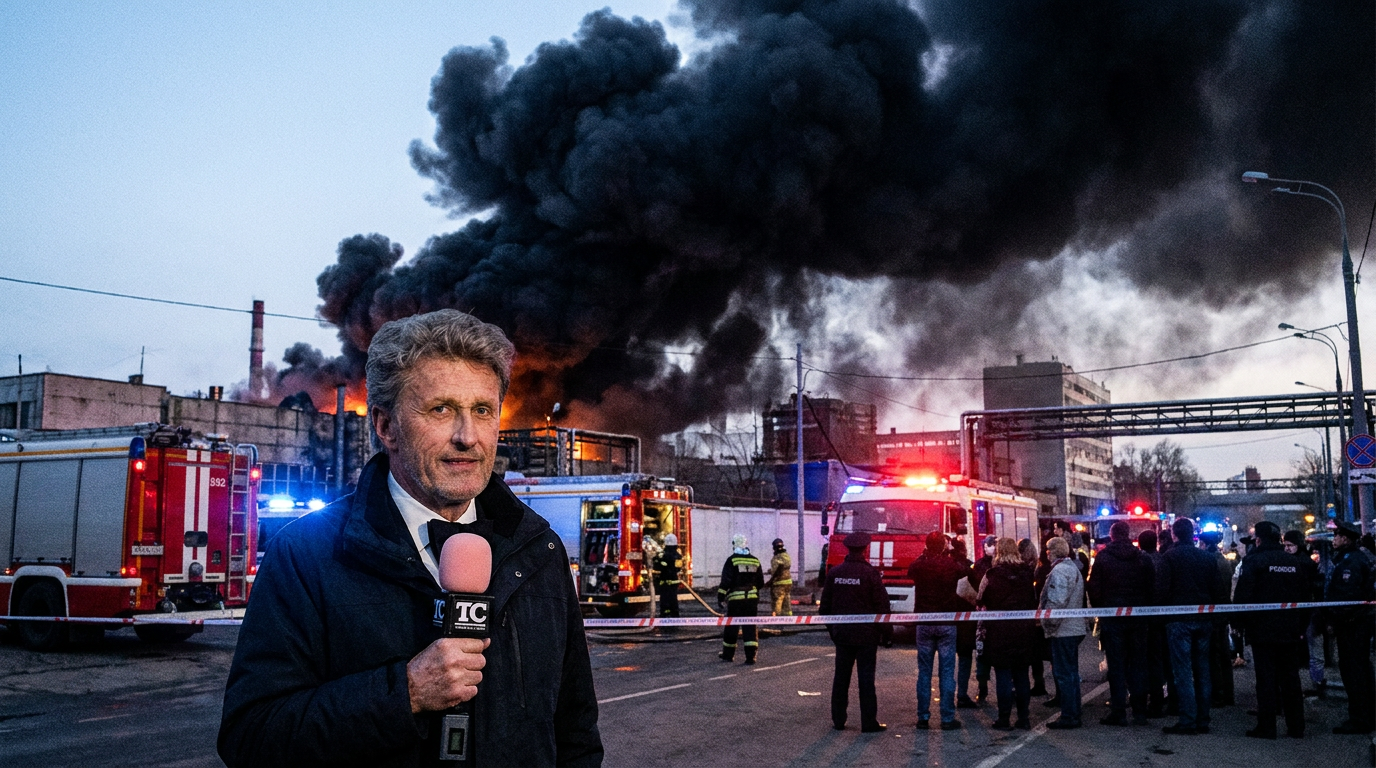
In a dramatic escalation of the multi-year conflict, the Russian capital was rocked early Thursday by the largest Ukrainian drone assault since the start of the full-scale war. An estimated swarm of nearly 200 unmanned aerial vehicles penetrated deep into Russian territory, targeting industrial and logistical hubs in the southeastern suburbs of Moscow. The sheer volume of the incoming munitions overwhelmed local air defense networks, transforming the morning sky into a chaotic theater of interceptor missiles, anti-aircraft fire, and plunging debris.[1][2]
The primary casualty of the strike was a major oil refinery situated on the outskirts of the city, which erupted into a massive blaze visible for miles. Emergency response teams rushed to contain the inferno, alongside secondary fires that ignited at a nearby shopping center. The cascading threat forced Russian aviation authorities to abruptly halt all civilian air traffic, paralyzing operations at Vnukovo, Domodedovo, and Sheremetyevo airports for several hours and leaving thousands of passengers stranded on the tarmac.[2][3]
Russian officials were quick to downplay the tactical success of the operation, with the Defense Ministry claiming that its layered air defense systems successfully intercepted the vast majority of the incoming drones. State media characterized the assault as a "terrorist attack" aimed at civilians, attributing the ground damage entirely to falling debris rather than direct, successful strikes. However, the scale of the fires and the immediate lockdown of the capital's airspace painted a starkly different picture of the morning's events.[6]

For Kyiv, the operation represents a deliberate and highly visible shift in strategy. After enduring years of relentless Russian missile and drone bombardments on their own cities, Ukrainian forces are increasingly determined to bring the physical and psychological costs of the war directly to the Russian populace. By targeting energy infrastructure and logistical nodes, Ukraine aims to systematically degrade the fuel supplies and supply chains that sustain Russia's frontline operations.[7]
For Kyiv, the operation represents a deliberate and highly visible shift in strategy.
The technical execution of the strike highlights a significant leap in Ukraine's domestic defense manufacturing. Launching nearly 200 drones simultaneously requires sophisticated swarm coordination and advanced navigation systems capable of bypassing extensive electronic warfare jamming. Western military analysts noted that the drones likely flew at extremely low altitudes, utilizing terrain masking to evade early warning radar systems until they were on the final approach to the capital.[5][8]
Beyond the immediate physical destruction, the psychological impact on Muscovites is profound. For much of the war, the Kremlin has successfully insulated the residents of the capital from the realities of the conflict, maintaining an atmosphere of normalcy. The sight of black smoke billowing over the city skyline and the sound of air raid sirens shatter that carefully constructed narrative, signaling that no part of the country is entirely beyond the reach of Ukrainian retaliation.[2][4]

International reaction has been a mix of quiet acknowledgment and underlying anxiety. While Western allies have consistently supported Ukraine's right to defend itself and target legitimate military infrastructure, strikes deep inside Russian territory always carry the risk of unpredictable escalation. Diplomats in Washington and European capitals are closely monitoring the situation, balancing their support for Kyiv's tactical innovations against the persistent fear of a disproportionate, potentially unconventional response from Moscow.[1][5]
As emergency crews continue to battle the refinery blaze, the immediate question is how the Kremlin will retaliate. Previous Ukrainian strikes on Russian soil have routinely been met with massive, punitive missile barrages directed at Ukraine's civilian energy grid and residential centers. With both sides now demonstrating the capability and willingness to strike deep into each other's heartlands, the conflict appears to be entering a volatile new phase defined by long-range, asymmetric warfare.[3][8]
How we got here
May 2023
Two small drones strike the roof of the Kremlin in the first symbolic attack on the capital.
Late 2023
Sporadic drone attacks target Moscow's financial district and surrounding military airfields.
Early 2026
Ukraine rapidly scales its domestic production of long-range, radar-evading kamikaze drones.
June 18, 2026
An unprecedented swarm of nearly 200 drones strikes Moscow infrastructure, halting flights and igniting a refinery.
Viewpoints in depth
Ukrainian Military Command
Views the strikes as a necessary evolution of the war to degrade Russian logistics.
From Kyiv's perspective, striking deep into Russian territory is a strategic imperative. Ukrainian officials argue that targeting oil refineries, airfields, and logistical hubs directly degrades the fuel and supply lines that sustain the Russian invasion force. Furthermore, these strikes serve a critical psychological purpose: demonstrating to the Russian public that the war is not a distant "special military operation," but a conflict with tangible consequences for their own safety and economy.
Russian Defense Ministry
Frames the assault as a desperate, terroristic act aimed at civilians.
The Kremlin's official narrative consistently downplays the military effectiveness of Ukrainian strikes while amplifying the threat to civilians. Russian defense officials argue that these drone swarms are "terrorist attacks" launched out of desperation due to Ukraine's inability to achieve decisive victories on the traditional battlefield. By claiming that air defenses successfully intercept the vast majority of the drones, the state seeks to reassure the public of its competence while justifying future retaliatory missile strikes against Ukrainian cities.
Western Strategic Analysts
Analyzes the strike as a milestone in asymmetric warfare, balancing tactical success against escalation risks.
Independent military observers view the attack as a masterclass in asymmetric warfare and a testament to Ukraine's rapidly advancing domestic defense industry. The ability to coordinate a 200-drone swarm to bypass one of the most heavily defended airspaces in the world exposes significant gaps in Russia's radar and electronic warfare networks. However, these analysts also caution that such highly visible humiliations for the Kremlin increase the likelihood of severe, disproportionate retaliation, keeping Western capitals on edge regarding the potential for nuclear posturing or attacks on NATO-adjacent supply lines.
What we don't know
- The exact percentage of drones that successfully hit their intended targets versus those intercepted by air defenses.
- The full extent of the structural damage to the targeted oil refinery and its impact on regional fuel production.
- How and when the Russian military will retaliate for the unprecedented strike on its capital.
Key terms
- Kamikaze Drone
- A loitering munition designed to crash into its target and detonate on impact, rather than dropping a payload and returning to base.
- Layered Air Defense
- A defensive strategy that utilizes multiple types of anti-aircraft systems at different ranges (long, medium, and short) to protect a specific area or target.
- Terrain Masking
- A flight tactic where an aircraft or drone flies extremely close to the ground, using hills, valleys, and curvature to hide from enemy radar.
Frequently asked
Were civilian areas targeted in the attack?
While a shopping center caught fire, the primary targets appeared to be industrial and logistical sites, specifically a major oil refinery in the southeastern suburbs.
How did the drones reach Moscow undetected?
Military analysts suggest the drones utilized swarm tactics and flew at extremely low altitudes, using terrain to hide from early warning radar systems until they reached the capital.
Will this strike affect global oil prices?
The targeted refinery primarily serves Russia's domestic fuel needs. While it degrades local logistics, it is unlikely to have a major immediate impact on global crude export markets.
Sources
Source coverage
8 outlets
3 viewpoints surfaced








[1]BBCUkrainian Defense Advocates
Moscow hit by largest Ukrainian attack since start of Russia's full-scale war
Read on BBC →[2]NYTWestern Security Observers
Ukraine Strikes Moscow Refinery in Large-Scale Drone Attack
Read on NYT →[3]ReutersWestern Security Observers
Russia halts Moscow flights as massive Ukrainian drone swarm strikes capital
Read on Reuters →[4]Al JazeeraWestern Security Observers
Fires rage in Moscow suburbs following unprecedented Ukrainian drone assault
Read on Al Jazeera →[5]Fox NewsWestern Security Observers
Ukraine launches historic drone strike on Moscow, exposing Russian air defense gaps
Read on Fox News →[6]TASSRussian State Narrative
Russian air defenses intercept massive terrorist drone attack on Moscow region
Read on TASS →[7]Kyiv IndependentUkrainian Defense Advocates
Ukraine brings war home to Putin with record-breaking drone strike on Moscow
Read on Kyiv Independent →[8]The GuardianUkrainian Defense Advocates
Moscow airports paralyzed as Ukrainian drones strike deep into Russian territory
Read on The Guardian →



Every angle. Every day.
Get news politics stories with full source coverage and perspective breakdowns delivered to your inbox.