
How Local LLMs Work: The Shift to Running AI on Your Own Hardware
Advances in hardware and software compression now allow highly capable AI models to run entirely on consumer laptops. This shift offers absolute data privacy, zero latency, and eliminates recurring cloud API costs.
By Factlen Editorial Team
- Privacy & Compliance Advocates
- Argue that absolute data sovereignty is non-negotiable for sensitive industries.
- Cost-Conscious Developers
- Focus on eliminating recurring per-token API fees in favor of one-time hardware investments.
- Hardware Ecosystem
- View local AI as the primary driver for upgrading consumer devices with NPUs.
- Cloud AI Providers
- Maintain that frontier reasoning will always require centralized data centers.
- Neutral Analysts
- Focus on the pragmatic, hybrid future of AI deployment.
What's not represented
- · Environmental Analysts
- · Cloud Infrastructure Providers
Why this matters
Running AI locally guarantees that your sensitive data never leaves your device, protecting you from corporate data harvesting and regulatory breaches. It also eliminates the recurring subscription fees associated with cloud-based AI tools, turning AI into a free, offline utility.
Key points
- Local LLMs run entirely on user hardware, ensuring absolute data privacy and offline capability.
- Quantization compresses massive AI models to fit within consumer RAM with minimal quality loss.
- Modern NPUs and unified memory architectures make laptops highly efficient at AI inference.
- While local models excel at daily tasks, cloud APIs remain necessary for massive reasoning workloads.
The assumption that artificial intelligence requires a massive, energy-hungry server farm is fundamentally shifting. For years, accessing state-of-the-art language models meant tethering your workflow to the cloud, relying on the infrastructure of tech giants. But in 2026, running a highly capable Large Language Model (LLM) directly on a consumer laptop is no longer a niche hobby for developers—it has matured into a mainstream computing paradigm. This transition is quietly reshaping how enterprises handle sensitive data and how individuals interact with machine intelligence.[7]
The traditional cloud-based AI model comes with inherent trade-offs that are becoming harder to ignore. When a user types a prompt into a service like ChatGPT or Claude, that data must travel across the internet to a remote server, be processed by a massive GPU cluster, and return. This constant network dependency introduces noticeable latency, incurs recurring per-token costs, and, most critically, creates a privacy vulnerability. Local AI severs that tether entirely, bringing the intelligence directly to the edge where the data actually lives, fundamentally changing the risk calculus.[2][5]
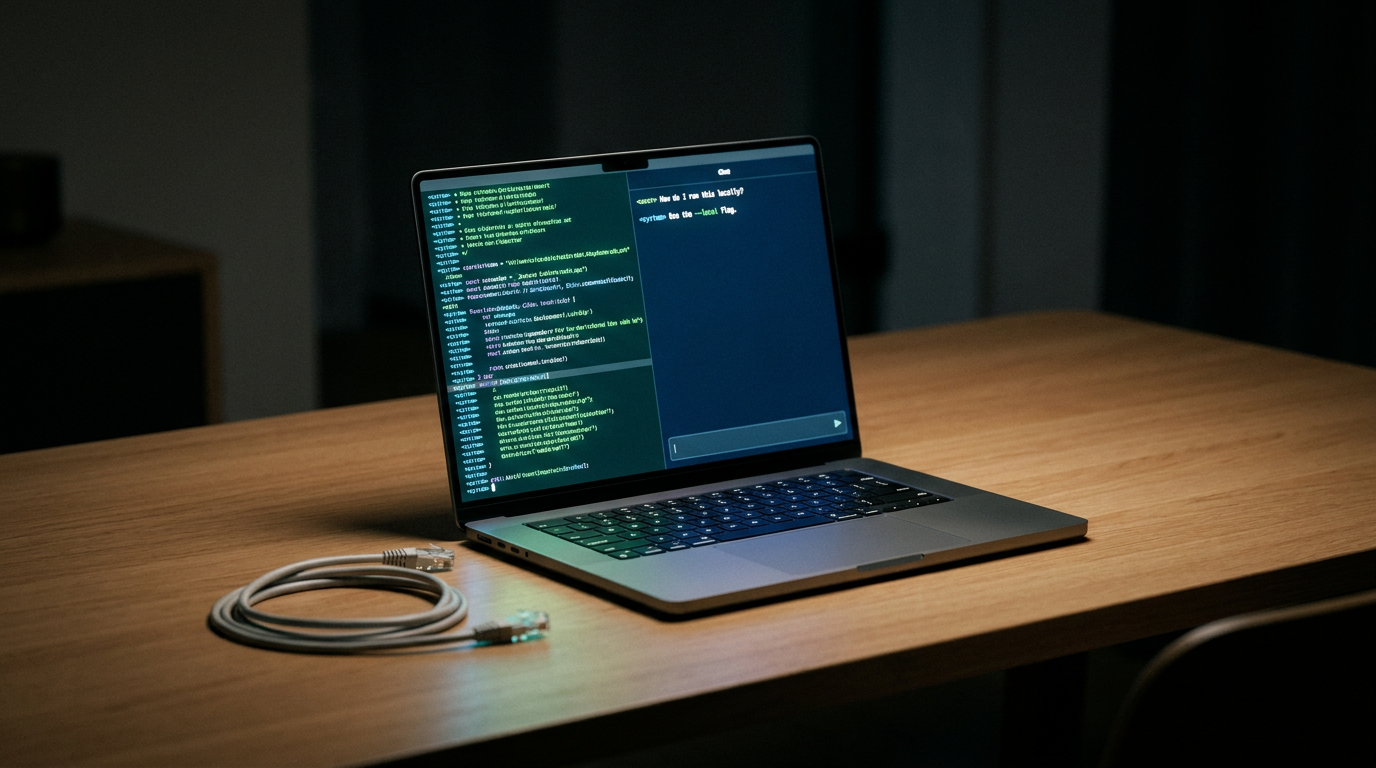
At its core, a local LLM is an artificial intelligence model whose underlying weights—the billions of mathematical parameters that dictate its behavior and knowledge—are downloaded and executed entirely on the user's own hardware. Once the model files are saved to the local drive, no internet connection is required to generate text, write code, or analyze documents. The device's own processor handles the heavy lifting, ensuring that the user retains absolute control over the software, the hardware, and the workflow.[4]

For enterprises handling sensitive information, this local architecture is not merely an optimization; it is a strict regulatory necessity. Sending proprietary source code, patient health records, or internal financial data to a third-party API creates immediate exposure under compliance frameworks like GDPR, HIPAA, and SOC 2. Even with strict enterprise data agreements, the information still crosses a network boundary to reach a processor you do not control. Local inference eliminates these concerns at the architectural level, guaranteeing that sensitive prompts and proprietary documents never leave the physical machine.[3][4]
The latency advantage of local processing heavily compounds the privacy argument. Cloud API round-trips typically introduce 200 to 800 milliseconds of network latency, depending on server load, geographic distance, and queue processing. Local inference, bypassing the internet entirely, can deliver "time-to-first-token" speeds as low as 10 to 50 milliseconds. For real-time applications—such as live voice transcription, latency-sensitive user interfaces, or autonomous coding agents making dozens of sequential decisions—that near-instantaneous response time is transformative, making the AI feel like a native extension of the operating system.[3][5]
The financial equation also flips dramatically when moving away from the cloud. Cloud providers charge per token, meaning every word read or generated incurs a microscopic fee. At scale, especially for high-volume automated tasks, these fees compound rapidly into massive monthly bills. Local AI shifts the financial model from recurring operational expenses to a one-time capital expenditure: buying capable hardware. After the initial purchase, generating a million tokens costs only the electricity required to run the machine, offering zero marginal cost per request.[4][6]

Understanding how this works requires looking at the mechanism of AI inference. At its core, an LLM predicts the next most likely token based on the vast patterns it learned during its initial training phase. To do this locally, the system must load the model's massive parameter file into the device's memory—either the system RAM or the dedicated VRAM of a graphics card. When a prompt is entered, the device's processor performs billions of rapid matrix multiplications to calculate and generate the response, keeping the entire computational loop self-contained.[7]
Understanding how this works requires looking at the mechanism of AI inference.
Historically, these models required massive server GPUs because their parameters were stored in 32-bit floating-point precision, demanding hundreds of gigabytes of memory just to load the file. The breakthrough that enabled the local AI revolution is a mathematical compression technique known as quantization. By compressing these parameters into 8-bit, 4-bit, or even experimental 1.58-bit integers, developers drastically reduced the memory footprint required to hold the model. This compression is the magic trick that makes it possible to run highly capable intelligence on standard consumer-grade hardware.[1][2]
In practice, quantization delivers astonishing efficiency. By using optimized file formats like GGUF, a massive 70-billion parameter model that would normally require over 140 gigabytes of memory can be compressed to fit into roughly 40 gigabytes. Remarkably, this aggressive compression results in less than a two percent degradation in output quality. This means a high-end desktop or a well-equipped laptop can now run reasoning engines that rival the capabilities of data centers from just a few years ago.[6]

Software compression is only half the story; the physical hardware has evolved rapidly to meet the intense demand of local inference. Modern consumer processors from companies like AMD, Intel, and Qualcomm now routinely include Neural Processing Units (NPUs). These are dedicated pieces of silicon designed specifically to handle the repetitive matrix math of AI inference far more efficiently than a general-purpose CPU. NPUs allow laptops to run background AI tasks continuously without immediately draining the battery or spinning up loud cooling fans, making on-device AI practical for daily use.[2]
Apple Silicon has been particularly disruptive in this space due to its unified memory architecture. In a traditional PC, the CPU and the GPU have separate pools of memory, and AI models usually need to fit entirely within the GPU's expensive VRAM. Because Apple's M-series chips share a single massive pool of unified memory, a Mac Studio or MacBook Pro with 64GB or 128GB of RAM can load massive AI models that would otherwise require multiple expensive, dedicated NVIDIA graphics cards.[3][4]
The software layer has also undergone a radical simplification, removing the steep technical barriers to entry. Two years ago, running a local model required navigating complex Python dependencies, compiling C++ code, and troubleshooting fragile command-line environments. Today, tools like Ollama, LM Studio, and GPT4All have reduced the entire deployment process to a single click. These applications automatically detect the system's hardware capabilities, download the appropriately quantized model, and provide a familiar, user-friendly chat interface that anyone can use, effectively democratizing access to raw AI compute.[2][4]

This thriving ecosystem is powered entirely by "open-weight" models—systems where the creator releases the underlying parameters to the public for free download and modification. In 2026, the quality of these open models is staggering. Releases like Meta's Llama 4 series, Alibaba's Qwen 3, and Microsoft's highly efficient Phi-4 offer reasoning, coding, and writing capabilities that rival the proprietary cloud models of just a year ago. Developers can pull these models down, test them locally, and even fine-tune them on their own private datasets without asking for permission.[1][5]
Despite this rapid progress, local AI is not a complete replacement for the cloud, and significant trade-offs remain for power users. Frontier cloud models still hold a distinct advantage in complex, multi-step reasoning, highly reliable autonomous agentic behavior, and massive context windows. When a user needs to analyze an entire library of documentation simultaneously—a task requiring a context window of a million tokens or more—the sheer memory requirements still necessitate the massive compute clusters of a centralized data center, far exceeding what a laptop can hold.[5]
Furthermore, running heavy inference on a local machine is computationally expensive in terms of power and thermal management. While modern NPUs have vastly improved efficiency, running a 32-billion parameter model continuously on a laptop will still consume significant power, rapidly draining batteries and generating noticeable heat under sustained loads. For the most demanding, cutting-edge tasks, or for users operating on older hardware without dedicated AI accelerators, cloud APIs remain the most practical, accessible, and battery-friendly solution for accessing artificial intelligence without overwhelming the host device.[2]
Ultimately, the future of AI architecture is not a zero-sum game between local and cloud, but a pragmatic hybrid approach. Developers and enterprises are increasingly adopting a routing strategy: using local, private models as the default for daily tasks, sensitive data processing, and high-volume automated workflows. They then fall back to premium cloud APIs only for the small percentage of requests that truly require frontier reasoning capabilities. This balance offers the best of both worlds: absolute privacy and zero marginal cost for the routine, with limitless power available on demand.[3][5]
How we got here
Feb 2023
Meta releases LLaMA, sparking the open-weight movement.
Late 2023
Quantization formats like GGUF mature, allowing large models to fit on consumer RAM.
2024
Tools like Ollama and LM Studio make local deployment a one-click process.
2025–2026
NPUs become standard in consumer laptops, and open models reach GPT-4-level capabilities.
Viewpoints in depth
Privacy & Compliance Advocates
Absolute data sovereignty is non-negotiable for sensitive industries.
For sectors like healthcare, finance, and legal services, sending proprietary data to a third-party cloud API introduces unacceptable regulatory risk. This camp argues that local inference is the only architecture that guarantees compliance with frameworks like GDPR and HIPAA, as the data physically never leaves the user's machine. They view local LLMs not just as a cost-saving measure, but as a fundamental requirement for enterprise AI adoption.
Hardware Ecosystem
Local AI is the primary driver for the next generation of consumer computing.
Chipmakers like Apple, AMD, Qualcomm, and Intel view local inference as the catalyst for a massive hardware upgrade cycle. By integrating Neural Processing Units (NPUs) and expanding unified memory architectures, they are positioning the personal computer as an AI appliance. This camp emphasizes that moving compute to the edge reduces global server strain and empowers users with offline capabilities.
Cloud AI Providers
Frontier reasoning and massive context will always require centralized data centers.
Proponents of cloud-based AI acknowledge the utility of local models for basic tasks, but argue that the cutting edge of artificial intelligence will always outpace consumer hardware. They point out that models capable of complex, multi-step logic or analyzing million-token context windows require clusters of enterprise GPUs that cannot be miniaturized. In their view, local AI is a complement to, rather than a replacement for, cloud APIs.
What we don't know
- How quickly cloud providers will lower API costs to compete with the zero-marginal-cost local ecosystem.
- Whether future frontier models will eventually become too large to ever compress for consumer hardware.
Key terms
- Local LLM
- A large language model that runs entirely on a user's own device without requiring an internet connection.
- Quantization
- A compression technique that reduces the precision of an AI model's parameters to save memory.
- NPU (Neural Processing Unit)
- Specialized hardware designed to accelerate the mathematical operations required for AI inference.
- Unified Memory
- An architecture where the CPU and GPU share the same pool of RAM, allowing large AI models to load efficiently.
- Open-weight model
- An AI model whose underlying parameters are publicly available to download and run.
Frequently asked
Can I run a local LLM without an internet connection?
Yes. Once the model weights and the software are downloaded, the AI processes everything directly on your device's hardware, fully offline.
Is running AI locally cheaper than using ChatGPT?
For high-volume use, yes. While you must purchase capable hardware upfront, there are no recurring subscription fees or per-token API costs.
Do I need a massive graphics card to run local AI?
Not necessarily. Thanks to quantization and modern NPUs, many capable models can run on standard laptops with 16GB to 32GB of RAM.
Sources
Source coverage
7 outlets
5 viewpoints surfaced







[1]CodeToCloudCost-Conscious Developers
Open-Source LLMs for Developers: The Complete Guide
Read on CodeToCloud →[2]CheckThat AIHardware Ecosystem
Running language models locally on your own hardware
Read on CheckThat AI →[3]Dev.toPrivacy & Compliance Advocates
Setting Up a Production-Ready Local Stack
Read on Dev.to →[4]DualitePrivacy & Compliance Advocates
The best local LLM tools in 2026
Read on Dualite →[5]MindStudioCloud AI Providers
The Gap Between Local and Cloud AI Is Closing
Read on MindStudio →[6]Create AI AgentCost-Conscious Developers
Best self hosted llm 2026
Read on Create AI Agent →[7]Factlen Editorial TeamNeutral Analysts
Synthesis by Factlen editorial team
Read on Factlen Editorial Team →



Every angle. Every day.
Get ai stories with full source coverage and perspective breakdowns delivered to your inbox.