
EU Delays High-Risk AI Rules as US Lawmakers Propose Federal Framework
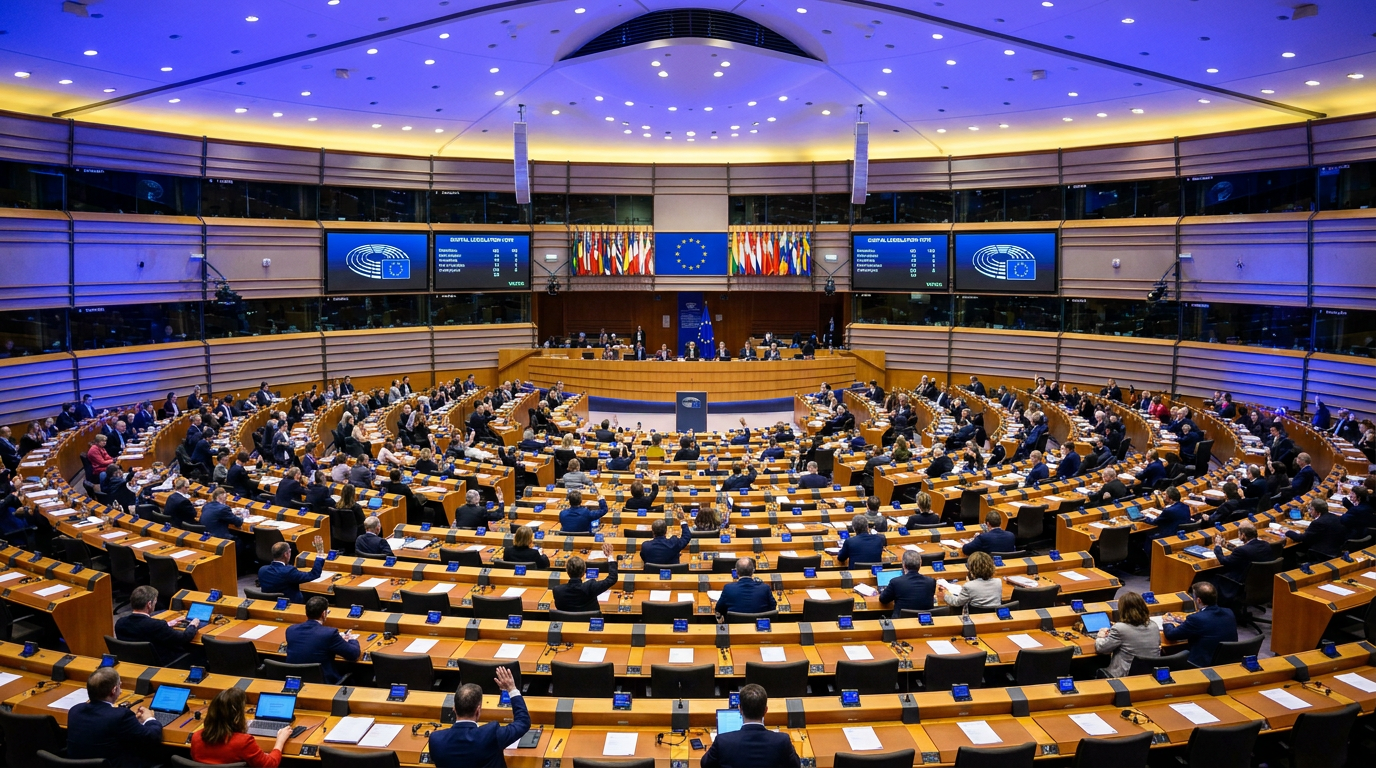
The European Parliament has officially delayed core provisions of the EU AI Act until late 2027, while US lawmakers introduced a bipartisan bill to preempt a growing patchwork of state-level AI regulations.
By Factlen Editorial Team
- Transatlantic Tech Industry
- Favors the EU's compliance delay and supports US federal preemption to avoid navigating a fractured patchwork of state laws.
- Civil Society Organizations
- Opposes federal preemption of state laws, arguing that voluntary federal guidelines are insufficient to protect consumers from algorithmic harms.
- State & EU Regulators
- Focused on building local enforcement mechanisms and defending regional legislative authority against federal or international overreach.
What's not represented
- · Open-source AI developers
- · Small-to-medium enterprise AI adopters
Why this matters
For AI developers and enterprise adopters, the transatlantic regulatory landscape has inverted: the EU is offering a temporary compliance reprieve, while the US faces a chaotic collision between state laws, voluntary federal guidelines, and pending congressional legislation.
Key points
- The EU Parliament approved the Digital Omnibus, delaying high-risk AI compliance to December 2027.
- EU watermarking rules and bans on AI-generated intimate imagery will still take effect in December 2026.
- The US White House issued a new executive order establishing a voluntary 30-day review for frontier models.
- US lawmakers introduced the Great American AI Act to mandate transparency and preempt state AI laws.
- States introduced over 1,500 AI bills in 2026, creating a complex patchwork for developers.
In June 2026, the global framework for artificial intelligence regulation underwent a structural realignment. While the European Union officially pumped the brakes on its landmark AI Act to give the industry more time, the United States saw a flurry of federal activity aimed at reining in a chaotic patchwork of state-level laws.[1][5]
The most concrete legislative shift occurred in Brussels. On June 16, the European Parliament approved the "Digital Omnibus on AI," a legislative package that fundamentally rewrites the compliance timeline for the world's first comprehensive AI law.[1][2]
The primary claim emerging from the Omnibus is a 16-month delay for core high-risk AI obligations. Under the approved text, the compliance deadline for stand-alone "high-risk" AI systems—categorized under Annex III, which includes employment screening tools and biometric identification—has been pushed from August 2, 2026, to December 2, 2027. Furthermore, obligations for AI embedded in regulated products, known as Annex I systems, are deferred to August 2028.[1][3]

However, legal analysts caution that this deferral is not a dismantling of the AI Act. The fundamental risk-based architecture remains intact, and the evidence shows that certain immediate prohibitions are strictly maintained to address acute public harms.[3]
Generative AI providers face immediate, unyielding deadlines for content moderation. The December 2, 2026, enforcement date remains firmly in place for Article 50 transparency obligations. This includes a strict mandate for machine-readable watermarking on AI-generated content and a total ban on AI systems that generate non-consensual intimate imagery, often termed "nudifiers," or child sexual abuse material.[2][3]
Across the Atlantic, the US regulatory approach is fracturing into three competing lanes: a deregulatory executive branch, an ambitious but stalled Congress, and highly active state legislatures.[4][5]
At the executive level, the White House has pivoted to a strictly voluntary oversight model for frontier AI. Following the January 2025 revocation of the Biden administration's mandatory AI reporting requirements, the Trump administration issued a new executive order on June 2, 2026, titled "Promoting Advanced Artificial Intelligence Innovation and Security."[5][6]
At the executive level, the White House has pivoted to a strictly voluntary oversight model for frontier AI.
The June 2 directive establishes a voluntary 30-day pre-release review framework for "covered frontier models," allowing companies to submit models for federal cybersecurity testing. Crucially, the order explicitly prohibits federal agencies from imposing mandatory licensing, preclearance, or permitting requirements on AI developers, cementing a hands-off federal posture.[6]

In contrast to the executive branch, US lawmakers are attempting to nationalize AI governance to prevent state-by-state fragmentation. On June 4, Representatives Jay Obernolte and Lori Trahan released a 269-page bipartisan discussion draft titled the "Great American Artificial Intelligence Act of 2026."[4]
The draft legislation would impose transparency reports, critical safety incident reporting, and whistleblower protections on large-scale frontier developers. It also mandates a study on the "jawboning" of AI firms and censorship, reflecting bipartisan compromises aimed at balancing free speech with algorithmic safety.[4][5]
The most contentious provision of the Great American AI Act is its preemption clause. The bill would explicitly preempt state laws that specifically regulate the development of AI models for a three-year period, effectively freezing local legislative efforts to allow a federal standard to take root.[4][5]
This preemption targets a rapidly expanding web of state legislation. In 2026 alone, states considered over 1,500 AI-related bills. Colorado recently replaced its original AI Act with the broader Automated Decision-Making Technology Act, while Utah has enforced strict disclosure requirements for AI use in regulated professions.[5]

There is high uncertainty regarding the Great American AI Act's path to passage. Civil society organizations and labor unions have already mounted opposition to the preemption measures, arguing that federal gridlock should not invalidate state-level consumer protections. Without congressional action, the voluntary executive order and the state patchwork will remain the de facto US regulatory regime.[4][5]
Meanwhile, EU member states are actively building their enforcement infrastructure to prepare for the delayed deadlines. On June 17, Ireland—home to the EU headquarters of major tech firms like Google and Meta—published the Regulation of Artificial Intelligence Bill 2026.[7]

The Irish legislation establishes the independent "AI Office of Ireland" as the central coordinating authority and empowers the Competition and Consumer Protection Commission to levy administrative sanctions against non-compliant AI deployers. This signals that while the EU timeline has shifted, the bureaucratic machinery for enforcement is already coming online.[7]
For enterprise AI adopters and foundation model developers, the transatlantic divergence requires a bifurcated compliance strategy. In Europe, the legal requirements are clear but delayed, allowing companies to focus on the immediate December 2026 watermarking rules. In the US, companies must navigate voluntary federal guidelines while bracing for a potential collision between state enforcement and congressional preemption.[1][3][4][5]
How we got here
January 2025
The Trump administration revokes the Biden-era mandatory AI reporting executive order.
June 2, 2026
The White House issues a new executive order establishing voluntary pre-release reviews for frontier models.
June 4, 2026
Bipartisan US lawmakers release the draft Great American Artificial Intelligence Act of 2026.
June 16, 2026
The European Parliament approves the Digital Omnibus on AI, delaying high-risk compliance deadlines.
June 17, 2026
Ireland publishes its domestic enforcement bill to regulate AI companies operating within its borders.
Viewpoints in depth
Transatlantic Tech Industry
Favors the EU's compliance delay and supports US federal preemption to avoid navigating a fractured patchwork of state laws.
For multinational technology companies and enterprise AI adopters, the current regulatory environment is a compliance minefield. Industry groups have welcomed the EU's decision to delay high-risk obligations to 2027, arguing that the original timeline was unworkable given the lack of finalized technical standards. In the United States, these same groups are heavily backing the Great American AI Act's preemption clause. They argue that complying with 50 different state-level AI frameworks—such as Colorado's ADMT Act and Utah's disclosure laws—stifles innovation and creates an impossible liability burden for developers.
Civil Society Organizations
Opposes federal preemption of state laws, arguing that voluntary federal guidelines are insufficient to protect consumers from algorithmic harms.
Consumer protection advocates and civil rights organizations view the current federal landscape with deep skepticism. They argue that the White House's pivot to a strictly voluntary 30-day review process effectively removes mandatory safety guardrails for the most powerful AI models. Consequently, these groups are fiercely defending state-level legislation as the only viable mechanism for holding AI companies accountable. They strongly oppose the preemption measures in the Great American AI Act, warning that a three-year freeze on state laws would leave citizens vulnerable to algorithmic discrimination and safety incidents while Congress remains gridlocked.
State & EU Regulators
Focused on building local enforcement mechanisms and defending regional legislative authority against federal or international overreach.
Regulators at the state and national levels are moving aggressively to establish their authority regardless of broader delays or federal preemption threats. In Europe, member states like Ireland are rapidly standing up their domestic AI Offices and empowering local consumer protection commissions to levy fines, ensuring the bureaucratic machinery is ready long before the 2027 deadlines. In the US, state attorneys general and local lawmakers are pushing back against congressional attempts to override their authority, arguing that states have historically served as the necessary testing ground for complex technology regulation when the federal government fails to act.
What we don't know
- Whether the Great American AI Act can secure enough bipartisan support to pass during an election year.
- How European regulators will enforce the December 2026 watermarking mandate on open-source models.
- If major AI developers will actually participate in the US government's voluntary 30-day pre-release review process.
Key terms
- Digital Omnibus on AI
- A legislative package approved by the European Parliament that amends the compliance timeline of the original EU AI Act.
- Annex III High-Risk Systems
- AI applications that pose significant risks to health, safety, or fundamental rights, such as employment screening or biometric identification tools.
- Frontier Models
- Highly capable, large-scale artificial intelligence models that exceed the capabilities of currently existing advanced systems.
- Preemption
- A legal doctrine where higher-level laws, such as federal legislation, override or displace lower-level state regulations.
Frequently asked
When do the EU AI Act rules take effect?
High-risk AI system rules have been delayed to December 2, 2027, but bans on AI-generated intimate imagery and watermarking requirements take effect on December 2, 2026.
Does the US have a federal AI law?
Not yet. The US currently relies on a voluntary executive order for frontier models, though lawmakers have introduced the Great American AI Act to establish federal rules.
Will federal law override state AI regulations?
The proposed Great American AI Act includes a clause to preempt state AI laws for three years, but the bill has not yet passed and faces opposition from civil society groups.
Sources
Source coverage
7 outlets
3 viewpoints surfaced







[1]TechJack SolutionsState & EU Regulators
EU Parliament approves the AI Act Digital Omnibus
Read on TechJack Solutions →[2]Global Policy WatchState & EU Regulators
Digital Omnibus on AI: Key Highlights
Read on Global Policy Watch →[3]Gibson DunnTransatlantic Tech Industry
EU Institutions Reach Provisional Agreement on Digital Omnibus on AI
Read on Gibson Dunn →[4]Tech Policy PressCivil Society Organizations
Bipartisan Lawmakers Release Draft Great American AI Act of 2026
Read on Tech Policy Press →[5]Goodwin LawTransatlantic Tech Industry
The Emerging Consensus on US AI Regulation in 2026
Read on Goodwin Law →[6]Jenner & BlockTransatlantic Tech Industry
The June 2 EO and Federal AI Policy
Read on Jenner & Block →[7]Enterprise IrelandState & EU Regulators
Publication of the Regulation of Artificial Intelligence Bill 2026
Read on Enterprise Ireland →

Every angle. Every day.
Get ai stories with full source coverage and perspective breakdowns delivered to your inbox.