
The Clinical Evidence Behind At-Home LED Face Masks
Dermatological studies confirm that at-home LED masks can reduce acne and boost collagen, but experts warn that power output and consistency are the real drivers of results.
By Factlen Editorial Team
- Dermatologists & Clinicians
- View LED therapy as a scientifically valid adjunct to skincare, but stress the importance of device irradiance, proper wavelengths, and consistent use over quick fixes.
- Clinical Researchers
- Focus on the underlying photobiomodulation data, measuring success through controlled trials, collagen density ultrasounds, and cellular mitochondrial response.
- Skincare Consumers
- Value the convenience, non-invasive nature, and long-term cost savings of at-home devices compared to expensive in-office laser treatments.
What's not represented
- · Manufacturers of clinical-grade laser equipment
- · Aestheticians offering in-office light therapy
Why this matters
With premium LED masks costing upwards of $400, understanding the clinical data prevents consumers from wasting money on underpowered gadgets. Knowing which wavelengths and power outputs actually work allows you to make an evidence-backed investment in your long-term skin health.
Key points
- Red and near-infrared light stimulate collagen production and reduce fine lines over 12 weeks of consistent use.
- Blue light targets and kills acne-causing bacteria, reducing breakouts by up to 45 percent.
- The effectiveness of an at-home mask depends heavily on its irradiance, or power output.
- FDA clearance guarantees safety and equivalence to existing devices, but not cosmetic results.
- LED therapy is safe and UV-free, though blue light requires proper eye protection.
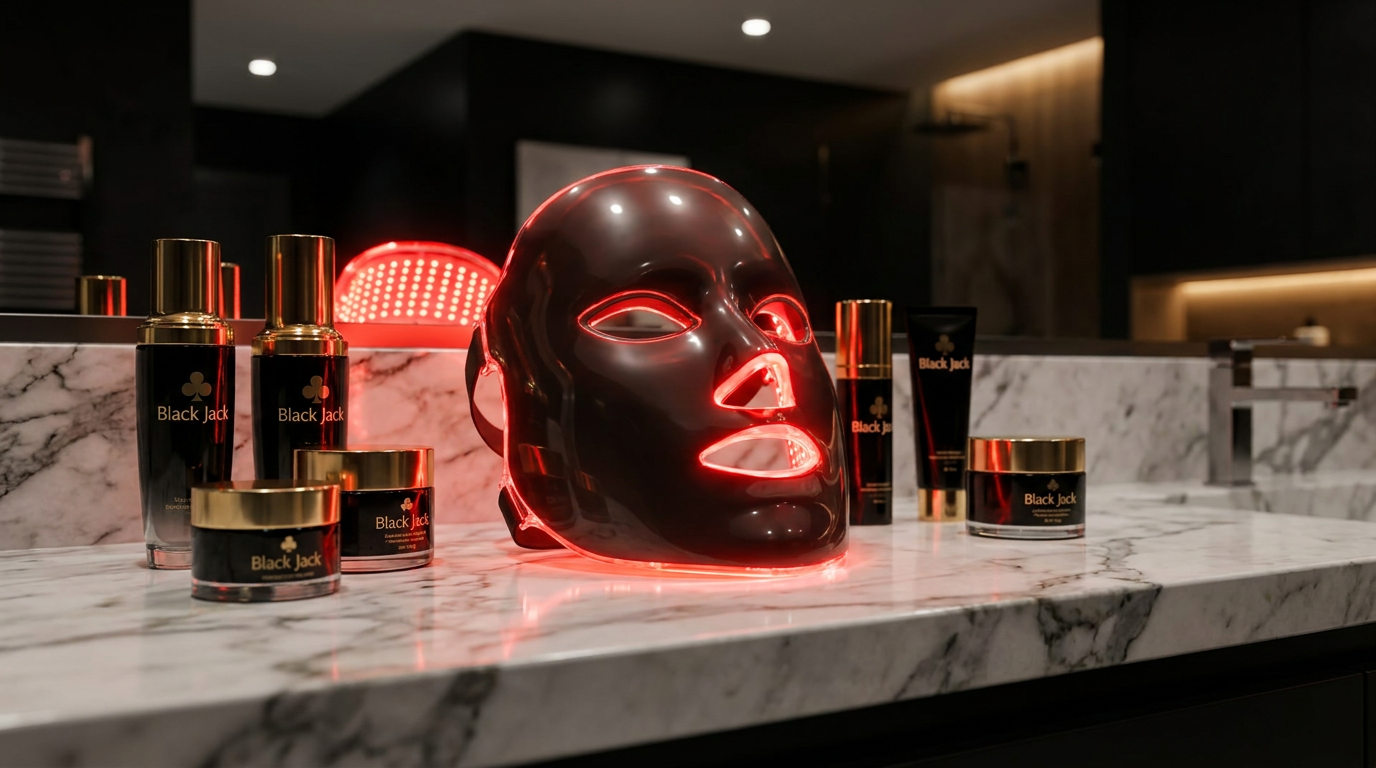
Over the past few years, glowing, robotic-looking LED face masks have transitioned from the exclusive domain of dermatology clinics to a staple of the nighttime routines of millions.[2][3]
Promising to erase fine lines, banish acne, and stimulate collagen, these wearable devices represent a significant financial investment, often costing between $300 and $500.[2]
But beneath the slick marketing and celebrity endorsements lies a genuine, heavily researched biological mechanism known as photobiomodulation.[6][8]
The foundational premise is that specific wavelengths of light can penetrate the skin without causing thermal damage, triggering cellular responses that promote healing and rejuvenation.[6][8]

The most common claim surrounding red and near-infrared light is its ability to reverse the visible signs of aging by stimulating fibroblasts, the cells responsible for producing collagen.[6]
A landmark 2023 study by Couturaud and colleagues provided concrete metrics for this process, tracking women who used a clinical-grade LED mask twice a week for twelve weeks.[6]
The clinical results were striking, with participants demonstrating a 38 percent decrease in crow's feet, a 48 percent increase in collagen density, and a 24 percent improvement in skin firmness.[6]
These findings are corroborated by earlier controlled trials utilizing ultrasound technology, which physically measured the thickening of the dermal layer following consistent red light exposure.[6]
While red light targets aging, blue light—typically operating at 415 nanometers—is deployed to combat acne by directly attacking the bacteria responsible for breakouts.[5][7]
While red light targets aging, blue light—typically operating at 415 nanometers—is deployed to combat acne by directly attacking the bacteria responsible for breakouts.
A March 2025 meta-analysis published in JAMA Dermatology reviewed multiple studies involving over two hundred patients, concluding that at-home LED devices reduced acne lesions by approximately 45 percent over four to eight weeks.[5][6]

Dermatologists note that the most effective acne treatments combine both blue and red light; the blue light neutralizes the bacteria on the surface, while the red light calms the associated inflammation beneath it.[5]
Interestingly, the most robust clinical data for photobiomodulation actually originates outside the cosmetic industry, tracing back to NASA research on military wound care.[6]
Clinical observations show that red light therapy can reduce healing times by up to 50 percent, prompting many dermatologists to use LED panels immediately following aggressive in-office procedures like microneedling or chemical peels.[6]
Despite the strong underlying science, experts warn that not all at-home masks are created equal, and the primary differentiator is a metric called irradiance.[1][8]
Irradiance measures the light energy delivered to the skin per square centimeter, dictating whether the device has the raw power to force cellular change.[8]
Clinical-grade devices typically output 100 milliwatts per square centimeter or more, whereas many consumer-grade masks deliver between 20 and 40 milliwatts, meaning they may lack the power necessary to replicate the results seen in clinical trials.[1][8]

Consumers are also often swayed by the "FDA Cleared" label, but regulatory experts emphasize that clearance—usually achieved via the 510(k) pathway—primarily confirms safety and equivalence to existing devices, not cosmetic efficacy.[1]
While LED therapy is broadly considered safe and free of the DNA-damaging ultraviolet rays associated with tanning beds, it is not entirely without risks.[4][7]
The American Academy of Dermatology cautions that individuals with darker skin tones may be more susceptible to hyperpigmentation from visible light, requiring consultation before use.[4]

Furthermore, blue light poses a documented risk of retinal damage if proper eye protection is not utilized during the treatment sessions.[7]
How we got here
1990s
NASA begins experimenting with red light therapy to promote wound healing and plant growth in space.
2014
Early controlled trials use ultrasound to definitively prove red light increases dermal collagen density.
2021
The at-home LED mask market surges as consumers seek clinic-level treatments during global lockdowns.
2023
Landmark studies confirm specific metrics for at-home use, showing up to a 48% increase in collagen over 12 weeks.
2025
JAMA Dermatology publishes a comprehensive meta-analysis validating at-home LED devices for acne reduction.
Viewpoints in depth
Dermatologists' View
Medical professionals view at-home masks as maintenance tools rather than replacements for clinical care.
Dermatologists generally support the use of LED masks as a non-invasive adjunct to a broader skincare routine. However, they frequently caution patients against abandoning proven topical treatments like retinoids or benzoyl peroxide. Their primary concern lies in the proliferation of cheap, underpowered devices that lack the irradiance necessary to penetrate the dermis, leading to consumer frustration. They also strongly emphasize the need for eye protection, particularly when using blue light, to prevent retinal damage.
Clinical Researchers' View
Scientists focus on the precise biological mechanisms of photobiomodulation and cellular energy production.
For researchers, the efficacy of LED therapy is entirely dependent on physics and biology. They study how specific nanometer wavelengths interact with the mitochondria in skin cells to boost adenosine triphosphate (ATP) production. From this perspective, the success of a device is measured not by subjective user reviews, but by controlled trials utilizing ultrasound to measure dermal thickening and precise lesion counts to track acne reduction.
Consumers' View
Users prioritize convenience, cost-effectiveness, and the ability to achieve visible results without clinical visits.
For the skincare consumer, at-home LED masks represent the democratization of beauty technology. While the upfront cost of $300 to $500 is significant, it is often viewed as a long-term investment that offsets the recurring expense of in-office laser treatments or chemical peels. Consumers value the non-invasive nature of the therapy, which requires no recovery time and can be seamlessly integrated into a daily routine while watching television or reading.
What we don't know
- The long-term effects of daily LED exposure over multiple decades remain unstudied.
- Whether the lower irradiance of consumer devices can eventually match clinical results if used for longer durations.
- The exact threshold at which visible light begins to cause hyperpigmentation in darker skin tones.
Key terms
- Photobiomodulation
- The use of specific wavelengths of light to stimulate cellular function, promote healing, and reduce inflammation.
- Irradiance
- The measure of light energy delivered to the skin per square centimeter, determining the power and effectiveness of an LED device.
- Fibroblasts
- Cells within the skin's dermal layer that are responsible for producing collagen and elastin.
- Wavelength
- The distance between successive crests of a light wave, measured in nanometers (nm), which determines how deeply the light penetrates the skin.
- FDA 510(k) Clearance
- A regulatory status indicating a device is safe and substantially equivalent to a legally marketed device, distinct from full FDA approval.
Frequently asked
Do at-home LED masks really work for wrinkles?
Yes, clinical trials show that consistent use of red and near-infrared light over 12 weeks can significantly increase collagen density and reduce fine lines.
Can LED light therapy cause cancer?
No. LED masks do not emit ultraviolet (UV) light, which is the type of light that damages DNA and causes skin cancer.
How often should I use an LED face mask?
Most clinical studies and dermatologists recommend using the device three to five times a week for 10 to 15 minutes per session.
What is the difference between red and blue light?
Red light penetrates deeper to stimulate collagen and reduce inflammation, while blue light stays on the surface to kill acne-causing bacteria.
What does FDA cleared mean for these masks?
FDA clearance means the device has been proven safe and substantially equivalent to existing technology, but it does not guarantee specific cosmetic results.
Sources
Source coverage
8 outlets
3 viewpoints surfaced








[1]ForbesSkincare Consumers
Do At-Home LED Face Masks Really Work? What The Science Says
Read on Forbes →[2]The GuardianSkincare Consumers
Best LED face masks tested and reviewed
Read on The Guardian →[3]Global NewsDermatologists & Clinicians
Are LED face masks worth the hype? A dermatologist weighs in
Read on Global News →[4]American Academy of DermatologyDermatologists & Clinicians
Light therapy for skin: What to know
Read on American Academy of Dermatology →[5]JAMA DermatologyClinical Researchers
Efficacy of combined blue and red LED therapy for acne
Read on JAMA Dermatology →[6]Ottawa RhinoplastyClinical Researchers
The Science Behind Red Light Therapy
Read on Ottawa Rhinoplasty →[7]Boulder Medical CenterDermatologists & Clinicians
At-Home LED Light Therapy: Safety and Efficacy
Read on Boulder Medical Center →[8]Dr. Caroline Warden ClinicDermatologists & Clinicians
Why Irradiance Matters in LED Masks
Read on Dr. Caroline Warden Clinic →

More in shopping
See all 6 stories →Home Electrification
The 2026 Heat Pump Buying Guide: Navigating SEER2, Cold-Climate Tech, and IRA Rebates
8 sources
AI Hardware
Copilot+ PCs and the Rise of the NPU: How to Buy an AI Laptop in 2026
8 sources

EV Tech
How Bidirectional Charging is Turning 2026 EVs into Massive Home Batteries
6 sources
Display Tech
OLED vs. Mini-LED TVs in 2026: Which Display Tech Wins Your Living Room?
6 sources
Every angle. Every day.
Get shopping stories with full source coverage and perspective breakdowns delivered to your inbox.