
The Science of Superforecasting: How Humans and AI Are Teaming Up to Predict the Future
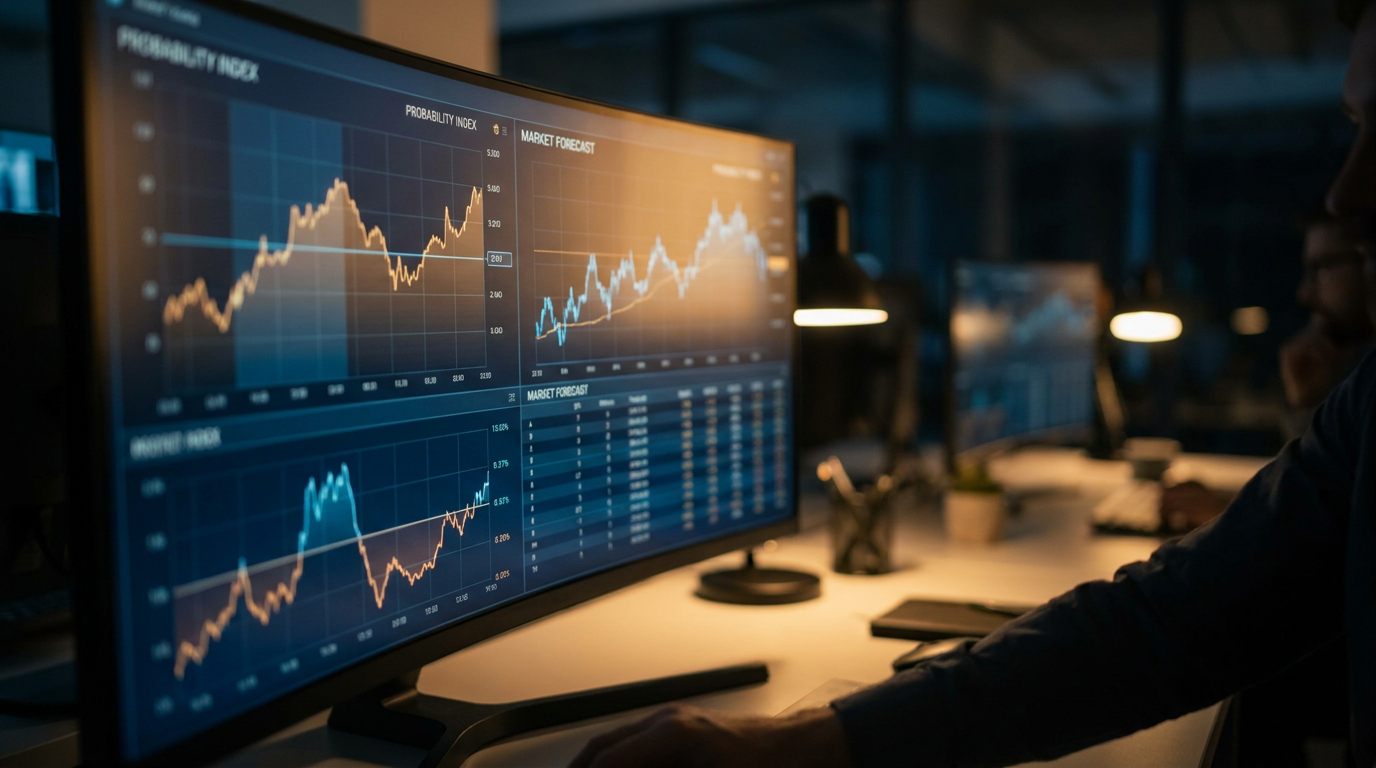
Prediction markets and artificial intelligence are converging to turn forecasting from a subjective guessing game into a rigorous, quantifiable science.
By Factlen Editorial Team
- Hybrid Pragmatists
- Advocate for combining AI's data processing with human strategic calibration for maximum accuracy.
- Algorithmic Optimists
- Believe AI's scale and pattern recognition will soon surpass human forecasting in all domains.
- Human Judgment Advocates
- Argue that human causal reasoning is irreplaceable for predicting novel, unprecedented events.
What's not represented
- · Regulators concerned about market manipulation
- · Traditional pollsters losing market share to prediction platforms
Why this matters
Understanding how probabilities are calculated helps you make better decisions about your investments, career, and personal risk. As AI and prediction markets become mainstream, learning to think like a superforecaster is a critical skill for navigating an uncertain world.
Key points
- Prediction markets turn uncertainty into tradable probabilities by crowdsourcing forecasts with real financial stakes.
- Human 'superforecasters' achieve high accuracy through disciplined cognitive frameworks and base-rate analysis.
- AI models are now competing in prediction markets, dominating in data-heavy, high-volume environments.
- Humans retain a measurable advantage in causal reasoning and predicting unprecedented 'Black Swan' events.
- The most accurate forecasting method in 2026 combines AI data processing with human strategic judgment.
Humans are hardwired to predict the future, yet historically, our track record has been dismal. Pundits, politicians, and even subject-matter experts routinely fail to forecast major geopolitical and economic shifts, often performing no better than random chance. Today, however, the landscape of forecasting is undergoing a radical, structural transformation. Driven by the mainstream explosion of prediction markets and the rapid integration of artificial intelligence, forecasting has shifted from a subjective art to a rigorous, quantifiable science.[1][4]
At the center of this shift are prediction markets—platforms where participants trade contracts tied to the outcomes of real-world events. Rather than buying a traditional asset like a stock or a commodity, a trader buys exposure to a specific outcome. The defining feature of these platforms is that they are built around clearly stated, resolvable questions, ranging from whether a central bank will cut interest rates to whether a specific technological milestone will be reached by year-end.[4]
The mechanics of these markets rely on simple event derivatives, most commonly binary options. A platform will offer a pair of linked contracts: "Yes, this will happen" and "No, it will not." If a "Yes" share is trading at 65 cents, the market is effectively pricing in a 65% probability of that event occurring. By attaching real financial consequences to these predictions, prediction markets force participants to put their money where their mouth is, effectively crowdsourcing a highly accurate, real-time probability signal.[4]

For years, the undisputed champions of these markets were a rare breed of individuals known as "superforecasters." The term was popularized by University of Pennsylvania psychology professor Philip Tetlock and the Good Judgment Project, which was initially funded by the U.S. intelligence community. Tetlock's research revealed a humbling truth: most people, including highly credentialed experts, are terrible at assigning precise probabilities to future events.[1][6]
Superforecasters, however, consistently outperform the wisdom of the crowd, subject-matter experts, and even intelligence analysts with access to classified information. Their edge does not come from psychic intuition or raw genius, but from a disciplined, almost algorithmic cognitive framework. They practice what Tetlock calls "decompositional reasoning"—breaking massive, intractable questions down into smaller, measurable sub-problems.[1][5][6]
A superforecaster tackling a complex question won't rely on a gut feeling. Instead, they start with the "outside view," anchoring their initial estimate in historical base rates—calculating how often similar events have occurred in the past. Only then do they apply the "inside view," adjusting their probability based on the specific, unique details of the current situation. Crucially, they ruthlessly update their beliefs as new evidence emerges, treating their forecasts as living hypotheses rather than rigid opinions.[5][6]
A superforecaster tackling a complex question won't rely on a gut feeling.
But the human monopoly on elite forecasting is now facing an unprecedented evolution. Throughout 2025 and 2026, specialized artificial intelligence models have entered prediction markets with devastating efficacy. The delta between the world's most advanced Large Language Models (LLMs) and top-tier human prediction teams has reached its narrowest point in history, turning "Forecasting Parity" from a theoretical debate into a live market event.[2]
Recent benchmarks highlight the scale of this disruption. A newly deployed AI model named EchoZ-1.0 recently achieved an alignment rate exceeding 63% on complex political and governance questions. When deployed autonomously onto platforms like Polymarket, the AI generated positive returns in an environment where an estimated 90% of human traders consistently lose money.[3]

AI possesses distinct structural advantages in the forecasting arena. It can process economic data releases, sports statistics, and historical precedents at a scale and speed impossible for the human brain. In high-volume, data-rich environments—such as predicting sports game outcomes against the spread or forecasting routine macroeconomic indicators—AI models consistently edge out expert humans. They act as automated market makers, adjusting liquidity spreads in real-time and identifying mispriced contracts before human traders can even read the headlines.[2][4]
Yet, the "silicon vs. synapse" battle is far from settled. While AI dominates in environments with clear historical patterns, human superforecasters retain a measurable edge when dealing with novel, unprecedented events. In recent forecasting tournaments, human elites maintained a roughly 20% performance gap—measured via Brier scores—over AI models on highly complex, ambiguous questions.[2]
The core vulnerability of current AI models is their reliance on historical correlation. They are prone to "hallucinating" trends based on past data, struggling to recognize when a structural paradigm has shifted. Human superforecasters, conversely, excel at causal reasoning. They understand exactly why a historical trend might suddenly break due to a unique geopolitical shift, a change in human psychology, or an unquantifiable cultural movement.[2][6]
Consequently, the frontier of prediction is no longer a binary choice between human intuition and machine computation. The most accurate forecasts in 2026 emerge from hybrid "centaur" models that combine the strengths of both. In these setups, an AI handles the heavy lifting of the "outside view"—crunching vast datasets to establish base rates and highlighting historical correlations.[5][6]

The human superforecaster then steps in to apply the "inside view," adjusting the AI's baseline to account for nuanced, unprecedented variables and resolving ambiguous criteria that confuse the machine. Studies have shown that equipping human forecasters with LLM assistants trained in Tetlock's "commandments" can improve human forecasting accuracy by 23% to 43%, primarily through structured reasoning and systematic confidence calibration.[5]
As prediction markets continue to mature and attract institutional capital, this symbiotic relationship will define the next era of decision-making under uncertainty. We may never possess a crystal ball that predicts the future with absolute certainty. But by combining the relentless processing power of artificial intelligence with the nuanced causal reasoning of the human mind, we are mapping the probabilities of tomorrow with unprecedented clarity.[4][7]
How we got here
2011
The Good Judgment Project is launched, identifying the first cohort of human 'superforecasters.'
2015
Philip Tetlock publishes 'Superforecasting,' bringing the science of prediction to the mainstream.
2024
Prediction markets like Polymarket and Kalshi see record trading volumes, mainstreaming event contracts.
Early 2026
AI models like EchoZ-1.0 begin autonomously trading and generating positive returns on prediction platforms.
Mid 2026
Hybrid 'centaur' forecasting emerges as the gold standard for institutional risk assessment.
Viewpoints in depth
Algorithmic Optimists
Believe AI's scale and pattern recognition will soon surpass human forecasting in all domains.
This camp argues that the current human advantage in causal reasoning is merely a temporary artifact of early AI limitations. As models improve their 'long-reasoning' capabilities and ingest more diverse datasets, algorithmic optimists believe AI will eventually map even the most complex geopolitical shifts. They view prediction markets as transitioning from psychological arenas into purely computational ones, where speed and volume dictate success.
Human Judgment Advocates
Argue that human causal reasoning is irreplaceable for predicting novel, unprecedented events.
Proponents of human judgment emphasize that AI is fundamentally backward-looking, trained to find correlations in historical data. They argue that novel 'Black Swan' events—such as unprecedented political movements or sudden cultural shifts—require human intuition, contextual understanding, and the ability to recognize when historical patterns no longer apply. To this camp, an AI might predict the weather, but it takes a human to predict a paradigm shift.
Hybrid Pragmatists
Advocate for combining AI's data processing with human strategic calibration for maximum accuracy.
This is the consensus view among top-tier institutional forecasters in 2026. Hybrid pragmatists view AI not as a replacement for human thought, but as an exoskeleton for the mind. They advocate using AI to rapidly establish base rates and process massive datasets, leaving the final strategic calibration and resolution of ambiguous criteria to human experts. This 'centaur' approach consistently yields the lowest Brier scores in competitive forecasting.
What we don't know
- Whether AI will eventually develop the causal reasoning necessary to predict novel 'Black Swan' events without human intervention.
- How financial regulators will adapt to the increasing volume of AI-driven autonomous agents trading on public prediction platforms.
- The extent to which highly accurate, public prediction markets might influence or alter the very events they are forecasting.
Key terms
- Prediction Market
- An exchange where participants trade contracts whose payoffs are tied to the outcome of unknown future events.
- Superforecaster
- An individual who consistently predicts future events with high accuracy using disciplined cognitive techniques and probability calibration.
- Brier Score
- A statistical metric used to measure the accuracy of probabilistic predictions; a lower score indicates better performance.
- Base Rate
- The historical frequency or probability of an event occurring, used as an objective starting point for making a specific prediction.
- Binary Contract
- A tradable asset that pays out a fixed amount if a specific event happens, and zero if it does not.
- Inside View vs. Outside View
- The outside view relies on historical statistics (base rates), while the inside view focuses on the unique, specific details of the current situation.
Frequently asked
What exactly is a prediction market?
A prediction market is a platform where people buy and sell contracts based on the outcome of future events. The prices of these contracts reflect the crowd's estimated probability of the event occurring.
Are prediction markets just a form of gambling?
Legally, regulated platforms like Kalshi are classified as derivatives markets. While they involve financial risk, their primary function is information aggregation and price discovery, often outperforming traditional polls.
Can artificial intelligence actually predict the future?
AI cannot see the future, but it excels at processing vast amounts of historical data to calculate the statistical probability of recurring events, though it struggles with entirely novel situations.
How can I become a better forecaster?
Experts recommend breaking complex questions into smaller parts, starting with historical base rates, seeking out opposing viewpoints, and rigorously tracking your accuracy over time to calibrate your confidence.
Sources
Source coverage
7 outlets
3 viewpoints surfaced







[1]Washington PostHuman Judgment Advocates
Good Judgment CEO Warren Hatch discusses what makes a 'super forecaster,' prediction markets and the role of AI
Read on Washington Post →[2]Wedbush SecuritiesAlgorithmic Optimists
AI vs. Human Parity in Prediction Markets
Read on Wedbush Securities →[3]BriefGlanceAlgorithmic Optimists
AI Super-Forecaster: EchoZ Model Beats Traders on Prediction Markets
Read on BriefGlance →[4]ChainlinkHybrid Pragmatists
How Prediction Markets Work
Read on Chainlink →[5]Emergent MindHybrid Pragmatists
Superforecasting LLM: Advanced Forecasting
Read on Emergent Mind →[6]Under the SurfaceHuman Judgment Advocates
Can AI Agents Mimic a Superforecasting Team?
Read on Under the Surface →[7]Factlen Editorial TeamHybrid Pragmatists
Synthesis by Factlen editorial team
Read on Factlen Editorial Team →


Every angle. Every day.
Get meta stories with full source coverage and perspective breakdowns delivered to your inbox.