
How the 'Library of Things' Movement is Transforming Neighborhoods
Community hubs that lend out tools, appliances, and camping gear are saving residents money while drastically reducing local waste.
By Factlen Editorial Team
- Resource Sharing Advocates
- Focus on the environmental necessity of reducing consumption and keeping waste out of landfills.
- Community Builders
- View the libraries primarily as social hubs that teach skills, foster equity, and combat neighborhood isolation.
- Municipal Planners
- Treat the model as essential civic infrastructure that provides cost-effective services to residents.
What's not represented
- · Traditional hardware retailers
- · Power tool manufacturers
Why this matters
By shifting from individual ownership to community borrowing, households can save thousands of dollars on rarely used items while drastically reducing their carbon footprint and local e-waste.
Key points
- The 'Library of Things' movement allows residents to borrow tools, appliances, and gear instead of buying them.
- Hubs operate via sliding-scale memberships, saving individual households hundreds of dollars annually.
- The model significantly reduces carbon emissions and prevents tonnes of electrical waste from entering landfills.
- Beyond lending, many libraries host repair cafes and skill-sharing workshops to build community resilience.
- Traditional public libraries are increasingly adopting the model, integrating non-traditional items into their catalogs.
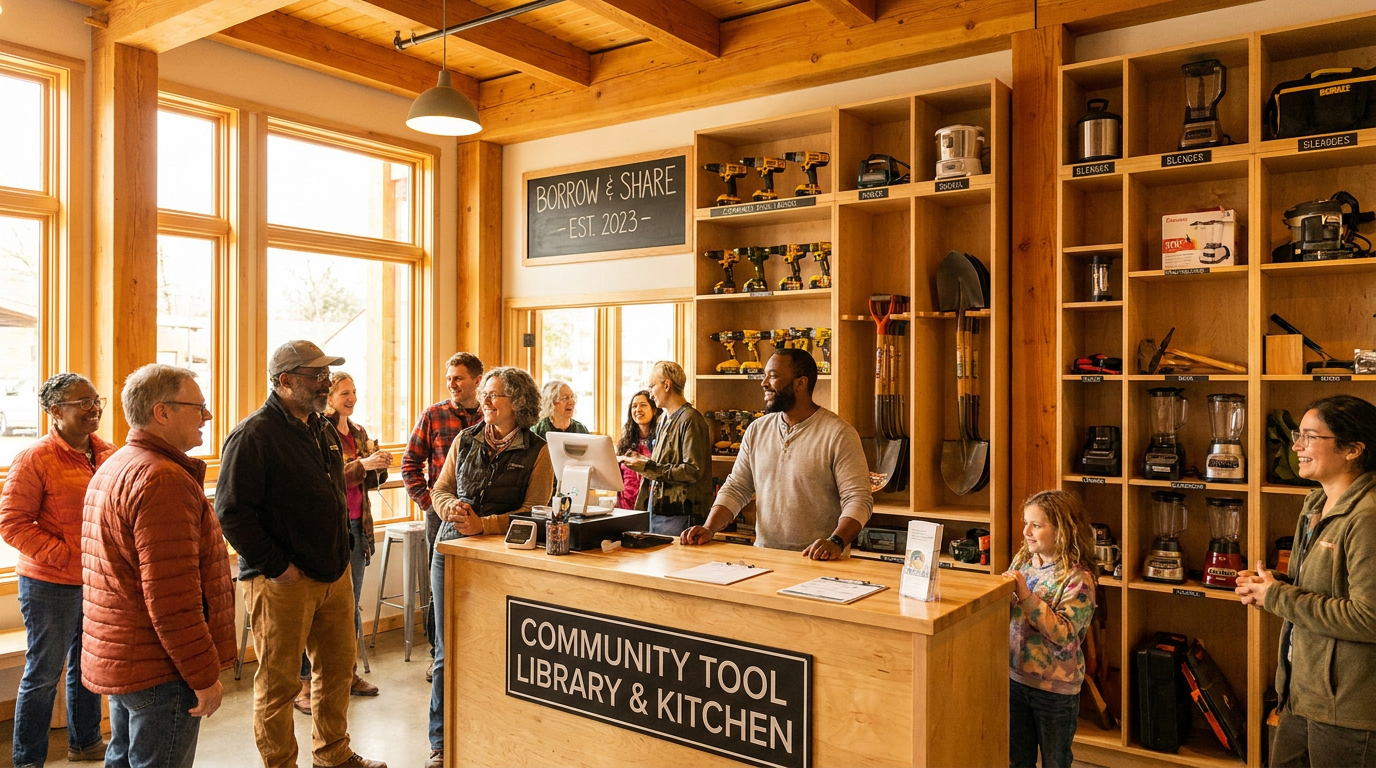
The average power drill is used for roughly 13 minutes over its entire lifespan. Yet, millions of households purchase one, store it in a closet, and let it gather dust. This phenomenon of "use-it-once" consumption—buying expensive, bulky items for a single weekend project—has long been a staple of modern homeownership. But a growing movement is challenging the necessity of the personal hardware stash. Across the globe, neighborhoods are launching "Libraries of Things," community-run hubs where residents can check out miter saws, pasta makers, and camping tents just as easily as they would a paperback novel.[6]
The concept is a practical evolution of the sharing economy, stripped of the venture-capital profit motives that define gig-work apps. While early tool-lending libraries date back to the 1970s in places like Berkeley, California, the modern "Library of Things" (LoT) movement gained significant traction over the last decade, popularized by grassroots experiments in the UK and Canada. Today, the model is scaling rapidly. From self-service lockers in London transit stations to sprawling warehouses in upstate New York, these libraries are transforming how communities access the physical objects they need to improve their lives.[6][7]
The mechanics of a Thing Library are straightforward, though the operational models vary. Most independent hubs operate as member-funded nonprofits. Residents pay an annual fee—often on a sliding scale ranging from $10 to $50—which grants them access to an online inventory system. A user can reserve a carpet cleaner or a tile saw on their phone, pick it up from a local storefront or automated locker, use it for a week, and return it. For higher-tier memberships, local block clubs and nonprofits can check out bulk items for neighborhood cleanups or community gardens.[6]
The financial impact on local households is staggering. In Buffalo, New York, a volunteer-run Tool Library that began with just 50 items has grown to an inventory of over 4,200 tools. By calculating the replacement cost of every item borrowed, the organization estimates it has saved its members over $436,000. For renters dealing with unresponsive landlords or low-income homeowners facing deferred maintenance, this access removes cost as a barrier to basic home improvement and quality of life.[5]

Beyond personal savings, the environmental mathematics of the movement are driving its expansion. Every manufactured product carries an embedded carbon footprint from its production, shipping, and eventual disposal. By maximizing the utilization rate of a single item, communities drastically reduce their collective emissions. The Walthamstow Tool Library in London, which facilitates over 3,000 loans annually, estimates its operations save roughly 25 tonnes of carbon emissions each year.[4]
Beyond personal savings, the environmental mathematics of the movement are driving its expansion.
Similarly, a Library of Things in Twickenham recently celebrated its 1,000th borrower, noting that the community had prevented nearly 12 tonnes of electrical waste from entering landfills over a two-year period. By borrowing instead of buying for long-delayed repairs or new hobbies, residents are actively participating in a hyper-local circular economy, keeping valuable materials in use and out of the waste stream.[2]

Recognizing the civic value of these services, traditional public library systems are increasingly adopting the model. In Texas, the Amarillo Public Library recently utilized philanthropic funding to launch its own Library of Things, integrating items like kitchen appliances, science equipment, and musical instruments into its standard catalog. Patrons with an account in good standing can place items on hold and pick them up the next day, utilizing the library's existing checkout infrastructure and storage capacity.[3]
But the most profound impact of the movement often happens inside the physical spaces themselves. These libraries are evolving into vibrant community hubs that prioritize skill-sharing and intergenerational connection. Many host regular "Dare to Repair" cafes, where residents can bring broken household items—from toasters to lamps—and work alongside volunteer "fixers" to diagnose and repair the issue. This shifts the local culture away from disposable consumption and empowers people with the mechanical confidence to maintain their own belongings.[5]

To ensure these benefits reach beyond affluent, eco-conscious neighborhoods, organizations like Shareable have launched initiatives like the Library of Things Co-Lab. This program provides training, public toolkits, and micro-grants to organizers specifically working to establish resource-sharing spaces in historically marginalized communities. By treating access to tools as a matter of equity, the movement is positioning the LoT model as essential civic infrastructure rather than a niche environmental project.[1][8]
Despite the enthusiasm, scaling these libraries presents distinct operational hurdles. Relying entirely on volunteer labor can lead to burnout, and managing an inventory of donated tools means dealing with inconsistent brands, missing parts, and complex maintenance requirements. A broken power drill isn't just an inconvenience; it requires a skilled technician to safely repair it before it can be loaned out again.[7]

To achieve long-term sustainability, many networks are restructuring their governance and funding. Some UK-based networks have adopted "steward ownership" models—a for-purpose corporate structure that allows them to raise external investment without sacrificing their mission to profit-driven shareholders. Others are forging direct partnerships with municipal governments, where city councils fund the capital costs of self-service lockers and pay the library an ongoing service fee to maintain the inventory.[7]
As the cost of living remains high and the realities of climate change demand a shift in consumer habits, the Library of Things movement offers a rare, tangible solution. It proves that abundance doesn't require individual ownership. By pooling resources, communities are not only saving money and reducing waste, but they are also relearning how to rely on one another—building resilience one borrowed tool at a time.[8]
How we got here
1979
The Berkeley Tool Library opens in California, pioneering the civic tool-lending model.
2014
A grassroots Library of Things project launches in South London, popularizing the broader 'things' concept beyond just tools.
2020
Pandemic lockdowns spark a surge in DIY projects, driving renewed interest in neighborhood sharing and resilience.
2024
The State of Libraries of Things Report is published, documenting the rapid global expansion of the movement.
2026
Traditional public libraries increasingly integrate LoT collections into their standard municipal offerings.
Viewpoints in depth
Resource Sharing Advocates
Focus on the environmental necessity of moving away from 'take-make-waste' capitalism.
For environmental advocates, the Library of Things is a direct countermeasure to hyper-consumerism. They argue that manufacturing millions of power drills that are used for only a few minutes each is a catastrophic misallocation of global resources. By maximizing the utility of a single object across dozens of households, these advocates emphasize that communities can drastically cut their carbon emissions and reduce the volume of electronic and plastic waste entering local landfills.
Community Builders
Focus on the social fabric, combating isolation through skill-sharing and repair cafes.
Community organizers view the physical items as secondary to the social connections the libraries foster. They highlight that modern neighborhoods often suffer from isolation, and a shared resource hub provides a natural gathering point. Through initiatives like 'Dare to Repair' cafes and woodworking workshops, these builders argue that the true value of the movement is teaching people new skills, empowering marginalized groups to improve their own living conditions, and creating spaces where different generations can interact.
Municipal Planners
Focus on the cost-efficiency and civic infrastructure aspect of the model.
City planners and local governments increasingly view the Library of Things as a necessary evolution of civic infrastructure, akin to public parks or traditional book libraries. They argue that subsidizing these hubs—either through direct funding or by integrating them into existing public library systems—provides a high return on investment. By giving residents affordable access to tools, municipalities can improve local housing stock, support small-scale entrepreneurship, and reduce the burden on municipal waste management services.
What we don't know
- Whether the model can remain financially sustainable in smaller, rural communities without dense populations.
- How traditional hardware and appliance retailers will respond if the borrowing economy captures a significant share of the market.
- The long-term durability of consumer-grade appliances when subjected to high-frequency community borrowing.
Key terms
- Library of Things (LoT)
- A community space or service that lends out non-traditional items like tools, appliances, and electronics instead of books.
- Circular Economy
- An economic system aimed at eliminating waste and the continual use of resources by sharing, leasing, reusing, and repairing.
- Steward Ownership
- A corporate structure where control remains with people dedicated to the mission, rather than external profit-driven investors.
- Embedded Carbon
- The total greenhouse gas emissions generated during the extraction, manufacturing, and transportation of a product before it is ever used.
Frequently asked
How much does it cost to join a Library of Things?
Most independent hubs operate on an annual membership fee, often on a sliding scale from $10 to $50. Some traditional public libraries offer the service for free with a standard library card.
What happens if an item breaks while I am using it?
Normal wear and tear is expected, and most libraries have volunteer technicians who repair items. However, intentional damage or gross negligence might incur a replacement fee.
Can I donate my old tools to a local hub?
Yes, many libraries rely on community donations to build their inventory. However, they usually request specific, high-quality items to avoid becoming a dumping ground for unusable junk.
Sources
Source coverage
8 outlets
3 viewpoints surfaced








[1]ShareableCommunity Builders
The Library of Things Co-Lab: Scaling Cooperative Infrastructure
Read on Shareable →[2]Richmond CouncilResource Sharing Advocates
Celebrating 1,000+ borrowers and a community built on sharing
Read on Richmond Council →[3]Amarillo Public LibraryMunicipal Planners
APL Library of Things Ready to Launch
Read on Amarillo Public Library →[4]North London Waste AuthorityResource Sharing Advocates
Walthamstow Tool Library offers an alternative for locals
Read on North London Waste Authority →[5]The Home PublicationsCommunity Builders
The Tool Library: Building a Community of Doers
Read on The Home Publications →[6]Apartment TherapyCommunity Builders
What Is a Tool Library? How to Borrow Tools for DIY Projects
Read on Apartment Therapy →[7]Cooperative CityResource Sharing Advocates
Library of Things: Making sharing easier than owning
Read on Cooperative City →[8]Factlen Editorial TeamMunicipal Planners
Synthesis by Factlen editorial team
Read on Factlen Editorial Team →


Every angle. Every day.
Get culture stories with full source coverage and perspective breakdowns delivered to your inbox.