
Global 'Repair Café' and Tool Library Networks Hit Record Growth as Communities Embrace the Circular Economy
Driven by inflation and a desire to reduce waste, neighborhood tool libraries and volunteer-led repair cafes are expanding rapidly worldwide, passing major milestones in 2026.
By Factlen Editorial Team
- Community Organizers
- Focus on the social bonds, skill-sharing, and resilience fostered by these collaborative spaces.
- Environmental Advocates
- View the movement as a crucial weapon against throwaway culture, e-waste, and climate change.
- Economic Pragmatists
- Highlight the immediate financial relief these hubs provide to working households facing high living costs.
What's not represented
- · Appliance and tool manufacturers whose sales models rely on planned obsolescence and frequent replacements.
- · Independent, for-profit repair shop owners who might view free community repair events as competition.
Why this matters
These community hubs save households thousands of dollars on tools and replacements while diverting millions of tons of usable goods from landfills, fostering local resilience and connection in the process.
Key points
- The global Repair Café network has surpassed 4,000 locations, fixing nearly 850,000 items annually.
- Tool libraries are expanding rapidly, allowing residents to borrow expensive equipment instead of buying it.
- The movement provides significant financial relief to households amid persistent inflation.
- By keeping functional items out of landfills, these hubs drastically reduce carbon emissions and e-waste.
- Studies show these spaces serve as vital social infrastructure, combating urban isolation and loneliness.
- The Tool Library Alliance is helping independent hubs network, share software, and secure permanent locations.
The scene inside a typical community center on a Saturday morning is shifting. A broken toaster, a torn winter coat, or a wobbly dining chair usually faces a simple, grim fate: the trash bin. But in church basements, public libraries, and dedicated cooperative spaces across the globe, a different solution is taking root. Neighbors are gathering not to discard their broken possessions, but to open them up, diagnose the faults, and bring them back to life. This hands-on rebellion against throwaway culture is rapidly moving from a niche environmental hobby to a mainstream civic staple.[1][2]
The "Repair Café" and "Tool Library" movements are experiencing unprecedented, record-breaking growth in 2026. Driven by a potent combination of persistent inflation, heightened environmental awareness, and a post-pandemic hunger for local, face-to-face connection, these volunteer-led hubs are turning the traditional consumer economy on its head. By pooling resources and expertise, communities are actively opting out of the cycle of constant purchasing, choosing instead to maintain what they already own and share what they only occasionally need. This shift represents a fundamental rethinking of how neighborhoods function and support their residents.[1][6]
The raw numbers reflect a massive cultural shift that has accelerated over the past decade. What started as a single, experimental event in Amsterdam in 2009 has blossomed into a sprawling global network. By mid-2026, tracking organizations report over 4,000 active Repair Café locations operating worldwide. Together, these volunteer hubs are collectively fixing nearly 850,000 items every single year, saving households millions of dollars in replacement costs while simultaneously preserving the embodied energy and materials of the original products.[1][5]
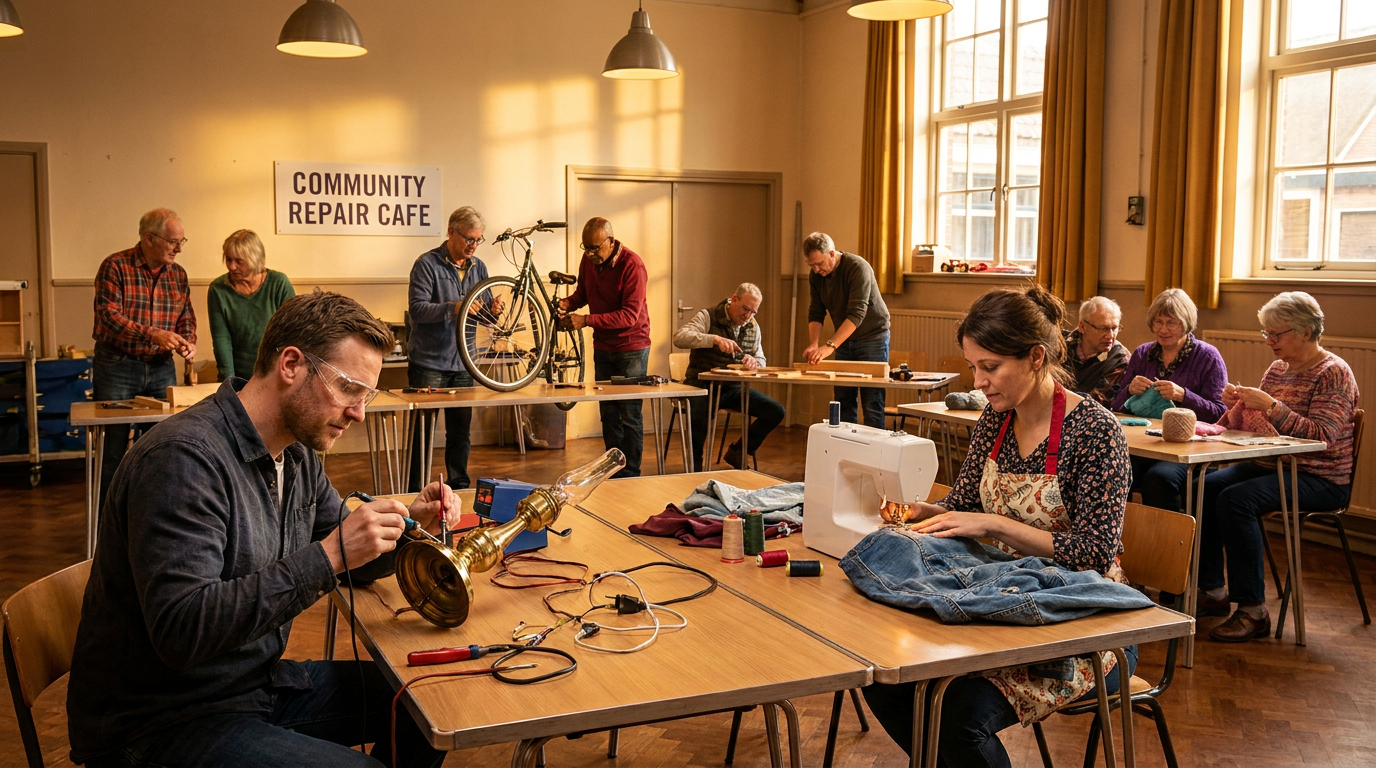
At these events, community members bring their malfunctioning electronics, flat bicycles, and damaged textiles. Volunteer "fixers"—often retired tradespeople, electrical engineers, or highly skilled hobbyists—sit down with them to diagnose and repair the items completely free of charge. The atmosphere is deliberately collaborative rather than transactional. The fixers do not take the item behind a curtain; they work at open tables, explaining the mechanism of a switch or the threading of a bobbin, demystifying the black boxes that dominate modern life.[2][5]

"Maybe their initial reason for coming is monetary or sentimental," one long-time organizer noted, but the collaborative process quickly becomes the primary draw. Participants don't just drop off their broken goods and leave; they sit with the fixers, learning how to wield a soldering iron, apply a multimeter, or operate a sewing machine themselves. This transfer of knowledge ensures that the next time a wire comes loose, the owner might feel empowered to fix it on their own kitchen table.[1]
Running parallel to the repair movement is the explosive expansion of Tool Libraries. Operating on the exact same principles as traditional municipal book libraries, these dedicated spaces allow residents to check out power drills, lawnmowers, extension cords, and specialized hand tools at little to no cost. Instead of a Dewey Decimal system for literature, these hubs catalog circular saws, pressure washers, and carpet cleaners, making heavy-duty home maintenance accessible to anyone with a library card, regardless of their income or storage capacity.[3][4]
The underlying logic driving tool libraries is simple but profoundly disruptive to traditional retail models. Research frequently cited by sharing-economy advocates points out a startling statistic: the average consumer power drill is used for only about 12 minutes over its entire lifespan. Tool libraries eliminate the absurd inefficiency of every single household on a suburban block needing to purchase, maintain, and store their own rarely-used equipment. By centralizing these assets, communities free up both garage space and tight household budgets for more pressing needs.[4]
The underlying logic driving tool libraries is simple but profoundly disruptive to traditional retail models.
In the United States, the recently formed Tool Library Alliance (TLA) is working aggressively to unite these previously independent, isolated hubs into a cohesive national network. The TLA provides essential resources, specialized inventory-tracking software, and peer networking to help new neighborhoods launch their own lending centers efficiently. By sharing best practices on liability insurance, tool maintenance, and volunteer retention, the alliance ensures that access to expensive tools isn't limited to wealthy enclaves, but can thrive and sustain itself in working-class neighborhoods as well.[4]

The economic benefits of this sharing infrastructure are particularly resonant in 2026. With consumer prices and the general cost of living remaining stubbornly high, the ability to borrow a $300 power washer for a weekend deck project, or to fix a $150 vacuum cleaner instead of replacing it, provides tangible, immediate financial relief to working families. It represents a localized, grassroots safety net that operates entirely outside of traditional government assistance programs, allowing communities to shield themselves from the worst impacts of inflation.[1][6]
Environmentally, the cumulative impact of these local actions is staggering. The United States alone generates hundreds of millions of tons of garbage annually, much of it consisting of complex electronics and synthetic textiles that take centuries to break down. By keeping perfectly functional items out of local landfills, these community hubs directly reduce the carbon emissions, water usage, and raw material extraction required to manufacture, package, and ship brand-new replacement products across the globe. It is practical, localized climate action with immediate visible results.[2][5]
To quantify this environmental impact, the repair movement has developed sophisticated online tracking databases. Using the Open Repair Data standard, volunteers meticulously log the types of products brought in, the specific faults experienced, and the ultimate success rates of their interventions. This creates a highly valuable repository of real-world reliability information that advocates and policymakers use to push for broader "Right to Repair" legislation. The data directly challenges major manufacturers to design products that are modular and fixable rather than glued together, proprietary, and inherently disposable.[5]

Yet, researchers and local organizers alike emphasize that the most valuable thing being built in these bustling spaces isn't a repaired desk lamp or a tuned-up bicycle—it is profound community resilience. A recent academic study published in the journal Cleaner Production Letters highlighted that Repair Cafés function as vital social infrastructure. They provide a rare, non-commercial "third place" where people can gather, interact, and collaborate without the expectation of spending money, effectively combating the deep isolation and fragmentation of modern urban life.[2]
In an era often defined by digital disconnection and what public health officials have termed an "epidemic of loneliness," these hubs offer a low-pressure environment for genuine intergenerational mingling. A teenager might learn how to patch a denim jacket from a retired tailor, while a young software engineer helps an elderly neighbor recover precious family photos from an unresponsive laptop. These organic interactions weave a tighter social fabric, building deep trust and mutual reliance among neighbors who might otherwise never cross paths in their daily routines.[1][2]
The movement is also rapidly maturing from temporary weekend pop-ups into permanent, heavily utilized neighborhood fixtures. In places like Buffalo, New York, and Berkeley, California, tool libraries have successfully secured their own permanent buildings, hired dedicated staff, and negotiated municipal funding lines. This institutionalization proves that the sharing model is not just a fleeting trend, but a sustainable, long-term public utility that forward-thinking municipalities are beginning to recognize as absolutely essential to their residents' overall quality of life and economic stability.[3]
As the circular economy transitions from a niche environmental concept to a mainstream community staple, the "borrow, don't buy" ethos is quietly transforming the modern neighborhood. By firmly rejecting the isolation and financial strain of hyper-consumerism, these growing networks are proving a powerful point: communities already possess the vast majority of the tools, skills, and resources they need to thrive and maintain their homes. They simply needed a dedicated, welcoming place to share them with one another, and in 2026, they are building those places themselves.[4][6]
How we got here
2009
The first Repair Café is held in Amsterdam by journalist Martine Postma.
2013
The Buy Nothing Project launches, accelerating the digital sharing economy and local gifting networks.
2017
The Open Repair Data standard is created to track global repair success rates and advocate for better product design.
2024
The Tool Library Alliance is founded to unite independent tool-lending hubs across the United States.
Mid-2026
The global Repair Café network surpasses 4,000 locations, fixing nearly 850,000 items annually.
Viewpoints in depth
Community Organizers
Focus on the social bonds and skill-sharing fostered by these spaces.
For organizers, the repaired toaster is just a byproduct of the real work: combating the epidemic of loneliness. By creating low-stakes, collaborative environments, these hubs force neighbors to interact, solve problems together, and bridge generational divides. They argue that in a highly digitized world, hands-on communal spaces are essential social infrastructure that builds trust and resilience at the neighborhood level.
Environmental Advocates
View the movement as a crucial weapon against throwaway culture and climate change.
Environmentalists see tool libraries and repair cafes as the front lines of the circular economy. By extending the lifespan of consumer goods, these initiatives directly reduce the carbon footprint associated with manufacturing, shipping, and disposing of products. They leverage the data collected at these events to lobby lawmakers for "Right to Repair" legislation, aiming to force corporations to design longer-lasting, modular goods.
Economic Pragmatists
Highlight the immediate financial relief these hubs provide to working households.
From an economic standpoint, the "borrow, don't buy" model is a direct response to inflation and the rising cost of living. Pragmatists point out that the average household wastes thousands of dollars replacing easily fixable appliances or buying specialized tools for one-off projects. They argue that scaling these libraries municipal-wide could significantly reduce the financial burden on lower-income families, acting as a grassroots economic safety net.
What we don't know
- Whether municipal governments will begin funding tool libraries as essential public services on par with traditional book libraries.
- How major manufacturers will respond to the growing consumer demand for repairable, modular products as the movement scales.
Key terms
- Circular Economy
- An economic system aimed at eliminating waste and the continual use of resources by reusing, repairing, refurbishing, and recycling existing materials.
- Planned Obsolescence
- A manufacturing policy of designing a product with an artificially limited useful life, ensuring it will become obsolete and require replacement.
- Right to Repair
- Legislation that would require manufacturers to provide consumers and independent repair shops with access to the parts, tools, and manuals needed to fix devices.
- Library of Things
- A collection of items other than books that are available for public loan, such as tools, kitchen appliances, camping gear, and musical instruments.
Frequently asked
What exactly is a Repair Café?
A free community event where volunteer experts help people diagnose and fix their broken household items, such as electronics, clothing, and bicycles, rather than throwing them away.
How does a Tool Library work?
It operates exactly like a traditional book library, but instead of books, members can borrow hand and power tools for a set period, usually for free or a small annual membership fee.
Do I need to know how to fix things to attend?
No. Volunteer fixers will diagnose the problem for you and guide you through the repair process, teaching you new skills along the way.
Are these organizations run by the government?
Most are independent, volunteer-run nonprofits or grassroots groups, though an increasing number are partnering with local municipal libraries or city recycling departments for funding and space.
Sources
Source coverage
6 outlets
3 viewpoints surfaced






[1]Los Angeles TimesEconomic Pragmatists
How Repair Cafes turn broken stuff into a global anticonsumerist community
Read on Los Angeles Times →[2]GOOD MagazineCommunity Organizers
Broken household items bring people to Repair Cafés but community keeps them coming back
Read on GOOD Magazine →[3]Reuse AllianceEnvironmental Advocates
Tool Libraries - Reuse Alliance
Read on Reuse Alliance →[4]Tool Library AllianceCommunity Organizers
Tool Library Alliance: Mission and Community
Read on Tool Library Alliance →[5]WikipediaEnvironmental Advocates
Repair Café
Read on Wikipedia →[6]Factlen Editorial TeamEconomic Pragmatists
Synthesis by Factlen editorial team
Read on Factlen Editorial Team →

Every angle. Every day.
Get community stories with full source coverage and perspective breakdowns delivered to your inbox.