
Europe's Sleeper Train Renaissance Accelerates With New Routes and High-Tech Cabins in 2026
A wave of new overnight rail routes and state-of-the-art sleeper carriages is sweeping across Europe in 2026, offering travelers a highly anticipated, climate-friendly alternative to short-haul flights.
By Factlen Editorial Team
- Rail Cooperatives & Startups
- Independent operators arguing that open-access, community-funded models are the future of cross-border rail.
- State Railway Operators
- National rail companies emphasizing the need for massive capital investment in premium rolling stock to attract modern travelers.
- Sustainable Travel Advocates
- Environmental and travel advocates championing sleeper trains as a crucial, practical weapon against climate change.
What's not represented
- · Budget Airline Operators
- · National Infrastructure Managers
Why this matters
The rapid expansion of Europe's sleeper train network offers travelers a highly practical, climate-friendly alternative to short-haul flights. By combining transportation and accommodation into a single overnight journey, these new routes are reshaping how tourists and business travelers navigate the continent.
Key points
- European Sleeper successfully relaunched the Paris-Berlin night train in March 2026 after state operators abandoned the route.
- A new Brussels-to-Milan overnight route via the Swiss Alps is scheduled to launch in September 2026.
- ÖBB's new-generation Nightjet trains, featuring private en suite bathrooms and solo 'Mini Cabins', entered service on the Zurich-Vienna route in June 2026.
- The expansion is driven by travelers seeking climate-friendly alternatives to short-haul flights and the convenience of city-center arrivals.
- Independent rail cooperatives continue to face high track access charges and complex cross-border regulations.
The romanticized era of European sleeper trains was widely declared dead just a decade ago, seemingly rendered obsolete by the relentless efficiency of budget airlines and high-speed daytime rail. Yet, in the summer of 2026, the continent is experiencing an unprecedented night train renaissance. Across Europe, new routes are launching, state-of-the-art carriages are entering service, and passenger demand is surging to record levels.[2][3]
This revival recently hit a brief but highly publicized stumbling block. In late 2025, the Austrian state operator ÖBB abruptly cancelled its flagship Paris-Berlin and Paris-Vienna Nightjet routes. The cancellation was driven by the withdrawal of crucial subsidies from the French government, dealing what many feared was a fatal blow to the cross-border sleeper network.[1][7]
But the void was immediately filled, proving the resilience of the modern rail market. In March 2026, the Belgian-Dutch citizen cooperative European Sleeper stepped in to rescue the Paris-Berlin corridor. The independent operator launched a new thrice-weekly service that routes through Brussels, successfully restoring the vital link between the French and German capitals.[1][7]
This handover from a state-backed giant to an independent cooperative illustrates the changing mechanics of Europe's railway network. Open-access operators like European Sleeper, which are funded by citizen investors rather than state treasuries, are proving that cross-border night trains can survive—and even thrive—without permanent government subsidies.[1][7]

European Sleeper is not stopping at Berlin. In September 2026, the cooperative is scheduled to launch a highly anticipated north-south route connecting Brussels and Amsterdam directly to Milan. This expansion marks a significant milestone in creating a truly comprehensive overnight rail network across the continent.[3][7]
The upcoming Milan route will trace the legendary Simplon Pass, offering passengers spectacular Alpine views at dawn before rolling into northern Italy. With fares starting at just €29 for a seat and €80 for a couchette, the cooperative is aggressively positioning the service as a highly competitive, budget-friendly alternative to flying.[7]
While private startups are rapidly expanding the map, state operators are revolutionizing the hardware. ÖBB, in partnership with Swiss Federal Railways (SBB), is currently in the midst of rolling out 22 brand-new, custom-built Nightjet trains manufactured by Siemens, representing a massive capital investment in passenger comfort.[4][5]
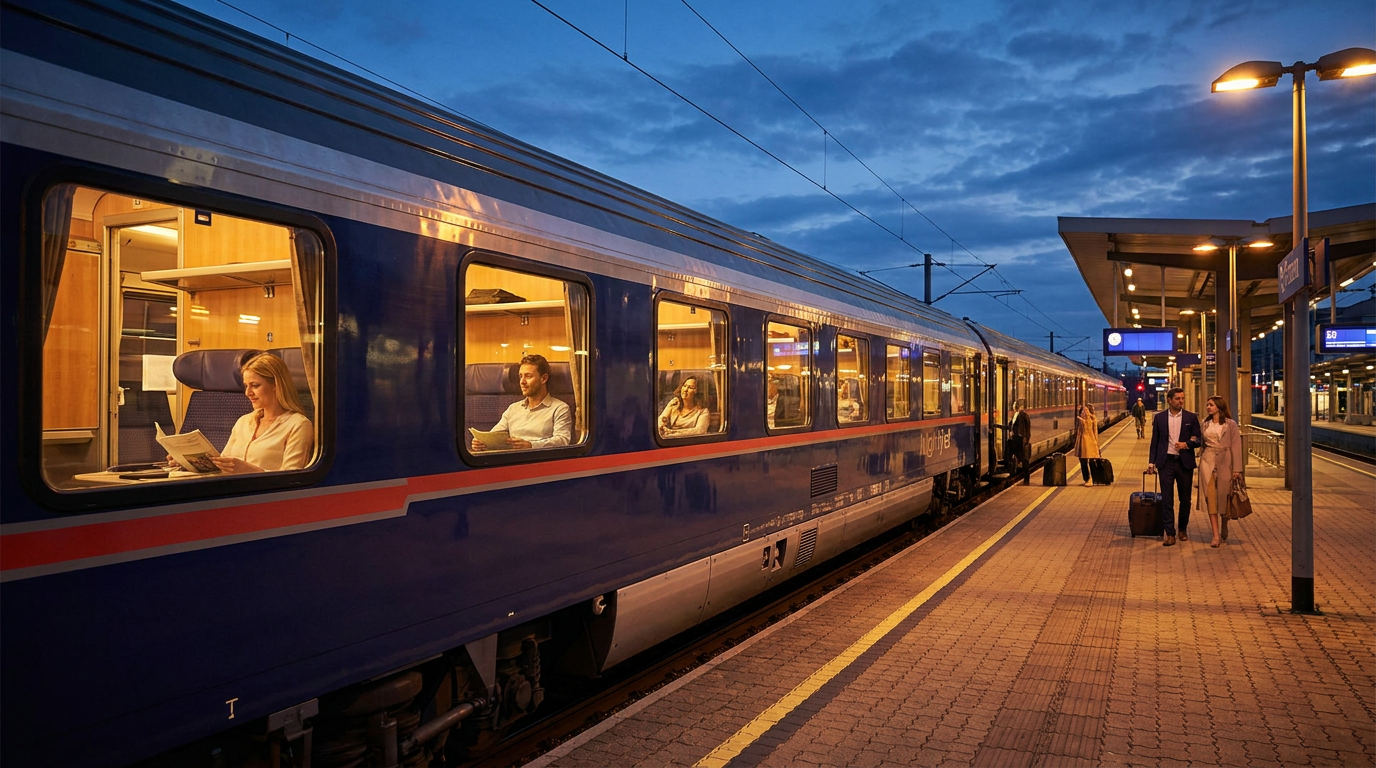
On June 14, 2026, the first of these new-generation Nightjets made its inaugural commercial run on the heavily trafficked Zurich–Vienna route. The deployment of this modern rolling stock marks a generational leap forward for an industry that has long relied on carriages built decades ago.[4][6]
On June 14, 2026, the first of these new-generation Nightjets made its inaugural commercial run on the heavily trafficked Zurich–Vienna route.
The new trains directly address the most common complaints associated with legacy sleeper travel. The premium sleeper cabins now feature private en suite toilets and showers, eliminating the age-old inconvenience of wandering down a moving corridor in the middle of the night to use a shared bathroom.[5][6]
Perhaps the most innovative addition to the new Nightjets is the introduction of the "Mini Cabin." Designed specifically for solo travelers, these compact, Japanese-style sleeping pods offer total privacy, wireless charging, and secure luggage storage at a fraction of the cost of booking a full private cabin.[4][5]

The hardware upgrades extend well beyond the beds themselves. The new trainsets feature dedicated spaces for bicycles, significantly improved wheelchair accessibility, and free Wi-Fi throughout the carriages—amenities that modern travelers now consider absolutely non-negotiable.[5][6]
The expansion of the sleeper network is not limited to Western Europe's traditional hubs. In April 2026, the Swiss and German railways launched a new 16-hour overnight service linking Basel to Copenhagen and Malmö, opening up a vital, climate-friendly rail artery into Scandinavia.[2]
Meanwhile, in Eastern Europe, the Czech operator RegioJet and Poland's PKP Intercity are rapidly expanding their own overnight networks. New routes connecting cities like Prague, Warsaw, and Munich are launching throughout 2026, offering highly affordable couchette options to a broader demographic of travelers.[3][7]
The driving force behind this continent-wide resurgence is a fundamental shift in consumer priorities. Travelers are increasingly willing to trade the sheer speed of a two-hour flight for the drastically lower carbon footprint and the seamless city-center-to-city-center convenience of a night train.[2][3]

By traveling while they sleep, passengers effectively save the cost of a hotel night. Furthermore, they avoid the exhausting logistics, hidden fees, and long transit times associated with airport security, baggage claims, and expensive suburban train transfers.[2][3]
However, the night train renaissance still faces significant structural headwinds. Operating a single train across three or four national borders requires navigating a complex labyrinth of different track gauges, incompatible signaling systems, and strict language requirements for train drivers.[1]

Track access charges—the tolls that operators must pay to national infrastructure managers for the right to use the rails—remain prohibitively high in several European countries. These fees continue to squeeze the already tight profit margins of independent cooperatives attempting to compete with heavily subsidized airlines.[1][7]
Despite these bureaucratic and financial hurdles, the momentum in 2026 is undeniable. With new routes launching monthly, state-of-the-art trains entering service, and passenger demand continuing to surge, the European sleeper train has successfully transformed from a nostalgic relic into a vital, modern pillar of sustainable travel.[2][3]
How we got here
May 2023
European Sleeper launches its first route between Brussels and Berlin.
Dec 2023
ÖBB introduces the first new-generation Nightjet trains on the Hamburg-Vienna route.
Dec 2025
ÖBB cancels the Paris-Berlin Nightjet due to the withdrawal of French subsidies.
Mar 2026
European Sleeper takes over the Paris-Berlin route, restoring the connection.
Jun 2026
New-generation Nightjets make their inaugural run on the Zurich-Vienna route.
Sep 2026
European Sleeper is scheduled to launch its new Brussels-Milan route via the Alps.
Viewpoints in depth
Rail Cooperatives & Startups
Independent operators argue that open-access models are the future of European rail.
Citizen-funded cooperatives like European Sleeper believe that state operators are too inflexible and overly dependent on political whims and government subsidies. By operating on an open-access model, these startups argue they can dynamically fill the cross-border gaps left by national railways. They point to their successful rescue of the Paris-Berlin route as proof that passenger demand, not state funding, should dictate the network.
State Railway Operators
National rail companies emphasize the need for massive capital investment in premium hardware.
Operators like ÖBB and SBB argue that the true future of the night train lies in modernizing the passenger experience to compete directly with hotels. They point out that independent startups often rely on refurbished, decades-old carriages, whereas state operators have the capital to commission entirely new fleets from manufacturers like Siemens. However, they maintain that certain complex, multi-country routes still require government subsidies to remain financially viable against budget airlines.
Sustainable Travel Advocates
Environmentalists view the sleeper train as a crucial weapon against climate change.
Climate advocates and travel experts champion the night train renaissance as a necessary shift away from carbon-intensive short-haul flights. They argue that while sleeper train tickets can sometimes appear more expensive than budget airfares, the calculation changes when factoring in the saved cost of a hotel night and expensive airport transfers. For this camp, the convenience of waking up in a city center perfectly aligns with the urgent need to decarbonize European tourism.
What we don't know
- Whether track access charges will be standardized across the European Union to lower costs for independent operators.
- If the planned Brussels-to-Barcelona sleeper route will overcome regulatory hurdles in France to launch by 2027.
Key terms
- Couchette
- A basic sleeping compartment on European trains, typically featuring four to six fold-out bunks and shared corridor bathrooms.
- Mini Cabin
- A compact, single-occupancy sleeping pod introduced on ÖBB's new-generation trains, designed to give solo travelers privacy at a lower cost.
- Open-access operator
- A private railway company that runs passenger services on state-owned infrastructure without relying on government subsidies.
- Rolling stock
- The physical vehicles used on a railway, including locomotives, passenger carriages, and sleeper cars.
- Track access charges
- The fees that train operators must pay to national infrastructure managers for the right to run trains on their rail networks.
Frequently asked
Are sleeper trains more expensive than flying?
Fares are dynamic and can sometimes exceed budget airline tickets, but they offset the cost of a night's hotel stay and expensive airport transfers.
Do the new trains have private bathrooms?
Yes, ÖBB's new-generation Nightjet sleeper cabins feature private en suite toilets and showers, though standard couchettes still use shared facilities.
When does the new Paris-Berlin night train run?
European Sleeper took over the route in March 2026, operating three times a week with departures from Paris Gare du Nord.
What is a Mini Cabin?
It is a compact, single-occupancy sleeping pod introduced on ÖBB's new trains, offering privacy and secure luggage storage for solo travelers.
Sources
Source coverage
7 outlets
3 viewpoints surfaced







[1]The GuardianRail Cooperatives & Startups
New sleeper service will run from Paris to Berlin next year
Read on The Guardian →[2]ForbesSustainable Travel Advocates
These 4 European Night Trains Are Debuting In 2026
Read on Forbes →[3]AfarSustainable Travel Advocates
New European Sleeper Trains for 2025 and 2026
Read on Afar →[4]Railway PROState Railway Operators
The new Nightjet begins service between Zurich and Vienna
Read on Railway PRO →[5]The Man in Seat 61Sustainable Travel Advocates
Nightjet, the New Generation
Read on The Man in Seat 61 →[6]Swiss Federal Railways (SBB)State Railway Operators
New Nightjet trains
Read on Swiss Federal Railways (SBB) →[7]PixidiaRail Cooperatives & Startups
European Sleeper is launching its second major novelty of 2026
Read on Pixidia →

Every angle. Every day.
Get lifestyle stories with full source coverage and perspective breakdowns delivered to your inbox.