
Apple Taps Intel to Manufacture Custom Chips at U.S. Foundries
Apple has agreed to use Intel as a contract manufacturer for its custom silicon, a landmark deal that boosts U.S. semiconductor production and eases Apple's reliance on overseas supply chains.
By Factlen Editorial Team
- Industrial Policy Advocates
- View the partnership as a critical victory for reshoring American manufacturing and reducing geopolitical risk.
- Supply Chain Analysts
- Emphasize Apple's practical need to secure secondary foundry capacity as AI demand squeezes TSMC.
- Market Investors
- Focus on the financial windfall for Intel's foundry business and the validation of its recent turnaround.
What's not represented
- · Taiwanese government officials reacting to the partial shift of Apple's supply chain away from TSMC.
- · Consumer electronics advocates questioning if dual-sourced chips will lead to performance disparities in identical Apple devices.
Why this matters
This partnership fundamentally reshapes the global technology supply chain, bringing the manufacturing of the world's most critical consumer electronics back to American soil. For investors, it validates Intel's massive corporate turnaround, while giving Apple a crucial buffer against geopolitical risks and overseas production bottlenecks.
Key points
- Apple and Intel have finalized a deal for Intel to manufacture custom Apple Silicon at its U.S. foundries.
- The partnership marks a historic shift, with Intel acting as a contract manufacturer rather than supplying its own processor designs.
- Production will take place at Intel facilities in Ohio, Arizona, and Oregon, utilizing the advanced 18A-P process node.
- The move helps Apple diversify its supply chain as its primary partner, TSMC, faces capacity constraints from massive AI chip demand.
- Intel's stock surged 9% on the news, capping a 464% rally over the past year under CEO Lip-Bu Tan.
- The U.S. government, which holds a 10% stake in Intel, heavily encouraged the partnership to boost domestic manufacturing.
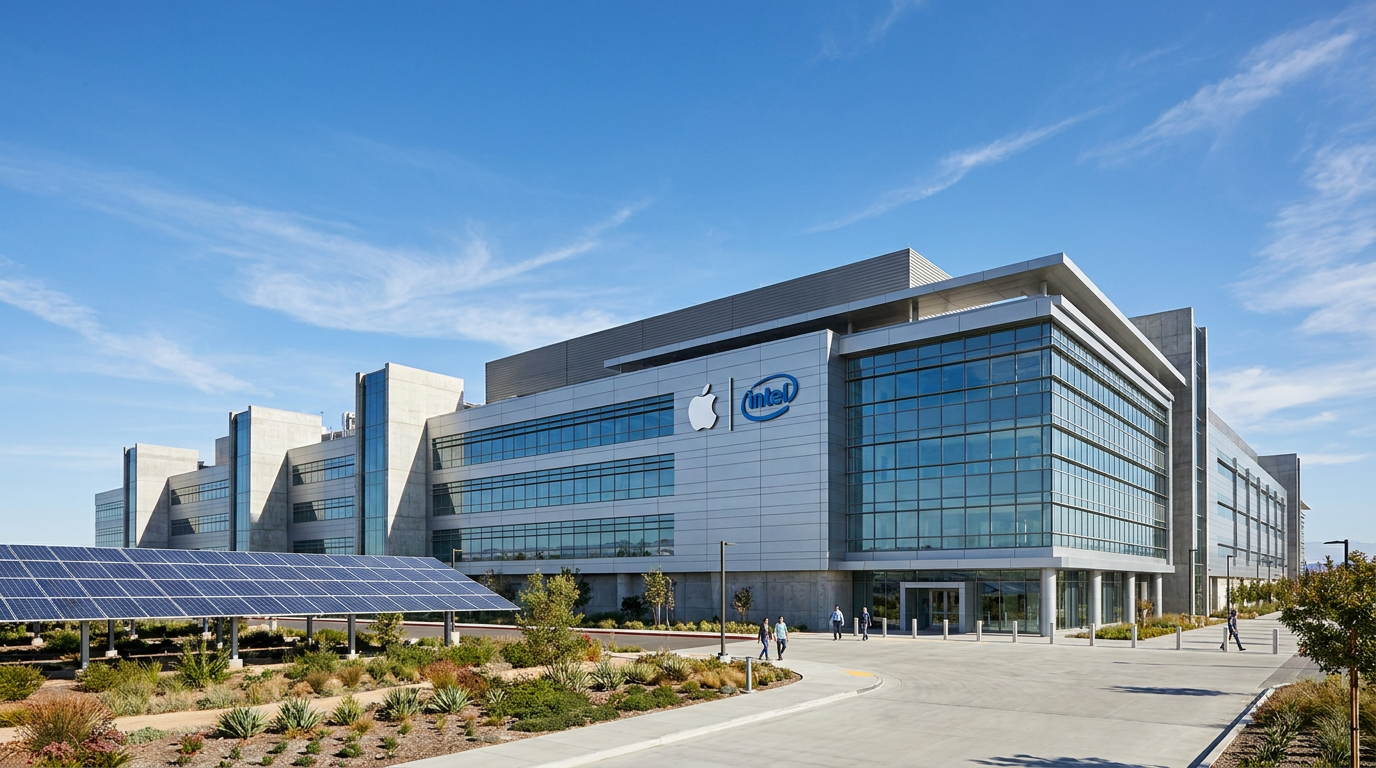
In a landmark realignment of the global technology supply chain, Apple has agreed to partner with Intel to manufacture custom processors at fabrication facilities within the United States. The agreement, confirmed Thursday by President Donald Trump, sent Intel shares surging 9% in pre-market trading and marks a historic milestone in the push to reshore American semiconductor production.[1][2]
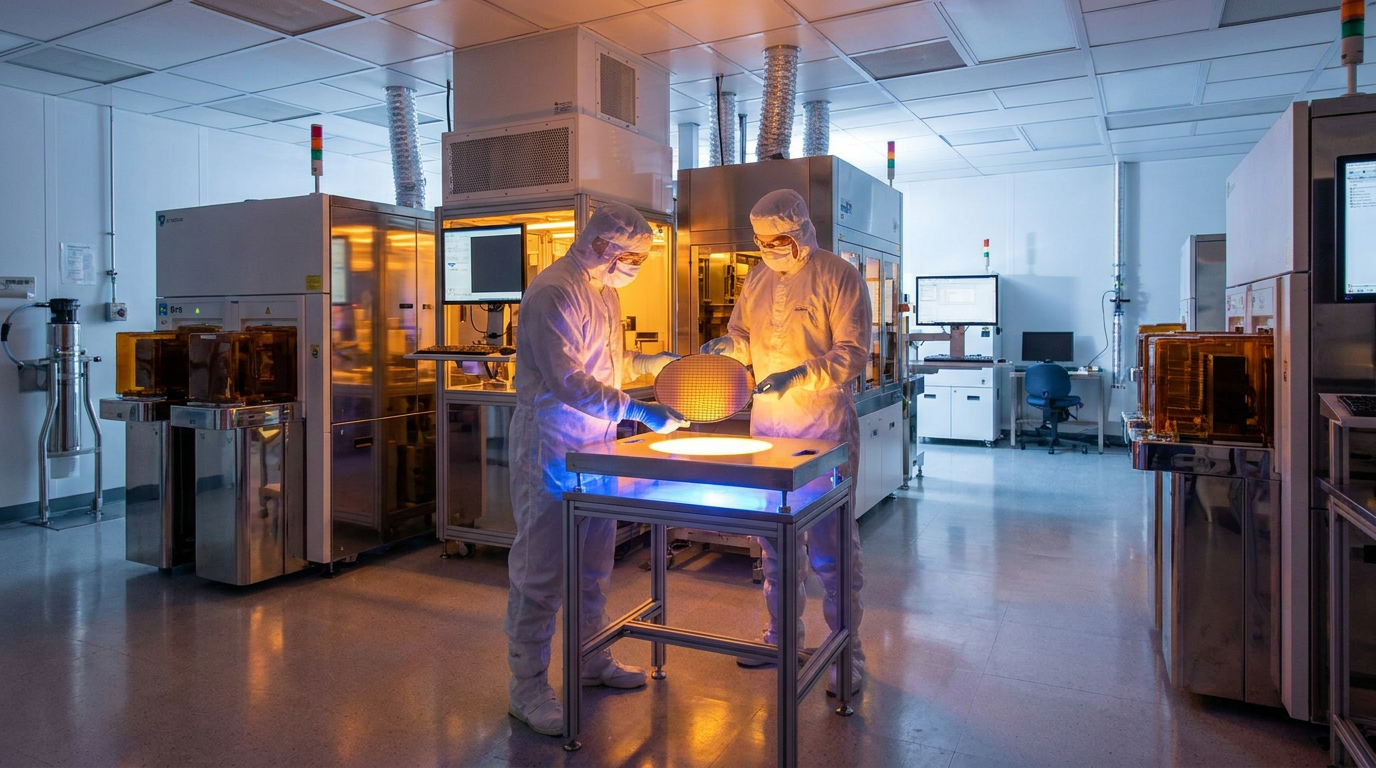
The partnership fundamentally rewrites the relationship between the two Silicon Valley pioneers. Rather than supplying its own proprietary x86 processors—a role Intel held for Mac computers until Apple transitioned to its own silicon in 2020—Intel will now act as a contract foundry. It will manufacture chips entirely designed by Apple's engineering teams, utilizing Intel's advanced 18A-P manufacturing process.[3][4]
Production is slated to take place across Intel's expanding footprint of domestic foundries, specifically targeting facilities in Oregon, Arizona, and Ohio. This geographic diversification provides Apple with a critical onshore manufacturing base, insulating its most vital components from trans-Pacific shipping vulnerabilities and geopolitical friction.[4][5]
Apple's pivot is driven by acute capacity constraints at its primary manufacturing partner, Taiwan Semiconductor Manufacturing Company (TSMC). As the generative AI boom consumes massive volumes of advanced silicon, TSMC's production lines have been increasingly monopolized by server chips for companies like Nvidia and AMD.[3][6]

Those bottlenecks have already impacted Apple's consumer hardware roadmap. During the company's most recent earnings call, CEO Tim Cook acknowledged that iPhone 17 supply was constrained because Apple could not secure sufficient quantities of the A19 and A19 Pro chips from TSMC. Securing a secondary foundry partner became an operational imperative.[3][7]
Industry analysts caution that Intel will not immediately produce Apple's most complex smartphone processors. According to supply chain analyst Ming-Chi Kuo, the initial phases of the partnership will focus on legacy components and lower-end M-series chips destined for select iPad and Mac models.[2][4]
Industry analysts caution that Intel will not immediately produce Apple's most complex smartphone processors.
Kuo noted that Intel has already commenced testing production for these Apple processors, a phase that will continue throughout 2026. If yield rates and performance metrics meet Apple's exacting standards, volume production and commercial delivery are expected to begin in 2027.[4]
For Intel, securing Apple as a foundry client is the crowning achievement of a dramatic corporate turnaround. Under the leadership of CEO Lip-Bu Tan, who took the helm in 2025 following the departure of Pat Gelsinger, Intel has aggressively restructured its manufacturing arm to compete directly with TSMC and Samsung.[3]

Wall Street has aggressively rewarded Tan's strategy. Intel's stock has skyrocketed 464% over the past twelve months, pushing the company's market capitalization past the $608 billion mark. Winning a contract from Apple—widely considered the most demanding silicon client in the world—serves as the ultimate validation of Intel's revitalized foundry capabilities.[3][7]
The agreement is also the product of sustained intervention by the U.S. government. Commerce Secretary Howard Lutnick reportedly held repeated meetings with Apple leadership over the past year, urging the iPhone maker to integrate Intel into its supply chain to bolster national economic security.[4]
The federal government has a direct financial interest in Intel's success. In August 2025, the U.S. government took a 10% equity stake in the chipmaker, converting $8.9 billion in unpaid CHIPS Act grants and Secure Enclave program funding into common stock.[3][4]

President Trump highlighted this dynamic in his announcement, framing the Apple-Intel partnership as a victory for domestic industrial policy. "We decided to help Intel in exchange for 10 percent of their shares," Trump wrote, emphasizing the administration's goal of reclaiming semiconductor manufacturing leadership from overseas competitors.[4][5]
While TSMC will remain Apple's primary silicon manufacturer for the foreseeable future, the Intel agreement establishes a vital secondary pipeline. By successfully bridging the gap between government industrial policy and commercial tech strategy, the deal ensures that the next generation of American consumer electronics will increasingly be powered by silicon forged on American soil.[2][6]
How we got here
2020
Apple begins transitioning its Mac lineup away from Intel-designed processors in favor of its own custom Apple Silicon.
August 2025
The U.S. government takes a 10% equity stake in Intel, converting $8.9 billion in CHIPS Act grants to support the company's manufacturing turnaround.
May 2026
Reports emerge that Apple and Intel have reached a preliminary agreement for domestic chip manufacturing after a year of negotiations.
June 18, 2026
President Trump publicly confirms the finalized partnership, sending Intel shares surging 9% in pre-market trading.
2027 (Projected)
Volume production and commercial delivery of Intel-manufactured Apple chips are expected to begin.
Viewpoints in depth
Industrial Policy Advocates
View the partnership as a critical victory for reshoring American manufacturing and reducing geopolitical risk.
For proponents of domestic manufacturing, Apple's commitment to Intel is the ultimate validation of the CHIPS Act and aggressive federal intervention. By converting billions in grants into a 10% equity stake, the U.S. government effectively underwrote Intel's turnaround while pressuring tech giants to utilize domestic foundries. This camp argues that relying exclusively on Taiwan for the world's most critical components is an unacceptable national security risk, and that the Apple-Intel deal proves that American foundries can once again compete at the highest levels of precision manufacturing.
Supply Chain Analysts
Emphasize Apple's practical need to secure secondary foundry capacity as AI demand squeezes TSMC.
Logistics and hardware experts view the deal less through a political lens and more as a necessary operational hedge. TSMC's advanced nodes are currently overwhelmed by the insatiable demand for generative AI server chips from Nvidia and AMD, leaving even a dominant client like Apple fighting for capacity. Analysts note that Apple's iPhone 17 production was already constrained by silicon shortages. By offloading the production of lower-end M-series chips to Intel, Apple frees up its TSMC allocation for its flagship smartphone processors, ensuring smoother product launches across its entire hardware ecosystem.
What we don't know
- The exact financial terms and volume commitments of the manufacturing contract between Apple and Intel.
- Whether Intel's 18A-P process can consistently match the yield rates and power efficiency of TSMC's equivalent nodes at mass scale.
- Exactly which future iPad or Mac models will be the first to feature Intel-manufactured Apple Silicon.
Key terms
- Foundry
- A semiconductor manufacturing facility that builds chips designed by other companies, rather than manufacturing its own proprietary designs.
- Apple Silicon
- Apple's custom-designed, Arm-based processors that power its modern iPhones, iPads, and Mac computers.
- TSMC
- Taiwan Semiconductor Manufacturing Company, the world's largest dedicated independent semiconductor foundry and Apple's primary chip supplier.
- Node (e.g., 18A-P)
- A specific generation of semiconductor manufacturing technology, which dictates the microscopic size and efficiency of the transistors on a chip.
- CHIPS Act
- U.S. federal legislation designed to boost domestic semiconductor research and manufacturing through billions of dollars in subsidies and investments.
Frequently asked
Will Intel be designing chips for Macs again?
No. Apple will continue to design its own custom Arm-based processors (Apple Silicon). Intel will simply act as a contract manufacturer, building the chips to Apple's exact specifications.
Which Apple devices will use Intel-made chips?
Analysts expect the partnership to initially focus on lower-end M-series chips used in select iPad and Mac models, rather than the highly complex A-series chips used in flagship iPhones.
Is Apple abandoning TSMC?
Not at all. TSMC remains Apple's primary silicon manufacturer. The Intel partnership is designed to diversify Apple's supply chain and secure additional capacity, not to replace TSMC entirely.
Why does the US government own a stake in Intel?
In August 2025, the U.S. government converted $8.9 billion in unpaid CHIPS Act grants and Secure Enclave funding into a 10% equity stake to help capitalize Intel's foundry turnaround.
Sources
Source coverage
7 outlets
3 viewpoints surfaced







[1]MarketWatchMarket Investors
Intel shares rally as Trump says company will build chips for Apple in the U.S.
Read on MarketWatch →[2]9to5MacSupply Chain Analysts
Apple and Intel are working together to build chips in America, says President Trump
Read on 9to5Mac →[3]MacRumorsSupply Chain Analysts
Trump Says Apple to Work With Intel to Manufacture Chips in US
Read on MacRumors →[4]EngadgetIndustrial Policy Advocates
Trump claims Apple and Intel finalized a deal for US chip manufacturing
Read on Engadget →[5]Channel News AsiaIndustrial Policy Advocates
Trump says Apple to work with Intel to manufacture chips in US
Read on Channel News Asia →[6]The Wall Street JournalSupply Chain Analysts
Apple, Intel Reach Preliminary Deal on Chip Manufacturing
Read on The Wall Street Journal →[7]ReutersMarket Investors
Intel shares surge 9% on Apple foundry partnership
Read on Reuters →

Every angle. Every day.
Get finance stories with full source coverage and perspective breakdowns delivered to your inbox.