
How AI and Bioacoustics Are Revolutionizing Wildlife Conservation
Scientists are deploying artificial intelligence to analyze millions of hours of environmental audio, allowing them to track endangered species and monitor ecosystem health with unprecedented speed.
By Factlen Editorial Team
- Conservation Biologists
- Advocating for non-invasive, ecosystem-wide monitoring to replace traditional manual surveys.
- AI Technologists
- Focusing on algorithmic efficiency, open-source deployment, and unsupervised learning.
- Wildlife Rangers & Managers
- Prioritizing real-time threat detection and actionable intelligence on the ground.
What's not represented
- · Indigenous land stewards whose traditional ecological knowledge complements acoustic data
- · Policymakers responsible for funding national biodiversity monitoring networks
Why this matters
As global biodiversity faces unprecedented threats, traditional methods of counting animals are proving too slow and expensive to keep up. By combining continuous audio recording with artificial intelligence, scientists can now monitor the health of entire ecosystems in real-time, enabling faster interventions to save endangered species and stop illegal poaching.
Key points
- Conservationists are increasingly using passive acoustic monitoring to record the ambient sounds of ecosystems over long periods.
- Advanced AI models can now process thousands of hours of audio, identifying species by converting sound waves into visual spectrograms.
- Google DeepMind's open-source Perch 2.0 model has allowed researchers to locate endangered Hawaiian birds 50 times faster than manual methods.
- AI has recently proven capable of identifying individual animals, such as lions, by detecting subtle acoustic signatures inaudible to humans.
- Acoustic sensors are also being deployed as real-time early warning systems to detect chainsaws and gunshots from poachers.
The natural world is in the midst of a silent crisis, with global bird populations alone seeing a 61 percent decline in recent years. For decades, conservationists have relied on labor-intensive methods to track these vanishing species, deploying camera traps or conducting physical surveys that are expensive, slow, and easily biased toward large, diurnal animals. But a quiet revolution is taking place in the world's rainforests, savannas, and coral reefs. Instead of trying to see every animal, scientists are increasingly choosing to listen to them.[7]
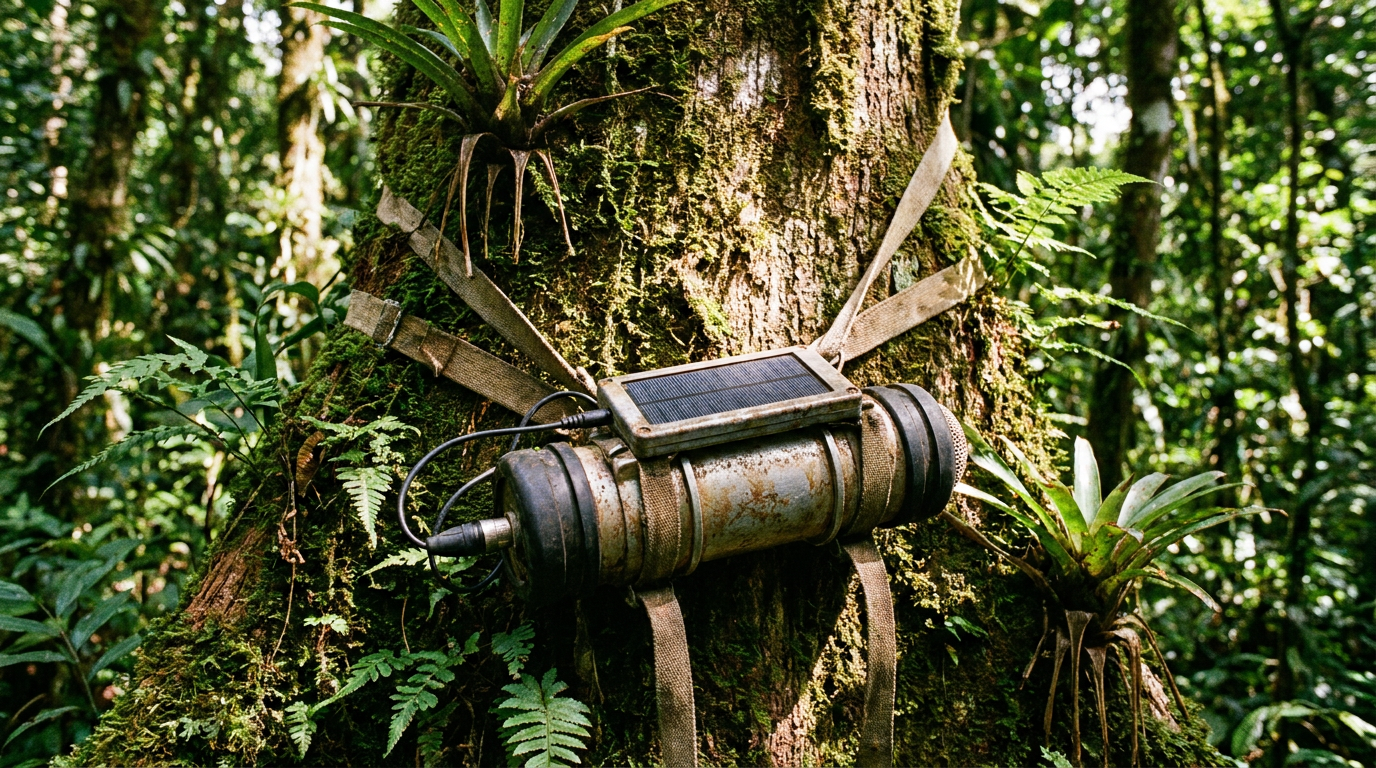
This shift is driven by the rapid maturation of ecoacoustics, a discipline that uses passive acoustic monitoring to record the ambient sounds of an environment over long periods. Small, solar-powered microphones are strapped to trees or submerged underwater, capturing the continuous hum of life—from the morning chorus of birds to the ultrasonic squeaks of bats and the low-frequency rumbles of elephants. The resulting data provides an unfiltered, non-invasive window into the health of an ecosystem.[6]
However, this acoustic approach quickly created a massive data bottleneck that threatened to derail the entire methodology. The Australian Acoustic Observatory, for instance, has amassed roughly two petabytes of environmental audio across its continental network of sensors—the equivalent of 2,000 years of nonstop recording. Human listeners could never process this staggering volume of data manually, meaning critical insights about species recovery, migration shifts, or population declines were often left buried in hard drives for years before they could be analyzed.[6]
The solution to this data paralysis has arrived in the form of advanced artificial intelligence and machine learning. By feeding vast quantities of audio recordings into deep learning algorithms, researchers can train neural networks to identify the unique acoustic signatures of thousands of species simultaneously. The AI achieves this remarkable feat by converting raw sound waves into spectrograms—detailed visual representations of audio frequencies over time—and scanning them for specific patterns in much the same way that facial recognition software identifies the contours of a human face.[1]

A major milestone in this computational field occurred in late 2025 with the release of Perch 2.0, a highly sophisticated, open-source AI model developed by Google DeepMind. Trained on nearly twice the data of its predecessor, the model can disentangle incredibly complex, overlapping acoustic scenes across diverse global environments, including the notoriously noisy and chaotic underwater soundscapes of coral reefs. Because the architecture is entirely open-source, conservationists worldwide can deploy the model locally without needing massive, prohibitive computing budgets.[1]
The real-world impact of these models is already being felt in high-stakes conservation efforts. In Hawaii, biologists are racing to save native honeycreepers from extinction driven by avian malaria. Using DeepMind's AI, researchers were able to scan thousands of hours of forest audio to locate the surviving bird populations 50 times faster than traditional manual analysis. This speed allows teams to deploy targeted mosquito-control interventions before the birds disappear entirely.[1]

The real-world impact of these models is already being felt in high-stakes conservation efforts.
But the technology is no longer limited to merely identifying the presence of a species; it is now capable of identifying specific, individual animals within a population. In December 2025, researchers analyzing audio from reserves in Tanzania and Zimbabwe made a breakthrough discovery regarding lion vocalizations. By applying deep learning to thousands of recorded roars, the AI isolated a previously undocumented 'intermediate roar' that is too deep and uniform for the human ear to distinguish, fundamentally changing our understanding of big cat communication.[3]
This hidden acoustic signature acts as a highly precise vocal fingerprint for each animal. The AI model proved capable of identifying individual lions with over 95 percent accuracy, while also extracting vital biological data on the animal's age and gender directly from the audio signal. For conservationists managing the roughly 23,000 lions left in the wild, this means populations can be counted and tracked remotely, entirely eliminating the need for stressful darting procedures and expensive GPS collaring.[3]
Beyond tracking specific endangered species, AI-powered ecoacoustics is proving invaluable for measuring the overall health of entire habitats. In the Chocó rainforest of Ecuador, scientists used acoustic data to track how quickly biodiversity returned to abandoned farmland. The AI models successfully correlated the complexity of the forest's soundscape with its overall ecological recovery, proving that regenerating forests can attract a robust mix of species in as little as 25 years.[2]

Crucially, researchers found that the acoustic richness of a forest serves as a highly accurate proxy for the presence of 'silent' species. Even animals that do not vocalize, such as certain insects, plants, and amphibians, return to habitats that exhibit complex, layered soundscapes. The AI effectively uses the vocalizing animals as a surrogate metric for the entire food web, offering land managers a cheap, verifiable way to measure the success of reforestation projects.[2]
Beyond tracking wildlife, the technology is also being weaponized against illegal human activity that threatens these fragile ecosystems. At Cornell University, researchers recently secured major funding to deploy real-time acoustic sensors across vulnerable forests in the Global South. These edge-computing devices do not just listen for animal calls; they are explicitly trained to detect the mechanical whine of chainsaws, the rumble of unauthorized vehicles, and the crack of poachers' gunshots, sending instant, geolocated alerts to park rangers before the perpetrators can escape with their illicit haul.[4]

Despite these rapid advances, significant challenges remain. The primary limitation of current AI models is their reliance on labeled training data. To teach an algorithm to recognize a specific frog, a human expert must first manually identify and label hundreds of examples of that frog's call. For rare species or under-researched regions, this labeled data simply does not exist, creating a bias toward well-documented animals in North America and Europe.[5]
To overcome this, researchers at Oxford University are pioneering self-supervised learning techniques inspired by large language models. Instead of relying on human labels, these AI systems ingest massive amounts of raw, unlabelled audio and learn the underlying 'grammar' of the soundscape on their own. The AI automatically clusters similar sounds together and flags anomalous noises, allowing scientists to discover new species or detect subtle ecological shifts without prior training data.[5]
As these AI models become increasingly sophisticated and hardware costs continue to plummet, the vision of a global, real-time biodiversity dashboard is rapidly moving from science fiction to reality. By blanketing the world's most vulnerable ecosystems with cheap, solar-powered microphones and linking them to cloud-based neural networks, humanity is effectively building a planetary stethoscope. For the first time in the history of conservation science, we have both the technological tools to listen to the natural world and the artificial intelligence required to truly understand what it is telling us.[7]
How we got here
2019
The Australian Acoustic Observatory begins deploying hundreds of sensors across the continent to capture continuous environmental audio.
2023
Google DeepMind releases the first iteration of Perch, an AI model designed to identify bird vocalizations.
August 2025
Perch 2.0 is launched, expanding the AI's capabilities to mammals, amphibians, and complex underwater environments like coral reefs.
December 2025
Researchers announce a breakthrough in using AI to identify individual lions with 95% accuracy based on a newly discovered 'intermediate roar'.
Viewpoints in depth
Conservation Biologists
Advocating for non-invasive, ecosystem-wide monitoring to replace traditional manual surveys.
For field biologists, the primary appeal of ecoacoustics is its ability to remove human bias and disturbance from the equation. Traditional surveys often frighten away the very animals being studied, and they heavily index toward large, diurnal species that are easy to spot. By deploying passive acoustic monitors, biologists can capture a continuous, unfiltered record of an ecosystem, including nocturnal and elusive species. They argue that this continuous data stream is the only viable way to measure the true impact of climate change and habitat restoration over decades.
AI Technologists
Focusing on algorithmic efficiency, open-source deployment, and unsupervised learning.
The technology sector views the biodiversity crisis as a massive data-processing bottleneck. Their priority is building models that can run efficiently on low-power edge devices and disentangle incredibly noisy audio environments. Technologists are particularly focused on moving beyond supervised learning—which requires thousands of hours of human-labeled data—toward self-supervised models that can independently learn the 'grammar' of a soundscape. They argue that making these models open-source is essential to democratizing conservation science globally.
Wildlife Rangers & Managers
Prioritizing real-time threat detection and actionable intelligence on the ground.
For the personnel tasked with physically protecting protected areas, historical data is less useful than real-time alerts. Park rangers and land managers prioritize the deployment of edge-computing acoustic sensors that can instantly detect the sounds of chainsaws, gunshots, or unauthorized vehicles. They argue that AI's greatest immediate value is serving as an automated early-warning system, allowing them to intercept poachers and illegal loggers before irreversible damage is done to the ecosystem.
What we don't know
- How well AI models trained in one specific ecosystem can generalize to entirely different, unmapped habitats.
- Whether the proliferation of acoustic sensors will raise unforeseen issues regarding data privacy and the interception of human conversations in the wild.
Key terms
- Ecoacoustics
- The scientific study of environmental sounds to assess the health and biodiversity of an ecosystem.
- Passive Acoustic Monitoring (PAM)
- The use of autonomous recording devices left in the field to continuously capture soundscapes without human presence.
- Spectrogram
- A visual representation of the spectrum of frequencies of a signal as it varies with time, heavily used by AI to 'see' sound.
- Self-supervised learning
- An AI training method where the model learns patterns from raw, unlabelled data without needing humans to categorize it first.
Frequently asked
Can AI monitor animals that don't make sounds?
Yes. Research shows that the overall complexity of a forest's soundscape strongly correlates with the presence of 'silent' species, such as certain insects and amphibians, allowing the audio to serve as a proxy for total biodiversity.
How does this technology help stop poaching?
Acoustic sensors can be programmed to recognize the specific audio signatures of chainsaws, vehicle engines, and gunshots, sending real-time alerts to park rangers to intercept illegal activity.
Is this technology expensive to deploy?
The costs are dropping rapidly. Many of the most powerful AI models, like Google's Perch 2.0, are open-source and free to use, while the solar-powered microphones are becoming increasingly cheap to manufacture.
Sources
Source coverage
7 outlets
3 viewpoints surfaced







[1]Google DeepMindAI Technologists
How AI is helping advance the science of bioacoustics to save endangered species
Read on Google DeepMind →[2]MongabayConservation Biologists
AI and acoustic data track forest recovery in Ecuador
Read on Mongabay →[3]AivancityWildlife Rangers & Managers
Recognizing a lion by the sound of its voice: AI ushers in a new era for wildlife
Read on Aivancity →[4]Cornell UniversityWildlife Rangers & Managers
AI tools to democratize genomics for wildlife conservation
Read on Cornell University →[5]Oxford UniversityAI Technologists
Advancing AI methods to determine ecosystem composition from acoustic recordings
Read on Oxford University →[6]Australian Acoustic ObservatoryConservation Biologists
A continental-scale acoustic sensor network
Read on Australian Acoustic Observatory →[7]Factlen Editorial TeamConservation Biologists
Synthesis by Factlen editorial team
Read on Factlen Editorial Team →
Every angle. Every day.
Get environment stories with full source coverage and perspective breakdowns delivered to your inbox.