
The Rise of the 'Climate Trades': Why Students Are Bypassing 4-Year Degrees for Green Vocational Schools
As the demand for solar installers, wind technicians, and heat pump specialists skyrockets, vocational schools are rapidly expanding 'climate trade' programs. These high-paying, green-collar jobs are offering a lucrative alternative to traditional university pathways while addressing a critical labor shortage in the energy transition.
By Factlen Editorial Team
- Vocational Educators
- Focus on rapid curriculum deployment, hands-on training, and providing debt-free career pathways.
- Climate Tech Employers
- Prioritize internal training, recruitment, and retention to combat the severe labor shortage.
- Workforce Analysts
- Track macroeconomic shifts, net-zero goals, and the structural reallocation of labor.
What's not represented
- · Traditional 4-year university administrators facing enrollment declines
- · Retiring veteran tradespeople navigating the digital shift
Why this matters
The transition to a clean energy economy is creating a massive new sector of high-paying, debt-free career opportunities. For students and transitioning workers, the 'climate trades' offer a fast track to middle-class stability, fundamentally challenging the narrative that a four-year university degree is the only path to success.
Key points
- Wind turbine technicians and solar installers are projected to be the fastest-growing occupations over the next decade.
- The skilled trades are facing a demographic crisis, with five workers retiring for every two entering the field.
- Vocational schools are launching accelerated, modular bootcamps to train workers for the energy transition.
- Climate trade jobs offer high starting wages and zero student debt, attracting a new generation of workers.
- The global renewable energy workforce reached 16.6 million jobs in 2024, driven heavily by solar photovoltaic deployment.
For decades, the default advice for high school graduates was straightforward: get a four-year college degree. But as the global economy undergoes a massive structural shift toward decarbonization, a new educational pathway is rapidly gaining traction. The "climate trades"—vocational careers focused on installing, maintaining, and repairing renewable energy infrastructure—are surging in popularity. Driven by a combination of high starting wages, zero student debt, and the appeal of purpose-driven work, a growing cohort of young adults is bypassing the university track in favor of toolbelts and technical certificates.[6]
This shift is not merely a cultural trend; it is an economic necessity. The transition to a net-zero economy is fundamentally a hardware challenge. Solar arrays must be mounted, wind turbines must be serviced, electric vehicle charging networks must be wired, and millions of residential gas furnaces must be replaced with high-efficiency heat pumps. These tasks cannot be automated or offshored. They require a localized, highly skilled workforce capable of executing complex physical labor in evolving technological environments.[6]
The demand for these green-collar workers is staggering. According to the U.S. Bureau of Labor Statistics, the two fastest-growing occupations in the country over the next decade are both in the climate trades [1]. Wind turbine service technicians are projected to see a 50 percent increase in employment by 2034, while solar photovoltaic installers are expected to grow by 42 percent [1]. These figures dwarf the 3 percent average growth rate projected for all other occupations, signaling a massive reallocation of labor toward sustainable infrastructure.[1]

Despite this explosive growth, the industry is facing a severe bottleneck: there simply are not enough trained professionals to meet the demand. The skilled trades are currently experiencing a demographic crisis often referred to as the "silver tsunami." Industry estimates suggest that for every five experienced technicians retiring, only two new workers are entering the field [3]. This attrition rate is colliding head-on with the largest infrastructure buildout in a generation, creating a critical talent gap that threatens to slow the pace of the energy transition.[3]
The shortage is perhaps most acute in the heating, ventilation, and air conditioning (HVAC) sector. The widespread adoption of cold-climate air source heat pumps is central to decarbonizing the built environment, which accounts for a significant portion of global emissions. However, installing a modern heat pump is vastly more complex than swapping out a traditional gas boiler. It requires a deep understanding of thermodynamics, electrical systems, and building automation software.[2][6]
In the United States alone, the HVAC industry faces an average of 42,500 job openings annually, with thousands of positions remaining unfilled [3]. The situation is mirrored globally; in the United Kingdom, for example, there are currently only about 4,000 qualified heat pump installers, against an estimated need of 150,000 to meet national climate targets. Without a massive influx of new talent, the capital allocated for green projects will remain stranded, unable to be deployed due to a lack of human resources.[3]

In the United States alone, the HVAC industry faces an average of 42,500 job openings annually, with thousands of positions remaining unfilled [3].
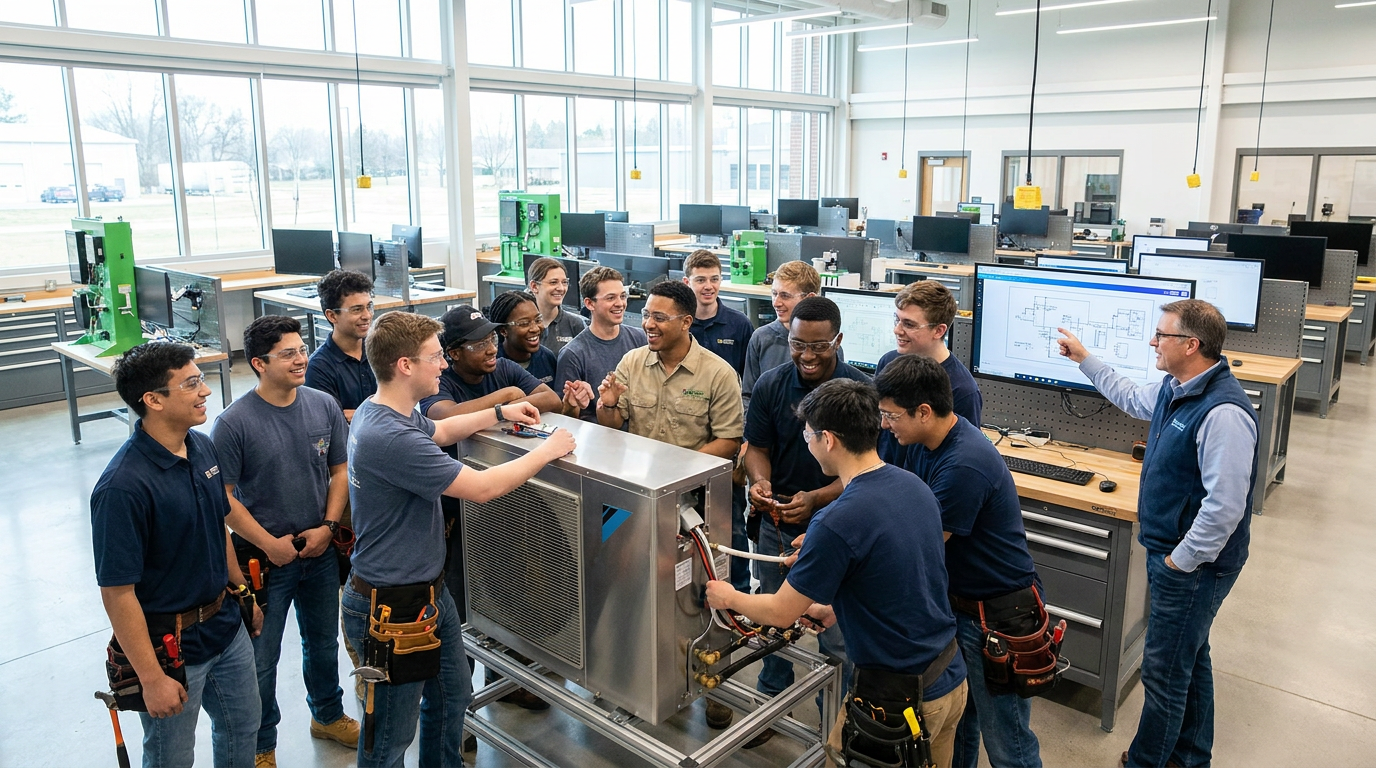
Recognizing this crisis, vocational schools, community colleges, and trade unions are rapidly overhauling their curricula. Traditional multi-year apprenticeships are being supplemented with intensive, modular training programs designed to get workers into the field faster. Institutions are launching specific "Clean Energy Technology" certificates and six-week bootcamps that focus exclusively on the latest health, safety, and smart-grid standards. These programs are heavily subsidized by federal and state grants, making them highly accessible to low-income students.[3][4]
The U.S. Department of Energy, for instance, has poured millions into initiatives like the "Training the Next Generation of Heat Pump HVAC Technicians" program, partnering with community colleges to develop advanced curricula for cold-climate systems [2]. Similarly, state-level legislation, such as the Climate and Equitable Jobs Act in Illinois, has distributed tens of millions of dollars to community colleges specifically for green workforce development, aiming to build a robust talent pipeline for the electric vehicle and solar sectors [4].[2][4]
For Generation Z, the appeal of these programs is multifaceted. Beyond the obvious financial benefits of avoiding crippling student loan debt, the climate trades offer a tangible way to combat global warming. While previous generations may have viewed vocational work as a fallback option, today's students increasingly see it as a frontline role in the climate crisis. The work is inherently local, highly secure, and offers a clear, rapid trajectory to middle-class stability.[6]
These roles are classic "middle-skill" jobs—occupations that require more education than a high school diploma but less than a four-year degree [4]. They represent the sweet spot of the modern green economy, offering starting salaries that frequently exceed those of recent university graduates in the humanities. Furthermore, as buildings become smarter and more connected, the nature of the work is shifting from purely mechanical labor to highly technical systems management, requiring a blend of physical dexterity and digital literacy.[3][4]
Employers are also adapting to the new reality. Recognizing that they can no longer rely on a steady stream of fully trained applicants, climate tech companies are investing heavily in internal training and retention. Data shows that companies prioritizing comprehensive technician training see significantly higher profit margins and vastly improved retention rates [3]. By offering continuous professional development and clear pathways to leadership, these firms are attempting to build loyalty in a hyper-competitive labor market.[3]

The scale of the global green workforce is already immense. According to joint data from the International Renewable Energy Agency and the International Labour Organization, 16.6 million people held renewable energy jobs globally in 2024 [5]. Solar photovoltaic employment alone accounted for 7.3 million of those positions [5]. Yet, despite these impressive numbers, the growth rate of the workforce is struggling to keep pace with the sheer volume of clean energy capacity being added to global grids.[5]
The challenge moving forward will be scaling these educational pathways quickly enough to prevent labor shortages from derailing climate goals. There is a persistent mismatch between the billions of dollars in available capital for green infrastructure and the viable, shovel-ready projects that can actually be executed by the current workforce. Bridging this gap will require unprecedented coordination between governments, educational institutions, and private industry.[6]
Ultimately, the rise of the climate trades represents a profound revaluation of skilled labor. For decades, economic policy heavily favored the knowledge economy, often at the expense of the physical trades. The urgent necessity of the energy transition is reversing that trend, proving that the path to a sustainable future is built not just by software engineers and policy analysts, but by the electricians, mechanics, and installers who are physically wiring the new world.[6]
How we got here
2021
Illinois passes the Climate and Equitable Jobs Act, directing millions to community colleges for green workforce training.
2022
The US Department of Energy launches specialized funding to train the next generation of cold-climate heat pump technicians.
2024
Global renewable energy employment reaches a record 16.6 million jobs, driven heavily by the solar photovoltaic sector.
2026
The Bureau of Labor Statistics projects wind and solar technicians to be the two fastest-growing occupations over the next decade.
Viewpoints in depth
Vocational Educators
Focusing on rapid curriculum deployment and debt-free career pathways.
Educators argue that the traditional four-year university model is no longer the only path to the middle class. By pivoting to modular, six-week intensive bootcamps and specialized clean energy certificates, community colleges are providing students with immediate, debt-free entry into high-paying fields. They view the climate trades as a dual solution: solving the macroeconomic labor shortage while offering unprecedented economic mobility to low-income and marginalized students.
Climate Tech Employers
Prioritizing retention and internal training to combat the severe labor shortage.
For employers, the narrative is defined by the acute demographic crisis known as the 'silver tsunami.' With five experienced technicians retiring for every two entering the field, companies can no longer rely on external hiring to fill their rosters. Instead, they are forced to build talent internally. Employers emphasize that investing in comprehensive, ongoing professional development is now a survival imperative, noting that well-trained technicians directly drive higher profit margins and customer satisfaction.
Workforce Analysts
Tracking the macroeconomic shift from the knowledge economy to physical infrastructure.
Labor economists and workforce analysts view the rise of the climate trades as a fundamental structural correction. For decades, economic incentives heavily favored digital and knowledge-based sectors, leading to a severe underinvestment in physical trades. Analysts warn that while the projected 50 percent growth in wind technician jobs is promising, the absolute number of workers must scale exponentially to meet net-zero targets. They argue that without sustained government intervention and funding, the capital allocated for green infrastructure will remain stranded.
What we don't know
- Whether vocational training programs can scale fast enough to meet the exponential demand required by 2030 net-zero targets.
- How the integration of artificial intelligence and advanced robotics might eventually alter the manual labor requirements of the climate trades.
Key terms
- Climate Trades
- Skilled vocational professions directly involved in the installation, maintenance, and operation of green technologies like solar panels, wind turbines, and heat pumps.
- Heat Pump
- A highly efficient electric heating and cooling system that transfers heat rather than generating it, crucial for building decarbonization.
- Green-Collar Worker
- A professional employed in the environmental sectors of the economy, particularly in renewable energy and energy efficiency.
- Middle-Skill Jobs
- Occupations that require more education and training than a high school diploma but less than a four-year college degree.
Frequently asked
Do climate trade jobs require a college degree?
No. Most require a high school diploma followed by a vocational certificate, apprenticeship, or postsecondary non-degree award.
How much do these jobs pay?
Wages vary by region and specialty, but many green-collar trades offer starting salaries competitive with or exceeding those of recent college graduates, often without the burden of student debt.
Why is there a shortage of heat pump technicians?
The shortage is driven by an aging workforce retiring faster than new workers enter, combined with a sudden surge in demand for energy-efficient smart technologies.
Sources
Source coverage
6 outlets
3 viewpoints surfaced






[1]Bureau of Labor StatisticsWorkforce Analysts
Fastest Growing Occupations: 2024-2034
Read on Bureau of Labor Statistics →[2]Department of EnergyVocational Educators
Training the Next Generation of Heat Pump HVAC Technicians
Read on Department of Energy →[3]MarketScaleClimate Tech Employers
Stronger Training Pipelines Can Help Solve HVAC's Talent Shortage
Read on MarketScale →[4]Illinois Community College BoardVocational Educators
Illinois Community Colleges are Building a Talent Pipeline for Green Jobs
Read on Illinois Community College Board →[5]Green Fuel JournalWorkforce Analysts
Renewable Energy Job Market Overview — Global Employment Trends
Read on Green Fuel Journal →[6]Factlen Editorial TeamWorkforce Analysts
Synthesis by Factlen editorial team
Read on Factlen Editorial Team →
Every angle. Every day.
Get education stories with full source coverage and perspective breakdowns delivered to your inbox.