
How AI and Autonomous Labs are Compressing Decades of Materials Science into Months
Artificial intelligence models are predicting hundreds of thousands of stable new materials, while robotic laboratories synthesize them without human intervention. This combined pipeline is rapidly accelerating the development of next-generation batteries, solar cells, and microchips.
By Factlen Editorial Team
- Computational Scientists
- Focus on pushing the boundaries of predictive models and active learning to map the entire universe of possible materials.
- Experimental Engineers
- Focus on validating AI predictions in the physical world and solving the complex challenges of scaling up manufacturing.
- Factlen Editorial Analysis
- Focus on synthesizing the broader economic and historical impact of automating the scientific method.
What's not represented
- · Industrial Manufacturing Executives
- · Mining and Raw Materials Suppliers
Why this matters
The physical constraints holding back solid-state batteries, hyper-efficient solar panels, and zero-loss power grids are fundamentally materials problems. By automating both the theoretical discovery and physical synthesis of new crystals, AI is unblocking the primary bottleneck in the global clean energy transition.
Key points
- AI models have predicted 380,000 highly stable new crystal structures.
- Autonomous robotic labs can physically synthesize these predictions with a 73% success rate.
- The combined pipeline compresses decades of experimental labor into mere weeks.
- These discoveries are critical for developing next-generation batteries and solar panels.
- Scaling lab-created materials to industrial mass production remains a significant hurdle.
For centuries, the discovery of new materials has been the fundamental bottleneck of human technological progress. Historically, identifying a novel compound like the lithium-ion structures that power modern smartphones required decades of painstaking, manual trial-and-error in chemistry laboratories.[5][6]
That paradigm is currently undergoing a radical shift. Artificial intelligence models, trained on the fundamental laws of quantum mechanics, are now bypassing human intuition entirely. These systems can predict the atomic structures of millions of potential crystals in silicon before a single physical experiment is ever run.[1][3]
The primary claim driving this revolution is that deep learning can accurately predict material stability at an unprecedented scale. Google DeepMind's Graph Networks for Materials Exploration (GNoME) serves as the foundational evidence for this capability, scaling computational chemistry to heights previously thought impossible.[1]
The evidence supporting this claim is staggering: GNoME discovered 2.2 million new crystal structures, identifying 380,000 of them as highly stable and viable for real-world technologies. This single computational run effectively expanded humanity's catalog of known stable materials by an order of magnitude overnight.[1][3][6]

However, there is transparent uncertainty in computational predictions. Theoretical stability in a computer simulation does not guarantee that a material can be physically manufactured in a laboratory. Many computationally "stable" crystals require impossible temperature gradients, extreme pressure conditions, or complex precursor reactions to form in the physical world.[3][5]
To bridge the gap between AI predictions and physical reality, researchers have introduced a second major claim: autonomous robotic laboratories can successfully synthesize these AI-generated compounds without human intervention. The primary evidence for this is the "A-Lab" at the Lawrence Berkeley National Laboratory.[2]
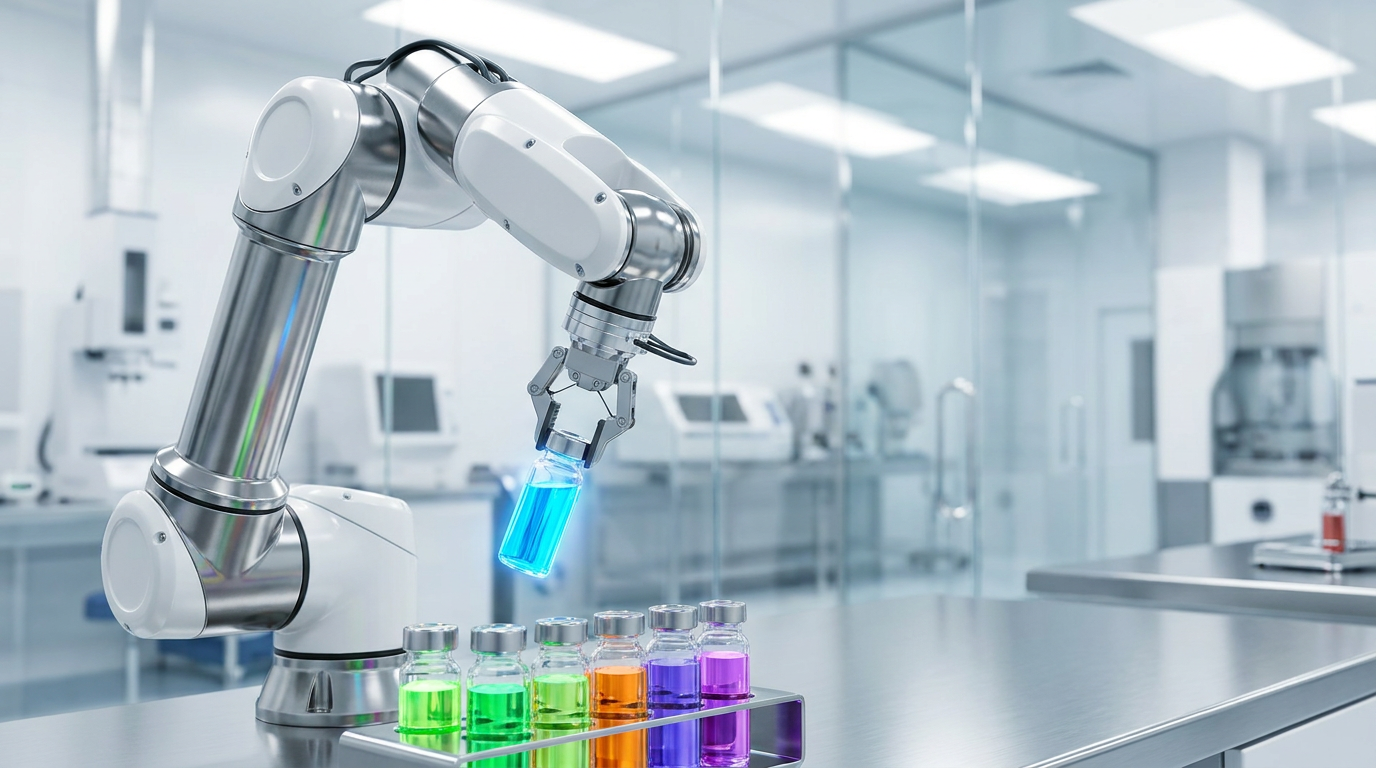
The A-Lab takes the computational predictions from models like GNoME and uses robotic arms, automated furnaces, and machine learning algorithms to physically mix, heat, and test the compounds. The entire process runs continuously, day and night, without requiring a human chemist to measure powders or operate the kilns.[2][4]
The entire process runs continuously, day and night, without requiring a human chemist to measure powders or operate the kilns.
In its initial proof-of-concept run, the A-Lab successfully synthesized 41 out of 58 targeted novel compounds in just 17 days. This represents a 73% success rate, a staggering achievement for completely autonomous physical chemistry and a robust validation of the robotic synthesis claim.[2][4][6]

The mechanism behind this high success rate relies on closed-loop active learning. When a robotic synthesis attempt fails, the AI analyzes the resulting X-ray diffraction data, adjusts the heating profile or precursor mix to correct the error, and immediately tries again, learning from its physical mistakes in real-time.[2][5]
The third major claim is that this automated pipeline directly accelerates the deployment of clean energy technology. The materials being discovered are not merely academic curiosities; they are highly specific candidates for next-generation solid-state batteries, advanced solar cells, and superconducting grids.[1][5]
The evidence for this application is found in the specific nature of the discoveries. Among the hundreds of thousands of stable predictions are over 52,000 new layered compounds akin to graphene, and hundreds of potential solid-state electrolytes that could replace the flammable liquid cores in current electric vehicle batteries.[1][3]
Yet, significant uncertainty remains regarding commercialization timelines. While the discovery and initial synthesis phases have been compressed from years to weeks, synthesizing a few grams of a novel battery material in a robotic lab does not solve the immense engineering challenges of mass-producing it at a gigafactory scale.[4][6]
Furthermore, current AI models and robotic labs still struggle with predicting and executing complex, multi-step synthesis pathways. The systems excel at solid-state "powder baking" methods, but synthesizing materials that require delicate liquid-phase reactions or precise atmospheric controls remains an open challenge.[2][5]

Despite these limitations, the integration of generative AI with robotic automation marks a fundamental transition in the scientific method itself. The traditional hypothesis-test-analyze loop, which has driven science since the Enlightenment, is now running at computational speeds.[4][6]
Researchers estimate that the combined output of predictive models like GNoME and autonomous facilities like the A-Lab represents the equivalent of roughly 800 years of human experimental labor, achieved in a matter of months.[1][3]
As these autonomous systems become more sophisticated and widely deployed, they are expected to expand beyond inorganic crystals into polymers, metal-organic frameworks, and the complex catalysts necessary for efficient carbon capture, fundamentally rewriting the timeline for global technological advancement.[5][6]
How we got here
Pre-2020
Materials discovery relies on human intuition and slow, manual trial-and-error, yielding a few thousand stable crystals per decade.
2021-2022
AI models begin accurately predicting the properties of known materials, hinting at generative capabilities.
Late 2023
DeepMind releases GNoME, predicting 380,000 stable materials; Berkeley's A-Lab demonstrates autonomous robotic synthesis.
2024-2026
Autonomous labs proliferate globally, shifting focus from discovery to automated scale-up and commercial testing.
Viewpoints in depth
Computational Scientists' View
AI is a powerful tool that augments human intuition rather than replacing it.
Researchers in this camp emphasize that AI frees them from the tedious, decades-long process of trial-and-error. By mapping out the theoretical bounds of stable materials, computational scientists can focus their energy on the 'why' and 'how' of material properties, directing the AI toward specific societal needs like carbon capture or energy storage rather than blindly mixing compounds.
Materials Engineers' View
Discovery is only the first step; manufacturability is the real bottleneck.
Engineers caution against over-hyping the initial discovery phase. They point out that synthesizing a few milligrams of a novel compound in a highly controlled robotic environment does not easily translate to producing tons of it in a commercial factory. The focus for this group is on developing AI that can predict not just a material's stability, but its cost-effective manufacturing pathways.
Clean Energy Advocates' View
This is the breakthrough needed to hit global net-zero targets.
For those focused on climate change, the current pace of battery and solar panel improvement is too slow to meet emissions targets. This camp views autonomous materials discovery as the critical accelerant needed to unlock solid-state batteries and hyper-efficient photovoltaics, arguing that the technology should receive massive public funding to speed up commercialization.
What we don't know
- How many of the 380,000 predicted materials can be manufactured cost-effectively at an industrial scale.
- Whether autonomous labs can master complex, multi-step synthesis pathways beyond basic powder-baking.
- The exact timeline for when the first AI-discovered, robot-synthesized material will reach commercial consumer markets.
Key terms
- Crystal Structure
- The highly ordered, repeating arrangement of atoms in a solid material, which dictates its physical and electrical properties.
- Active Learning
- A machine learning paradigm where the algorithm iteratively queries a physical system for new data to improve its own subsequent predictions.
- Solid-State Battery
- A next-generation battery technology that uses a solid electrolyte instead of a liquid one, offering higher energy density and improved safety.
- X-ray Diffraction (XRD)
- A technique used by autonomous labs to analyze the atomic structure of a newly synthesized material to confirm if the experiment succeeded.
Frequently asked
Will these AI models replace human chemists?
No. The AI and robotic labs automate the tedious trial-and-error process, allowing human scientists to focus on designing the experiments and figuring out how to commercialize the successful materials.
How long until these new materials are in consumer products?
While discovery and lab synthesis now take weeks instead of years, scaling up a new material for industrial mass manufacturing still typically takes 5 to 10 years.
Can the AI invent materials that violate physics?
No. The models are trained on quantum mechanical principles and density functional theory, ensuring their predictions are physically plausible, though they may still be difficult to manufacture.
Sources
Source coverage
6 outlets
3 viewpoints surfaced





[1]NatureComputational Scientists
Scaling deep learning for materials discovery
Read on Nature →An autonomous laboratory for the accelerated synthesis of novel materials
Read on Nature →[3]MIT Technology ReviewComputational Scientists
Google DeepMind’s new AI tool helped create 380,000 new materials
Read on MIT Technology Review →[4]WiredExperimental Engineers
AI and Robots Are Teaming Up to Invent New Materials
Read on Wired →[5]U.S. Department of EnergyExperimental Engineers
Artificial Intelligence Accelerates Materials Discovery
Read on U.S. Department of Energy →[6]Factlen Editorial TeamFactlen Editorial Analysis
Synthesis by Factlen editorial team
Read on Factlen Editorial Team →



Every angle. Every day.
Get ai stories with full source coverage and perspective breakdowns delivered to your inbox.