
The Rise of Local AI: How Small, Open-Source Models Are Running on Everyday Devices
A new generation of highly efficient 'Small Language Models' is allowing users to run powerful AI directly on their laptops and phones, offering total privacy and zero API costs.
By Factlen Editorial Team
- Privacy & Open-Source Advocates
- Argue that local AI is essential for data sovereignty, protecting users from corporate surveillance and vendor lock-in.
- Enterprise AI Developers
- Value small models for their predictable costs, low latency, and ability to be fine-tuned securely on proprietary company data.
- Hardware & Edge Manufacturers
- View the rise of local AI as a major driver for upgrading consumer hardware, pushing for more powerful neural processing units (NPUs) in everyday devices.
What's not represented
- · Cloud API Providers
- · Cybersecurity Auditors
Why this matters
By running AI locally, you no longer have to send sensitive personal or corporate data to cloud providers, nor do you have to pay monthly subscription fees. This shift democratizes advanced computing, putting frontier-level intelligence directly into the hands of anyone with a standard computer.
Key points
- Small Language Models (SLMs) allow users to run powerful AI directly on laptops and smartphones.
- Local execution guarantees complete data privacy, as prompts never leave the physical device.
- Techniques like quantization and Mixture of Experts (MoE) compress models to fit on consumer hardware.
- Running open-source models locally eliminates the monthly subscription and API costs associated with cloud AI.
- Tools like Ollama and LM Studio have made installing local AI as easy as downloading a desktop app.
For the past several years, the artificial intelligence narrative has been dominated by a singular philosophy: bigger is better. The industry's most famous tools have relied on massive data centers, requiring thousands of specialized graphics processors and consuming vast amounts of electricity to answer a single user prompt. But as the technology matures in 2026, a quiet and highly empowering revolution is taking place on everyday consumer hardware.[4][6]
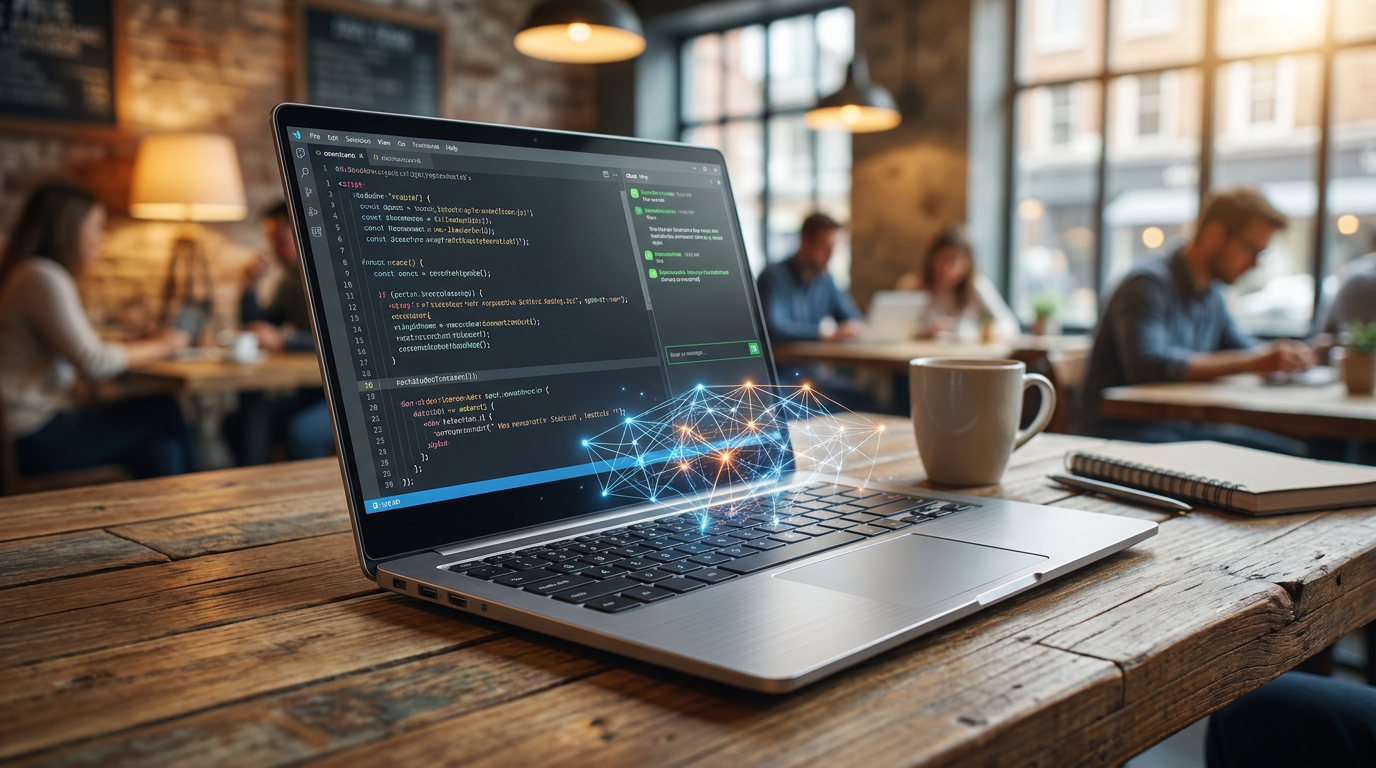
Developers and researchers have successfully engineered a new class of artificial intelligence known as Small Language Models (SLMs). Unlike their cloud-bound predecessors, these compact systems are designed specifically to run locally on standard laptops, smartphones, and edge devices. This shift is fundamentally changing who controls AI, moving the power from centralized tech giants directly into the hands of individual users.[3][6]
To understand how this is possible, it helps to look at how AI models are measured. The size of a neural network is typically defined by its parameter count—the artificial "neurons" or mathematical weights that store the model's learned knowledge. While massive frontier models boast hundreds of billions or even trillions of parameters, SLMs operate in the highly efficient sweet spot of 1 billion to 10 billion parameters.[2][3]
Operating underneath that 10-billion parameter ceiling means the model requires significantly less Random Access Memory (RAM) to function. A standard modern laptop with 8 to 16 gigabytes of unified memory can comfortably load and execute these models without crashing or freezing. The result is a highly capable digital assistant that lives entirely on your hard drive, ready to draft emails, write code, or summarize documents.[3][5]

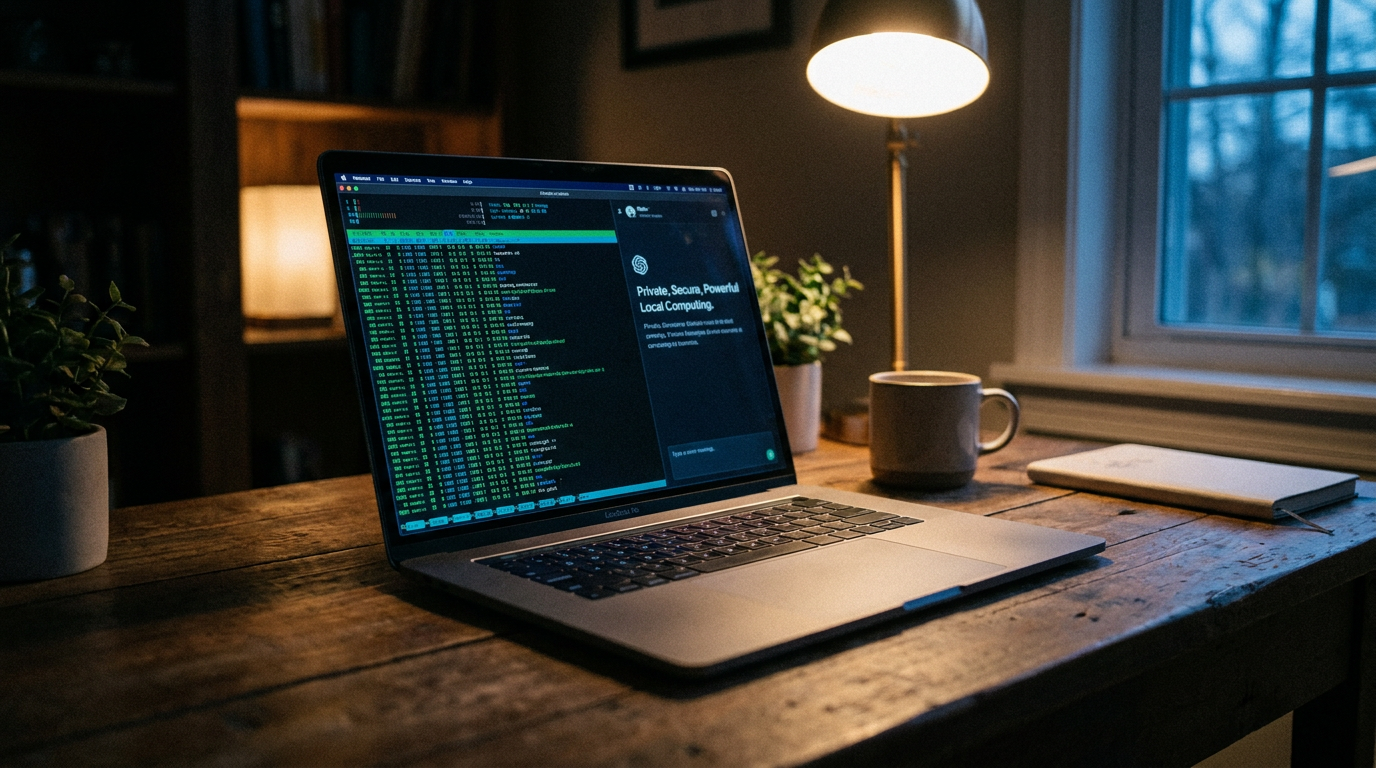
The primary catalyst driving users toward local AI is absolute data privacy. When you type a prompt into a cloud-based service, your data is transmitted over the internet, processed on a remote server, and often logged for future model training. With a local SLM, the internet connection can be completely severed. The data never leaves the physical device, making it the ultimate solution for handling sensitive corporate documents, personal journals, or proprietary source code.[2][5]
Beyond privacy, the economic advantage is undeniable. Cloud-based AI APIs charge developers per token—a fraction of a word—which can quickly escalate into thousands of dollars a month for heavy users or small businesses. Local models, being open-source and running on hardware the user already owns, effectively drop the marginal cost of inference to zero. You pay only for the electricity required to charge your laptop.[4][5]
Fitting a highly intelligent model onto a consumer device requires clever software engineering. One of the primary techniques making this possible is called quantization. In simple terms, quantization compresses the mathematical precision of the model's parameters. By shrinking the weights from high-precision 16-bit formats down to 4-bit formats, developers can drastically reduce the model's file size and memory footprint with almost no noticeable drop in the quality of its answers.[2][6]
Fitting a highly intelligent model onto a consumer device requires clever software engineering.
Another breakthrough technique is the Mixture of Experts (MoE) architecture. Instead of activating the entire neural network for every single word it generates, an MoE model acts like a team of specialists. It routes the prompt to only the specific "expert" parameters needed for that exact topic. This means a model might technically contain 24 billion parameters, but only activate 3 billion of them at any given moment, allowing it to run at lightning speed on a standard processor.[2][4]

The landscape of these compact models is currently dominated by a few major open-source families. Microsoft has led the charge in proving that data quality matters more than sheer size. Their Phi family of models, particularly the Phi-3.5 and Phi-4 series, were trained almost exclusively on "textbook quality" synthetic data. By feeding the model highly curated, educational content rather than the chaotic noise of the open internet, Microsoft achieved graduate-level reasoning in a model small enough to run on an iPhone.[1][3]
Meta's Llama lineage remains the industry's generalist standard. The Llama 3.2 releases, specifically the 1-billion and 3-billion parameter variants, offer incredible versatility. They are widely considered the "Swiss Army Knife" of local AI, capable of handling everything from creative writing to complex logic puzzles, all while maintaining a remarkably small memory footprint.[2][3]
Meanwhile, international developers are pushing the boundaries of efficiency. France's Mistral AI has popularized the MoE approach for consumer hardware, creating models that excel in multilingual tasks and rapid inference. Alibaba's Qwen series has introduced highly capable coding models that feature a "thinking mode" toggle, allowing the local AI to pause and reason through complex problems step-by-step before outputting an answer.[2][5]

Deploying these models used to require a PhD in computer science, but the open-source community has entirely democratized the process. Tools like Ollama, LM Studio, and llama.cpp have packaged the complex backend engineering into simple, user-friendly applications. Today, installing a local AI is as straightforward as downloading a standard desktop application and clicking "run."[4][6]
With a single terminal command, a developer can pull a model from a public repository and have it chatting within seconds. These local tools also expose standard APIs, meaning software engineers can build their own custom applications—like private document search engines or automated coding assistants—that plug directly into the local model instead of relying on a paid cloud service.[4][5]
There are, of course, limitations to what a laptop can achieve. Small language models do not possess the encyclopedic breadth of trivia found in massive trillion-parameter systems, and they can struggle with highly obscure facts. However, for practical, day-to-day tasks like summarizing meeting notes, drafting boilerplate code, or rewriting emails for tone, they are virtually indistinguishable from their massive cloud counterparts.[3][6]

The trajectory of artificial intelligence is splitting into two distinct paths. While tech giants will continue to build massive, energy-intensive models in centralized data centers for cutting-edge scientific research, the daily utility of AI is moving to the edge. By running capable, private, and free models on the devices we already own, open-source SLMs are ensuring that the future of computing remains decentralized and accessible to everyone.[4][6]
Viewpoints in depth
Privacy & Open-Source Advocates
This camp views local AI as a necessary defense against corporate surveillance and data harvesting.
For privacy advocates and open-source purists, the shift to local AI is about fundamental digital rights. They argue that sending personal journals, proprietary corporate code, or sensitive financial data to centralized cloud providers creates unacceptable security risks and vendor lock-in. By running models locally, users reclaim data sovereignty. This community heavily champions permissive licenses like Apache 2.0, ensuring that the foundational models of the future remain a public good rather than a walled garden controlled by a few tech monopolies.
Enterprise AI Developers
This group focuses on the practical economics and latency benefits of deploying small models in production.
Enterprise developers are adopting SLMs primarily for cost predictability and speed. Relying on massive frontier models for simple, repetitive tasks—like formatting JSON data or summarizing internal emails—results in bloated API bills and unnecessary network latency. By fine-tuning a 3-billion parameter model on their own specific company data, these developers can achieve the same accuracy as a massive cloud model but at a fraction of the cost, running the workloads securely on their own internal servers or edge devices.
Hardware & Edge Manufacturers
Device makers see local AI as the ultimate catalyst for a massive hardware upgrade cycle.
For companies manufacturing laptops, smartphones, and silicon chips, the local AI boom is a massive commercial opportunity. They are actively optimizing their hardware—introducing dedicated Neural Processing Units (NPUs) and expanding unified memory architectures—specifically to run models like Llama and Phi more efficiently. Their argument is that the future of computing requires AI to be deeply integrated into the operating system, functioning instantly without waiting for a network connection, which in turn requires consumers to purchase the next generation of AI-ready devices.
What we don't know
- Whether small models will ever be able to reliably overcome 'hallucinations' when dealing with highly complex, multi-step logic problems without cloud assistance.
- How upcoming regulations regarding AI safety will apply to open-weight models that can be freely downloaded and modified by anyone offline.
Key terms
- Parameter
- The mathematical weights or artificial 'neurons' inside an AI model that store the knowledge it learned during training.
- Quantization
- A compression technique that reduces the precision of an AI model's parameters, allowing it to take up significantly less memory without losing much intelligence.
- Mixture of Experts (MoE)
- An AI architecture that divides a model into specialized sub-sections, activating only the necessary 'experts' for a specific prompt to save computing power.
- Inference
- The process of an AI model actively running and generating a response to a user's prompt.
- Edge Device
- A piece of hardware that processes data locally near the user—like a smartphone, laptop, or IoT sensor—rather than relying on a centralized cloud server.
Frequently asked
What is a Small Language Model (SLM)?
An SLM is an artificial intelligence model designed with fewer parameters (typically under 10 billion) so it can run efficiently on consumer hardware like laptops and phones, rather than requiring massive data centers.
Can my current laptop run a local AI?
Yes, most modern laptops with 8GB to 16GB of RAM can comfortably run mid-tier local models, especially when using quantization techniques to compress the model's size.
Is local AI completely private?
Yes. Because the model is downloaded and executed entirely on your physical device, your prompts and data never leave your machine or get sent to a cloud server.
Do I have to pay to use open-source SLMs?
No. The models themselves are free to download, and because you are providing the computing power with your own hardware, there are no monthly API or subscription fees.
Sources
Source coverage
6 outlets
3 viewpoints surfaced





[1]arXivHardware & Edge Manufacturers
Phi-3 Technical Report: A Highly Capable Language Model Locally on Your Phone
Read on arXiv →[2]Hugging FacePrivacy & Open-Source Advocates
Best Open-Source LLM to Run Locally in 2026
Read on Hugging Face →[3]Machine Learning MasteryEnterprise AI Developers
Introduction to Small Language Models: The Complete Guide
Read on Machine Learning Mastery →[4]All Things OpenPrivacy & Open-Source Advocates
Why open source controls the small language model stack
Read on All Things Open →[5]BentoMLEnterprise AI Developers
Running Open-Source Small Language Models in Production
Read on BentoML →[6]Factlen Editorial TeamHardware & Edge Manufacturers
Synthesis by Factlen editorial team
Read on Factlen Editorial Team →
More in ai
See all 5 stories →AI Governance
The 2026 US AI Regulatory Showdown: Federal Preemption Collides With State Laws
5 sources

Frontier AI Regulation
US Advances First Comprehensive Federal AI Governance Frameworks
6 sources

Orbital Compute
First Vision-Language AI Model Deployed in Space as Satellite Autonomously Analyzes Earth Imagery
6 sources

Every angle. Every day.
Get ai stories with full source coverage and perspective breakdowns delivered to your inbox.