
The Science of Aquascaping: How Underwater Gardening Balances Chemistry and Mental Health
The rapidly growing hobby of aquascaping blends rigorous aquatic chemistry with interior design, offering hobbyists a unique tool for mindfulness and stress reduction.
By Factlen Editorial Team
- Therapeutic Practitioners
- Focus on the hobby as a mental health tool, emphasizing the anxiety-reducing benefits of the Wabi-sabi aesthetic and mindful maintenance.
- High-Tech Aquascapers
- Advocate for using pressurized CO2 and intense lighting to unlock rapid growth and vibrant plant coloration.
- Ecological Purists
- Favor low-tech setups that rely on natural biological filtration and slow growth to create highly stable, self-sustaining ecosystems.
What's not represented
- · Marine Biologists
- · Interior Designers
Why this matters
Understanding the mechanics of aquascaping demystifies a hobby that actively lowers cortisol and anxiety, offering a scientifically backed, screen-free method to cultivate mindfulness and bring self-sustaining nature into the home.
Key points
- Aquascaping combines horticulture, design, and aquatic chemistry to create self-sustaining underwater ecosystems.
- Clinical studies show observing aquariums can lower blood pressure and reduce anxiety levels by an average of 12%.
- A healthy aquascape relies on the nitrogen cycle, where beneficial bacteria convert toxic ammonia into plant-friendly nitrates.
- High-tech setups use pressurized CO2 injection and intense LED lighting to accelerate photosynthesis and plant growth.
- When photosynthesis peaks, plants release visible oxygen bubbles in a visual reward known as 'pearling.'
- The routine maintenance of an aquascape serves as a powerful mindfulness practice, lowering cortisol and stress.
The modern living room has a new centerpiece. It is not a television or a smart display, but a glowing, meticulously curated underwater forest. Moving far beyond the plastic castles and neon gravel of childhood goldfish bowls, a growing demographic of adults has embraced a hobby that sits at the intersection of horticulture, interior design, and aquatic chemistry.[11]
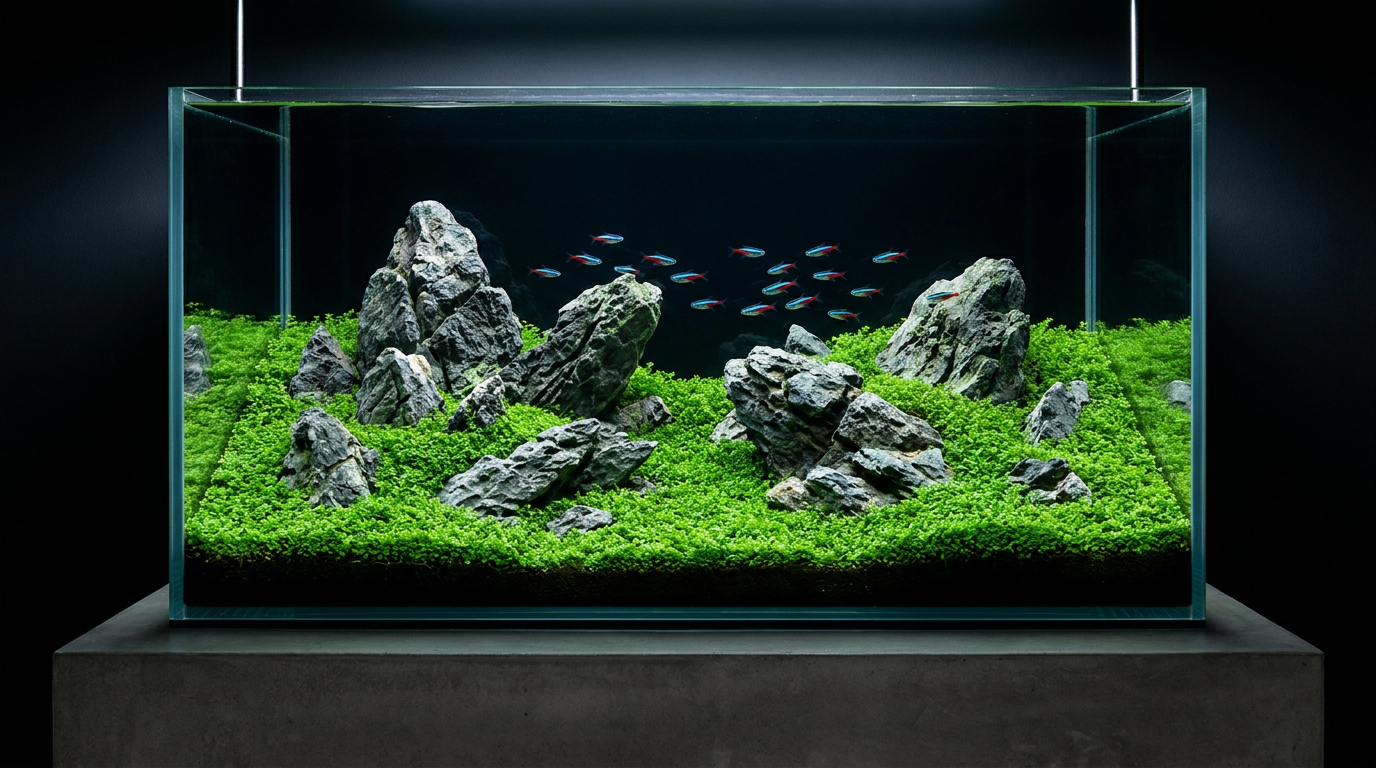
This is aquascaping—the art of creating self-sustaining, aesthetically stunning ecosystems within the confines of a glass box. Pioneered in the 1990s by Japanese photographer Takashi Amano, the "Nature Aquarium" style treats the tank not merely as a habitat for fish, but as a living canvas where aquatic plants play the leading role.[4][11]
In an increasingly hyper-connected and fast-paced world, the appeal of these underwater gardens extends far beyond their visual beauty. Psychologists and therapeutic practitioners are increasingly recognizing aquascaping as a form of "aquatic therapy," utilizing the hobby to combat the chronic stress of modern life.[7]
The psychological benefits are measurable. Clinical studies have demonstrated that spending time observing a thriving aquarium can lower blood pressure, reduce heart rates, and drop ambient anxiety levels by an average of 12 percent. The gentle movement of schooling fish, the swaying of aquatic flora, and the soft hum of water filtration create a multi-sensory environment that actively suppresses cortisol production.[6][7]

Furthermore, the routine maintenance of an aquascape demands a high degree of mindfulness. The act of carefully trimming delicate stem plants with specialized aquascaping scissors forces the hobbyist into the present moment. Particularly in the minimalist "Iwagumi" style—which relies on the Japanese Zen principle of "Wabi-sabi" to find beauty in asymmetry—the aquarium becomes a living meditation tool that rewards patience and deliberate focus.[5][8]
But beneath this tranquil, meditative surface, a complex and unforgiving chemical engine is running. To achieve the lush, vibrant growth seen in professional aquascapes, hobbyists must master the invisible science of water chemistry, acting as the orchestrators of a microscopic world.[11]
The absolute foundation of any successful aquascape is the biological filter, governed by the nitrogen cycle. Unlike natural rivers or lakes, an aquarium is a closed system. Without intervention, the organic waste produced by fish, decaying plant matter, and uneaten food would quickly turn the water toxic.[9][10]
The nitrogen cycle relies on colonies of beneficial chemoautotrophic bacteria to process this waste. The cycle begins when organic matter breaks down into ammonia, a compound that is highly toxic to aquatic life even in microscopic amounts. The first strain of bacteria consumes this ammonia and converts it into nitrite—which is equally dangerous. Finally, a second strain of bacteria oxidizes the nitrite into nitrate, a relatively benign compound that serves as a vital fertilizer for aquatic plants.[10]

The nitrogen cycle relies on colonies of beneficial chemoautotrophic bacteria to process this waste.
Establishing this invisible bacterial workforce—a process known as "cycling" the tank—requires immense patience. Beginners often fail by rushing to add fish before the bacterial colonies are large enough to handle the biological load. A properly cycled aquascape must consistently test at 0 ppm for both ammonia and nitrite, ensuring a safe environment for its inhabitants.[9][10]
In a heavily planted aquascape, the flora itself acts as a powerful secondary filtration system. Aquatic plants aggressively absorb nitrates and phosphates from the water column to fuel their growth, naturally purifying the water and outcompeting unsightly algae for available nutrients.[1]
To maximize this natural filtration and achieve dense, vibrant foliage, aquascapers must manipulate the two primary drivers of photosynthesis: light and carbon dioxide. High-intensity RGB LED lighting acts as the accelerator pedal for plant growth, providing the specific spectrums of red and blue light required for chlorophyll synthesis.[2][4]
However, intense lighting alone is a recipe for disaster. In natural waterways, carbon dioxide is constantly replenished by atmospheric exchange and decomposing organics. In the closed environment of an aquarium, rapidly photosynthesizing plants will deplete the naturally dissolved CO2 within hours, stalling their growth and leaving excess light energy available for nuisance algae to exploit.[1][3]
This bottleneck divides the hobby into two distinct camps: "low-tech" and "high-tech." Low-tech aquascapers choose slow-growing plants that can survive on ambient CO2 levels, accepting a more subdued aesthetic in exchange for simplicity. High-tech aquascapers, conversely, utilize pressurized CO2 injection systems to artificially inflate the carbon levels in the water.[3]
A high-tech setup resembles a chemistry lab. It involves a compressed CO2 cylinder pressurized to roughly 800 psi, a dual-stage regulator to step down the pressure, and an electronic solenoid valve synced to the aquarium's lighting timer. The gas is pushed through a ceramic diffuser, creating a mist of micro-bubbles that dissolve into the water column. Aquascapers use a glass "drop checker" filled with a bromothymol blue indicator solution to monitor these levels, aiming for an optimal concentration of 20 to 30 ppm.[2][3]

When the balance of intense light, abundant nutrients, and injected CO2 is perfectly dialed in, aquascapers are rewarded with a phenomenon known as "pearling." The plants photosynthesize so rapidly that the surrounding water becomes supersaturated with oxygen. Unable to dissolve any further, the pure oxygen forms glittering, crystal-clear bubbles that bead up on the leaves and float to the surface.[4]

Beyond the immediate aesthetic and psychological rewards, mastering this delicate balance fosters a profound environmental awareness. By micro-managing the water parameters, nutrient loads, and biological stability of a 20-gallon glass box, hobbyists gain a visceral understanding of how fragile real-world aquatic ecosystems truly are.[1]
The journey is rarely without setbacks. Almost every aquascaper will face devastating algae blooms, mysterious plant melting, or sudden chemical imbalances that test their resolve. Yet, it is precisely this steep learning curve that makes the hobby so deeply rewarding.[11]
Ultimately, aquascaping is an exercise in engineered harmony. It requires the hobbyist to blend the aesthetic eye of a landscape architect with the rigorous discipline of a chemist. The final result is not just a decoration, but a thriving, breathing slice of nature that heals the water within it, and calms the human observing it.[11]
How we got here
1990s
Takashi Amano introduces the 'Nature Aquarium' concept, shifting the hobby's focus from fish to aquatic plants.
2000s
Pressurized CO2 injection becomes widely accessible to home hobbyists, enabling high-tech planted tanks.
2010s
The introduction of high-output RGB LED lighting revolutionizes plant coloration and growth rates.
2020s
Aquascaping surges in popularity as a mindfulness and mental health tool during global lockdowns.
Viewpoints in depth
High-Tech Aquascapers
Argue that injecting pressurized CO2 and using high-intensity lighting is essential for unlocking the full potential of aquatic flora.
This camp views the aquarium as a highly controlled laboratory. By artificially inflating carbon dioxide levels to 30 ppm and blasting the tank with specific spectrums of RGB light, they force plants into overdrive. They argue that this precise nutrient dosing is the only way to achieve the vibrant reds, dense carpets, and rapid growth rates that define modern competition-level aquascapes.
Ecological Purists
Advocate for minimizing mechanical intervention to create a more stable, self-sustaining ecosystem.
Ecological purists argue that the "high-tech" approach creates a fragile system that is entirely dependent on machinery. Instead, they rely heavily on the natural nitrogen cycle, robust biological filtration, and slow-growing plants like Anubias and Cryptocoryne. By balancing the biological load naturally, they believe the resulting ecosystem is far more resilient to chemical crashes and sudden algae blooms.
Therapeutic Practitioners
View the aquarium primarily as a tool for mental health, mindfulness, and anxiety reduction.
For this group, the chemical and biological mechanics are secondary to the psychological impact of the hobby. They emphasize the mental health benefits of the "Wabi-sabi" aesthetic and the meditative routine of tank maintenance. They argue that the true value of aquascaping lies in its proven ability to lower cortisol, reduce blood pressure, and provide a daily, screen-free escape from digital fatigue.
What we don't know
- The exact long-term psychological differences between maintaining a high-maintenance 'high-tech' tank versus a low-maintenance 'low-tech' setup.
- How emerging smart-sensor technologies and automated dosing will alter the traditional hands-on mindfulness aspect of the hobby.
Key terms
- Aquascaping
- The craft of arranging aquatic plants, rocks, stones, and driftwood in an aesthetically pleasing manner within an aquarium.
- Nitrogen Cycle
- The biological process where beneficial bacteria convert highly toxic fish waste (ammonia) into nitrite, and finally into relatively harmless nitrate.
- Pearling
- The visible accumulation and release of oxygen bubbles from aquatic plants during periods of peak photosynthesis.
- Drop Checker
- A small glass device placed inside the aquarium containing an indicator solution that changes color to monitor dissolved CO2 levels.
- Wabi-sabi
- A Japanese aesthetic principle centered on the acceptance of transience and imperfection, heavily utilized in minimalist aquascape designs.
Frequently asked
Do I need to inject CO2 to have a planted aquarium?
No. While CO2 injection accelerates growth and allows for more demanding plant species, many 'low-tech' plants like Anubias and Java Fern thrive perfectly well using only the ambient CO2 naturally dissolved in the water.
How long does it take to cycle a new aquarium?
Establishing a robust nitrogen cycle typically takes three to six weeks. During this time, beneficial bacteria colonize the filter media to safely process toxic ammonia into less harmful nitrates.
What is the 'Iwagumi' style of aquascaping?
Iwagumi is a minimalist Japanese aquascaping style that focuses on the precise placement of stones and a single type of carpeting plant, emphasizing simplicity, asymmetry, and the Zen principle of 'Wabi-sabi.'
Why are my aquatic plants producing bubbles?
This phenomenon, known as 'pearling,' occurs when plants are photosynthesizing so rapidly that the surrounding water becomes supersaturated with oxygen, causing visible bubbles to form and detach from the leaves.
Sources
Source coverage
11 outlets
3 viewpoints surfaced











[1]School of ScapeHigh-Tech Aquascapers
The Power of CO2 in Aquascaping & Environmental Benefits
Read on School of Scape →[2]Aquascape ShopHigh-Tech Aquascapers
Benefits of CO2 Injection for Planted Tanks
Read on Aquascape Shop →[3]Gensou AquascapingHigh-Tech Aquascapers
CO2 System Setup Beginners Guide
Read on Gensou Aquascaping →[4]Aqua Design AmanoEcological Purists
An aquarium environment supported by plant photosynthesis
Read on Aqua Design Amano →[5]SJ WaveTherapeutic Practitioners
Therapeutic Benefits of Aquascaping
Read on SJ Wave →[6]Buce PlantTherapeutic Practitioners
Aquariums and Mental Health: Relieving Stress
Read on Buce Plant →[7]CO2ArtHigh-Tech Aquascapers
The psychological benefits of having an aquarium
Read on CO2Art →[8]Rate My Fish TankTherapeutic Practitioners
The Psychological Benefits of Aquascaping for Stress Relief
Read on Rate My Fish Tank →[9]East Ocean AquariumEcological Purists
Maintaining the Nitrogen Cycle: Long-term Aquarium Health
Read on East Ocean Aquarium →[10]Matthews' Aquatic ParadiseEcological Purists
Understanding the Aquarium Nitrogen Cycle
Read on Matthews' Aquatic Paradise →[11]Factlen Editorial TeamTherapeutic Practitioners
Synthesis by Factlen editorial team
Read on Factlen Editorial Team →
Every angle. Every day.
Get lifestyle stories with full source coverage and perspective breakdowns delivered to your inbox.