
How Virtual Reality is Rewiring Vocational Training for the Skilled Trades
Trade schools and corporate apprenticeships are increasingly using immersive virtual reality to train electricians, welders, and HVAC technicians. The technology offers a safe, cost-effective way to accelerate learning and address a massive national labor shortage.
By Factlen Editorial Team
- Vocational Educators
- Focus on the pedagogical benefits, safety, and cost savings of VR simulations.
- Industry Employers
- Emphasize the need for rapid, scalable training to fill massive labor shortages.
- Traditional Tradespeople
- Skeptical of replacing physical, tactile experience with digital simulations.
What's not represented
- · Students without broadband access
- · Small independent contractors
Why this matters
With hundreds of thousands of unfilled jobs in the skilled trades, traditional training methods are too slow and expensive to meet demand. Virtual reality is democratizing access to technical education, allowing students to learn dangerous, high-paying skills safely and efficiently.
Key points
- The skilled trades are facing a massive labor shortage, with over 110,000 unfilled positions in the HVAC sector alone.
- Virtual reality is being adopted by trade schools to accelerate training, reduce material costs, and improve safety.
- Students using VR can practice dangerous tasks, like high-voltage wiring, in a completely risk-free digital environment.
- A pilot study showed students using immersive VR scored 75% on certification exams, compared to 53% for traditional learners.
- Experts caution that VR cannot entirely replace hands-on training, as the tactile feel of physical tools remains essential.
The American economy is facing a quiet crisis in its physical infrastructure, driven not by a lack of materials, but by a severe shortage of the hands needed to build and maintain it. The skilled trades are experiencing a massive demographic cliff as older workers retire without enough young apprentices to replace them. In the heating, ventilation, and air conditioning (HVAC) sector alone, industry groups estimate there are currently 110,000 unfilled positions nationwide. Bridging this labor gap requires a monumental training effort, but traditional vocational education is often bottlenecked by limited physical space, expensive materials, and a shortage of qualified instructors.[1]
To accelerate the pipeline of new workers, trade schools and corporate training programs are turning to a technology once exclusively associated with video games: Virtual Reality (VR). Immersive VR is rapidly becoming a cornerstone of modern vocational education, transforming how the next generation of electricians, welders, and plumbers learn their craft. By donning a headset, a novice can step onto a virtual job site and begin turning wrenches, wiring panels, and diagnosing complex machinery before they ever set foot in a physical workshop.[6]
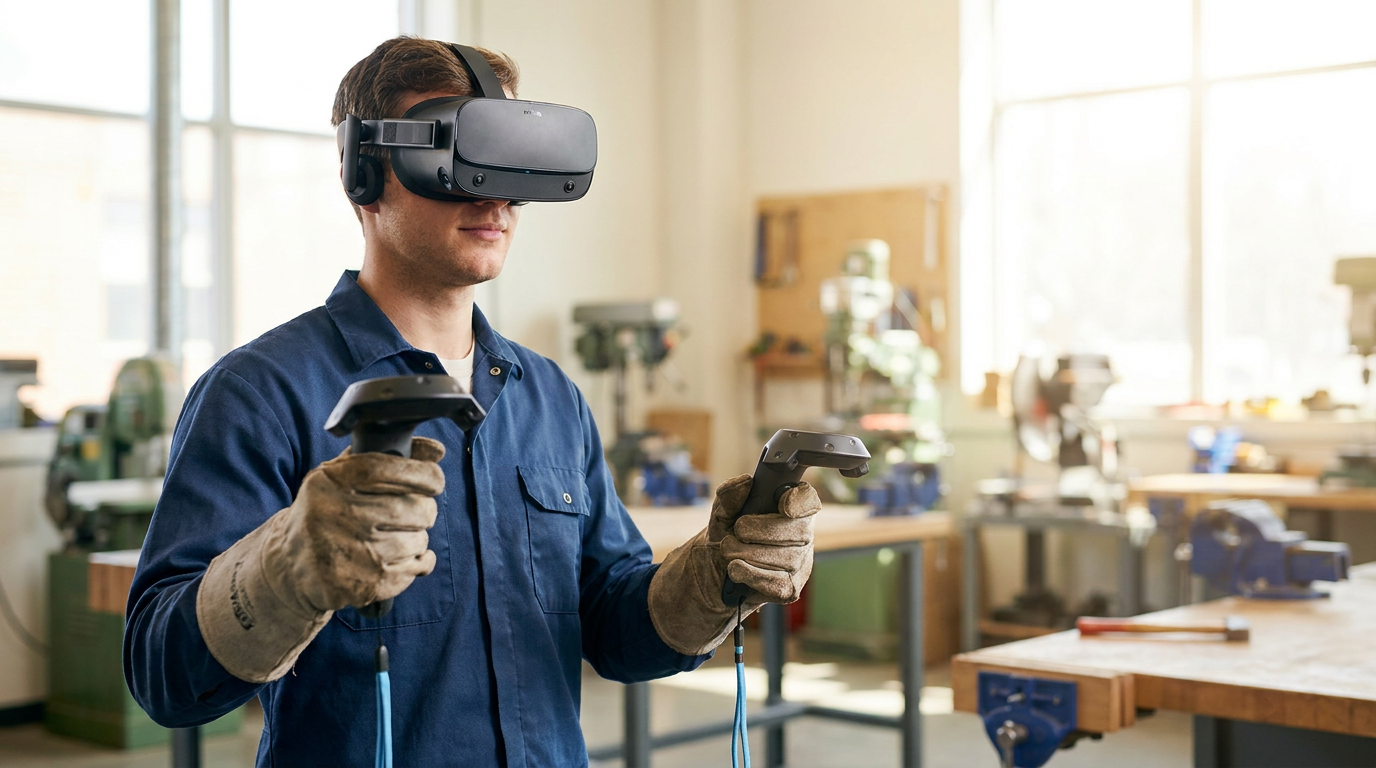
The mechanism behind this educational shift relies on Head-Mounted Displays (HMDs) paired with haptic controllers. When a student puts on the headset, the physical classroom disappears, replaced by a high-fidelity 3D simulation of a specific work environment—such as a residential basement, a commercial boiler room, or a solar array. Looking down, the student sees virtual hands wearing work gloves. As they move their physical hands, the virtual hands manipulate digital tools, allowing them to practice the exact sequence of a repair or installation.[1][4]
One of the most significant advantages of virtual training is the dramatic reduction in material costs. Traditional skilled trades education requires a constant supply of expensive consumables. Every time a student practices a weld, they burn through welding gas and metal; every time they practice plumbing, they use up copper pipe and solder. VR allows for unlimited repetition with zero material waste, enabling trade schools to stretch their budgets further while giving students more opportunities to practice without fear of wasting resources.[6]

Beyond cost, VR fundamentally alters the safety equation of vocational training. The construction and skilled trades industries consistently rank among the most dangerous professions. Learning to navigate high-voltage electrical panels, handle combustible gases, or operate heavy machinery carries inherent physical risks for beginners. Virtual reality provides a completely risk-free sandbox. If a student wires a virtual circuit incorrectly, the resulting "spark" is merely a visual and auditory cue, allowing them to learn from a catastrophic mistake without the danger of electrocution or fire.[6]
The educational efficacy of this approach is increasingly supported by rigorous academic research. A comprehensive meta-analysis published by the World Bank, which reviewed more than 90 distinct experiments, found that virtual reality training is significantly more effective than traditional methods for developing technical and practical skills. The immersiveness of the technology forces a level of focus that is difficult to achieve in a crowded, noisy physical workshop, shielding the learner from external distractions.[2]
The improvements in learning outcomes are not merely theoretical; they translate directly to certification success. In a 2022 pilot study conducted by the National Center for Construction Education and Research (NCCER), the results were striking. Participants who utilized immersive VR learning scored an average of 75% on their industry certification exams. In contrast, students who trained exclusively in traditional physical labs scored an average of 53%. Furthermore, all graduates from the VR cohort successfully secured employment in their respective fields.[5]

The improvements in learning outcomes are not merely theoretical; they translate directly to certification success.
Educators attribute this success to the rapid development of cognitive muscle memory. While a student holding a lightweight plastic controller is not experiencing the true physical weight of a pipe wrench, they are repeatedly practicing the spatial sequence of a task. The immediate feedback loop of a VR module—which can instantly highlight a skipped safety step or an incorrect measurement—allows students to correct their technique in real-time, cementing the proper procedure in their minds before they attempt it in reality.[6]
Interestingly, the benefits of VR extend beyond purely technical maneuvers. Modern vocational programs are increasingly using virtual simulations to teach the socio-emotional and soft skills required in the trades. Plumbers and HVAC technicians do not just fix machines; they interact with frustrated homeowners and coordinate with other contractors. VR scenarios now include mock customer interactions, requiring students to practice explaining complex repair issues clearly and setting accurate expectations under pressure.[2][6]
Academic literature also highlights VR's unique ability to make the invisible visible. Studies published in peer-reviewed journals note that VR is particularly effective for teaching abstract concepts that are difficult to illustrate with traditional diagrams. For example, an electrical apprentice can use VR to visually "see" the flow of an electromagnetic field or look inside an operating HVAC duct to understand the internal airflow dynamics—perspectives that are physically impossible in the real world.[3]
Despite these profound advantages, industry veterans and educators are quick to acknowledge the boundaries of the technology. Virtual reality is a powerful accelerant, but it cannot entirely replace the tactile reality of the physical trades. A simulation can teach a student the exact sequence of steps to tighten a fitting, but it cannot replicate the physical resistance of a cross-threaded bolt, the intense heat radiating from a welding torch, or the physical stamina required to work in a cramped crawlspace.[1]

Consequently, experts view VR as an effective supplemental tool rather than a total replacement for physical labs. Corporate training directors emphasize that relying solely on virtual simulations without a hands-on component remains a "pipe dream." The most successful vocational programs employ a blended approach: students use VR to master the procedural steps, safety protocols, and troubleshooting logic, and then move to a physical lab to develop the necessary physical touch and tool control.[1]
The rollout of VR in education also faces practical implementation hurdles. While the cost of headsets has decreased, outfitting an entire classroom still requires a significant upfront capital investment. More pressingly, there is a nationwide shortage of qualified instructors who are comfortable integrating digital simulations into traditional, hands-on curricula. Many veteran tradespeople who transition into teaching are unfamiliar with the technology, requiring schools to invest heavily in professional development.[1][4]
Nevertheless, as the technology matures and becomes more accessible, it is democratizing access to high-quality technical education. For students in rural or underfunded school districts that cannot afford state-of-the-art physical workshops, a VR headset offers a portal to world-class training facilities. It allows learners to explore careers they might never have considered, safely testing the waters of various trades before committing to a specific apprenticeship.[4]
Ultimately, the integration of virtual reality into vocational education represents a necessary evolution for the skilled trades. By lowering the barriers to entry, reducing the costs of training, and accelerating the learning curve, VR is helping to modernize an industry that is desperate for new talent. It ensures that the next generation of tradespeople will enter the workforce not only faster, but with a deeper, safer, and more comprehensive understanding of their vital craft.[6]
How we got here
Late 1960s
The earliest concepts of immersive virtual reality using head-mounted displays are introduced in computer science labs.
2010s
VR technology becomes commercially viable, but its use remains largely confined to gaming and high-end corporate training.
2022
Pilot studies demonstrate that immersive VR learning can significantly boost certification exam scores in the skilled trades.
2024-2025
Public school districts and community colleges begin widely integrating VR simulations into their career and technical education programs.
2026
VR becomes a standard supplemental tool to address the massive national shortage of skilled trade workers.
Viewpoints in depth
Vocational Educators
Focus on the pedagogical benefits, safety, and cost savings of VR simulations.
Educators view virtual reality as a breakthrough in instructional design. By removing the fear of physical injury and the cost of wasted materials, VR allows students to engage in 'productive failure'—making mistakes and learning from them in real-time. Academic researchers emphasize that the immersive nature of the technology blocks out classroom distractions, leading to higher engagement and better retention of complex, abstract concepts.
Industry Employers
Emphasize the need for rapid, scalable training to fill massive labor shortages, but insist on final hands-on verification.
For corporate training directors and trade associations, the primary appeal of VR is scalability. With massive backlogs of unfilled positions, employers need a way to train apprentices faster than traditional physical labs allow. However, they remain pragmatic about the technology's limits. Employers stress that while VR is excellent for teaching procedures and safety protocols, a worker is not fully job-ready until they have proven they can handle the physical tactile feedback of real tools on a real job site.
Traditional Tradespeople
Skeptical of replacing physical, tactile experience with digital simulations.
Many veteran tradespeople argue that the essence of skilled labor is physical intuition—knowing how much torque to apply to a wrench or feeling the exact temperature of a weld. They express concern that an over-reliance on virtual training might produce apprentices who know the steps intellectually but lack the physical conditioning and tactile sensitivity required for the actual work. They advocate for keeping VR strictly as a preliminary step before extensive physical apprenticeship.
What we don't know
- Whether long-term retention of physical skills is equal between VR-first learners and traditional apprentices.
- How the widespread adoption of VR will impact the licensing and certification standards set by state boards.
Key terms
- Head-Mounted Display (HMD)
- A headset or pair of goggles that presents virtual visuals directly to the eyes, tracking the user's head movements to create a sense of immersion.
- Haptic Feedback
- Technology that simulates the sense of touch by applying forces, vibrations, or motions to the user, often used in VR controllers.
- Consumables
- Materials in vocational training that are used up and must be regularly replaced, such as welding gas, copper wire, or sheet metal.
- Muscle Memory
- The ability to reproduce a particular physical movement without conscious thought, acquired as a result of frequent repetition.
Frequently asked
What is the difference between desktop VR and immersive VR?
Desktop VR displays a 3D environment on a standard computer screen, while immersive VR uses a head-mounted display to completely surround the user's vision and track their physical movements.
Can virtual reality completely replace hands-on trade training?
No. While VR is excellent for teaching procedures and safety protocols, instructors emphasize that students still need physical labs to learn the tactile feel and physical resistance of real tools.
Why is VR cheaper for vocational schools in the long run?
It drastically reduces the need to purchase consumable materials. Students can practice welding or plumbing thousands of times without wasting expensive gas, metal, or copper pipes.
Sources
Source coverage
6 outlets
3 viewpoints surfaced




[1]Facilities DiveTraditional Tradespeople
How VR is bridging the skilled trades gap
Read on Facilities Dive →[2]World BankVocational Educators
Policy Research Working Paper 9587: Virtual Reality Training in Education
Read on World Bank →[3]Taylor & FrancisVocational Educators
Virtual reality in engineering and technical education
Read on Taylor & Francis →[4]U.S. Department of EducationVocational Educators
The use of immersive virtual reality in the learning sciences
Read on U.S. Department of Education →[5]National Center for Construction Education and Research (NCCER)Industry Employers
2022 NCCER Pilot Study on Immersive VR Learning
Read on National Center for Construction Education and Research (NCCER) →[6]Factlen Editorial TeamIndustry Employers
Synthesis by Factlen editorial team
Read on Factlen Editorial Team →

Every angle. Every day.
Get education stories with full source coverage and perspective breakdowns delivered to your inbox.