
The End-to-End Revolution: How AI is Rewriting the Rules of Autonomous Driving
The autonomous vehicle industry is abandoning decades of hand-coded rules in favor of 'end-to-end' neural networks that learn to drive by observing human behavior.
By Factlen Editorial Team
- End-to-End AI Developers
- Argue that pure neural networks trained on massive data will outperform hand-coded rules.
- Hybrid & Modular Advocates
- Believe that while E2E is powerful, deterministic guardrails and modularity are required for safety and explainability.
- Academic & Market Researchers
- Focus on the quantitative trade-offs, latency, and market growth of the technology.
What's not represented
- · Traditional Automotive Software Engineers
- · Public Safety Advocates
Why this matters
The transition to end-to-end AI is fundamentally accelerating the timeline for fully autonomous vehicles. By allowing cars to learn from data rather than relying on brittle, hand-coded rules, this technology promises smoother, safer, and more adaptable transportation—while forcing regulators to rethink how they certify 'black box' AI systems for public roads.
Key points
- The autonomous vehicle industry is shifting from modular, rule-based software to end-to-end neural networks.
- Instead of relying on explicit programming, these new systems learn to drive by processing millions of hours of human driving data.
- This approach allows vehicles to generalize their learning, navigating new cities and complex environments without relying heavily on high-definition maps.
- The shift requires massive investments in hyperscale AI data centers and specialized computing hardware.
- The primary challenge remains the 'black box' problem, as end-to-end networks lack the explainability of traditional code, complicating regulatory approval.
For years, the quest to build a self-driving car resembled a massive, infinitely complex flowchart. Engineers attempted to anticipate every possible scenario a vehicle might encounter on the road, writing explicit "if-then" rules for each one. If the camera detects a red octagon, stop. If a pedestrian steps into the crosswalk, yield. But the real world is messy, unpredictable, and full of edge cases that defy rigid programming. Today, the autonomous vehicle industry is undergoing a radical architectural pivot, abandoning decades of hand-coded rules in favor of a fundamentally different approach: end-to-end neural networks.[1][5]
This transition, often referred to as the shift from "AV 1.0" to "AV 2.0," mirrors the revolution that recently transformed natural language processing. Just as large language models like ChatGPT learned to write by ingesting the internet rather than being taught the rules of grammar, modern autonomous systems are learning to drive by watching millions of hours of human driving footage.[7][8]
To understand the magnitude of this shift, one must look at the traditional "modular" software stack that has powered self-driving cars for the past decade. In a modular system, the driving task is sliced into distinct, human-engineered sub-tasks: perception, localization, prediction, and planning.[1][6]
First, a perception module identifies objects—cars, pedestrians, lane lines. Then, a localization module determines exactly where the car is on a high-definition map. Next, a prediction module guesses what the identified objects will do next. Finally, a planning module calculates the safest trajectory and sends steering and braking commands to the vehicle's control systems.[6]

While this modular approach is highly interpretable—if the car makes a mistake, engineers can check which specific module failed—it is incredibly brittle. The system relies on intermediate representations of the world, and an error in the perception module cascades through the entire pipeline. Furthermore, writing explicit C++ code for every conceivable driving scenario requires an unsustainable amount of engineering effort.[1][6]
Enter the end-to-end (E2E) neural network. In an E2E architecture, the rigid boundaries between perception, planning, and control are dissolved entirely. The system consists of a single, massive artificial neural network. The input is raw sensor data—primarily video streams from the car's cameras—and the output is direct vehicle control commands: steering angle, acceleration, and braking.[1][6]
This "photons-to-control" philosophy means the AI is not explicitly taught what a stop sign is or how to calculate a trajectory curve. Instead, it is fed petabytes of video data showing how expert human drivers react to various road conditions. Through deep learning, the neural network internalizes the relationship between the visual input and the correct physical output, developing an intuitive, human-like driving behavior.[7][8]
The most prominent validation of this approach came when Tesla fundamentally rewrote its Full Self-Driving (FSD) architecture. With the release of FSD version 12, the company deleted roughly 300,000 lines of explicit C++ control code, replacing the entire modular planning stack with an end-to-end neural network trained on video from its global fleet of millions of vehicles.[4][8]

The most prominent validation of this approach came when Tesla fundamentally rewrote its Full Self-Driving (FSD) architecture.
But the E2E revolution extends far beyond a single automaker. Wayve, a British AI startup backed by major industry players, has built its entire foundation on what it calls "Embodied AI." By eschewing high-definition maps and expensive LiDAR sensors in favor of pure vision and machine learning, Wayve has demonstrated remarkable generalization capabilities.[2][7]
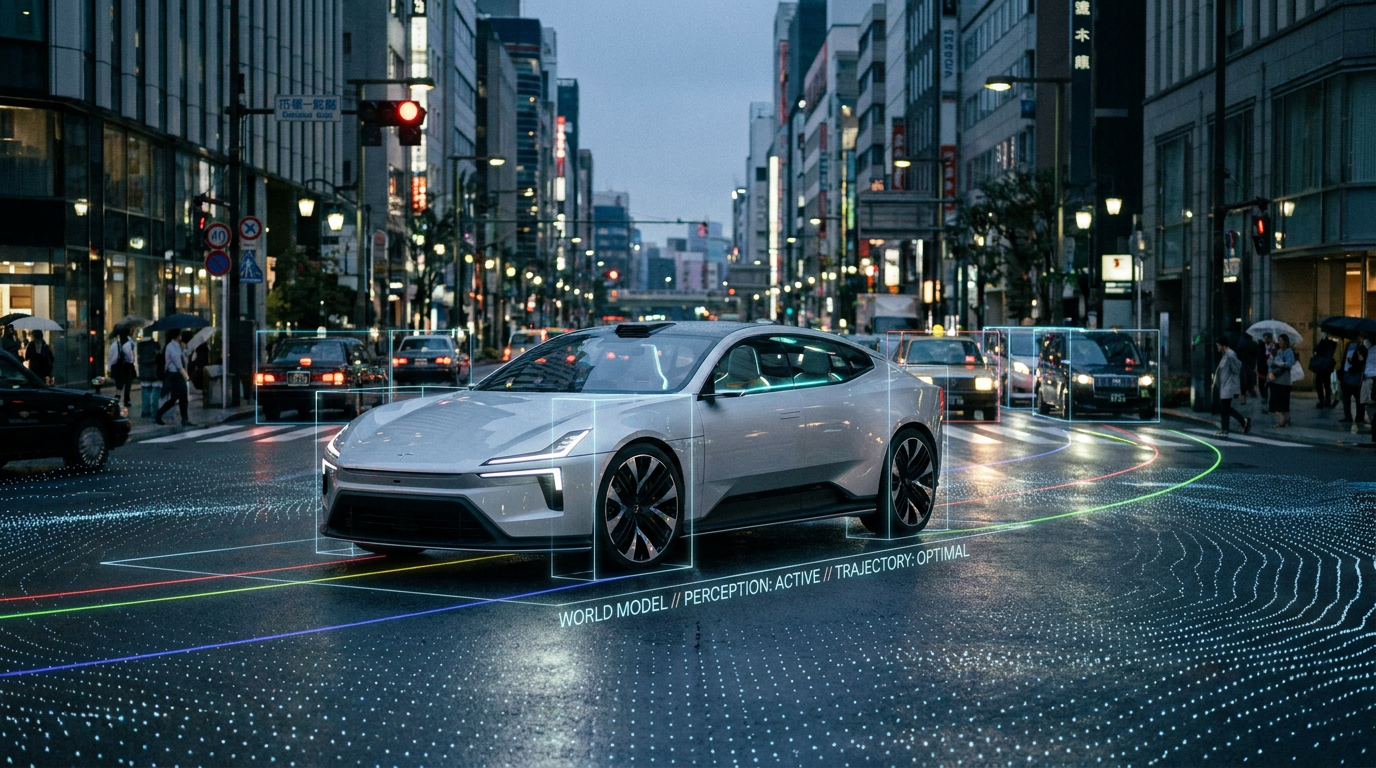
Because Wayve's foundation model learns the underlying principles of driving rather than memorizing specific routes, it can adapt to new environments with astonishing speed. The company's software has successfully navigated complex urban environments across hundreds of cities globally—including dense traffic in Tokyo and London—often in vehicles and locations the AI had never previously encountered.[2][7]
This level of generalization is achieved through the development of "world models." Advanced E2E networks don't just react to pixels; they build an internal, three-dimensional understanding of space, physics, and object permanence. They can reason about occluded vehicles, anticipate the flow of traffic, and navigate unstructured environments like construction zones where traditional map-based systems often freeze.[7][8]
However, this architectural leap introduces a massive new bottleneck: compute power. Training a single, unified neural network to drive a car requires processing immense volumes of multimodal sensor data. The economics of autonomous driving are shifting away from traditional automotive engineering and toward hyperscale AI infrastructure, demanding massive data center capacity and specialized AI silicon.[1][8]

Beyond the computational cost, the end-to-end approach faces a profound structural challenge: the "black box" dilemma. Unlike modular systems, where engineers can trace a bad decision back to a specific line of code or a failed object detection, an E2E neural network's decision-making process is deeply opaque.[1][5]
If an end-to-end system abruptly brakes or makes an unsafe swerve, it is incredibly difficult to ascertain exactly why the neural network weighted its parameters to produce that specific output. This lack of explainability complicates debugging, safety validation, and the establishment of trust with the public.[5][6]
This opacity is also a looming regulatory hurdle. Frameworks like the European Union's Artificial Intelligence Act emphasize the need for traceability and explainability in high-risk AI systems. It remains an open question whether a pure, unconstrained end-to-end neural network can meet the stringent safety certification standards required for fully driverless deployment.[5]

To bridge this gap, many industry leaders are exploring hybrid architectures. These systems utilize the powerful, generalized learning capabilities of an end-to-end neural network for the primary driving task, but wrap the AI in deterministic, rule-based guardrails. If the neural network suggests a trajectory that violates a hard-coded safety constraint—such as crossing a solid red line or accelerating toward an obstacle—the modular safeguard overrides the AI.[1][5]
The market is aggressively backing this AI-native transition. The global market for end-to-end neural network autonomous driving systems, valued at roughly $671 million in 2025, is projected to surge to $2.5 billion by 2035. This growth reflects a consensus that pure machine learning, rather than human engineering, is the key to unlocking scalable autonomy.[4]
How we got here
Pre-2023
The 'AV 1.0' era is dominated by modular architectures, requiring hundreds of thousands of lines of explicit code for perception and planning.
Late 2023
Tesla begins rolling out FSD v12, replacing its traditional C++ planning stack with an end-to-end neural network.
2024
AI startups like Wayve demonstrate the ability of 'Embodied AI' to generalize, navigating complex cities like London and Tokyo without HD maps.
2025–2026
The industry experiences a hyperscale shift, with automakers investing heavily in massive AI data centers to train end-to-end driving models.
Viewpoints in depth
End-to-End Purists
Advocates for replacing all hand-coded rules with pure machine learning.
This camp, led by AI-native startups and companies like Tesla, argues that the real world is too complex to capture in 'if-then' code. They believe that scaling neural networks with massive amounts of high-quality driving data is the only mathematical path to generalized autonomy. In their view, holding onto modular systems is a dead end that limits a vehicle's ability to handle unpredictable edge cases.
Hybrid & Safety Advocates
Proponents of combining neural networks with hard-coded safety guardrails.
While acknowledging the power of end-to-end learning, this group emphasizes the critical need for explainability and deterministic safety. If an AI makes a fatal error, regulators and engineers must be able to understand why. They advocate for architectures where a neural network handles the primary driving intuition, but a traditional, rule-based software layer acts as an unbreakable safety net to prevent catastrophic maneuvers.
What we don't know
- How regulatory bodies like the NHTSA and the EU will ultimately certify fully 'black box' end-to-end driving systems for unsupervised public use.
- Whether pure end-to-end networks can achieve a provable safety record superior to human drivers without the need for hybrid, rule-based guardrails.
- How the massive compute and energy costs required to train these models will impact the long-term profitability of autonomous fleet operators.
Key terms
- End-to-End (E2E) Neural Network
- An AI architecture that takes raw sensor data (like video) as input and directly outputs vehicle control commands (steering, braking), bypassing intermediate steps.
- Modular Architecture
- The traditional approach to autonomous driving, where the software is divided into distinct, human-engineered sub-tasks like perception, prediction, and planning.
- World Model
- An AI's internal, three-dimensional understanding of its environment, allowing it to reason about physics, space, and the future movements of objects.
- Black Box Problem
- The challenge of understanding exactly how and why a deep neural network makes a specific decision, due to its complex and opaque internal structure.
- Embodied AI
- Artificial intelligence designed to interact with and navigate the physical world, rather than just processing digital text or images.
Frequently asked
What is the difference between modular and end-to-end autonomous driving?
Modular systems use separate, human-coded programs for tasks like seeing objects and planning routes. End-to-end systems use a single AI model that learns to go directly from camera video to steering and braking.
Why are companies switching to end-to-end AI?
The real world has too many unpredictable 'edge cases' to program manually. End-to-end AI learns from massive amounts of human driving data, allowing it to handle complex, unseen situations more naturally.
Is end-to-end autonomous driving safe?
Proponents argue it is safer because it can adapt to unexpected scenarios better than brittle code. However, its 'black box' nature makes it harder for engineers to debug exactly why the AI made a mistake.
Do end-to-end systems still need maps?
Many end-to-end systems, like those developed by Wayve, are designed to be 'mapless.' They rely on real-time visual understanding rather than pre-programmed high-definition 3D maps.
Sources
Source coverage
8 outlets
3 viewpoints surfaced








[1]McKinsey & CompanyHybrid & Modular Advocates
The hyperscale shift: Why autonomous driving is becoming an AI infrastructure challenge
Read on McKinsey & Company →[2]WayveEnd-to-End AI Developers
Autonomy for any vehicle, anywhere
Read on Wayve →[3]arXivAcademic & Market Researchers
Latency-Accuracy Tradeoffs in End-to-End Autonomous Driving
Read on arXiv →[4]Global Market InsightsAcademic & Market Researchers
End-to-End Neural Network Autonomous Driving System Market
Read on Global Market Insights →[5]Edge AI VisionHybrid & Modular Advocates
Autonomous Driving Software and AI in Automotive 2026-2046
Read on Edge AI Vision →[6]ResearchGateAcademic & Market Researchers
Recent Advancements in End-to-End Autonomous Driving using Deep Learning
Read on ResearchGate →[7]Sequoia CapitalEnd-to-End AI Developers
Alex Kendall: Wayve's End-to-End AI
Read on Sequoia Capital →[8]Factlen Editorial TeamAcademic & Market Researchers
Synthesis by Factlen editorial team
Read on Factlen Editorial Team →
Every angle. Every day.
Get automotive stories with full source coverage and perspective breakdowns delivered to your inbox.