
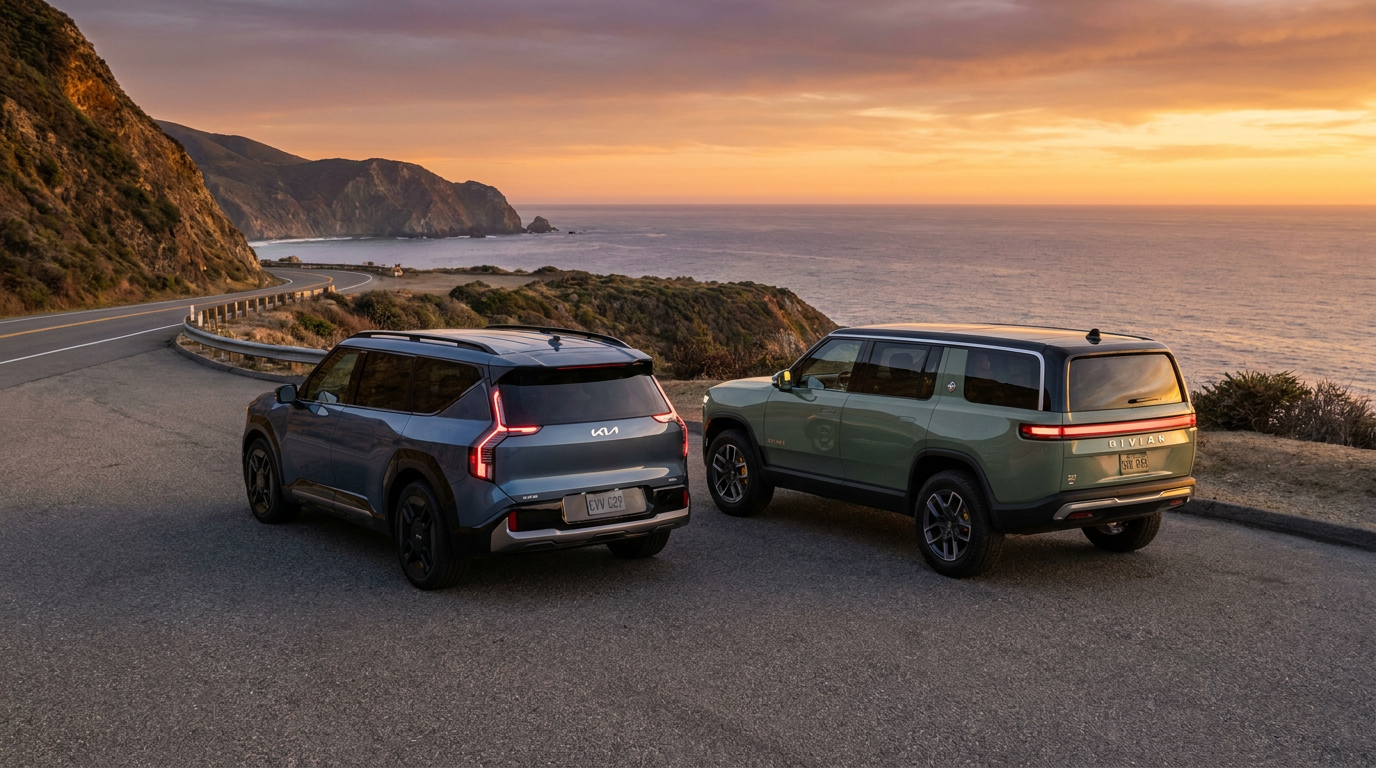
Kia EV9 vs. Rivian R1S: Choosing the Right 3-Row Electric SUV
The Kia EV9 and Rivian R1S dominate the three-row electric SUV market, but they cater to entirely different lifestyles. We break down the trade-offs between Kia's family-focused value and Rivian's rugged off-road capability.
By Factlen Editorial Team
- Pragmatic Family Haulers
- Values accessibility, daily driving comfort, fast charging, and familiar tech like Apple CarPlay.
- Adventure Seekers
- Prioritizes off-road capability, maximum ground clearance, high towing capacity, and rugged utility.
- Tech & Software Purists
- Prefers deeply integrated native software ecosystems, frequent OTA updates, and minimalist digital interfaces.
What's not represented
- · Dealership Service Technicians
- · Long-term EV Depreciation Analysts
Why this matters
For families making the leap to an electric vehicle, the three-row SUV segment has finally matured. Choosing between the EV9 and the R1S means deciding whether you want to optimize for daily commuting comfort and fast charging, or maximum range and weekend off-road adventures.
Key points
- The Kia EV9 excels in daily comfort, offering a plush ride, fast 800V charging, and a family-friendly price point.
- The Rivian R1S is a powerhouse built for adventure, featuring up to 665 horsepower, air suspension, and 7,700 lbs of towing capacity.
- Kia includes familiar tech like Apple CarPlay, while Rivian relies on a deeply integrated native software ecosystem.
- The EV9's captain's chairs make third-row access easier, but the R1S offers significantly more overall cargo volume.
For years, families looking to transition to an electric vehicle faced a frustrating bottleneck: a severe lack of spacious, three-row SUVs. That landscape has fundamentally shifted. Today, the market offers two highly capable, fully realized electric family haulers that approach the assignment from entirely different philosophies: the Kia EV9 and the Rivian R1S.[1][2]
While both vehicles offer seating for up to seven passengers and boast impressive electric range, they are engineered for different primary use cases. The Kia EV9 is a pragmatic, feature-rich innovator designed to make daily family life as seamless as possible. The Rivian R1S, fresh off its Gen 2 refresh, is an aspirational, off-road-focused adventurer built to conquer trails and carry heavy gear.[3][4]
The most immediate differentiator between the two is the cost of entry. The Kia EV9 provides a highly accessible entry point for a three-row EV, starting around $56,000. Even a fully loaded EV9 GT-Line with all-wheel drive tops out in the mid-$70,000 range. In contrast, the Rivian R1S carries a luxury premium, starting at roughly $76,000 and easily exceeding $100,000 for top-tier motor and battery configurations.[2][6]
When it comes to battery performance, buyers face a trade-off between ultimate range and charging speed. The Rivian R1S wins the distance battle. Equipped with its Max battery pack, the R1S can achieve up to 410 miles on a single charge, providing massive peace of mind for drivers venturing far from established charging networks.[3][5]
However, the Kia EV9 dominates at the charging station. Built on an advanced 800-volt electrical architecture, the EV9 can accept DC fast charging at up to 210 kW. This allows the vehicle to charge from 10% to 80% in under 25 minutes. The Rivian, utilizing a 400-volt architecture, takes roughly 40 minutes to complete the same 10% to 80% charge, making the Kia significantly more convenient for highway road trips.[2][6]

On the road, the driving dynamics reflect their distinct personalities. The EV9 handles like a refined luxury lounge. It is exceptionally quiet, smooth, and easy to maneuver in tight parking lots, earning praise as the ultimate asphalt cruiser. Its lower center of gravity and unibody construction make it feel agile despite its size.[1][4]
The Rivian R1S, meanwhile, is a powerhouse. The dual-motor performance variant delivers a staggering 665 horsepower and 829 lb-ft of torque, launching the heavy SUV from zero to 60 mph in just 3.7 seconds. While the Gen 2 suspension updates have smoothed out its ride, it still feels more utilitarian and truck-like from behind the wheel compared to the plush Kia.[1][3]
The dual-motor performance variant delivers a staggering 665 horsepower and 829 lb-ft of torque, launching the heavy SUV from zero to 60 mph in just 3.7 seconds.
Where the Rivian truly separates itself is off the pavement. The R1S features a standard adjustable air suspension that can raise the vehicle to provide 14.9 inches of ground clearance—nearly double the EV9's 7.8 inches. With a wading depth of over three feet and dedicated off-road drive modes, the Rivian is built to tackle serious terrain.[1][3]
Towing capacity further highlights the Rivian's rugged intent. The R1S is rated to tow up to 7,700 pounds, making it suitable for hauling large boats or travel trailers. The Kia EV9 maxes out at a respectable, but lower, 5,000 pounds, which is sufficient for small utility trailers and pop-up campers but falls short of heavy-duty needs.[3][4]
Inside the cabin, the Kia EV9 focuses heavily on passenger accessibility. It offers available second-row captain's chairs that slide far forward, creating a wide pass-through for third-row access. The EV9's third row is genuinely accommodating for adults, featuring dedicated USB-C ports, cup holders, and air vents.[1][6]

The Rivian R1S interior is beautifully crafted with premium materials like open-pore wood and vegan leather, but it is slightly less accommodating for large families. It relies on a second-row bench seat, making third-row access a bit tighter. However, the Rivian's boxier exterior design yields a massive 90.7 cubic feet of maximum cargo space, plus a cavernous front trunk that easily swallows a large cooler.[1][2]
Technology and infotainment present another stark philosophical divide. Kia embraces familiar connectivity, offering wireless Apple CarPlay and Android Auto as standard features, alongside physical buttons for climate control. This makes the EV9 incredibly intuitive for drivers who want their car to mirror their smartphone.[1][6]
Rivian, taking a page from Tesla's playbook, eschews Apple CarPlay entirely in favor of a proprietary, highly responsive native interface. While this requires a learning curve, Rivian's software is deeply integrated with the vehicle's hardware, offering excellent route planning for charging and receiving frequent over-the-air updates that add new features over time.[1][5]

Safety testing also reveals slight differences. The Kia EV9 achieved top marks in recent IIHS frontal crash prevention tests, outperforming the Rivian's acceptable rating in specific automatic braking scenarios. Kia's suite of driver-assistance features is highly refined for highway cruising and stop-and-go traffic.[1][2]
Ultimately, declaring a single winner is impossible without knowing the buyer's lifestyle. The Kia EV9 fits perfectly when a family needs a daily commuter that prioritizes passenger comfort, seamless smartphone integration, rapid highway charging, and exceptional value.[2][6]
Conversely, the Rivian R1S is the definitive choice when the mission involves weekend camping, heavy towing, off-road exploration, or simply the desire for sports-car acceleration in a three-row package. Both prove that the electric family SUV has not only arrived, but has splintered into highly specialized, deeply impressive machines.[2][5]
Viewpoints in depth
Pragmatic Family Haulers
Focuses on the daily realities of transporting children, running errands, and managing a household budget.
For this camp, a vehicle is a tool to make life easier. They heavily favor the Kia EV9 because it directly addresses the friction points of family travel. The inclusion of Apple CarPlay means parents don't have to relearn a navigation system, and the 800-volt charging architecture means highway pit stops with restless toddlers are kept to a strict 25-minute minimum. Furthermore, the $20,000 price gap between the EV9 and the R1S is viewed as money better spent on college funds or family vacations, rather than off-road capability that will rarely be used.
Adventure Seekers
Views the vehicle as an enabler for outdoor exploration, heavy towing, and off-grid travel.
This perspective sees the Rivian R1S not just as a car, but as a piece of premium outdoor gear. They are willing to pay the luxury premium for the R1S because it offers capabilities the EV9 simply cannot match. The 14.9 inches of air-lifted ground clearance, the 7,700-pound towing capacity, and the massive 410-mile Max battery pack are non-negotiable requirements for towing boats to remote lakes or navigating rutted mountain trails. To them, the EV9 is a great minivan alternative, but the R1S is a true utility vehicle.
Tech & Software Purists
Evaluates vehicles based on their digital architecture, compute power, and software integration.
This camp, often migrating from Tesla, views legacy automaker software as fundamentally flawed. They prefer the Rivian R1S because it operates like a smartphone on wheels. They are unbothered by the lack of Apple CarPlay because they believe a vehicle's native software should seamlessly integrate battery pre-conditioning, route planning, and climate control into one cohesive interface. They value Rivian's frequent over-the-air updates, which continually refine the vehicle's driving dynamics and add new features long after the initial purchase.
What we don't know
- How the long-term reliability of Rivian's complex air suspension will compare to Kia's traditional setup after 100,000 miles.
- Whether Rivian will eventually cave to consumer pressure and offer Apple CarPlay via a future software update.
- How the resale values of both vehicles will hold up as battery technology continues to rapidly evolve.
Key terms
- 800-volt architecture
- An advanced electrical system in an EV that allows for ultra-fast DC charging, significantly reducing the time spent at charging stations.
- Air suspension
- A vehicle suspension system powered by an electric air pump or compressor, allowing the driver to raise or lower the vehicle's ride height on demand.
- Frunk
- A portmanteau of 'front trunk,' referring to the enclosed storage space located under the hood of an electric vehicle where an engine would traditionally sit.
- Over-the-air (OTA) updates
- Software updates delivered wirelessly to a vehicle, allowing the manufacturer to improve performance, fix bugs, or add new features without a dealership visit.
Frequently asked
Which SUV charges faster on a road trip?
The Kia EV9 charges significantly faster. Thanks to its 800-volt architecture, it can charge from 10% to 80% in under 25 minutes, compared to about 40 minutes for the Rivian R1S.
Do both vehicles have Apple CarPlay and Android Auto?
No. The Kia EV9 includes wireless Apple CarPlay and Android Auto as standard. The Rivian R1S does not support either, relying instead on its own highly capable native infotainment system.
Which SUV is better for off-roading?
The Rivian R1S is the clear winner for off-roading. It features an adjustable air suspension with up to 14.9 inches of ground clearance, dedicated off-road modes, and a wading depth of over three feet.
Can adults comfortably fit in the third row?
Yes, both vehicles can accommodate adults in the third row, but the Kia EV9 offers easier access and slightly more passenger comfort thanks to its available second-row captain's chairs.
Sources
Source coverage
6 outlets
3 viewpoints surfaced






[1]EdmundsPragmatic Family Haulers
The electric three-row SUV battle you've been waiting for
Read on Edmunds →[2]Kelley Blue BookPragmatic Family Haulers
2025 Kia EV9 vs. 2025 Rivian R1S Comparison
Read on Kelley Blue Book →[3]The EV ReportAdventure Seekers
Tale of Two Titans: 2025 Rivian R1S vs. 2025 Kia EV9
Read on The EV Report →[4]InsideEVsAdventure Seekers
Kia EV9 Vs. Rivian R1S: Which 3-Row Electric SUV Is Best?
Read on InsideEVs →[5]TorqueNewsTech & Software Purists
Rivian R1S vs Kia EV9: A Tale of Two Philosophies
Read on TorqueNews →[6]Towbin KiaPragmatic Family Haulers
2026 Kia EV9 vs. Rivian R1S: Which 3-Row Electric SUV is Right for Your Family?
Read on Towbin Kia →
Every angle. Every day.
Get automotive stories with full source coverage and perspective breakdowns delivered to your inbox.