
U.S. Announces Review of Forces in Europe, Demands Shift to 'NATO 3.0'
Defense Secretary Pete Hegseth announced a six-month review of American military deployments in Europe, warning allies they must take primary responsibility for their own conventional defense.
By Factlen Editorial Team
- U.S. Defense Establishment
- Argues that Europe has become overly dependent on American security and must take primary responsibility for its own defense.
- European Allies
- Emphasizes that Europe is already rapidly increasing defense spending and taking on more command responsibilities.
- Security Analysts
- Views the review as a fundamental restructuring of the post-Cold War security order driven by the U.S. pivot to the Indo-Pacific.
What's not represented
- · Eastern European border nations facing direct Russian threats
- · European defense industry executives
Why this matters
This posture review marks a fundamental restructuring of the post-Cold War security order. If the U.S. significantly draws down its 100,000 troops in Europe, allied nations will be forced to drastically increase their own military spending and industrial production to fill the void.
Key points
- Defense Secretary Pete Hegseth announced a six-month review of the roughly 100,000 U.S. troops stationed in Europe.
- The U.S. is demanding a shift to 'NATO 3.0', requiring Europe to take primary responsibility for its own conventional defense.
- Hegseth warned that U.S. financial contributions to NATO will become contingent on allies meeting defense spending targets.
- The Pentagon heavily criticized European allies for denying U.S. forces basing and overflight access during the recent Iran conflict.
- NATO leadership noted that European allies and Canada increased defense spending by $90 billion in 2025.
- Several senior NATO command positions are being transferred from American officers to European allies.
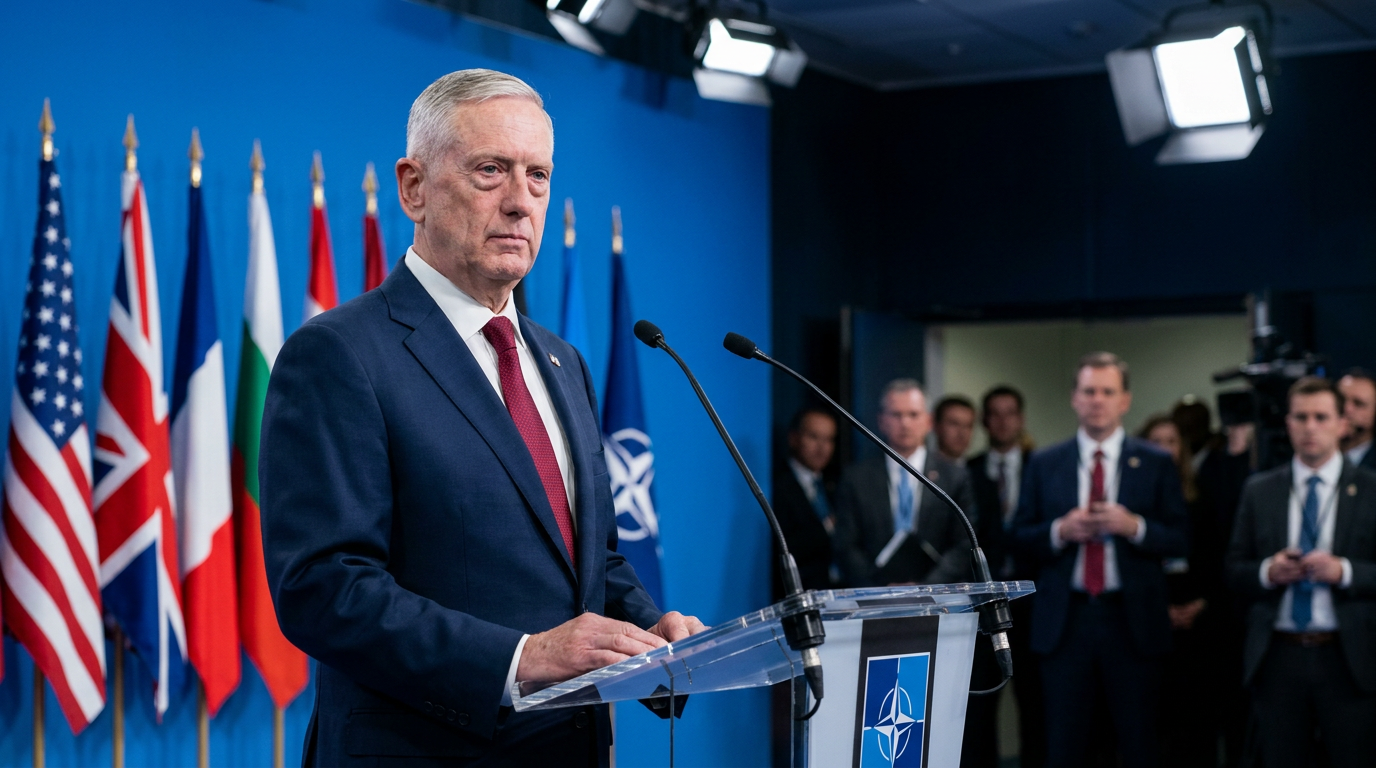
U.S. Defense Secretary Pete Hegseth delivered a stark ultimatum to European allies on Thursday, announcing a comprehensive six-month Pentagon review of American military forces stationed across the continent. Speaking at a gathering of NATO defense ministers in Brussels, Hegseth declared that the era of European dependency on American security guarantees is ending. He called for a fundamental reboot of the 32-nation bloc into "NATO 3.0," a framework that requires European nations to assume primary responsibility for their own conventional defense. The announcement marks a sharp escalation in the U.S. administration's ongoing effort to restructure the post-Cold War transatlantic security architecture, signaling that future American military deployments will be strictly conditional on allied performance and alignment with Washington's strategic priorities.[1][3]
The concept of NATO 3.0, as outlined by Hegseth, strips away the alliance's recent expansions into non-traditional security domains and refocuses entirely on hard military deterrence. Hegseth argued that the organization must return to being a "real hard-line military alliance" capable of deterring threats directly on the European continent without relying on massive American reinforcements. He sharply criticized the domestic priorities of several European capitals, asserting that instead of investing in "tanks and fighters and air defenses," allies had allowed their defense budgets to crater while focusing on "gender equity and climate change and defense austerity." This cultural and political critique underscores the administration's view that Europe has neglected its fundamental security obligations for decades, treating the U.S. military as a subsidized shield.[1][4]

A significant catalyst for the aggressive posture review stems from the recent U.S. military confrontation with Iran. Hegseth used the Brussels platform to publicly lambast European allies for their lack of cooperation during the conflict, specifically calling out nations that denied U.S. forces predictable access to European bases and overflight rights. He described the allied response as "shameful," arguing that the restrictions put American service members at unnecessary risk. This lingering resentment over the Iran conflict has clearly hardened the Pentagon's stance, transforming abstract debates over defense spending into concrete grievances about operational loyalty. For the U.S. defense establishment, the refusal of certain NATO members to facilitate American military operations outside of Europe demonstrated a fundamental imbalance in the alliance's reciprocal obligations.[3][4]
The impending six-month review of the roughly 100,000 U.S. troops currently deployed across Europe will not be a mere bureaucratic exercise. Hegseth explicitly warned that it is a test "that some countries will fail, and others will pass with flying colors." The outcome of this assessment will dictate where the United States maintains its bases, pre-positions its equipment, and conducts joint exercises. Furthermore, Hegseth indicated that U.S. financial contributions to the broader NATO budget will become entirely contingent on individual member states meeting their own defense spending targets. This transactional approach effectively weaponizes the American military footprint, using the threat of troop withdrawals and funding cuts to force compliance from capitals that have historically lagged in military investment.[2][6]
troops currently deployed across Europe will not be a mere bureaucratic exercise.
While demanding more from Europe, Hegseth emphasized that the United States is simultaneously executing a massive military buildup of its own. He touted a planned $1.5 trillion investment in the U.S. defense budget for 2027, describing it as the creation of an "arsenal of freedom" designed primarily to protect American interests while backstopping allied strength. However, this buildup is increasingly oriented away from the Atlantic. The Pentagon has repeatedly signaled that it needs to preserve its highest-end military assets—such as aircraft carriers, aerial refueling tankers, and advanced fighter squadrons—for potential conflicts in the Indo-Pacific region, particularly concerning China. By forcing Europe to take the lead in its own theater, Washington aims to free up the strategic bandwidth and resources necessary to maintain dominance in Asia.[1][7]

In response to the blistering critique, NATO leadership attempted to project unity while highlighting the tangible financial progress Europe has made over the past year. NATO Secretary-General Mark Rutte pointed out that European allies and Canada have injected "staggering amounts of money" into their militaries, spending an additional $90 billion on defense in 2025 compared to the previous year—a nearly 20% increase. Rutte and other European defense officials argue that the continent is already moving rapidly to address Washington's concerns, launching unprecedented efforts to expand their armed forces and revitalize their defense industrial bases. Despite the positive spin, alliance officials acknowledge that several member states remain on course to fall short of the baseline 2% GDP spending threshold.[5][7]
The transition toward a European-led defense model is already manifesting in structural changes within the alliance's command hierarchy. Earlier in the week, NATO announced that several senior command positions traditionally held by American officers will be transferred to European allies. The United Kingdom is slated to take over Joint Force Command Norfolk, Italy will assume leadership of Joint Force Command Naples, and the command in Brunssum, Netherlands, will rotate between Germany and Poland. While NATO stressed that the U.S. remains committed to the alliance and will retain the role of Supreme Allied Commander Europe, these command shifts represent a tangible step toward the "fairer distribution of responsibilities" that Washington is demanding.[7]

As the six-month Pentagon review commences, European capitals face a compressed timeline to prove their military value to the United States. The results of the posture assessment are expected to heavily influence the agenda for the upcoming NATO summit in July, where President Trump is anticipated to demand further concessions. European defense ministries are now scrambling to draft contingency plans, recognizing that the U.S. threat to withhold critical support assets in a crisis is no longer rhetorical. The transition to NATO 3.0 represents the most profound test of transatlantic cohesion since the alliance's founding, forcing Europe to rapidly build the independent military capacity it has deferred for generations.[1][2][5]
How we got here
June 3, 2026
The U.S. signals to allies that it will no longer guarantee the supply of certain high-end warships and aircraft in a European crisis.
June 18, 2026
Defense Secretary Pete Hegseth announces the six-month review of U.S. forces and demands a transition to 'NATO 3.0' in Brussels.
July 2026
NATO leaders are scheduled to meet for a major summit with President Trump to discuss defense spending and alliance restructuring.
Viewpoints in depth
The U.S. Administration's View
Washington argues that Europe must stop relying on American forces and take primary responsibility for its own conventional defense.
The Pentagon's push for 'NATO 3.0' is rooted in a belief that the post-Cold War security arrangement has allowed European nations to underfund their militaries while relying on the U.S. as a subsidized shield. U.S. defense officials argue that Washington can no longer afford to serve as the primary guarantor of European security while simultaneously preparing for potential high-end conflicts in the Indo-Pacific. By threatening to withdraw troops and withhold funding from allies who fail the posture review, the administration aims to force a rapid revitalization of Europe's defense industrial base.
European Allies' View
European capitals emphasize their recent massive increases in defense spending while warning against fracturing the alliance.
European leaders point to the $90 billion surge in defense spending in 2025 as proof that they are already answering Washington's call for greater burden-sharing. While acknowledging the need to take on more command responsibilities, allied defense ministries are deeply concerned by the transactional nature of the U.S. posture review. They argue that publicly threatening to abandon allies or condition NATO dues on specific spending targets undermines the core deterrence value of the alliance, potentially emboldening adversaries who might perceive fractures in transatlantic unity.
Strategic Analysts' View
Defense experts view the posture review as a permanent structural shift rather than just a negotiating tactic.
Military analysts note that the U.S. pivot away from Europe is driven by long-term structural realities, not just political rhetoric. The Pentagon's decision to withhold certain high-end naval and aviation assets from European defense plans reflects a genuine scarcity of resources needed to counter China in Asia. Analysts suggest that regardless of how much money Europe spends, the era of massive, permanent American troop presence on the continent is ending, forcing NATO to transition into an alliance where the U.S. acts primarily as an offshore balancer rather than a frontline defender.
What we don't know
- Exactly which European countries are currently failing the Pentagon's internal metrics for the posture review.
- How many of the 100,000 U.S. troops currently in Europe might be withdrawn or relocated after the six-month review concludes.
- Whether the U.S. will formally alter its Article 5 commitments if certain allies refuse to meet the new spending demands.
Key terms
- NATO 3.0
- A framework proposed by the U.S. requiring the alliance to return to its roots as a hard-line military deterrent led primarily by European conventional forces.
- Force Posture Review
- A comprehensive military assessment that determines where troops, bases, and equipment should be deployed globally to meet strategic objectives.
- Joint Force Command
- A major NATO military headquarters responsible for planning and executing operations within a specific geographic region.
Frequently asked
What is NATO 3.0?
NATO 3.0 is a concept introduced by the U.S. Defense Secretary to describe a restructured alliance focused strictly on hard military power, where European nations take primary responsibility for their own conventional defense.
Why is the U.S. reviewing its troop deployments?
The Pentagon wants to ensure forces are positioned efficiently, reward allies who meet spending targets, and free up high-end military resources for potential conflicts in the Indo-Pacific region.
How did the Iran conflict affect this decision?
U.S. officials expressed deep frustration that some European allies denied American forces basing and overflight access during the recent conflict with Iran, viewing it as a failure of reciprocal loyalty.
Is Europe increasing its defense spending?
Yes. According to NATO leadership, European allies and Canada spent an additional $90 billion on defense in 2025, representing a nearly 20% increase over the previous year.
Sources
Source coverage
7 outlets
3 viewpoints surfaced







[1]AP NewsU.S. Defense Establishment
Hegseth calls for Europe to take lead in revamping NATO
Read on AP News →[2]The GuardianSecurity Analysts
Hegseth says some Nato countries 'will fail' US posture review
Read on The Guardian →[3]NPRU.S. Defense Establishment
Hegseth announces in Brussels a review of U.S. forces in Europe, and a 'NATO 3.0'
Read on NPR →[4]ReutersSecurity Analysts
Hegseth announces review of US forces in Europe, slams NATO allies
Read on Reuters →[5]The Straits TimesEuropean Allies
US Defence Secretary Pete Hegseth hails NATO progress but says some must 'do more'
Read on The Straits Times →[6]Navy TimesU.S. Defense Establishment
Hegseth says force posture review will include US troop levels in Europe
Read on Navy Times →[7]Belga News AgencyEuropean Allies
Washington welcomes European efforts for 'NATO 3.0'
Read on Belga News Agency →

More in news politics
See all 5 stories →Digital Literacy
How 'Prebunking' is Acting as a Psychological Vaccine Against Online Misinformation
8 sources

Energy Markets
U.S. Gas Prices Fall Below $4 as Washington Navigates the New Iran Deal
7 sources

Russia-Ukraine War
Ukraine Launches Largest Drone Strike on Moscow Since War Began, Hitting Refinery and Halting Flights
8 sources

Every angle. Every day.
Get news politics stories with full source coverage and perspective breakdowns delivered to your inbox.