
How AI and Polymer Tech Are Rewriting the Physics of Snowmaking to Save Skiing
Faced with shrinking winters, the $20 billion ski industry is deploying artificial intelligence, polymer additives, and gravity-fed reservoirs to produce snow at higher temperatures while slashing energy use.
By Factlen Editorial Team
- Climate-Adaptive Resort Operators
- Focus on technological innovation to preserve the winter sports economy.
- Environmental Skeptics
- Argue that artificial snowmaking is a maladaptation that ignores the root cause of emissions.
- Winter Sports Traditionalists
- Concerned about the changing nature of the sport and the reliance on engineered environments.
What's not represented
- · Local mountain town residents
- · Lower-income skiers priced out of mega-resorts
Why this matters
Winter sports generate billions in economic activity for mountain communities worldwide. If these technological adaptations succeed, they provide a blueprint for how weather-dependent industries can survive climate change without exacerbating the carbon emissions that cause it.
Key points
- Climate change threatens to shrink US ski seasons by up to 62 days by 2050, forcing resorts to adapt.
- AI-driven snowmaking systems monitor wet-bulb temperatures to identify micro-windows of cold, cutting energy use by up to 70%.
- Polymer additives alter water's structure, allowing resorts to manufacture snow at ambient temperatures up to 36°F (+2°C).
- Major operators have formed a global alliance to share decarbonization strategies and transition to fully renewable energy.
The $20 billion winter sports industry is staring down an existential clock. Across the globe, rising temperatures and erratic weather patterns are steadily eroding the foundation of alpine skiing. In the United States alone, the average ski season has already shrunk by five to seven days over the past few decades. Climate models project that under high-emission scenarios, resorts could lose up to 62 operating days annually by the 2050s. For an industry entirely dependent on a frozen landscape, these numbers represent a looming economic catastrophe.[1][5]
Historically, the industry's primary defense against dry winters was brute force. Traditional snowmaking relies on pumping millions of gallons of water up a mountain and blasting it through high-pressure air compressors into the freezing night sky. This process is notoriously resource-intensive, often accounting for up to 67% of a resort's total energy consumption. As the climate crisis accelerates, relying on fossil-fuel-powered grids to manufacture snow has been increasingly criticized as a maladaptation—a short-term fix that actively worsens the long-term warming problem.[1][2]
But the physics and economics of snowmaking are undergoing a radical, technology-driven transformation. Faced with the prospect that half of all lower-altitude ski areas could become economically unviable by mid-century, resort operators are rewriting the playbook. By integrating artificial intelligence, advanced polymer chemistry, and gravity-fed infrastructure, the industry is attempting to decouple snow production from massive carbon emissions. The goal is no longer just to make snow, but to make it with surgical precision.[8]
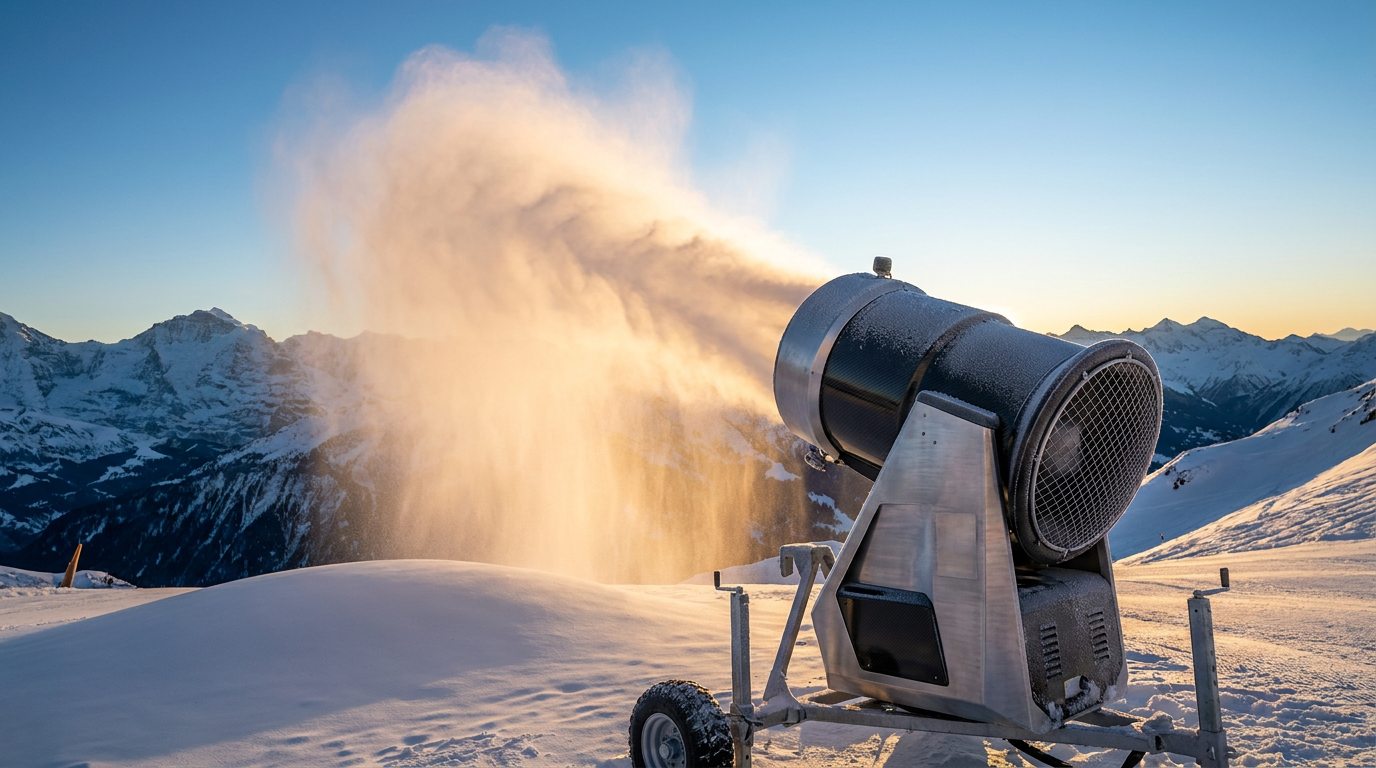
The vanguard of this shift is AI-driven automation. In the past, snowmaking required crews to manually monitor thermometers and physically open valves across miles of steep terrain. Today, modern systems rely on dense networks of atmospheric sensors that continuously feed data into machine-learning algorithms. These systems monitor the "wet-bulb temperature"—a crucial metric that combines ambient heat with humidity. Because dry air evaporates moisture and cools the surrounding droplets, snow can actually be manufactured at ambient temperatures slightly above freezing if the humidity is low enough.[3][7]

AI platforms, such as TechnoAlpin's ATASSpro, process these micro-fluctuations in real time. Instead of reacting to a cold front after it arrives, the software uses predictive modeling to identify brief, optimal windows for snow production days in advance. When the wet-bulb temperature drops to the exact optimal threshold, the system automatically fires up specific snow lances across the mountain, adjusting water pressure and airflow second by second. When the window closes, the system shuts down instantly, ensuring that not a single kilowatt of energy is wasted.[7]
The operational results of this automation are staggering. At Super-Besse in central France and Mountain Creek in New Jersey, operators have reported slashing their snowmaking energy consumption by up to 70% while simultaneously doubling their snow output. By exploiting tiny windows of optimal cold that manual crews would have missed, these resorts are laying down thicker bases using a fraction of the electricity. In Finnish Lapland, the Levi Ski Resort now operates 335 fully automated guns that continuously adjust to the Arctic microclimate, maximizing yield per gallon of water.[3][8]
Beyond software, the actual chemistry of the water is being optimized. Companies like Advanced Snow Technologies have introduced proprietary polymer-based additives that fundamentally alter how water droplets freeze. Added to the resort's water supply at a microscopic concentration of just six parts per million, these polymers create a structure that accelerates nucleation—the process by which water turns into an ice crystal.[8]
Beyond software, the actual chemistry of the water is being optimized.
This chemical tweak effectively bends the temperature rules of snowmaking. By accelerating nucleation, the additives allow resorts to produce reliable, dense snow at ambient temperatures as high as 36°F (+2°C). For resorts operating on the margins of freezing, this technology can extend the ski season by one to two weeks, providing a critical buffer against warm spells without requiring resorts to replace their existing snow cannons.[8]

Infrastructure is also being redesigned to work with gravity rather than against it. Pumping water thousands of vertical feet up a mountain requires massive amounts of electricity. To circumvent this, forward-thinking resorts are building high-altitude reservoirs to capture and store water at the top of the mountain.[6]
At Corviglia-St. Moritz in the Swiss Alps, engineers recently constructed the Nair Pitschen reservoir, capable of holding 300,000 cubic meters of water. Because the water is already at the summit, the resort's snow cannons can be entirely gravity-fed. This eliminates the need for energy-hungry valley pumps, saving the resort approximately one gigawatt-hour of electricity annually—roughly 10% of its total power usage.[6]
When it is simply too warm to make snow, some resorts are opting to save it instead. The practice of "snow farming" involves harvesting massive mounds of snow at the end of the winter season and covering them with thick, insulating geotextile blankets. The snow sits dormant through the heat of summer, protected from the sun and rain.[8]
In Levi, Finland, snow farming has become a cornerstone of the resort's climate strategy. The resort stores roughly 200,000 cubic meters of snow over the summer, experiencing a melt loss of only 13%. When autumn arrives, groomers spread the preserved snow back onto the slopes, guaranteeing an October opening and securing the terrain needed to host early-season World Cup races, regardless of what the current weather dictates.[8]

Recognizing that climate survival requires collective action, the industry is beginning to pool its resources. Resorts like LAAX in Switzerland have already transitioned to powering all their snow cannons and lifts entirely with renewable energy. Building on these individual successes, eight of the world's largest ski operators formed the Global Sustainability Ski Alliance (GSSA) in 2025. Representing over 800 ski lifts, the coalition shares proprietary data on decarbonization and snowmaking efficiency to accelerate the industry's path to net-zero emissions.[4][8]
Despite these technological leaps, the laws of physics remain absolute. If the air is too warm and too humid, no amount of artificial intelligence or polymer additives can freeze water. Researchers caution that while these innovations buy the industry crucial time, they are not a panacea for unchecked global warming. Lower-altitude resorts that cannot afford multi-million-dollar infrastructure upgrades will likely continue to face existential pressure.[2][5]
Furthermore, environmental advocates point out a glaring blind spot in the industry's sustainability narrative: the skiers themselves. While resorts are aggressively cutting their operational emissions, the carbon footprint of a ski holiday is overwhelmingly dominated by travel. Studies indicate that up to 80% of a ski trip's emissions come from tourists flying or driving to the mountains. A resort running on 100% renewable energy and AI snowmaking still relies on a heavily carbon-intensive transportation network to deliver its customers.[2]

Ultimately, the future of skiing will look vastly different from its past. The romantic era of relying entirely on natural blizzards is giving way to a highly engineered, data-driven reality. By transforming snowmaking from a brute-force energy drain into a precise, sustainable science, the industry is proving that it can adapt to a warming world. The question is no longer whether technology can save the ski season, but whether global emissions can be curbed fast enough to give that technology a fighting chance.[8]
How we got here
1980s
Ski resorts begin widely adopting traditional air-and-water snow cannons to guarantee early-season openings.
2010s
The industry shifts toward more efficient fan guns, reducing the massive energy footprint of compressed air systems.
2020
French ski areas collectively commit to achieving carbon neutrality by 2037, spurring investment in sustainable operations.
2024
Climate models project that US ski seasons could shrink by up to 62 days by 2050 under high-emission scenarios.
2025
Eight major global operators launch the Global Sustainability Ski Alliance (GSSA) to share decarbonization technology.
2026
AI-driven snowmaking and polymer additives become baseline expectations for major resorts seeking to survive marginal temperatures.
Viewpoints in depth
Climate-Adaptive Resort Operators
Focus on technological innovation to preserve the winter sports economy.
This camp argues that skiing can survive a warming world through aggressive decarbonization and hyper-efficient technology. By investing in AI snowmaking, gravity-fed reservoirs, and renewable energy, they believe resorts can maintain reliable snow cover without exacerbating climate change, protecting the economic lifeblood of mountain communities.
Environmental Skeptics
Argue that artificial snowmaking is a maladaptation that ignores the root cause of emissions.
Researchers and environmental advocates caution that pumping water and compressing air to make snow is inherently energy-intensive. They point out that even with efficiency gains, snowmaking in marginal temperatures requires vast resources. Furthermore, they argue that focusing on resort operations ignores the massive carbon footprint of skiers flying or driving to the mountains, which accounts for the lion's share of the sport's emissions.
Winter Sports Traditionalists
Concerned about the changing nature of the sport and the reliance on engineered environments.
This perspective mourns the loss of natural powder and the shift toward heavily engineered, icy artificial snow. They worry that as skiing becomes increasingly dependent on expensive technology, the sport will become even more exclusive, pushing out smaller, lower-altitude ski hills that cannot afford multi-million-dollar AI snowmaking systems.
What we don't know
- Whether smaller, independent ski hills will be able to afford the multi-million-dollar capital investments required for AI snowmaking and high-altitude reservoirs.
- How the industry will address the massive carbon footprint of skier travel, which accounts for up to 80% of a typical ski holiday's emissions.
Key terms
- Wet-bulb temperature
- A metric combining air temperature and humidity, crucial for snowmaking because dry air allows water to freeze at higher ambient temperatures.
- Snow farming
- The practice of piling snow at the end of winter and covering it with insulating blankets to preserve it through the summer for the next season.
- Nucleation
- The process by which water droplets form ice crystals around a particle, which is essential for creating artificial snow.
- Maladaptation
- An adaptation to climate change that inadvertently increases vulnerability or contributes to further greenhouse gas emissions.
Frequently asked
Can ski resorts make snow if it is above freezing?
Yes, but it depends on humidity. If the air is very dry, the 'wet-bulb temperature' can remain below freezing even if the ambient temperature is slightly above 32°F (0°C). New polymer additives are also pushing this threshold up to 36°F (+2°C).
Does artificial snowmaking waste water?
Snowmaking requires millions of gallons of water, but it is largely non-consumptive. About 80% of the water used eventually melts and returns to the local watershed, though it can alter the timing of spring runoff.
Are all ski resorts adopting this technology?
No. The high capital cost of AI systems and automated infrastructure means that well-funded, high-altitude mega-resorts are adapting quickly, while smaller, lower-altitude hills often struggle to afford the upgrades.
Sources
Source coverage
8 outlets
3 viewpoints surfaced








[1]EESIEnvironmental Skeptics
On Thin Ice: Rethinking the Future of Winter Sports in a Changing Climate
Read on EESI →[2]High Country NewsEnvironmental Skeptics
Snowmaking could be the future of skiing. But at what cost?
Read on High Country News →[3]The GuardianEnvironmental Skeptics
Greener snowmaking is helping ski resorts tackle climate change
Read on The Guardian →[4]ForbesClimate-Adaptive Resort Operators
Inside 5 Sustainability-Focused European Ski Resorts
Read on Forbes →[5]TrellisClimate-Adaptive Resort Operators
How ski resorts are preparing for a future with much less snow
Read on Trellis →[6]SnowBrainsClimate-Adaptive Resort Operators
Innovations & Improvements in Snowmaking Systems Across the Globe Improve Sustainability
Read on SnowBrains →[7]TechnoAlpinClimate-Adaptive Resort Operators
Sustainable snowmaking with ATASSpro
Read on TechnoAlpin →[8]Factlen Editorial TeamWinter Sports Traditionalists
Synthesis by Factlen editorial team
Read on Factlen Editorial Team →



Every angle. Every day.
Get sports stories with full source coverage and perspective breakdowns delivered to your inbox.