
The Science of Spin: How Physics and High-Tech Equipment Made Table Tennis the Fastest Sport on Earth
Modern table tennis relies on the Magnus effect and advanced carbon-fiber equipment to generate ball speeds exceeding 70 km/h and spin rates over 9,000 RPM. As the sport evolves, the arms race between tensor rubbers, synthetic blades, and ITTF regulations continues to reshape the game.
By Factlen Editorial Team
- Equipment Innovators
- Manufacturers prioritize the development of advanced materials to maximize mechanical advantage.
- Regulatory Body
- The governing body focuses on maintaining fairness, health, and the fundamental nature of the sport.
- Sports Science Analysts
- Physicists and analysts view the sport as a masterclass in applied fluid dynamics and energy transfer.
What's not represented
- · Amateur recreational players
- · Defensive 'chopper' style players
Why this matters
Understanding the physics and equipment behind table tennis transforms it from a simple recreational game into a showcase of extreme human reaction and materials science. For players and fans, knowing how spin and carbon technology work is essential for mastering the modern sport.
Key points
- Modern table tennis relies heavily on the Magnus effect, where spinning the ball creates aerodynamic pressure differentials that alter its flight path.
- Professional players can generate over 9,000 revolutions per minute (RPM) on a topspin shot, causing the ball to dip sharply and accelerate.
- The 2008 ban on toxic "speed glues" led to the invention of tensor rubbers, which feature built-in mechanical tension to maximize the catapult effect.
- Elite blades incorporate aerospace-grade synthetic fibers like Arylate-Carbon (ALC) and Zylon-Carbon (ZLC) to increase the racket's sweet spot and raw speed.
- The ITTF strictly enforces a 4.0mm maximum thickness limit for rubber and sponge to combat the illegal use of chemical boosters.
Table tennis is often perceived as a basement pastime, but at the professional level, it is a high-speed physics experiment. With the ball traveling at speeds up to 70 km/h across a 2.74-meter table, players have less than half a second to react. To control the ball at these extreme velocities, the modern game relies entirely on the manipulation of rotational physics and advanced materials science.[2][8]
The core mechanism governing table tennis is the Magnus effect, an aerodynamic phenomenon that occurs when a spinning object moves through a fluid. As the celluloid or plastic ball rotates in the air, it drags a boundary layer of air along with it. This creates a pressure differential: air accelerates on one side of the ball, causing pressure to drop, while decelerating on the opposite side, causing pressure to rise.[1][4]
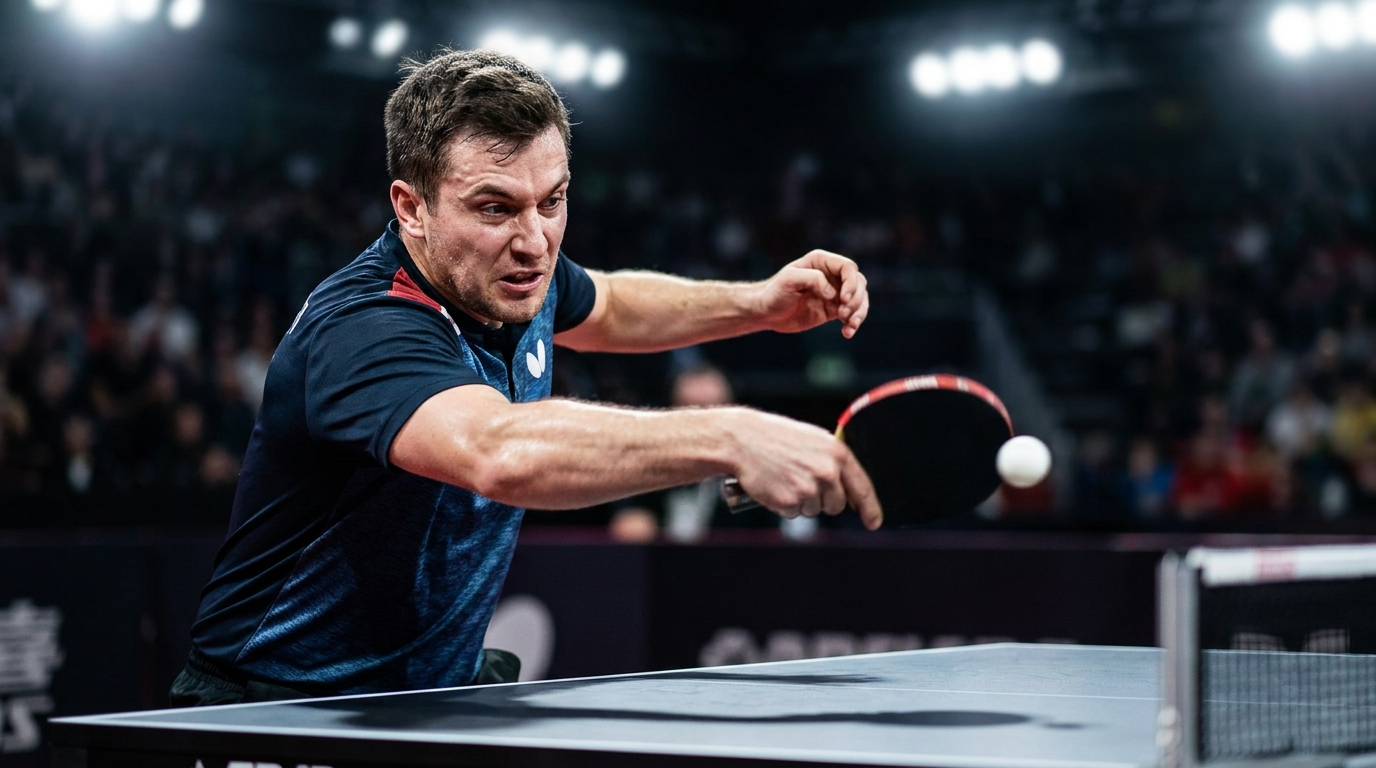
Players exploit this pressure differential to bend the ball's trajectory. When a player executes a "topspin" shot—brushing the top of the ball with a closed racket angle—the forward rotation creates a downward aerodynamic force. This causes the ball to dip sharply over the net and accelerate upon bouncing, allowing players to hit the ball with immense power without it flying off the table.[1][4]

Conversely, "backspin" is generated by slicing underneath the ball. The backward rotation creates an upward lift force that counteracts gravity, causing the ball to float longer in the air and skid low upon bouncing. The rotational forces involved are staggering: professional players can generate between 5,000 and 9,000 revolutions per minute (RPM) on a topspin loop, transforming the 2.7-gram ball into a highly volatile projectile.[1][8]
Generating 9,000 RPM requires more than just human biomechanics; it requires highly engineered equipment. The sport's first major technological leap occurred in the 1950s with the introduction of the sponge racket, which placed a layer of cellular foam underneath a pimpled rubber surface. This sponge allowed the ball to sink into the racket, increasing "dwell time"—the fraction of a second the ball remains in contact with the paddle—which is essential for imparting heavy spin.[3][8]

For decades, players artificially enhanced this effect using "speed glue," a volatile organic compound (VOC) adhesive that expanded the sponge's pores, creating a massive trampoline effect. However, citing severe health risks associated with inhaling VOC fumes, the International Table Tennis Federation (ITTF) implemented a strict ban on speed glues in 2008.[3][7]
However, citing severe health risks associated with inhaling VOC fumes, the International Table Tennis Federation (ITTF) implemented a strict ban on speed glues in 2008.
The speed glue ban forced equipment manufacturers to innovate, leading to the era of "tensor rubbers". Tensor technology involves stretching the rubber topsheet and placing it under high tension before permanently bonding it to the underlying sponge. This built-in tension mimics the catapult effect of speed glue, allowing players to generate explosive speed and spin without relying on toxic chemicals.[3][8]
Beneath the rubber lies the blade, which has undergone its own high-tech revolution. While ITTF rules mandate that a blade must be at least 85% natural wood by thickness, the remaining 15% can consist of synthetic materials like carbon fiber, glass fiber, or compressed paper. Today, almost all elite players use composite blades reinforced with advanced synthetic weaves.[3][6]
The two most prominent synthetic fibers in modern table tennis are Arylate-Carbon (ALC) and Zylon-Carbon (ZLC). ALC blades weave carbon with arylate, a material that dampens vibration. This provides a balance of raw speed and a softer "touch," increasing dwell time and making it the preferred choice for players who rely on heavy, controlled topspin.[5][6]
Zylon-Carbon (ZLC), on the other hand, utilizes a polymer that is stiffer than steel and 1.6 times stronger than ALC. ZLC blades offer the highest reaction property available, resulting in a shorter ball contact time and explosive, direct speed. However, this extreme stiffness makes ZLC blades less forgiving, requiring pristine stroke mechanics to control the rebound.[5]

Despite the advancements in tensor rubbers and carbon blades, an underground arms race persists in the form of "boosters". Boosters are chemical oils applied to the sponge to artificially expand it, essentially acting as a modern, non-VOC equivalent to speed glue. While explicitly banned by the ITTF because they alter the rubber's factory-approved properties, boosters remain highly controversial because they are notoriously difficult to detect.[7]
To combat illegal boosting, the ITTF has stepped up its regulatory enforcement. The federation strictly enforces a rule that the total thickness of the rubber and sponge cannot exceed 4.0 millimeters. Because boosters cause the sponge to swell, heavily boosted rubbers often fail this thickness test. The ITTF has recently introduced post-match racket inspections using highly sensitive electronic devices to detect chemical tampering, ensuring a level playing field.[7]

As table tennis continues to evolve, the interplay between physics, equipment, and regulation remains the sport's defining narrative. Every rally is a complex collision of kinetic energy, elastic deformation, and fluid dynamics. For the players at the table, mastering the science of spin is the only way to survive the fastest sport on earth.[2][8]
How we got here
1902
Rubber is first applied to the wooden racket surface, allowing players to generate spin.
1950s
The sponge racket is introduced, dramatically increasing the potential for speed and spin.
2008
The ITTF officially bans VOC speed glues due to severe respiratory health concerns.
2009
Manufacturers introduce "tensor" rubbers with built-in tension to replace the catapult effect of speed glue.
2019
The ITTF implements stricter testing protocols to combat the illegal use of chemical boosters.
Viewpoints in depth
Equipment Innovators
Manufacturers prioritize the development of advanced materials to maximize mechanical advantage.
Brands like Butterfly and ESN continuously push the boundaries of materials science to give players an edge. By weaving aerospace-grade synthetic fibers like Zylon into wooden blades and engineering high-tension topsheets, they aim to replicate the explosive power of the banned speed-glue era. Their focus is on maximizing the coefficient of restitution and optimizing the friction of the rubber surface, treating the racket as a highly tuned engine for generating kinetic energy.
The ITTF Regulators
The governing body focuses on maintaining fairness, health, and the fundamental nature of the sport.
The International Table Tennis Federation views unregulated equipment as an existential threat to the sport's integrity. Their primary concern is preventing the game from becoming entirely dictated by technology rather than athletic skill. By enforcing the 4.0mm maximum thickness rule and deploying advanced electronic sensors to detect illegal chemical boosters, the ITTF attempts to cap the maximum speed and spin achievable, while also protecting players from the toxic fumes associated with volatile organic compounds.
Sports Science Analysts
Physicists and analysts view the sport as a masterclass in applied fluid dynamics and energy transfer.
From an analytical perspective, table tennis is a real-time demonstration of the Magnus effect and collision physics. Analysts focus on how the micro-texture of the rubber interacts with the celluloid or plastic ball to generate up to 9,000 RPM. They study the exact angles of incidence and reflection, noting that the sport requires players to perform complex subconscious calculus, adjusting their paddle angles by mere fractions of a degree to compensate for incoming aerodynamic forces.
What we don't know
- It remains unclear if the ITTF's new post-match electronic testing devices will completely eliminate the underground use of chemical boosters among elite players.
- As materials science advances, it is unknown whether the ITTF will eventually need to impose stricter limits on the carbon and synthetic fiber content of blades to keep ball speeds manageable.
Key terms
- Magnus effect
- An aerodynamic force that alters the trajectory of a spinning object moving through a fluid.
- Topspin
- Forward rotation of the ball that creates a downward aerodynamic force, causing the ball to dip sharply.
- Dwell time
- The fraction of a second the ball remains in contact with the racket's rubber and sponge during a stroke.
- Tensor rubber
- A modern table tennis rubber where the topsheet is stretched under high tension before being glued to the sponge, creating a catapult effect.
- Arylate-Carbon (ALC)
- A synthetic composite material woven into blades that provides high speed while dampening vibration for better control.
- Booster
- A banned chemical oil applied to the sponge of a rubber to artificially expand it and increase speed and spin.
Frequently asked
Why do table tennis balls curve in the air?
Spinning balls experience the Magnus effect, an aerodynamic phenomenon where air pressure differences cause the ball's trajectory to bend up, down, or sideways.
What is the difference between ALC and ZLC blades?
ALC (Arylate-Carbon) blades dampen vibration for better control and spin, while ZLC (Zylon-Carbon) blades are stiffer and faster, offering explosive power but less forgiveness.
Why did the ITTF ban speed glue?
Speed glue was banned in 2008 because the volatile organic compounds (VOCs) used in the adhesive posed severe respiratory health risks to players.
Are players allowed to chemically treat their rackets?
No. The ITTF strictly prohibits the use of "boosters" or any chemical treatments that alter the factory properties of the rubber, though enforcement remains a challenge.
Sources
Source coverage
8 outlets
3 viewpoints surfaced







[1]Topspin11Equipment Innovators
Understanding Spin in Table Tennis: Physics, Technique, and Equipment
Read on Topspin11 →[2]MediumSports Science Analysts
The Physics of Table Tennis
Read on Medium →[3]WikipediaSports Science Analysts
Table tennis rubber
Read on Wikipedia →Magnus effect
Read on Wikipedia →[5]ButterflyEquipment Innovators
ZLC Blades — Zylon-Carbon
Read on Butterfly →[6]Butterfly Table TennisEquipment Innovators
ALC blades comparison by coach Truong Tu
Read on Butterfly Table Tennis →[7]International Table Tennis FederationRegulatory Body
ITTF steps up measures against boostering
Read on International Table Tennis Federation →[8]Factlen Editorial TeamSports Science Analysts
Synthesis by Factlen editorial team
Read on Factlen Editorial Team →



Every angle. Every day.
Get sports stories with full source coverage and perspective breakdowns delivered to your inbox.