
The Trillion-Dollar AI Datacenter Boom: How Hyperscalers Are Rewiring the Cloud
As AI workloads push traditional servers past their physical limits, a massive global infrastructure shift is replacing air-cooled racks with liquid-cooled, gigawatt-scale superfactories.
By Factlen Editorial Team
- Hyperscalers & Cloud Providers
- Tech giants view massive infrastructure investments as the necessary foundation for AI dominance.
- Infrastructure Investors
- Financial institutions see data centers as the most lucrative real estate asset class of the decade.
- Sustainability Advocates
- Environmental groups and grid operators warn of the severe ecological toll of gigawatt-scale computing.
- Enterprise IT Leaders
- Corporate technology officers are focused on securing high-density colocation space to run their AI models.
What's not represented
- · Local communities living near gigawatt-scale data centers
- · Traditional non-AI enterprise software vendors
Why this matters
The physical infrastructure of the internet is being rebuilt from the ground up. For enterprises and consumers, this trillion-dollar buildout determines the speed, cost, and capability of the next generation of AI tools.
Key points
- Hyperscalers are projected to spend roughly $1 trillion on AI infrastructure, fundamentally reshaping the global cloud.
- Modern AI racks draw over 120 kW of power, far exceeding the 25-30 kW physical limit of traditional air cooling.
- Liquid cooling is rapidly becoming the industry standard, projected to be used in 76% of AI servers by late 2026.
- Data center operators are securing land and power globally, highlighted by AirTrunk's $30 billion expansion in India.
- The massive energy demands of AI campuses have prompted the U.S. to invoke the Defense Production Act for grid infrastructure.
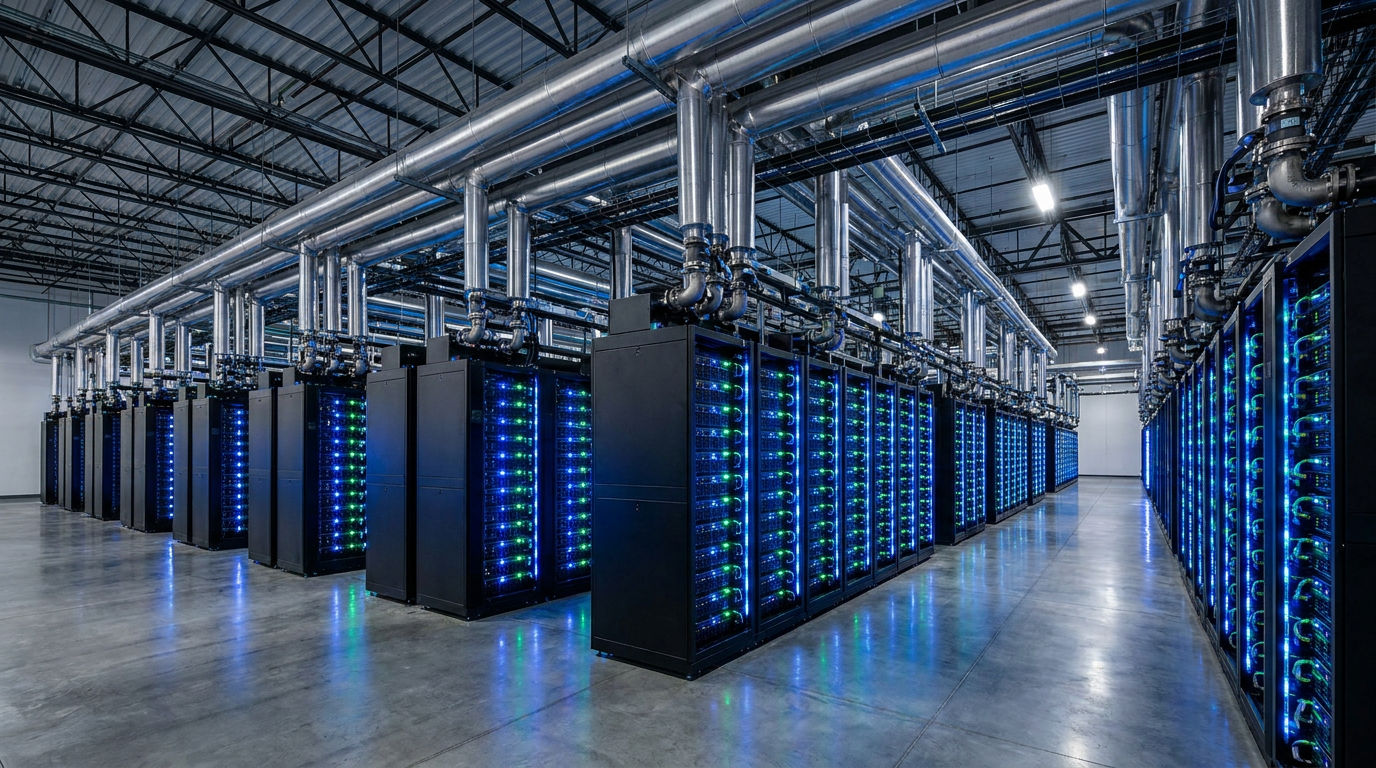
The cloud is often described as an invisible, ethereal network, but its physical reality is made of concrete, steel, and electricity. For the past decade, the infrastructure powering the internet was relatively predictable, built around standard enterprise workloads and steady storage needs. But the generative artificial intelligence boom has shattered that equilibrium, forcing the industry to rethink how data centers are built, powered, and cooled.
Training and running large language models requires a fundamentally different kind of computing power. AI workloads do not just ask servers to retrieve information; they force thousands of specialized processors to perform trillions of simultaneous calculations. This relentless computational intensity is triggering the largest infrastructure buildout in the history of technology, transforming the cloud from a network of quiet server rooms into a grid of heavy industrial engines.
The financial scale of this shift is staggering. Major cloud providers—known as hyperscalers—are projected to spend roughly $1 trillion over the next year on AI datacenters and the supply chain that supports them. In 2025 alone, collective spending on AI infrastructure reached estimated highs of up to $580 billion, as tech giants raced to secure the physical footprint required for the next generation of digital tools.[1][5]
At the heart of this transformation is a metric known as rack density. A decade ago, data center engineers designed facilities to handle server racks pulling 10 to 20 kilowatts (kW) of power. Today, a single rack packed with modern AI accelerators, such as Nvidia's GB200 NVL72, can draw 120 to 130 kW. Industry analysts at Deloitte project that next-generation AI racks could reach an astonishing 370 kW by the end of 2026.[6][8]

This unprecedented power draw has created a severe physical bottleneck: heat. Traditional data centers rely on massive air conditioning units pushing cold air across server racks. But air cooling hits a physical wall at around 25 to 30 kW per rack. Above that threshold, air simply cannot absorb and carry away heat fast enough to prevent the multi-million-dollar chips from melting or throttling their performance.[8]
The solution lies in basic physics. Water has a thermal conductivity roughly 23 times higher than air, making it vastly superior at capturing and moving heat. Consequently, the "air versus liquid" debate has ended. Liquid cooling is no longer a niche technology for supercomputers; it is the mandatory foundation for the AI era, allowing operators to cram vastly more compute power into the same physical footprint.[8]
The adoption curve is steep and accelerating. According to forecasts from Goldman Sachs, the proportion of AI servers utilizing liquid cooling is expected to jump from 15 percent in 2024 to 76 percent by the end of 2026. Facilities are rapidly retrofitting existing floors or building entirely new architectures to support the plumbing required for these advanced thermal systems.[7]

Facilities are rapidly retrofitting existing floors or building entirely new architectures to support the plumbing required for these advanced thermal systems.
The most common approach is Direct-to-Chip (D2C) cooling, where thermally conductive cold plates replace traditional heat sinks. A sealed network of micro-tubes circulates coolant directly over the hottest components. In more extreme setups, entire servers are submerged in non-conductive engineered fluids—a method known as immersion cooling—which guarantees near-perfect heat capture and eliminates the need for internal server fans entirely.
This infrastructure boom is not confined to Silicon Valley; it is a global land grab. Data center operators backed by massive institutional capital are securing land and power rights across the world. Blackstone-backed AirTrunk, for example, is currently negotiating a $3 billion loan to fund a massive new hyperscale project in Sydney, Australia, as part of a debt-fueled expansion across the Asia-Pacific region.[2]
AirTrunk's ambitions highlight the sheer scale of the international buildout. In June 2026, the company announced a historic $30 billion investment to develop 5 gigawatts of new data center capacity across India by 2030. This follows an $8 billion commitment to expand its footprint in Japan, demonstrating how critical the Asian market has become to the global AI supply chain.[3][4]
In the United States, hyperscalers are constructing bespoke "superfactories" that resemble small cities. Amazon Web Services recently activated Project Rainier in Indiana, an $11 billion campus spanning 1,200 acres. Microsoft is advancing its Fairwater AI data center in Wisconsin, a $7.7 billion facility designed to house hundreds of thousands of GPUs in a unified supercluster.[5]

These gigawatt-scale campuses bring a new, daunting challenge: finding enough electricity to turn them on. Power availability now outweighs fiber-optic connectivity as the primary factor in data center site selection. Global data center electricity consumption is projected to more than double by 2030, placing immense strain on regional utility grids and forcing operators to co-locate near massive power generation sources.
The energy bottleneck has become so severe that it is now a matter of national policy. In April 2026, the U.S. government invoked the Defense Production Act to designate large-scale grid infrastructure as essential to national defense. This move authorizes emergency federal financing to expand the domestic supply of transformers, switchgear, and transmission lines needed to power the AI boom without destabilizing public grids.[9]
To mitigate their environmental impact, operators are pushing the boundaries of thermal efficiency. New hardware platforms now support "warm-water" liquid cooling, operating at supply temperatures of 45°C (113°F). This allows facilities to reject heat using ambient outside air rather than energy-hungry mechanical chillers, drastically reducing the facility's overall power overhead and expanding the geographic regions where these data centers can be built.[8]

For enterprise IT leaders, this physical rewiring of the cloud dictates the pace of corporate AI adoption. Companies are realizing that deploying advanced AI models requires migrating to these specialized, high-density facilities. The colocation space capable of supporting liquid-cooled, 100-kW racks is being leased faster than it can be built, creating a premium market for AI-ready infrastructure.
The cloud of 2026 looks fundamentally different from the cloud of 2020. It has evolved from rows of humming, air-chilled servers into a network of liquid-cooled, gigawatt-scale industrial engines. As hyperscalers continue to pour trillions into this physical foundation, they are not just building data centers—they are constructing the heavy machinery of the twenty-first-century economy.
How we got here
Early 2024
The generative AI boom triggers a surge in GPU demand, exposing the thermal limits of traditional air-cooled data centers.
2025
Hyperscalers invest an estimated $320–$580 billion into new AI infrastructure and gigawatt-scale campuses.
January 2026
The liquid cooling market crosses a critical threshold, with major hardware vendors standardizing warm-water cooling platforms.
April 2026
The U.S. government invokes the Defense Production Act to accelerate the manufacturing of large-scale grid infrastructure.
June 2026
Blackstone-backed AirTrunk announces a massive $30 billion expansion in India, highlighting the global race for AI capacity.
Viewpoints in depth
Hyperscalers & Cloud Providers
Tech giants view massive infrastructure investments as the necessary foundation for AI dominance.
For companies like Amazon, Microsoft, and Google, the gigawatt-scale data center is the new moat. They argue that the sheer capital expenditure required to build liquid-cooled, high-density facilities naturally limits competition to a few well-resourced players. Their primary focus is on securing land, power, and cooling supply chains years in advance to ensure their AI models are never bottlenecked by physical hardware constraints.
Infrastructure Investors
Financial institutions see data centers as the most lucrative real estate asset class of the decade.
Private equity firms and institutional investors view the AI boom as a generational wealth-creation event. Firms like Blackstone are pouring tens of billions into operators like AirTrunk, betting that the insatiable demand for compute will guarantee long-term, high-margin leases. They are particularly focused on the 'picks and shovels' of the AI gold rush—funding the companies that manufacture cooling systems, transformers, and power distribution units.
Sustainability Advocates
Environmental groups and grid operators warn of the severe ecological toll of gigawatt-scale computing.
While acknowledging the efficiency gains of liquid cooling, sustainability advocates point out that absolute energy and water consumption are still skyrocketing. They argue that the projected doubling of global data center electricity use by 2030 threatens to derail climate goals and destabilize local power grids. This camp pushes for stricter regulations on Water Usage Effectiveness (WUE) and mandates that hyperscalers fund net-new renewable energy projects rather than draining existing municipal grids.
What we don't know
- Whether global utility grids can scale fast enough to meet the projected doubling of data center electricity demand by 2030.
- How the long-term environmental impact of water-intensive cooling systems will be regulated across different countries.
Key terms
- Rack Density
- The amount of electrical power consumed, and heat generated, by a single cabinet of server equipment, measured in kilowatts (kW).
- Liquid Cooling
- A thermal management technique that uses a liquid coolant, rather than air, to remove heat from computer hardware.
- Immersion Cooling
- An advanced cooling method where entire servers are submerged in a thermally conductive, electrically non-conductive engineered fluid.
- Power Usage Effectiveness (PUE)
- A metric used to determine how energy-efficient a data center is, calculated by dividing the total facility power by the IT equipment power.
Frequently asked
What is a hyperscaler?
A hyperscaler is a massive cloud service provider—such as Amazon Web Services, Microsoft Azure, or Google Cloud—capable of providing computing and storage services at a global, industrial scale.
Why do AI data centers need liquid cooling?
Modern AI chips generate far more heat than traditional processors. Air cooling hits a physical limit around 30 kW per rack, whereas liquid cooling can efficiently absorb and remove the heat from racks pulling over 100 kW.
How much power does an AI data center use?
Next-generation AI data centers are reaching 'gigawatt' scale. A single 1-gigawatt campus consumes roughly the same amount of electricity as a medium-sized city.
What is Direct-to-Chip (D2C) cooling?
D2C is a thermal management method where cold plates are attached directly to the hottest components, like GPUs. A liquid coolant circulates through micro-tubes to absorb the heat at its source.
Sources
Source coverage
9 outlets
4 viewpoints surfaced








[1]BloombergInfrastructure Investors
Plurimi CIO Sees Value in AI Supply Chain
Read on Bloomberg →Blackstone’s AirTrunk Seeks $3 Billion Loan for Sydney Project
Read on Bloomberg →[3]ForbesInfrastructure Investors
Blackstone-Backed AirTrunk Earmarks $8 Billion To Expand Data Center Footprint In Japan
Read on Forbes →[4]Outlook BusinessEnterprise IT Leaders
Blackstone-backed AirTrunk Bets $30 Bn on India Data Centre Boom by 2030
Read on Outlook Business →[5]CloudInfra BlogHyperscalers & Cloud Providers
The 2025 Boom: Key Players and Massive Builds
Read on CloudInfra Blog →[6]DCNT GlobalHyperscalers & Cloud Providers
The Future of Data Centers in 2026
Read on DCNT Global →[7]Lombard OdierSustainability Advocates
AI supercharges the race for liquid cooling solutions: what's in store for 2026?
Read on Lombard Odier →[8]NasscomEnterprise IT Leaders
Liquid Cooled Data Centers: The 2026 Standard
Read on Nasscom →[9]Bessemer Venture PartnersInfrastructure Investors
Roadmap: The AI data center stack
Read on Bessemer Venture Partners →


Every angle. Every day.
Get technology stories with full source coverage and perspective breakdowns delivered to your inbox.