
New Construction vs. Existing Homes: The 2026 Buyer's Guide
With existing home prices surpassing new builds for the first time in decades, buyers face a radically altered real estate landscape. This side-by-side analysis breaks down the true costs, trade-offs, and long-term evidence for both paths.
By Factlen Editorial Team
- New Construction Advocates
- Argue that modern energy efficiency, builder warranties, and rate buydowns make new builds the superior long-term financial choice.
- Resale Market Traditionalists
- Emphasize the irreplaceable value of mature neighborhoods, architectural character, and the negotiating flexibility of existing homes.
- Macroeconomic Analysts
- Focus on the historical anomaly of the price inversion and the broader impact of locked-in mortgage rates on housing supply.
What's not represented
- · First-time homebuyers priced out of both markets
- · Local municipal planners managing suburban sprawl
- · Independent contractors and renovation specialists
Why this matters
For the first time in modern history, buying a brand-new home is often cheaper upfront than buying a used one. Understanding the hidden long-term costs of both options is essential to avoiding massive financial mistakes and finding a home that actually fits your lifestyle.
Key points
- For the fourth consecutive quarter in early 2026, the median price of an existing home exceeded that of a newly built home.
- New construction offers significant financial predictability through 1-2-10 builder warranties and 15 to 30 percent savings on monthly utility bills.
- Existing homes provide irreplaceable value through mature neighborhoods, established school districts, and greater contractual flexibility during negotiations.
- The choice ultimately depends on whether a buyer prioritizes the fixed monthly costs of a new build or the immediate context and location of an older home.
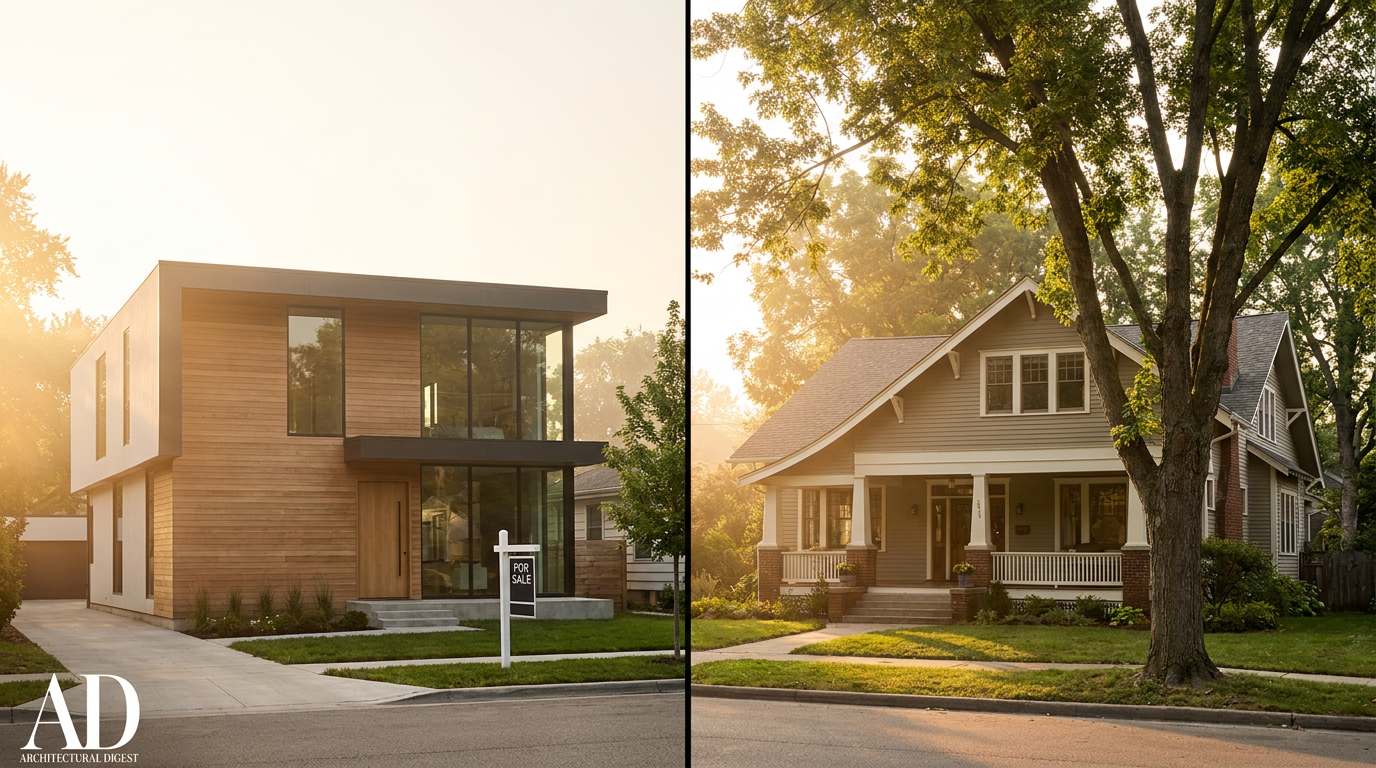
For decades, the real estate market operated on a simple rule: brand-new homes commanded a premium, while older, lived-in houses offered a discount. But in 2026, that fundamental dynamic has flipped, creating an unprecedented window of opportunity for homebuyers. A combination of aggressive builder incentives, shifting supply chains, and a frozen resale market has rewritten the math of homeownership. Buyers stepping into the market today are no longer just choosing between fresh paint and historic charm; they are navigating a landscape where the traditional cost assumptions are entirely backward, making the side-by-side comparison between new construction and existing homes more critical than ever.[3][5]
The evidence of this market inversion is stark. According to first-quarter data from the National Association of Home Builders and the U.S. Census Bureau, the median price of a new single-family home dropped to $403,200. In contrast, the median price of an existing home climbed to $404,600. This marks the fourth consecutive quarter where used homes actually cost more than new ones—a historical anomaly that has only happened a handful of times in modern real estate. For the first time in a generation, buyers are essentially paying a premium for someone else’s lived-in space, while builders are offering never-occupied homes for less money.[3]
This pricing paradox is driven by two colliding forces. On the resale side, millions of homeowners secured ultra-low mortgage rates during the pandemic and are now hesitant to sell, creating a severe inventory shortage that artificially inflates the prices of existing homes. On the new construction side, builders are sitting on burgeoning inventories and have deployed massive financial incentives to move them. From permanent mortgage rate buydowns to waived lot premiums and covered closing costs, corporate builders are leveraging their in-house financing arms to manufacture affordability in ways that individual sellers simply cannot match.[4][5][8]

When evaluating the case for new construction, the strongest argument centers on financial predictability and peace of mind. A newly built home operates as a blank slate with zero deferred maintenance. Buyers benefit from the standard 1-2-10 warranty structure—one year for workmanship, two years for mechanical systems, and ten years for structural defects. This comprehensive coverage means that for the first decade of ownership, the catastrophic out-of-pocket expenses that typically haunt first-time buyers, such as a failing foundation or a cracked heat exchanger, are effectively neutralized.[1][7]
The case for new construction is further bolstered by massive leaps in energy efficiency and modern design. Homes built to 2026 codes feature tight building envelopes, advanced insulation, low-E windows, and high-efficiency HVAC systems that older properties simply cannot compete with. Industry data indicates that these modern standards can reduce monthly utility bills by 15 to 30 percent compared to a similarly sized home built before 2010. Furthermore, the floor plans reflect how people actually live today, offering open-concept living spaces, dedicated home offices, and primary suites with expansive storage, eliminating the need for costly renovations.[1][2][7]
However, the case against new construction often comes down to context, location constraints, and hidden premiums. Because land near city centers is scarce and expensive, new developments are frequently pushed to the suburban fringes, resulting in longer commutes and car-dependent lifestyles. Buyers must also contend with the reality of living in an active construction zone for years, enduring noise, dust, and heavy machinery. Additionally, the base price on the billboard rarely reflects the final cost; lot premiums, design center upgrades, and mandatory homeowner association fees can quickly inflate the purchase price far beyond the initial estimate.[6][7]
The evidence supporting these new-build trade-offs is found in the total cost of ownership over the first five years. While the upfront maintenance costs are near zero, buyers often face a delayed financial shock when property taxes are reassessed. A buyer might receive an initial tax estimate based on the value of the unimproved dirt, only to see their escrow payments skyrocket once the local municipality assesses the fully completed structure. When factoring in higher special assessment taxes and the premium paid for custom finishes, the monthly carrying cost of a new build can sometimes eclipse that of an older home, despite the lower initial purchase price.[6]

The evidence supporting these new-build trade-offs is found in the total cost of ownership over the first five years.
Shifting to the case for existing homes, the primary advantage is the established environment and immediate context. You cannot manufacture a mature neighborhood. Existing homes offer towering, decades-old trees, settled landscaping, known traffic patterns, and a genuine sense of community that new developments may take a generation to cultivate. For buyers who value walkability, proximity to urban centers, and established school attendance zones, the resale market is often the only viable path. You can see exactly how the neighborhood feels on a Tuesday afternoon, removing the guesswork of a master-planned community that exists only on a blueprint.[1][6][7]
The case for existing homes also highlights architectural character and negotiation flexibility. Older properties frequently feature craftsmanship and materials that are prohibitively expensive to replicate today, such as original hardwood floors, solid core doors, plaster walls, and intricate millwork. Furthermore, the transaction process is entirely different. When buying from an individual seller, everything is negotiable. Buyers can request price reductions, ask for repair credits after an inspection, or negotiate a flexible closing date. Corporate builders, bound by strict margin requirements and standardized contracts, rarely offer this level of contractual flexibility.[1][6]
Conversely, the case against existing homes hinges almost entirely on deferred maintenance and the risk of catastrophic system failures. When you buy a used home, you are inheriting the previous owner’s DIY mistakes, aging infrastructure, and hidden wear and tear. Even the most thorough home inspection cannot predict exactly when a fifteen-year-old HVAC system will fail or when a cast-iron plumbing stack will finally crack. In a market where existing homes are already commanding a price premium, the prospect of immediately sinking tens of thousands of dollars into unglamorous repairs is a daunting reality for many buyers.[1][7]
The evidence here is stark when buyers calculate the true, long-term cost of ownership. A 1995 resale home might look like a better value on a price-per-square-foot basis, but that math quickly deteriorates when factoring in a $15,000 roof replacement, an $8,000 furnace upgrade, and the ongoing premium of higher monthly utility bills due to poor insulation. The debate over new versus old is rarely about the aesthetics of the house; it is a mathematical comparison between predictable, amortized costs and the sudden, out-of-pocket expenses of deferred maintenance.[2][6][7]

When placing these options in a side-by-side comparison, buyers must weigh customization against context. A new build allows you to choose your lot, your elevation, and your finishes, ensuring you start with the exact home you want rather than adapting to someone else’s choices. However, an existing home provides a known quantity. You can inspect the actual structure you are buying, assess the health of the neighborhood, and move in within thirty days. New construction timelines are notoriously fluid, often delayed by supply chain hiccups, labor shortages, and weather, requiring buyers to have highly flexible living arrangements.[2][6]
Financing complexity also plays a major role in this side-by-side analysis. Purchasing an existing home is a straightforward process: you secure a single mortgage, close the deal, and get the keys. New construction, particularly if you are building custom rather than buying an inventory home, can involve complex construction-to-permanent loans, higher down payment requirements, and the stress of managing draw schedules. Even when buying a spec home from a corporate builder, buyers are often heavily pressured to use the builder’s affiliated lender to unlock the advertised incentives, which can limit their ability to shop for the best overall loan terms.[2][6]
Ultimately, new construction fits well when buyers prioritize predictable monthly costs, value energy efficiency, and desire modern layouts without the hassle of renovation. It is the ideal path for those who want the peace of mind that comes with comprehensive warranties and brand-new mechanical systems. It also fits well for buyers who have flexible move-in timelines and can capitalize on the aggressive mortgage rate buydowns currently offered by builders. If your primary goal is to lock in a fixed cost of living for the next decade with zero weekend repair projects, the new home market is highly attractive.[1][2][8]
However, new construction does not fit well when buyers are strictly bound to a specific urban location, require immediate occupancy, or want to avoid the ongoing noise and dust of a developing subdivision. It is also a poor fit for buyers who chafe at strict homeowner association rules or who want the architectural uniqueness that only comes from historic properties. If you cannot stomach the idea of a fluctuating completion date or the hidden costs of design center upgrades, the new build process will likely be a source of immense frustration.[6][7]

Conversely, an existing home fits well when buyers prioritize location, mature communities, and the charm of established architecture. It is the best choice for those who need to move quickly, want the flexibility to negotiate directly with a human seller, and prefer a neighborhood with a proven track record. Existing homes do not fit well when buyers have depleted their savings on the down payment and lack an emergency fund for sudden repairs. If the thought of replacing a water heater or upgrading outdated electrical panels induces panic, the predictability of a new build is likely the wiser investment.[2][6]
How we got here
2020–2021
Mortgage rates hit historic lows, allowing millions of homeowners to lock in cheap financing.
2022–2023
Interest rates rise sharply, creating a 'lock-in effect' that freezes the resale market inventory.
Mid-2024
The median price of existing homes surpasses new construction for the first time in recent history.
Early 2026
The price inversion continues into its fourth consecutive quarter as builders aggressively use incentives to attract buyers.
Viewpoints in depth
New Construction Advocates
Argue that modern energy efficiency, builder warranties, and rate buydowns make new builds the superior long-term financial choice.
Proponents of new construction emphasize that the true cost of a home extends far beyond the purchase price. By factoring in the 15 to 30 percent savings on monthly utility bills and the elimination of major repair costs during the first decade of ownership, they argue that new builds offer unparalleled financial predictability. Furthermore, they point out that corporate builders are currently the only entities in the market capable of offering massive mortgage rate buydowns, effectively manufacturing affordability in a high-interest-rate environment.
Resale Market Traditionalists
Emphasize the irreplaceable value of mature neighborhoods, architectural character, and the negotiating flexibility of existing homes.
Advocates for the existing home market argue that real estate is fundamentally about location and context, two things that new construction cannot instantly provide. They highlight that older homes are often situated in established, walkable neighborhoods with mature tree canopies and proven school districts. Additionally, they stress that individual sellers offer a level of contractual flexibility—such as price reductions and repair credits—that corporate builders rarely entertain, allowing savvy buyers to negotiate better overall terms.
Macroeconomic Analysts
Focus on the historical anomaly of the price inversion and the broader impact of locked-in mortgage rates on housing supply.
Financial analysts view the current market dynamic as a structural anomaly driven by the 'lock-in effect.' Because millions of homeowners secured mortgage rates below four percent prior to 2022, they are financially disincentivized to sell, artificially choking the supply of existing homes and driving up their median price. Analysts argue that until the gap between current mortgage rates and these historical lows narrows, the unusual phenomenon of new homes pricing below existing homes will likely persist, fundamentally altering buyer behavior.
What we don't know
- How long the pricing inversion between new and existing homes will last if mortgage rates begin to drop significantly.
- Whether local municipalities will increase property tax assessment rates to offset the growing infrastructure costs of new suburban developments.
- The long-term resale value of 2026 new builds compared to historic homes once the current inventory shortage normalizes.
Key terms
- Rate Buydown
- A financing incentive where a builder or seller pays an upfront fee to lower the buyer's mortgage interest rate for the first few years or the life of the loan.
- Deferred Maintenance
- Necessary home repairs or upgrades that previous owners have postponed, which the new buyer will eventually have to pay for.
- Lot Premium
- An additional fee charged by a builder for a more desirable piece of land within a subdivision, such as a corner lot or one backing up to a forest.
- Escrow Reassessment
- The process where a local municipality updates a property's tax value after construction is completed, often leading to a sudden increase in the homeowner's monthly payment.
Frequently asked
Why are existing homes currently more expensive than new builds?
A severe lack of inventory has driven up the price of existing homes, as current owners with low mortgage rates are hesitant to sell. Meanwhile, builders have increased supply and are using price cuts and incentives to move their new inventory.
What is a 1-2-10 builder warranty?
It is a standard warranty structure for new construction that covers workmanship for one year, mechanical systems like plumbing and electrical for two years, and major structural defects for ten years.
Do new construction homes save money on utilities?
Yes, modern building codes require better insulation, high-efficiency HVAC systems, and low-E windows, which can reduce monthly utility bills by 15 to 30 percent compared to older homes.
Can I negotiate the price of a new construction home?
While builders are less likely to drop the base price of a home, they are currently very willing to negotiate by offering incentives like covering closing costs, providing free upgrades, or buying down your mortgage rate.
Sources
Source coverage
8 outlets
3 viewpoints surfaced








[1]ZillowNew Construction Advocates
New Construction vs Existing Homes: The Pros and Cons of Both
Read on Zillow →[2]AmeriSaveMacroeconomic Analysts
Buying a House in 2026: 7 Essential Cost Comparisons
Read on AmeriSave →[3]National Association of Home BuildersNew Construction Advocates
New Home Prices vs Existing Home Prices in Q1 2026
Read on National Association of Home Builders →[4]National Association of RealtorsMacroeconomic Analysts
A Q&A on construction trends, builder incentives and affordability
Read on National Association of Realtors →[5]Seeking AlphaMacroeconomic Analysts
U.S. Economy: 4 Reasons Housing Is Toast In 2026
Read on Seeking Alpha →[6]Foxes Sell FasterResale Market Traditionalists
New Construction vs Existing Homes in 2026: Which One Actually Saves You More Money Long Term?
Read on Foxes Sell Faster →[7]Own Luxury HomesResale Market Traditionalists
New Construction vs Existing Home: The Side-by-Side for 2026
Read on Own Luxury Homes →[8]Pacific Keys RealtyNew Construction Advocates
New Construction Prices Are Moving Lower
Read on Pacific Keys Realty →
Every angle. Every day.
Get real estate stories with full source coverage and perspective breakdowns delivered to your inbox.