
Why Induction Stoves Are Dominating Kitchen Remodeling in 2026
Driven by breakthroughs in battery technology and mounting health data, induction cooktops are rapidly replacing gas ranges as the new standard in home renovation.
By Factlen Editorial Team
- Homeowners and Remodelers
- Focused on the practical benefits of cooking speed, easy cleaning, and avoiding costly installation upgrades.
- Public Health and Environmental Advocates
- Focused on eliminating indoor nitrogen dioxide emissions and reducing reliance on fossil fuels.
- Appliance Innovators
- Focused on technological advancement, battery integration, and overcoming market barriers to electrification.
What's not represented
- · Natural Gas Utility Companies
- · Professional Chefs with legacy gas training
Why this matters
Switching to an induction stove can drastically improve your home's indoor air quality while cutting cooking times in half. With new 120-volt models eliminating the need for expensive electrical upgrades, high-performance electric cooking is now accessible to almost any household.
Key points
- Induction stoves use magnetic fields to heat cookware directly, offering faster boiling and precise temperature control.
- New 120-volt battery-backed models plug into standard outlets, eliminating the need for costly electrical panel upgrades.
- Switching from gas to induction significantly reduces indoor air pollutants like nitrogen dioxide.
- Induction cooktops transfer up to 90 percent of their energy to the food, making them highly efficient.
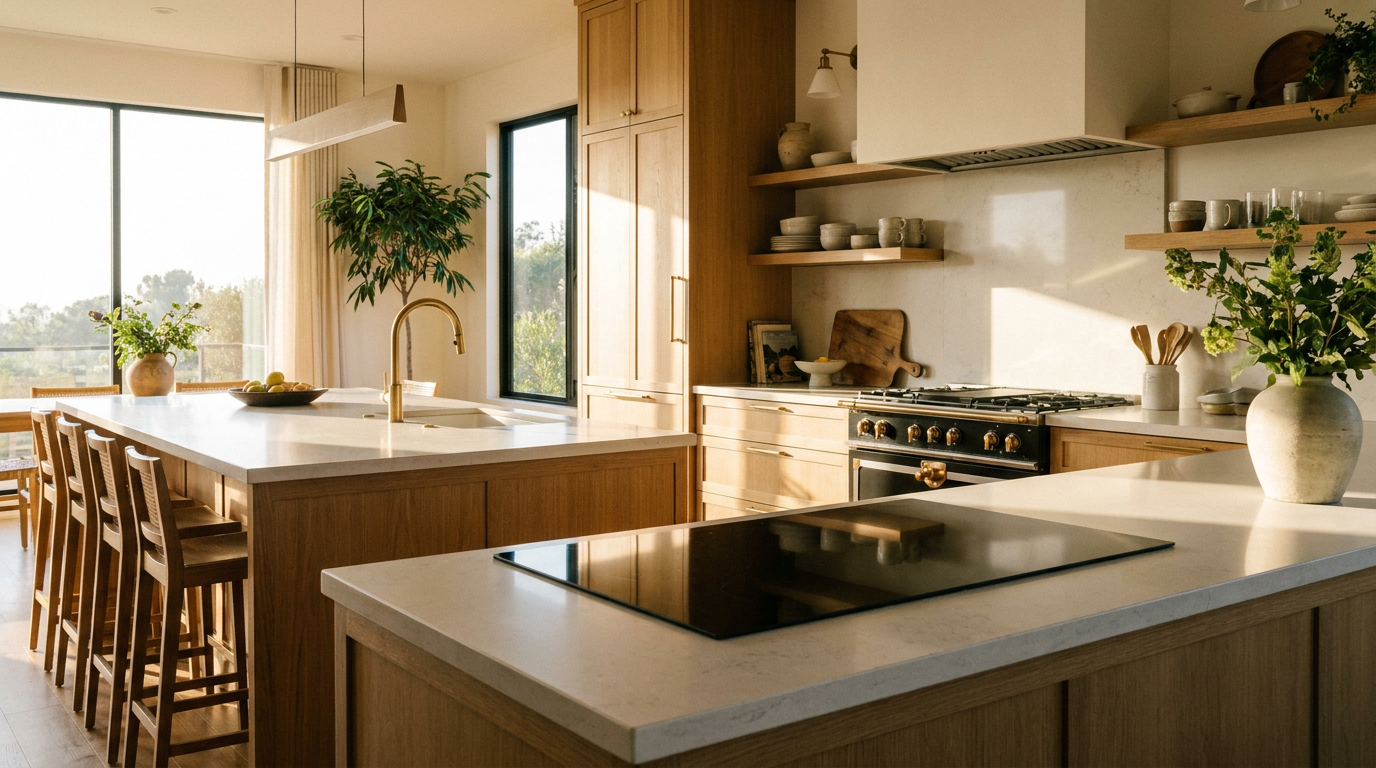
For decades, the gold standard of a high-end kitchen remodel was a massive, commercial-style gas range. Home cooks lusted after the heavy iron grates and the visceral roar of an open blue flame, convinced that gas was the only way to achieve professional-grade temperature control. But as we move deeper into 2026, the breakout trend in home renovation looks entirely different. The heavy gas ranges are being swapped out for sleek, featureless sheets of black glass. Induction cooking, once viewed as a pricey European niche or a confusing novelty, has officially crossed into the American mainstream.[1]
Driven by a combination of plunging prices, mounting health data, and a wave of technological breakthroughs that make installation vastly easier, induction is upending traditional kitchen design. It is no longer just an eco-friendly alternative; for a growing majority of remodelers, it is simply the superior way to cook.[8]
The shift represents a fundamental change in how heat is generated in the home. Traditional electric stoves rely on thermal conduction: electricity heats a metal coil or a radiant element under the glass, which then slowly transfers its heat to the pot, and eventually to the food. Gas stoves rely on combustion, burning fossil fuels to create an open flame that heats the air around the pot as much as the pot itself. Induction bypasses both of these inefficient middlemen. Instead of generating heat on the surface of the appliance, an induction cooktop uses copper coils beneath the glass to create a rapidly oscillating magnetic field. When a compatible piece of metal cookware is placed in that field, it induces an electric current directly inside the metal of the pan.[1][8]

Because the pan itself becomes the heat source, the performance metrics of induction are staggering. From a culinary perspective, induction stoves heat up pans more rapidly and evenly than both gas and traditional electric models. They are powerful enough to boil a large pot of water in nearly half the time it takes a conventional burner. More importantly for serious cooks, induction offers instantaneous, fine-tuned temperature control that gas struggles to match. The moment the magnetic field is reduced, the heat generation stops immediately, allowing a rolling boil to drop to a delicate simmer in seconds without the residual heat lag of a glowing electric coil.[1][2]
Beyond speed, the unique physics of magnetic induction solve one of the most universal kitchen headaches: cleaning. Because the glass surface of an induction stove does not generate its own heat, it only gets warm from the residual heat reflecting back off the hot pan. As a result, the surrounding cooktop remains relatively cool to the touch. When a pot boils over or sauce splatters, the food does not instantly bake and carbonize onto a scorching hot surface. Homeowners can simply wipe away spills with a damp cloth immediately after cooking, maintaining a pristine kitchen with a fraction of the scrubbing required by traditional grates or radiant electric glass.[2][8]
The direct-heating mechanism also translates to massive gains in energy efficiency. When a gas stove is ignited, a significant portion of the thermal energy escapes around the sides of the pan, heating the ambient air in the kitchen rather than the food. According to data from the American Council for an Energy-Efficient Economy, gas stoves operate at roughly 40 percent efficiency, while traditional electric resistance coils hover around 74 percent. Induction cooking, by contrast, transfers up to 90 percent of the energy consumed directly into the food. This near-total energy transfer means less wasted electricity, lower utility bills, and a kitchen that stays noticeably cooler during heavy summer cooking sessions.[5][8]

The direct-heating mechanism also translates to massive gains in energy efficiency.
Despite these overwhelming advantages, a massive structural barrier has historically prevented millions of homeowners from making the switch. Traditional induction ranges require a dedicated 240-volt electrical circuit to handle the immense power draw of multiple magnetic coils operating simultaneously. For homes built with standard 120-volt wiring in the kitchen—particularly older homes that have relied on gas for decades—upgrading the electrical panel and running new heavy-duty wiring can add thousands, or even tens of thousands, of dollars to a remodeling budget. For many families, that hidden electrical cost was the dealbreaker that kept them tethered to fossil fuels.[3][8]
That barrier is now collapsing thanks to the arrival of 120-volt battery-backed induction stoves. Debuting to widespread acclaim at recent tech showcases, these next-generation appliances are designed to plug directly into a standard, everyday wall outlet. To deliver the high-amperage power required to sear a steak or boil water instantly, these stoves feature a built-in lithium-ion battery system, typically holding around 5 kilowatt-hours of energy. The stove draws a low, steady trickle of power from the standard 120-volt wall outlet to keep the internal battery charged, and then discharges that battery power in massive bursts to the induction coils when the user turns on the burners.[2][3]
This battery integration is a transformative development for home electrification. By eliminating the need for a 240-volt circuit, these appliances allow homeowners to cap their gas lines and slide a new induction range into place with zero electrical panel upgrades. Furthermore, the internal battery provides a profound layer of household resilience. In the event of a grid outage or severe weather event, the stove's battery can continue to power the cooktop for several days, ensuring families can still boil water and prepare hot meals when the neighborhood goes dark.[2][3]

While the technological and financial arguments for induction are winning over remodelers, the public health data is providing an equally powerful push. For decades, the indoor air quality impacts of cooking with combustible gas were largely ignored by the general public. However, recent comprehensive studies have definitively linked gas stoves to elevated levels of indoor pollutants, particularly nitrogen dioxide (NO2) and ultrafine particulate matter. Nitrogen dioxide is a known respiratory irritant that can exacerbate asthma, cause coughing and wheezing, and degrade overall lung function, especially in children.[6][8]
The difference in air quality between gas and induction kitchens is stark. In a landmark study conducted by WE ACT for Environmental Justice in New York City public housing, researchers monitored apartments where residents swapped their gas stoves for induction models. The results showed that households cooking with gas experienced NO2 concentrations that were, on average, 190 percent higher than those using induction. Over a ten-month monitoring period, the simple act of replacing the gas appliance resulted in a 35 percent reduction in daily NO2 concentrations, fundamentally transforming the respiratory environment of the home.[6]

These health benefits extend beyond residential kitchens into the commercial sector. Research conducted by the Lawrence Berkeley National Laboratory evaluated the pollutant exposure impacts in commercial kitchens, comparing gas to induction. Their findings confirmed that induction cooking produced zero discernible nitrogen oxides and significantly fewer ultrafine particles. Furthermore, the commercial induction setups used 50 percent less energy than their gas counterparts, offering a dual benefit of protecting worker health while drastically cutting overhead utility costs for restaurant operators.[4]
The only significant caveat to the induction revolution is the cookware requirement. Because the technology relies on magnetic fields, pots and pans must contain a ferromagnetic metal—such as cast iron or magnetic stainless steel—to function. Pure aluminum, copper, and glass cookware will not heat up on an induction surface because the magnetic field cannot induce a concentrated current within those materials. However, most modern cookware is already induction-compatible, and remodelers can easily test their existing pots by seeing if a standard refrigerator magnet sticks firmly to the bottom of the pan.[5][8]
As consumer awareness grows, the appliance market has responded with a flood of high-quality, reliable options at increasingly accessible price points. Major testing organizations like Consumer Reports have rigorously evaluated the latest generation of induction ranges, noting that brands like Frigidaire and LG are consistently delivering top-tier performance, rapid heating, and high predicted reliability. With the technology now refined, affordable, and capable of bypassing electrical panel upgrades, induction has shed its status as a futuristic luxury. In 2026, it is simply the smartest, safest, and most efficient way to build a kitchen.[7][8]
How we got here
2014
The Department of Energy and ACEEE publish standardized tests demonstrating induction's superior energy transfer efficiency.
2022
Major public health studies definitively link gas stove emissions to elevated indoor nitrogen dioxide levels.
2024
Federal and state electrification rebates begin subsidizing the cost of transitioning away from fossil fuel appliances.
2025
120-volt battery-backed induction stoves debut, removing the need for expensive home electrical panel upgrades.
2026
Induction cooktops become the dominant breakout trend in mainstream American kitchen remodeling.
Viewpoints in depth
Homeowners and Remodelers
Focused on the practical benefits of cooking speed, easy cleaning, and avoiding costly installation upgrades.
For the everyday consumer, the appeal of induction is largely practical. Home cooks are drawn to the ability to boil water in half the time of gas and the ease of wiping down a cool glass surface without scrubbing heavy iron grates. The arrival of 120-volt battery-backed models has been a game-changer for this group, allowing them to upgrade their kitchens without spending thousands of dollars on 240-volt electrical panel upgrades.
Public Health and Environmental Advocates
Focused on eliminating indoor nitrogen dioxide emissions and reducing reliance on fossil fuels.
Health researchers and environmental groups view the transition to induction as a critical public health intervention. By removing combustible gas from the kitchen, households can eliminate a primary source of indoor nitrogen dioxide (NO2) and ultrafine particles, which are strongly linked to childhood asthma and respiratory distress. Environmentally, moving away from gas stoves caps methane leaks and aligns residential homes with broader renewable energy grids.
Appliance Innovators
Focused on technological advancement, battery integration, and overcoming market barriers to electrification.
The appliance industry sees induction as the definitive future of cooking technology. Engineers are focused on refining the user experience with smart connectivity, precise temperature sensors, and built-in battery storage. By developing stoves that can trickle-charge from a standard wall outlet and provide backup power during grid outages, manufacturers are actively dismantling the historical barriers to home electrification.
What we don't know
- The long-term lifespan and replacement cost of the internal lithium-ion batteries used in the new 120-volt stove models.
- How quickly landlords and property managers will adopt induction technology in rental units where tenants pay the utility bills.
Key terms
- Magnetic Induction
- The process of using an oscillating magnetic field to generate heat directly inside ferromagnetic cookware, rather than heating the stove surface.
- 120V Battery-Backed Stove
- A new appliance class that plugs into a standard wall outlet and uses an internal battery to deliver the high power needed for induction cooking.
- Nitrogen Dioxide (NO2)
- A respiratory irritant produced by gas combustion that can exacerbate asthma and degrade indoor air quality.
- Ferromagnetic Cookware
- Pots and pans containing iron, such as cast iron or magnetic stainless steel, required for induction cooktops to function.
Frequently asked
Do I need to upgrade my electrical panel for induction?
Traditionally yes, but new 120-volt battery-backed models plug into standard outlets, eliminating the need for costly 240-volt upgrades.
Will I have to buy all new pots and pans?
Only if your current cookware isn't magnetic. Cast iron and most stainless steel work perfectly; aluminum and copper do not.
Is the glass cooktop surface difficult to keep clean?
No. Because the cooktop itself doesn't get hot, food spills don't bake onto the surface, making it much easier to wipe clean than gas grates.
Does an induction stove actually cook faster than gas?
Yes. Induction transfers electromagnetic energy directly to the pan, boiling water up to twice as fast as traditional gas or electric burners.
Sources
Source coverage
8 outlets
3 viewpoints surfaced








[1]Tasting TableHomeowners and Remodelers
The Breakout Kitchen Trend For 2026 Is Looking Like Induction Stoves
Read on Tasting Table →[2]Good HousekeepingHomeowners and Remodelers
Why Induction Stoves Are the Future of Cooking
Read on Good Housekeeping →[3]Electrical Contractor MagazineAppliance Innovators
120V induction stoves offer affordable electrification
Read on Electrical Contractor Magazine →[4]Lawrence Berkeley National LaboratoryPublic Health and Environmental Advocates
Air pollutant exposure concentrations from cooking a meal with a gas or induction cooktop
Read on Lawrence Berkeley National Laboratory →[5]American Council for an Energy-Efficient EconomyPublic Health and Environmental Advocates
Induction Cooking Technology Design and Assessment
Read on American Council for an Energy-Efficient Economy →[6]WE ACT for Environmental JusticePublic Health and Environmental Advocates
Out of Gas, In with Justice: Studying the Impacts of Induction Stoves
Read on WE ACT for Environmental Justice →[7]House DigestHomeowners and Remodelers
The Electric Range Brand That Dethroned LG In Consumer Reports' Rankings
Read on House Digest →[8]Factlen Editorial TeamAppliance Innovators
Synthesis by Factlen editorial team
Read on Factlen Editorial Team →

Every angle. Every day.
Get home stories with full source coverage and perspective breakdowns delivered to your inbox.