
How Deep Energy Retrofits and the EnerPHit Standard Are Transforming Older Homes
Homeowners are increasingly turning to 'deep energy retrofits' and the rigorous EnerPHit standard to cut their energy use by over 50%. By applying Passive House principles to existing buildings, these whole-home renovations drastically improve comfort, indoor air quality, and climate resilience.
By Factlen Editorial Team
- Building Scientists & Certifiers
- Focus on rigorous standards, verified performance, and the physics of the building envelope.
- Homeowners & Renovators
- Focus on upfront costs, phased planning, and the tangible improvements to daily comfort.
- Climate Policymakers
- Focus on decarbonizing the existing housing stock to meet mid-century emissions targets.
What's not represented
- · Traditional General Contractors
- · Historic Preservationists
Why this matters
With over 70% of today's buildings expected to still be standing in 2050, upgrading existing homes is crucial for global climate goals. For homeowners, a deep energy retrofit means permanently slashing utility bills, eliminating drafts, and creating a healthier, more resilient living space.
Key points
- Deep energy retrofits aim to reduce a home's total energy consumption by 50 percent or more.
- The EnerPHit standard adapts rigorous Passive House principles specifically for the limitations of existing buildings.
- Projects prioritize the building envelope first, utilizing thick insulation, airtight sealing, and triple-glazed windows.
- Continuous filtered ventilation systems drastically improve indoor air quality and acoustic comfort.
- While upfront costs are high, phased retrofit plans and government incentives make the upgrades more accessible.
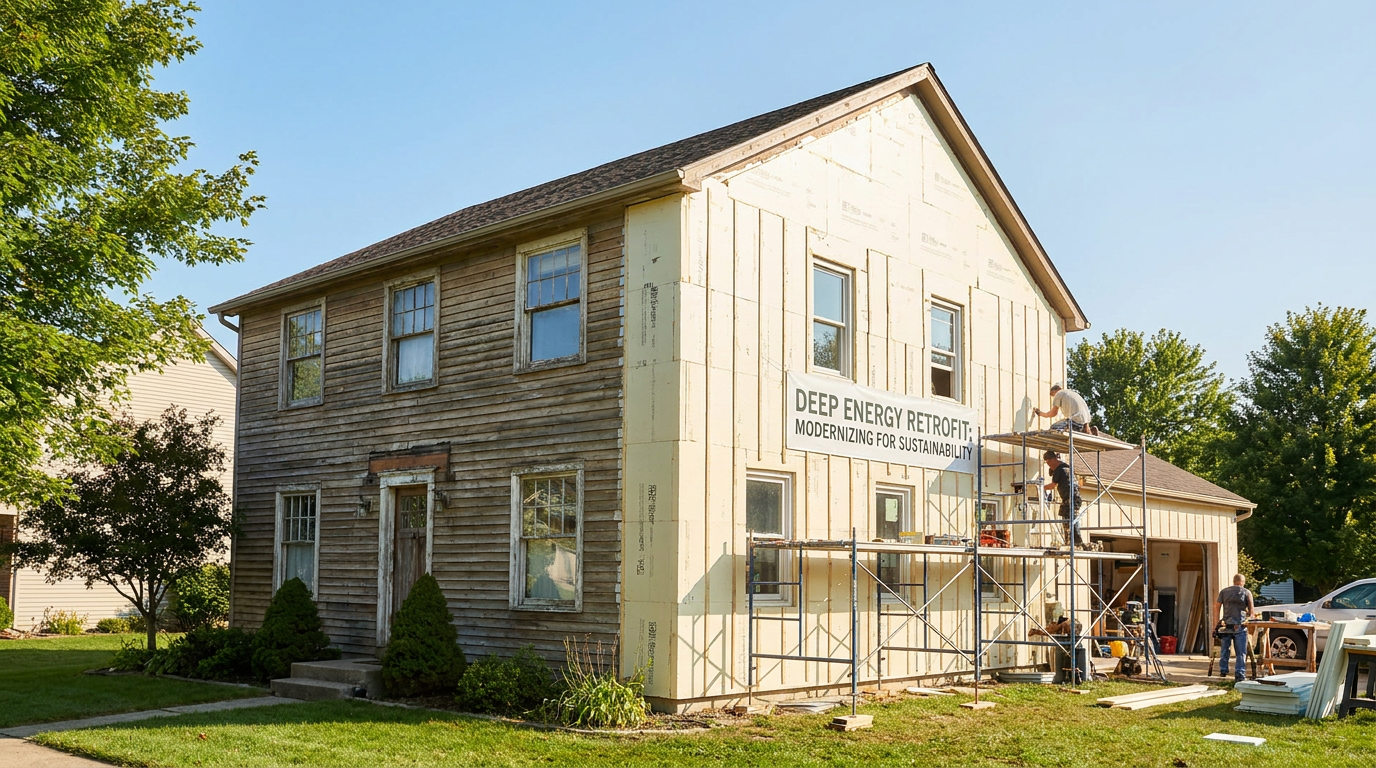
For decades, remodeling an older home meant updating the kitchen, knocking down a wall for an open floor plan, or adding a fresh coat of paint. But a quiet revolution is shifting the focus from aesthetics to performance. Faced with rising utility costs and a growing awareness of residential carbon footprints, a new wave of homeowners is embracing the "deep energy retrofit." Unlike conventional weatherization—which might involve blowing some cellulose into the attic and caulking a few windows—a deep energy retrofit is a comprehensive, whole-building overhaul. The goal is not a modest 10 percent dip in the heating bill, but a radical 50 to 90 percent reduction in total energy consumption, transforming drafty, mid-century houses into ultra-efficient, resilient sanctuaries.[3][4]
At the forefront of this movement is EnerPHit, a rigorous certification standard developed by the Passive House Institute specifically for existing buildings. The original Passive House standard, renowned for creating homes that require almost no active heating or cooling, is notoriously difficult to achieve in retrofits. Existing structures come with baked-in limitations: their orientation to the sun is fixed, their foundational geometry cannot be easily altered, and unavoidable "thermal bridges"—pathways where heat escapes through the building's structural frame—are often permanently embedded in the architecture. EnerPHit was created as an admission of these physical realities, offering a pragmatic but highly ambitious benchmark for older homes.[1][2]
Rather than demanding the near-impossible metrics of a new-build Passive House, EnerPHit adjusts the targets. For example, while a new Passive House is capped at 15 kilowatt-hours per square meter per year for space heating, an EnerPHit retrofit is allowed up to 25 kilowatt-hours. Similarly, the airtightness requirement is slightly relaxed from 0.6 air changes per hour to 1.0. Yet, even with these adjustments, an EnerPHit-certified home performs exponentially better than standard housing stock. It provides a verified, science-backed roadmap for renovators, ensuring that the massive effort put into a remodel actually translates into measurable, long-term performance rather than just theoretical gains.[1][2]
The mechanism behind a deep energy retrofit relies on an "envelope-first" philosophy. Before any mechanical systems are considered, the building's outer shell must be fundamentally upgraded. This involves wrapping the exterior or interior walls in continuous, thick insulation, significantly upgrading roof insulation, and replacing standard double-pane glass with high-performance, triple-glazed windows. Crucially, the construction team must meticulously seal every crack, joint, and seam to prevent outdoor air from infiltrating the home and conditioned air from leaking out. This obsessive focus on airtightness is what separates a true deep retrofit from a standard remodel, fundamentally changing how the building interacts with the outside climate.[3][5]

Once the envelope is sealed, the home's internal environment changes dramatically. Because the house is now virtually airtight, it can no longer rely on the "natural ventilation" of drafts and leaks to provide fresh air. To prevent the air from becoming stale and to manage indoor moisture, a deep energy retrofit mandates the installation of a Heat Recovery Ventilator (HRV) or an Energy Recovery Ventilator (ERV). These systems continuously exhaust stale indoor air while drawing in fresh outdoor air. Before the two airstreams leave the building, they pass through a heat exchanger core, allowing the outgoing stale air to transfer its thermal energy to the incoming fresh air without ever mixing.[2][5]
This continuous, filtered ventilation is one of the most celebrated, yet least understood, benefits of the EnerPHit standard. Homeowners frequently report that the most life-changing aspect of their retrofit isn't the low utility bill, but the profound improvement in indoor air quality. Because the incoming air is constantly filtered, dust, pollen, and outdoor pollutants are drastically reduced. Furthermore, the robust insulation and triple-pane windows act as an exceptional acoustic barrier. The result is an interior environment that is not only thermally stable but remarkably quiet, completely isolating the occupants from street noise and neighborhood clamor.[1][4]
This continuous, filtered ventilation is one of the most celebrated, yet least understood, benefits of the EnerPHit standard.
With the building envelope secured and the ventilation managed, the final step of the deep energy retrofit is addressing the heating and cooling systems. In a traditional home, massive furnaces and oversized air conditioning units are required to constantly battle the heat loss leaking through the walls. In an EnerPHit home, the heating and cooling loads are so drastically reduced that these legacy systems become entirely obsolete. Instead, the home can be serviced by highly efficient, right-sized electric heat pumps. Because the overall electrical load is now a fraction of what it once was, it becomes highly feasible to power the remaining demand with a modest array of rooftop solar panels, pushing the home toward net-zero emissions.[3][4]
The evidence supporting this whole-home approach is robust. Data collected by the Lawrence Berkeley National Laboratory (LBNL), which maintains a database of over 1,700 home energy upgrade projects, demonstrates that deep energy retrofits consistently achieve their ambitious targets. Across various climates in the United States, projects that adhere to these rigorous envelope-first principles routinely see energy savings of 50 percent or more. Post-retrofit utility bills often drop to roughly 30 percent below the national average, proving that the underlying physics of the Passive House methodology translate reliably from the spreadsheet to the real world.[4]

However, the transition to this level of performance is not without significant friction, primarily centered around cost. A deep energy retrofit is a major capital investment. According to LBNL's review, an average deep retrofit project in the U.S. costs approximately $40,000, and comprehensive projects aiming for full EnerPHit certification can easily exceed $100,000. These figures often include necessary deferred maintenance, such as replacing siding or roofing, which makes isolating the pure "energy efficiency" cost difficult. Nonetheless, the upfront financial barrier remains the single largest hurdle preventing widespread adoption of the standard among average homeowners.[4][6]
To mitigate this financial shock, the Passive House Institute introduced the EnerPHit Retrofit Plan (ERP). Recognizing that few homeowners have the capital or the tolerance to execute a $100,000 whole-house renovation in a single phase, the ERP provides a framework for a step-by-step retrofit. A certified designer uses the Passive House Planning Package (PHPP) software to model the entire home and create a long-term master plan. This allows the homeowner to tackle the project over several years—perhaps upgrading the windows and roof in phase one, and insulating the exterior walls in phase two—ensuring that each step is compatible with the final goal and avoiding costly rework.[2][5]
Beyond capital, the industry faces a profound workforce challenge. Executing an EnerPHit project requires a level of precision that is entirely foreign to standard residential construction. The meticulous taping of air barriers, the careful calculation of dew points to prevent trapped moisture within walls, and the specialized installation of European-style tilt-turn windows require highly trained tradespeople. Currently, there is a severe shortage of contractors and builders who possess the specialized knowledge required to successfully deliver a deep energy retrofit without inadvertently causing moisture or mold issues due to improper detailing.[4][5]

Despite these hurdles, the momentum behind deep energy retrofits is accelerating, driven by macroeconomic and climate imperatives. The U.S. Department of Energy and various international bodies recognize that it is mathematically impossible to meet 2050 carbon neutrality goals simply by building efficient new homes. Approximately 70 percent of the buildings that will exist in 2050 have already been built. Decarbonizing the grid requires drastically reducing the energy demand of this existing housing stock, making the widespread adoption of deep retrofit methodologies a critical pillar of global climate strategy.[3][6]
To spur this transition, an unprecedented array of financial incentives is becoming available. Utility rebates, state-level grants, and federal tax credits—such as those expanded under recent U.S. climate legislation—are specifically designed to improve the economics of deep energy retrofits. When homeowners combine these incentives with low-interest green financing or Energy Savings Performance Contracts, the monthly utility bill savings can often offset the loan payments, making the transition financially viable for a broader segment of the population.[3][4]
Ultimately, the rise of the EnerPHit standard and deep energy retrofits represents a profoundly optimistic shift in how we view our aging built environment. Rather than tearing down inefficient mid-century homes to build anew—a process that generates massive landfill waste and embodied carbon emissions—we now have the technology and the blueprints to rescue them. By applying rigorous building science, homeowners can transform the drafty, energy-wasting houses of the past into the comfortable, clean, and hyper-efficient homes of the future.[5][6]
How we got here
1990
The first official Passivhaus is built in Darmstadt, Germany, pioneering ultra-low energy building standards.
2010
The Passive House Institute introduces the EnerPHit standard, specifically adapting the rigorous metrics for existing building retrofits.
2021
Lawrence Berkeley National Laboratory publishes extensive data showing deep energy retrofits in the U.S. consistently achieve 50%+ energy savings.
2026
Deep energy retrofits gain mainstream traction as homeowners leverage expanded climate tax credits to offset high upfront remodeling costs.
Viewpoints in depth
Building Scientists & Certifiers
Focus on rigorous standards, verified performance, and the physics of the building envelope.
For building scientists and Passive House certifiers, the value of EnerPHit lies in its uncompromising reliance on physics and verified data. They argue that the construction industry has historically relied on 'guesswork' weatherization that often fails to deliver promised savings and can even cause structural damage by trapping moisture. By using advanced modeling software (PHPP) and requiring on-site blower-door tests to prove airtightness, this camp believes that strict certification is the only way to guarantee that a deep retrofit will actually perform as designed for the next century.
Homeowners & Renovators
Focus on upfront costs, phased planning, and the tangible improvements to daily comfort.
From the perspective of those actually living in and paying for these projects, the primary drivers are often comfort and utility savings, balanced against daunting upfront costs. While homeowners appreciate the climate benefits, their immediate reality is the elimination of cold drafts, the drastic reduction in street noise, and the health benefits of filtered air. Because a $40,000 to $100,000 capital outlay is out of reach for many, this group heavily advocates for the step-by-step EnerPHit Retrofit Plan and relies on government rebates and green financing to make the math work.
Climate Policymakers
Focus on decarbonizing the existing housing stock to meet mid-century emissions targets.
Policymakers and energy departments view deep energy retrofits through a macroeconomic lens. Knowing that the vast majority of buildings that will exist in 2050 are already standing, they argue that upgrading the existing housing stock is a non-negotiable climate imperative. This camp focuses on scaling the workforce, providing systemic financial incentives, and lowering the barrier to entry so that deep retrofits can transition from a niche luxury for eco-conscious homeowners to a standard, widespread practice essential for stabilizing the power grid.
What we don't know
- How quickly the residential construction workforce can scale to meet the demand for specialized, airtight building techniques.
- The exact long-term impact of deep retrofits on the resale value of homes in varied regional real estate markets.
Key terms
- Deep Energy Retrofit (DER)
- A whole-building renovation that aims to reduce a home's on-site energy consumption by 50 percent or more.
- EnerPHit
- A certification standard developed by the Passive House Institute specifically tailored for the energy retrofitting of existing buildings.
- Thermal Bridge
- An area or component of a building's structure that has higher thermal conductivity than the surrounding materials, creating a path for heat to escape.
- Heat Recovery Ventilator (HRV)
- A mechanical ventilation system that continuously replaces stale indoor air with fresh outdoor air while capturing and transferring the heat to save energy.
- Airtightness
- The degree to which a building's envelope prevents the uncontrolled leakage of air, usually measured with a blower-door test.
- Building Envelope
- The physical separator between the conditioned and unconditioned environment of a building, including the walls, roof, foundation, and windows.
Frequently asked
Can any home be retrofitted to the EnerPHit standard?
Yes, almost any existing home can undergo a deep energy retrofit, though the specific architectural features and orientation will dictate how easily it can meet the strict EnerPHit certification metrics.
How much does a deep energy retrofit cost?
Costs vary widely based on the home's size and condition, but data shows average projects cost around $40,000, with comprehensive whole-home overhauls easily exceeding $100,000.
Do I have to do the entire retrofit all at once?
No. The EnerPHit Retrofit Plan allows homeowners to phase the upgrades over several years (e.g., roof first, windows later) using a master plan to ensure all steps work together.
Why is airtightness so important in a retrofit?
Airtightness prevents heated or cooled air from escaping through cracks, which is the primary source of energy loss in older homes. It also prevents moisture from getting trapped inside the walls.
Sources
Source coverage
6 outlets
3 viewpoints surfaced





[1]Homebuilding & RenovatingHomeowners & Renovators
What is EnerPHit? The Passive House Standard for Retrofits
Read on Homebuilding & Renovating →[2]Passive House InstituteBuilding Scientists & Certifiers
EnerPHit: The Passive House Standard for Retrofits
Read on Passive House Institute →[3]U.S. Department of EnergyClimate Policymakers
Deep Energy Retrofits
Read on U.S. Department of Energy →[4]Lawrence Berkeley National LaboratoryClimate Policymakers
Deep Energy Retrofits for Homes
Read on Lawrence Berkeley National Laboratory →[5]Passivhaus Trust UKBuilding Scientists & Certifiers
Passivhaus Retrofit & EnerPHit
Read on Passivhaus Trust UK →[6]Factlen Editorial TeamClimate Policymakers
Synthesis by Factlen editorial team
Read on Factlen Editorial Team →
Every angle. Every day.
Get home stories with full source coverage and perspective breakdowns delivered to your inbox.