
How AI and Underwater Speakers Are 'Singing' Ecosystems Back to Life
Scientists are combining artificial intelligence with continuous acoustic monitoring to track global biodiversity in real-time, while using underwater speakers to actively lure marine life back to degraded coral reefs.
By Hao Li

In short
- Bioacoustics uses autonomous, solar-powered microphones to continuously record the soundscapes of remote ecosystems.
- AI models like Google DeepMind's Perch 2.0 convert these recordings into visual spectrograms to instantly identify thousands of species.
- Acoustic sensors can detect the sound of chainsaws in real-time, sending instant GPS alerts to rangers to stop illegal logging.
The natural world is defined by its soundtrack. A pristine Amazonian rainforest is a deafening chorus of howler monkeys, cicadas, and avian calls, while a healthy coral reef crackles and pops with the constant activity of snapping shrimp and grazing fish.
But as global biodiversity faces unprecedented declines, these vibrant soundscapes are fading. Ecologists have long relied on physical surveys to track this quietening, a slow and labor-intensive process that leaves massive blind spots. Now, a rapidly maturing field known as bioacoustics is fundamentally changing how humanity measures and protects the natural world.[2]
Bioacoustics operates on a simple premise: if you want to know what is happening in an ecosystem, you just have to listen. By deploying networks of autonomous, solar-powered microphones—often built from repurposed smartphones—conservationists can maintain a constant, unblinking presence in some of the most remote environments on Earth. Organizations like Rainforest Connection have deployed these "Guardian" devices high in the canopies of 37 countries, capturing everything from the subtle rustle of leaves to the distinct calls of endangered species.
The sheer volume of data collected by these continuous listening stations is staggering. Rainforest Connection alone has cataloged over 160 million audio files. For decades, the bottleneck in bioacoustics was human processing power; it would take an army of graduate students lifetimes to manually listen to and categorize years of continuous forest recordings. The data was being collected, but the insights were trapped in an insurmountable backlog of noise.
That bottleneck has recently been shattered by breakthroughs in artificial intelligence, specifically the application of Convolutional Neural Networks (CNNs) to audio data. Instead of trying to teach a computer to "hear" a bird, scientists convert the audio recordings into spectrograms—visual representations of sound frequencies over time. The AI is then trained to recognize the visual patterns of specific animal calls, much like facial recognition software identifies a human face.
The capabilities of these AI models have scaled exponentially. In late 2025, Google DeepMind released Perch 2.0, a foundational bioacoustics model that represents a massive leap forward. Trained on vast public datasets like Xeno-Canto and iNaturalist, Perch 2.0 can identify nearly 15,000 distinct species of birds, mammals, and amphibians. It can untangle complex acoustic scenes, picking out the call of a rare Hawaiian honeycreeper even when it is buried under the roar of wind and the chatter of common insects.
Perhaps the most surprising development in AI bioacoustics is a phenomenon known as transfer learning. DeepMind researchers discovered that Perch 2.0, despite being trained almost exclusively on terrestrial animals and birds, could be effectively deployed in marine environments. The model's underlying architecture had become so adept at isolating and categorizing acoustic patterns that it successfully transferred its "knowledge" to underwater tasks, accurately classifying the vocalizations of different whale species with minimal retraining.
This AI-driven monitoring is not just an academic exercise; it is an active defense mechanism. In rainforests plagued by illegal logging, acoustic sensors are programmed to listen for the specific mechanical whine of chainsaws or the rumble of heavy trucks. When the AI detects these anthropogenic sounds, it instantly beams an alert via satellite or cellular network to local rangers, providing exact GPS coordinates. This transforms forest protection from a reactive forensic investigation into a real-time interception.
But the application of sound in conservation is evolving beyond passive listening. In the world's oceans, scientists are using sound not just to monitor ecosystems, but to actively rebuild them. This emerging technique, known as "acoustic enrichment," leverages the fact that many marine organisms rely on sound to navigate and select habitats.[1]
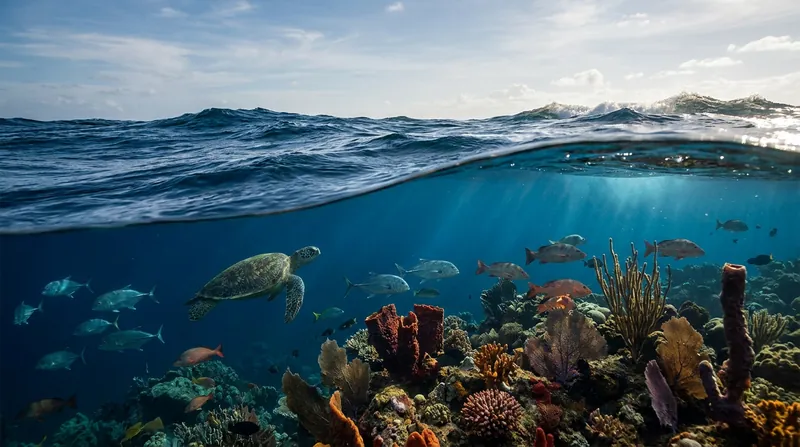
Coral reefs, which support a quarter of all marine life, are facing catastrophic degradation from warming waters and ocean acidification. When a reef dies, it loses its complex, noisy community of fish and invertebrates. It goes silent. This silence creates a deadly feedback loop: coral larvae, which are free-swimming in their early stages, use the crackle and pop of a healthy reef as a homing beacon to decide where to settle and grow. If a degraded reef is silent, the larvae swim past it, preventing any natural recovery.[1]
To break this cycle, researchers from institutions like the Woods Hole Oceanographic Institution have begun installing underwater loudspeakers in degraded coral rubble fields. These speakers broadcast the rich, complex soundscapes recorded from thriving, healthy reefs. The results have been remarkably effective.
Studies have shown that playing healthy reef sounds can increase the settlement rates of coral larvae by up to seven times compared to silent control sites. The exterior cilia on the microscopic larvae allow them to sense the acoustic vibrations in the water column and actively swim toward the source. By artificially mimicking the sensory cues of a thriving ecosystem, scientists can trick the larvae into recolonizing dead zones.[1]
The benefits of acoustic enrichment extend beyond the coral itself. A landmark study on Australia's Great Barrier Reef demonstrated that playing healthy sounds in degraded areas led to a 50 percent increase in the species richness of juvenile fish. The fish not only arrived at the acoustically enriched sites but set up territories and remained there. Because fish excrete vital nutrients and graze on algae that would otherwise smother new coral growth, their return accelerates the entire ecosystem's recovery.[1]
This creates a manufactured positive feedback loop. The artificial sound attracts the first wave of fish and coral. As those organisms settle and grow, they begin to generate their own natural acoustic signature. Eventually, the speakers can be removed, and the newly restored reef becomes self-sustaining, broadcasting its own biological beacon to attract future generations of marine life.
Despite these incredible breakthroughs, the integration of AI and bioacoustics is not a panacea. Technologists caution that AI models still struggle with "acoustic overlap"—when multiple species vocalize simultaneously at the exact same frequency—and can be confused by novel anthropogenic noises. Furthermore, the hardware required to survive underwater or in hyper-humid rainforest canopies remains expensive and prone to physical failure.[2]
More fundamentally, traditional ecologists warn against viewing technology as a standalone solution. Knowing that a critically endangered species exists in a specific patch of forest, or detecting a chainsaw in real-time, is only useful if there is a well-funded, legally empowered human infrastructure ready to act on that data. Acoustic enrichment can attract coral larvae, but if the water remains too hot or too acidic, those newly settled corals will simply bleach and die again.[2]
Nevertheless, the synthesis of bioacoustics, artificial intelligence, and active acoustic restoration represents one of the most hopeful developments in modern conservation. By learning to decode and replicate the complex languages of the natural world, humanity is moving from being a deaf observer of ecological collapse to an active participant in planetary recovery.[2]
Terms to know
- Bioacoustics
- The scientific study of sounds produced by living organisms and their environment, used to monitor ecosystem health.
- Spectrogram
- A visual representation of the spectrum of frequencies of a sound as it varies with time, used by AI to "see" audio.
- Acoustic Enrichment
- A conservation technique where healthy ecosystem sounds are played via speakers in degraded habitats to attract wildlife.
- Convolutional Neural Network (CNN)
- A type of artificial intelligence designed to process and recognize patterns in visual data, including spectrograms.
- Transfer Learning
- An AI machine learning technique where a model trained on one task (like identifying bird calls) is repurposed for a different but related task (like identifying whale calls).
Questions readers ask
How does AI identify an animal from a sound recording?
The AI converts the audio into a visual graph called a spectrogram. It then uses neural networks to recognize the unique visual patterns of specific animal calls, much like facial recognition software.
Why do coral larvae care about sound?
Coral larvae are free-swimming. They use the natural crackle and pop of a healthy reef—created by snapping shrimp and fish—as a homing beacon to find a safe, thriving place to settle and grow.
Can acoustic monitoring stop illegal logging?
Yes. Solar-powered sensors can be trained to detect the specific acoustic signature of chainsaws or trucks. When detected, the system instantly sends GPS alerts to local rangers to intercept the loggers.
Different angles
Conservation Technologists
Argue that AI and continuous acoustic monitoring are the only viable ways to scale biodiversity tracking to a planetary level.
For technologists and data scientists, the primary bottleneck in conservation has always been the sheer scale of the Earth. Traditional physical surveys are too slow, too localized, and too expensive to provide a real-time picture of global biodiversity collapse. By deploying cheap, autonomous sensors and leveraging AI models like Perch 2.0, they argue we can finally monitor ecosystems continuously. This camp views data as the ultimate weapon against extinction, pointing to real-time chainsaw detection systems as proof that technology can transform conservation from a passive observational science into an active, scalable defense network.
Marine Restoration Scientists
Focus on active ecosystem manipulation, using sound not just to monitor, but to actively draw life back to degraded habitats.
Marine ecologists studying acoustic enrichment view sound as a physical tool for rebuilding, rather than just a metric for listening. They argue that degraded ecosystems often suffer from a 'chicken-and-egg' problem: animals won't return to a dead habitat, but the habitat cannot recover without the animals. By artificially broadcasting the acoustic signatures of a healthy reef, they can trick the ecosystem into kickstarting its own recovery. This perspective emphasizes that humanity must move beyond simply protecting what is left and begin actively engineering the revival of lost environments.
Traditional Ecologists
Emphasize that while AI is a powerful tool, it must be paired with on-the-ground habitat protection and human intervention to be effective.
While acknowledging the incredible breakthroughs in bioacoustics, traditional field biologists caution against techno-optimism. They argue that knowing a species is declining, or detecting a chainsaw in a remote forest, does not inherently solve the problem. If local rangers are underfunded, or if the underlying drivers of deforestation and climate change are ignored, the AI is simply documenting an extinction in high fidelity. Similarly, they point out that acoustic enrichment can attract coral larvae, but if ocean temperatures remain fatally high, those new corals will not survive. For this camp, technology is only a force multiplier for human political and physical action, not a replacement for it.
- Conservation Technologists
- Argue that AI and continuous acoustic monitoring are the only viable ways to scale biodiversity tracking to a planetary level.
- Marine Restoration Scientists
- Focus on active ecosystem manipulation, using sound not just to monitor, but to actively draw life back to degraded habitats.
- Traditional Ecologists
- Emphasize that while AI is a powerful tool, it must be paired with on-the-ground habitat protection and human intervention to be effective.
Perspectives this story doesn't cover
- Local indigenous communities managing the forests where sensors are deployed
- Policymakers allocating funding for conservation technology
Sources
Source coverage
2 outlets
3 viewpoints surfaced


- [1]Earth.orgMarine Restoration Scientists
Acoustic Enrichment: A Novel Approach to Coral Reef Restoration
Read on Earth.org → - [2]Factlen Editorial TeamTraditional Ecologists
Synthesis by Factlen editorial team
Read on Factlen Editorial Team →
More in Environment
See all →Offshore Leasing
The Mechanics of the Interior Department's 2026–2031 Offshore Drilling Expansion
8 sources

Nature-Based Solutions
The return of the ecosystem engineer: How beaver rewilding is reshaping flood management
2 sources
Beaver Reintroduction
How the Reintroduction of Beavers is Quietly Solving Modern Climate Crises
6 sources

Marine Biology
How Deep-Diving Whales Avoid Decompression Sickness
10 sources
Comments
Every angle. Every day.
Get Environment stories with full source coverage and perspective breakdowns, free every day.