
The Landlords of the AI Boom: How Data Center REITs Are Reshaping Real Estate
As artificial intelligence drives unprecedented demand for specialized computing facilities, data center REITs have surpassed traditional office buildings in construction spending, offering investors a direct stake in the physical backbone of the digital economy.
By Factlen Editorial Team
- Institutional Investors
- Focus on the stable dividend yields, long-term hyperscaler leases, and high barriers to entry that make data centers a reliable asset class.
- Tech Hyperscalers & Enterprises
- View data center REITs as essential partners to rapidly deploy AI compute infrastructure without tying up all their own capital in real estate.
- Real Estate Analysts
- Observe the historic shift of capital away from traditional office and retail spaces toward specialized digital infrastructure.
What's not represented
- · Grid Operators & Utilities
- · Local Municipalities & Environmental Groups
Why this matters
Artificial intelligence isn't just software—it requires massive, power-hungry physical infrastructure. Understanding data center REITs reveals how everyday investors can participate in the AI boom without betting on individual tech stocks, while highlighting a historic shift in the commercial real estate market.
Key points
- Data center construction spending hit a record $50 billion annualized rate in early 2026, surpassing traditional office building construction.
- Data center REITs own and operate the specialized facilities housing the servers and cooling systems required for AI workloads.
- By law, REITs must distribute at least 90% of their taxable income as dividends, offering investors passive income from the AI boom.
- Industry leaders like Equinix and Digital Realty are investing billions annually to double their global capacity and meet hyperscaler demand.
The artificial intelligence revolution is frequently described in ethereal, intangible terms—cloud computing, neural networks, virtual agents, and invisible algorithms. However, the reality of artificial intelligence is intensely, heavily physical. Every complex prompt processed by a large language model, every high-resolution image generated from text, and every enterprise data set analyzed requires tangible, high-performance hardware housed in massive, highly specialized warehouses. As the technology sector races to build more capable models, the demand for the physical space to store and cool the necessary computing equipment has skyrocketed, transforming what was once a niche corner of the commercial property market into the most critical infrastructure of the twenty-first century.[4]
This insatiable physical demand has triggered a historic and highly visible changing of the guard in the commercial real estate sector. In early 2026, annualized spending on data center construction in the United States surged by 34% year-over-year, reaching an unprecedented record of $50 billion. This milestone marked a profound shift: for the first time in history, the capital pouring into these digital fortresses outright exceeded the $46 billion spent on traditional office building construction. While legacy office spaces continue to grapple with the entrenched realities of remote work and elevated vacancy rates, the specialized, power-hungry warehouses of the digital age have emerged as the undisputed growth engine of the broader real estate market.[1][7]
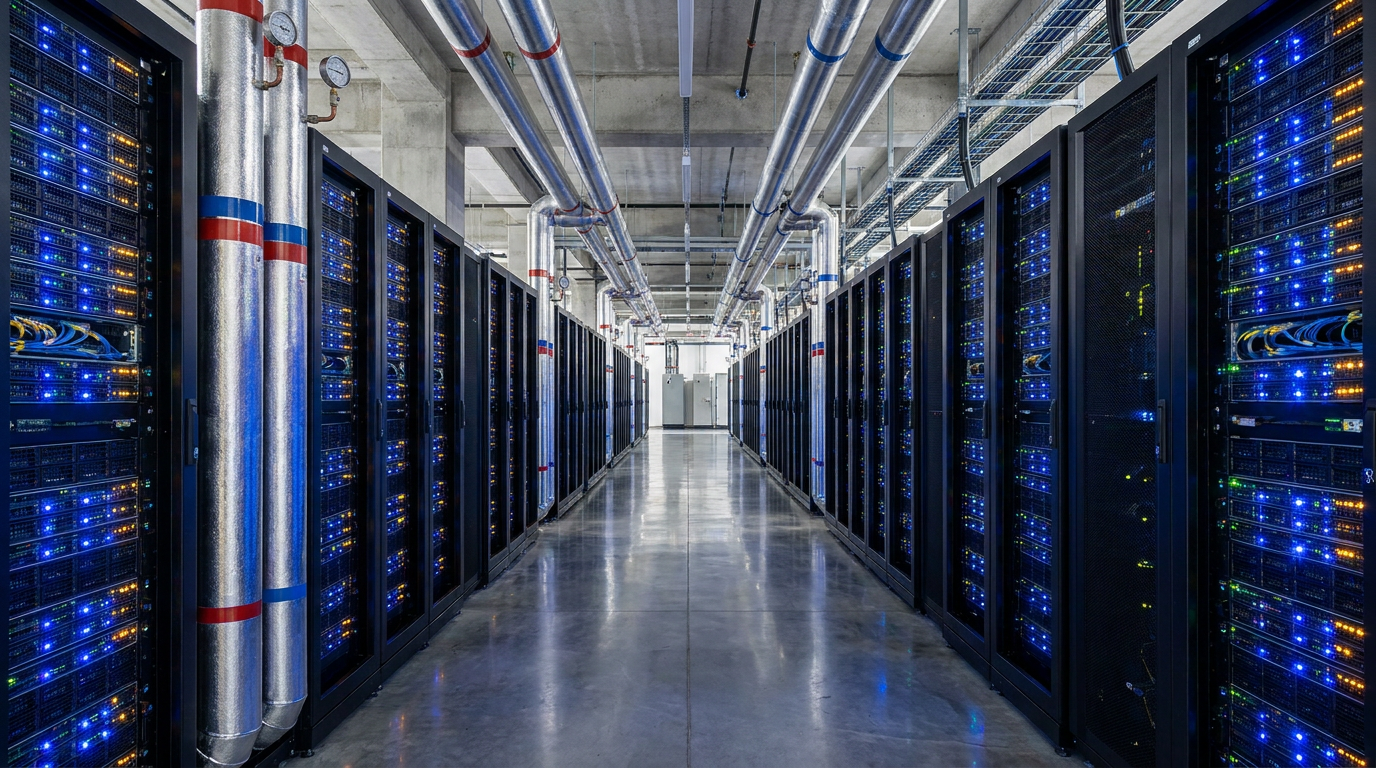
At the very center of this infrastructure boom are Data Center Real Estate Investment Trusts, commonly known as REITs. These specialized, publicly traded entities own, operate, and continuously develop the highly secure facilities that house the servers, storage systems, and networking equipment powering the modern internet. Unlike traditional tech companies that design software or manufacture semiconductor chips, data center REITs are fundamentally property managers. They acquire the land, secure the necessary zoning permits, build the reinforced structures, and manage the complex electrical and cooling systems required to keep thousands of high-performance computers running without interruption.[6]

For everyday investors, these real estate investment trusts offer a unique and highly regulated mechanism to participate in the artificial intelligence gold rush without attempting to pick the winning software developer or hardware manufacturer. By federal law, a REIT is required to distribute at least 90% of its taxable income directly to its shareholders in the form of dividends. This unique corporate structure effectively transforms the massive rental payments made by the world's largest technology companies into a steady, reliable stream of passive income for retail and institutional investors alike, bridging the gap between high-tech growth and traditional yield-focused investing.[6][7]
The underlying business model of a data center REIT is relatively straightforward but highly lucrative in practice. These companies generate revenue primarily by leasing physical space, securing massive amounts of electrical power, and providing industrial-grade cooling capacity to a diverse range of tenants. These tenants span from mid-sized enterprises transitioning their legacy IT systems to hybrid cloud setups, all the way up to the "hyperscalers"—the massive, trillion-dollar technology conglomerates like Amazon, Microsoft, Google, and Meta. By serving as the neutral landlord for the digital economy, these REITs capture value from the overall growth of data consumption, regardless of which specific tech platform ultimately wins the consumer market.[4][5]
While data centers have been growing steadily for over two decades alongside the broader rise of cloud computing and mobile internet usage, the recent generative artificial intelligence boom has fundamentally altered the scale, density, and complexity of the facilities required. Traditional cloud computing servers are relatively uniform and can be packed densely into standard racks with conventional air conditioning. However, training and running inference for advanced AI models rely on ultra-dense clusters of graphics processing units (GPUs), which operate at a completely different magnitude of power and thermal output.[4]

These AI-specific workloads consume exponentially more electricity per square foot and generate staggering amounts of heat that traditional data center infrastructure simply cannot handle. To accommodate these next-generation servers, newly constructed data centers require heavily reinforced flooring to support the sheer weight of the dense hardware racks. More importantly, they require advanced liquid cooling systems—where specialized fluids are circulated directly to the chips or entire server racks are submerged—to prevent the multi-million-dollar hardware from melting down under the intense computational strain.[4]
As the requirements for these facilities have grown increasingly complex, two dominant players have emerged as the primary landlords of this new digital economy: Equinix and Digital Realty. Both of these massive REITs operate vast, global footprints of carrier-neutral facilities. This carrier-neutrality is a crucial competitive advantage, meaning that tenants who lease space in their buildings can seamlessly connect with dozens of different internet service providers, telecommunications networks, and cloud platforms under a single roof, creating a highly sticky ecosystem that is difficult for customers to leave.[5]
Both of these massive REITs operate vast, global footprints of carrier-neutral facilities.
The sheer scale of the current expansion undertaken by these industry leaders is entirely unprecedented in the history of commercial real estate. Equinix, for example, recently announced highly ambitious plans to effectively double its global data center capacity by the end of 2029. To achieve this monumental goal, the company projects spending between $4 billion and $5 billion annually on capital expenditures, aiming to build and bring online as much physical infrastructure in the next five years as it managed to construct in its previous 27 years of operation.[2]
Digital Realty is executing a similarly aggressive expansion strategy to capture the surging demand from major technology firms. The company recently announced the successful closing of a $3.25 billion hyperscale data center fund, drawing massive capital commitments from public pensions, sovereign wealth funds, and university endowments. This influx of institutional capital is being deployed to build massive, AI-ready campus environments across major U.S. metropolitan areas, including Northern Virginia, Dallas, and Chicago, ensuring that the physical space is ready before the next generation of AI chips rolls off the assembly line.[5]

This frantic pace of construction is entirely demand-driven, fueled by an arms race among the world's largest technology companies. The top tech hyperscalers are locked in a fierce battle for artificial intelligence supremacy, and they require physical space much faster than they can permit, design, and build it themselves. Industry projections suggest that these top six tech giants will spend an astonishing $700 billion on AI-related capital expenditures in 2026 alone. By outsourcing the real estate and facility management to specialized REITs, these tech companies can focus their capital on acquiring expensive GPUs and recruiting top engineering talent.[3]
For the data center REITs, this insatiable demand translates into highly visible, deeply reliable recurring revenue streams. Because migrating thousands of servers is incredibly expensive and risky, hyperscalers and large enterprises typically sign long-term lease agreements spanning anywhere from five to fifteen years. These extended contracts often include built-in annual rent escalators, providing the data center operators with stable, predictable cash flows that insulate their balance sheets from short-term economic volatility and provide a clear runway for future dividend growth.[3][5]
Furthermore, the data center industry benefits from massive, almost insurmountable barriers to entry that protect existing operators from sudden waves of new competition. Constructing a modern hyperscale facility is no longer a simple real estate venture; it requires billions of dollars in upfront capital, years of navigating complex local zoning laws and environmental approvals, and highly specialized engineering expertise to design the intricate cooling and power routing systems required by modern supercomputers.[3]
The most significant bottleneck protecting the incumbent REITs, however, is access to raw electricity. As artificial intelligence models grow exponentially larger, their power requirements have severely strained regional electrical grids across the globe. Existing data center operators that have already secured long-term power purchase agreements, built dedicated substations, and established firm grid connections possess a formidable competitive moat. In many prime markets, new entrants simply cannot obtain the necessary power allocations from local utilities, making the existing, energized facilities incredibly valuable.[3]

Despite these powerful structural tailwinds, the data center REIT sector is not entirely without risks. Because these companies rely heavily on issuing debt and raising capital to finance their massive, multi-billion-dollar construction pipelines, they are inherently sensitive to macroeconomic shifts and interest rate fluctuations. If borrowing costs remain elevated for an extended period, the profit margins on new facility developments could be squeezed, potentially impacting the pace of future expansion and the growth rate of shareholder dividends.[3]
There is also the long-term, existential question of technological efficiency. The current boom is predicated on the assumption that AI models will continue to require exponentially more compute power. However, if future breakthroughs in semiconductor design, quantum computing, or AI model architecture drastically reduce the physical hardware required to train and run artificial intelligence, the surging demand for physical space could eventually plateau, leaving operators with expensive, underutilized facilities.[3]
For the foreseeable future, however, the backlog of demand from technology companies far outstrips the available supply of power-ready data center space. As traditional commercial real estate sectors continue to grapple with the permanent realities of remote work, shifting retail habits, and higher financing costs, data center REITs have firmly established themselves as the new, undisputed anchor of the institutional real estate market, attracting capital from across the globe.[1][7]
Ultimately, the artificial intelligence revolution will not be built solely on code and algorithms; it will be built on concrete, steel, and massive amounts of electricity. By providing the critical, highly specialized physical layer for the digital world, data center REITs are ensuring that the infrastructure of tomorrow is funded, built, and operational today, offering investors a tangible stake in the future of human computing.[1][5]
How we got here
Early 2000s
Data center REITs emerge to support the initial growth of the internet and early enterprise networking.
2010s
The rise of cloud computing drives a massive expansion in hyperscale data center leasing.
Late 2023
The generative AI boom triggers a sudden, exponential increase in demand for high-density, GPU-ready data center capacity.
March 2026
U.S. data center construction spending hits a record $50 billion annualized rate, officially surpassing traditional office building construction.
2029 (Projected)
Industry leaders like Equinix aim to double their global data center capacity to meet sustained AI infrastructure demand.
Viewpoints in depth
Institutional Investors
Focusing on stable dividend yields and the wide economic moats of existing data center operators.
For institutional capital, the appeal of data center REITs lies in their predictability amid a volatile tech landscape. While picking the winning AI software company carries significant risk, the physical infrastructure providers benefit regardless of which tech giant ultimately dominates the market. Investors highlight the 5-to-15-year lease agreements signed by hyperscalers, which guarantee long-term cash flow. Furthermore, the immense difficulty of securing power grid connections for new facilities creates a natural monopoly for existing operators, insulating them from sudden influxes of new competition.
Tech Hyperscalers
Viewing REITs as essential partners to rapidly scale compute capacity without exhausting capital.
Companies like Amazon, Microsoft, and Google possess the capital to build their own data centers, but the sheer speed of the AI arms race makes relying solely on self-built infrastructure impossible. By partnering with data center REITs, hyperscalers can rapidly deploy servers in pre-approved, power-ready facilities across the globe. This symbiotic relationship allows tech giants to direct their massive capital expenditures toward purchasing expensive GPUs and developing AI models, rather than tying up billions in concrete, steel, and real estate acquisition.
Real Estate Analysts
Observing a generational reallocation of capital from traditional commercial properties to digital infrastructure.
Traditional real estate analysts view the rise of data center REITs as the starkest indicator of a permanent shift in the commercial property market. With office buildings suffering from the entrenched realities of remote work and retail spaces battling e-commerce, capital is fleeing legacy assets. Analysts note that the historic crossover in March 2026—where data center construction spending officially eclipsed office construction—marks the point of no return. Digital infrastructure is no longer a niche sub-sector; it is the new anchor asset of the modern real estate portfolio.
What we don't know
- How quickly regional power grids can adapt to the massive electricity demands of new AI data centers, and whether power scarcity will eventually cap industry growth.
- Whether future breakthroughs in AI model efficiency will reduce the exponential need for physical compute space, potentially leading to an oversupply of data center capacity.
Key terms
- REIT (Real Estate Investment Trust)
- A company that owns, operates, or finances income-producing real estate, allowing individual investors to buy shares and receive dividends from commercial properties.
- Hyperscaler
- Massive technology companies, such as Amazon, Microsoft, and Google, that dominate the cloud computing and AI infrastructure markets.
- Liquid Cooling
- An advanced thermal management technique used in modern data centers where liquid is circulated near high-powered computer chips to absorb and remove excess heat.
- Carrier-Neutral Facility
- A data center that allows its tenants to connect to multiple different internet service providers and telecommunications networks, rather than being locked into a single provider.
- Capital Expenditure (CapEx)
- Funds used by a company to acquire, upgrade, and maintain physical assets such as property, industrial buildings, or equipment.
Frequently asked
What exactly is a data center REIT?
A Real Estate Investment Trust that owns, operates, and leases specialized facilities designed to house computer servers, networking equipment, and cooling systems.
Why are data centers suddenly requiring more space and power?
Artificial intelligence workloads, particularly model training, require ultra-dense clusters of GPUs that consume significantly more electricity and generate much more heat than traditional cloud servers.
How do investors make money from these REITs?
By law, REITs must distribute at least 90% of their taxable income to shareholders as dividends, providing a steady stream of passive income derived from the rent paid by tech companies.
What are the main risks of investing in data center REITs?
The primary risks include sensitivity to high interest rates, which increase borrowing costs for new construction, and the potential for future AI efficiency breakthroughs to cool physical demand.
Sources
Source coverage
7 outlets
3 viewpoints surfaced







[1]BenzingaReal Estate Analysts
Equinix, Digital Realty REITs In Focus As AI Frenzy Drives $50 Billion Data Center Construction Surge
Read on Benzinga →[2]S&P GlobalTech Hyperscalers & Enterprises
Digital Realty, Equinix ramp up datacenters as AI drives demand
Read on S&P Global →[3]ForbesInstitutional Investors
Data Center Stocks As Long-Term Investments
Read on Forbes →[4]Constellation ResearchTech Hyperscalers & Enterprises
Equinix, Digital Realty: AI workloads to pick up cloud baton amid data center boom
Read on Constellation Research →[5]The Motley FoolInstitutional Investors
Best Data Center REITs for 2026 and How to Invest
Read on The Motley Fool →[6]SmartAssetInstitutional Investors
What Is a Data Center REIT?
Read on SmartAsset →[7]Cohen & CoInstitutional Investors
REITs Offer Opportunity for Your Portfolio, When Coupled with Discipline
Read on Cohen & Co →

Every angle. Every day.
Get real estate stories with full source coverage and perspective breakdowns delivered to your inbox.