
Webb Telescope Solves the 'Little Red Dot' Mystery: They Are 'Black Hole Stars'
The deepest spectrum ever taken of a mysterious early-universe object confirms it is a rapidly growing supermassive black hole hidden inside a dense cocoon of gas.
By Factlen Editorial Team
- Observational Astrophysicists
- Focus on the empirical data provided by JWST, arguing that the spectral lines definitively prove the existence of obscured black holes.
- Cosmological Theorists
- Relieved that the discovery aligns with existing models of the universe, proving that early galaxies were not forming impossibly fast.
- Numerical Modelers
- Acknowledge the observational evidence but emphasize the need for computer simulations to prove how these structures physically form.
What's not represented
- · Theoretical physicists studying alternative gravity models
Why this matters
When these objects were first discovered, their impossible brightness threatened to upend our fundamental understanding of how the universe formed. By proving they are simply obscured black holes, this discovery rescues standard cosmology and provides a new window into how the first supermassive black holes grew so quickly.
Key points
- JWST captured the deepest spectrum ever of a 'little red dot' in the early universe.
- The data confirms the object is a 'black hole star'—a supermassive black hole hidden in a dense gas cocoon.
- Over 40 spectral lines, including an 'iron forest', point to a high-energy central engine.
- The gas cocoon absorbs X-rays and re-emits them as red infrared light, explaining the object's color.
- The discovery rescues standard cosmology by proving these objects are not impossibly mature galaxies.
When the James Webb Space Telescope (JWST) first opened its golden mirrors to the early universe in 2022, it immediately spotted something that threatened to break standard cosmology. Scattered across the cosmic dawn were thousands of compact, intensely red objects that appeared far too mature and luminous to exist just 600 million years after the Big Bang. Astronomers dubbed them "little red dots" (LRDs), and their sheer abundance sparked a mild panic in the astrophysics community. If these were fully formed galaxies bursting with stars, the timeline of the universe would need a radical rewrite.[2][3][5]
For four years, the true nature of these objects remained one of astronomy's most fiercely debated mysteries. Now, a team led by Vasily Kokorev at the University of Texas at Austin has obtained the deepest, most detailed spectrum ever recorded of a little red dot. The target, a distant source named GLIMPSE-17775, exists roughly 1.8 billion years after the Big Bang, at a cosmological redshift of 3.5. By splitting the object's light into its component colors, the researchers have assembled a mosaic of evidence that definitively solves the puzzle.[1][4][6]
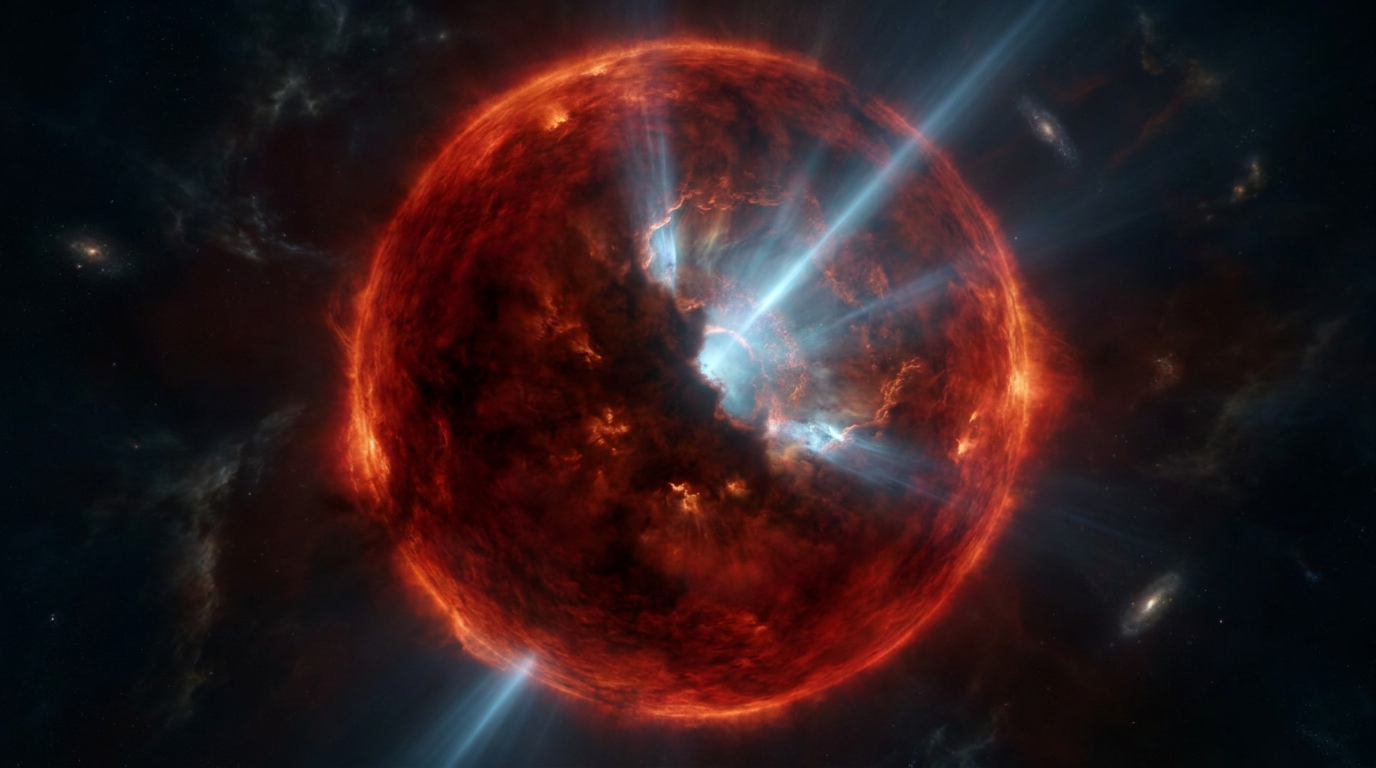
The verdict is both elegant and extreme: GLIMPSE-17775 is not an impossibly mature galaxy, but rather a "Black Hole Star" (BH*). Despite the name, a black hole star is not a collapsing stellar object. Instead, it describes a ravenously feeding supermassive black hole that is completely enveloped in a thick, dense cocoon of partially ionized gas. This dense shroud acts as a cosmic disguise, masking the ferocious central engine and tricking telescopes into seeing a gentle, starlike red glow.[1][2][4][5]

Gathering the evidence required a stroke of cosmic luck. GLIMPSE-17775 happens to sit directly behind a massive foreground galaxy cluster known as Abell S1063. The immense gravity of this cluster warps the fabric of spacetime, acting as a natural magnifying glass in a phenomenon called gravitational lensing. While JWST stared at the target for 30 hours, the lensing effect amplified the light, yielding the equivalent of 80 hours of continuous telescope observation.[1][2][4][5]
This unprecedented depth allowed the team to tease out more than 40 distinct spectral lines—the chemical fingerprints of the object's interior. According to Kokorev, analyzing the data was like finding a scattered puzzle on the floor and watching the pieces slowly form a single, coherent image. The spectrum revealed strong emission features from ionized oxygen, helium, and an abundance of iron that the team dubbed an "iron forest." These specific signatures require a massive, high-energy source to strip electrons from atoms, perfectly matching the profile of an actively feeding 5-million-solar-mass black hole.[1][2][3][4][6]
This unprecedented depth allowed the team to tease out more than 40 distinct spectral lines—the chemical fingerprints of the object's interior.
The most crucial piece of evidence came from how the light behaved before it escaped into space. The spectrum showed clear signs of electron scattering, meaning the photons did not travel in a straight line from the source. Instead, they ricocheted off a dense wall of particles. This scattering only occurs when the surrounding gas cocoon is incredibly thick—far denser than the interstellar medium found in ordinary galaxies.[2][3]

This dense shroud elegantly explains why previous observations failed to identify the black holes. Typically, actively feeding supermassive black holes emit blinding amounts of high-energy X-rays. However, little red dots have remained stubbornly quiet in X-ray surveys. The BH* model resolves this contradiction: the thick gas cocoon absorbs the brutal X-ray radiation, preventing it from escaping. The gas then heats up and re-emits that energy at longer, softer infrared wavelengths, producing the characteristic red hue that JWST detects.[2][4][5]
The new data also resolved a lingering anomaly regarding the object's host environment. Most little red dots exhibit a sharp dip in their light spectrum known as a "Balmer break," but GLIMPSE-17775's break was unusually weak. The combined data from JWST and the Hubble Space Telescope revealed that this specific black hole star is surrounded by a giant host galaxy. The excess blue light from the host galaxy's stellar population washes out the Balmer break, perfectly aligning with the theoretical predictions of the BH* model.[1][2]

For the cosmological community, the confirmation of the black hole star model brings a profound sense of relief. The early universe is not broken; it is simply hiding its monsters in plain sight. Because these objects are supermassive black holes rather than impossibly massive galaxies, the standard models of cosmic evolution and structure formation remain intact. As Kokorev noted, "Everything fits, nothing is broken, and I think that makes the puzzle that is our universe even better."[3][5][6]
While the observational evidence is now overwhelming, the theoretical mechanics of how these objects form remain a frontier for discovery. Sadegh Khochfar, an astrophysicist at the University of Edinburgh who was not involved in the study, pointed out that the BH* scenario, while highly plausible, has not yet been replicated in self-consistent numerical simulations. Theorists must now build models that can accurately track the simultaneous formation of a supermassive black hole and its dense gas cocoon in the turbulent environment of the early universe.[4]
Furthermore, astronomers still need to determine the ultimate fate of these little red dots. They appear in large numbers around 600 million years after the Big Bang but seem to vanish by the time the universe is 2 billion years old. Researchers hypothesize that this disappearance marks the end of an intense, short-lived growth spurt. Eventually, the central black hole likely consumes or blows away its obscuring cocoon, evolving into a more traditional, visible active galactic nucleus.[2][4]

The discovery of GLIMPSE-17775 stands as a testament to the transformative power of the James Webb Space Telescope. By providing the deepest look yet into the cosmic dawn, JWST has turned a cosmological crisis into a triumph of observational astrophysics. As astronomers continue to sift through the telescope's vast datasets, the focus now shifts from identifying these mysterious red dots to understanding the ferocious engines that power them.[3][5][6]
How we got here
Summer 2022
JWST begins science operations and discovers an unexpected abundance of 'little red dots' in the early universe.
2022–2025
Astronomers debate whether the objects are impossibly mature galaxies or obscured black holes, fearing standard cosmology might be broken.
June 10, 2026
Researchers publish the deepest spectrum yet of a little red dot, confirming the 'black hole star' model.
Viewpoints in depth
Observational Astrophysicists
Focusing on the empirical data, this camp views the spectral lines as definitive proof of obscured black holes.
For astronomers operating the world's most powerful telescopes, the debate is settled by the data. The presence of over 40 distinct spectral lines, particularly the 'iron forest' and signs of electron scattering, leaves no room for alternative explanations. They argue that the chemical fingerprints perfectly match the profile of a high-energy central engine buried in dense gas, validating the capabilities of JWST to peer through cosmic dust and resolve long-standing mysteries.
Cosmological Theorists
Relieved that the findings align with existing models, this group emphasizes that the early universe is not 'broken.'
When little red dots were first discovered, theorists faced the terrifying prospect that galaxies were forming stars much faster than the laws of physics should allow. The confirmation that these objects are actually supermassive black holes is a massive relief. It means that the standard model of cosmic evolution—where structures grow gradually over time—remains intact. For this camp, the discovery is a triumph of standard cosmology, proving that the universe is simply adept at hiding its most extreme phenomena.
Numerical Modelers
While accepting the observational data, this group stresses the need for computer simulations to explain how these objects form.
Astrophysicists who build computer simulations of the universe acknowledge the strength of the JWST data but remain cautious about the mechanics. They point out that no current self-consistent numerical simulation has successfully modeled the simultaneous formation of a supermassive black hole and a gas cocoon dense enough to trap X-rays in the early universe. For this camp, the observational discovery is just the first step; the real work now lies in tweaking the physics engines of their simulations to replicate how a 'black hole star' actually comes into existence.
What we don't know
- How these supermassive black holes and their dense gas cocoons physically form so early in the universe.
- What exact mechanism causes the little red dots to seemingly vanish by the time the universe is 2 billion years old.
- Whether every little red dot discovered by JWST follows this exact 'black hole star' model, or if some are genuinely mature galaxies.
Key terms
- Black Hole Star (BH*)
- A configuration where a supermassive black hole is entirely enclosed by a dense gas cocoon, absorbing its X-rays and emitting infrared light.
- Gravitational Lensing
- A phenomenon where the immense gravity of a massive object, like a galaxy cluster, bends and magnifies the light of objects behind it.
- Spectrum
- The result of splitting light into its component colors, revealing dark and bright lines that act as chemical fingerprints for an object.
- Cosmological Redshift
- The stretching of light toward the red end of the spectrum as it travels across the expanding universe, used to measure distance and age.
- Electron Scattering
- A process where light photons bounce off electrons in a dense gas, indicating that the light is not traveling in a straight line from its source.
Frequently asked
What is a 'little red dot'?
A class of compact, intensely red objects discovered by the James Webb Space Telescope in the early universe, originally thought to be impossibly mature galaxies.
What is a 'black hole star'?
A theoretical model describing a rapidly growing supermassive black hole that is completely surrounded by a thick, dense cocoon of gas, masking its true nature.
Why did astronomers think these objects broke cosmology?
If the little red dots were actually galaxies, they would contain too many stars for how early they appeared in the universe, contradicting models of how fast galaxies can grow.
How did gravitational lensing help this discovery?
A massive galaxy cluster sitting in front of the target warped spacetime, acting as a magnifying glass that turned 30 hours of observation into the equivalent of 80 hours.
Why couldn't we see these black holes before?
The dense gas cocoon surrounding the black hole absorbs the high-energy X-rays that astronomers usually use to detect them, re-emitting the energy as infrared light.
Sources
Source coverage
6 outlets
3 viewpoints surfaced






[1]NASAObservational Astrophysicists
NASA Webb Finds Strongest Evidence Yet for 'Black Hole Stars'
Read on NASA →[2]Space.comObservational Astrophysicists
James Webb Space Telescope may be close to solving the mystery of 'little red dots' in the early universe
Read on Space.com →[3]MashableCosmological Theorists
Astronomers now have stronger evidence that mysterious 'little red dots' found in the early universe could come from black holes
Read on Mashable →[4]Sky & TelescopeNumerical Modelers
A deep spectrum of a mysterious 'little red dot' reveals a supermassive black hole cocooned in gas
Read on Sky & Telescope →[5]Universe TodayObservational Astrophysicists
The Little Red Dots That Turned Out to Be Black Holes in Disguise
Read on Universe Today →[6]Sci.NewsObservational Astrophysicists
Webb Delivers Strongest-Ever Case for 'Black Hole Stars' Lurking in Early Universe
Read on Sci.News →


Every angle. Every day.
Get science stories with full source coverage and perspective breakdowns delivered to your inbox.