
Midjourney Pivots to Healthcare With 60-Second Full-Body Ultrasound Scanner
The AI image-generation company has unveiled 'The Midjourney Scanner,' a water-based ultrasonic imaging system that aims to deliver MRI-like body maps in under a minute.
By Factlen Editorial Team
- Consumer Health Optimizers
- Advocates who view the scanner as a breakthrough for proactive, data-driven personal wellness.
- Medical Imaging Skeptics
- Clinicians and physicists who caution that ultrasound has fundamental limits that compute cannot entirely solve.
- AI & Hardware Technologists
- Engineers fascinated by the sheer scale of the data processing and the pivot from generative models to physical sensors.
What's not represented
- · Traditional MRI Manufacturers
- · Health Insurance Providers
Why this matters
If successful, this technology could democratize preventative medical imaging, turning expensive, time-consuming MRI-style scans into a quick, accessible consumer health habit.
Key points
- Midjourney has launched a medical division and unveiled a full-body ultrasound scanner.
- The device uses a ring of 358,000 sensors and a water bath to capture 3D body maps in 60 seconds.
- The company aims to provide MRI-like image quality without radiation or powerful magnetic fields.
- Midjourney plans to open a flagship wellness spa in San Francisco by late 2027 to deploy the first units.
Midjourney, the artificial intelligence lab famous for generating surreal digital art from text prompts, has announced a radical departure from its software roots. At an event in San Francisco, CEO David Holz unveiled "Midjourney Medical" and its first hardware product: a full-body ultrasound machine dubbed The Midjourney Scanner.[1][3]
The announcement marks a highly unusual transition from generative AI to physical medical sensing. Holz described the device as the "first new whole-body medical imaging modality in 50 years," aiming to provide detailed 3D maps of human tissue, fat, muscle, and organs.[4][6]
The core claim is ambitious: Midjourney states the scanner can deliver image quality comparable to a magnetic resonance imaging (MRI) machine, but in just 60 seconds. Unlike standard CT scans or X-rays, the system uses no ionizing radiation, and unlike MRIs, it requires no powerful magnetic fields.[1][5][6]
The system relies on a technique known as "Ultrasonic CT" (computed tomography). To undergo a scan, a user steps onto a platform that slowly descends into a shallow pool of water at a rate of roughly two inches per second. Water is necessary because ultrasonic waves travel efficiently through liquid, allowing the sensors to capture clean acoustic reflections from the body without interference from the air.[2][4][5]

The physical architecture of the scanner is built in partnership with Butterfly Network, a company known for pioneering handheld "Ultrasound-on-Chip" technology. Midjourney's system arranges 40 of these advanced imaging modules into a 70-centimeter-diameter ring.[1][7]
In total, the ring houses approximately 358,000 individual ultrasonic elements. As the user passes through the ring, these transducers emit sound waves from multiple angles, recording the ripples that bounce back from internal structures to map the body down to a fraction of a millimeter.[2][4]
This is where Midjourney's data science expertise becomes relevant. The scanner generates an immense volume of raw acoustic data, capturing information at a staggering rate of 17 gigabytes per second. A single full-body slice produces roughly 40 gigabytes of data.[4][6]
This is where Midjourney's data science expertise becomes relevant.
Reconstructing this raw acoustic scatter into a clean, accurate 3D map is a massive "inverse problem" in physics and signal processing. Midjourney reportedly utilizes 21 dedicated servers per scan to process the data, applying advanced machine learning algorithms to translate sound wave reflections into visual structural representations.[4][5]

Rather than selling the first-generation machines directly to hospitals, Midjourney is targeting the consumer wellness market. The company plans to open a flagship "Midjourney Spa" in San Francisco by the end of 2027.[1][6]
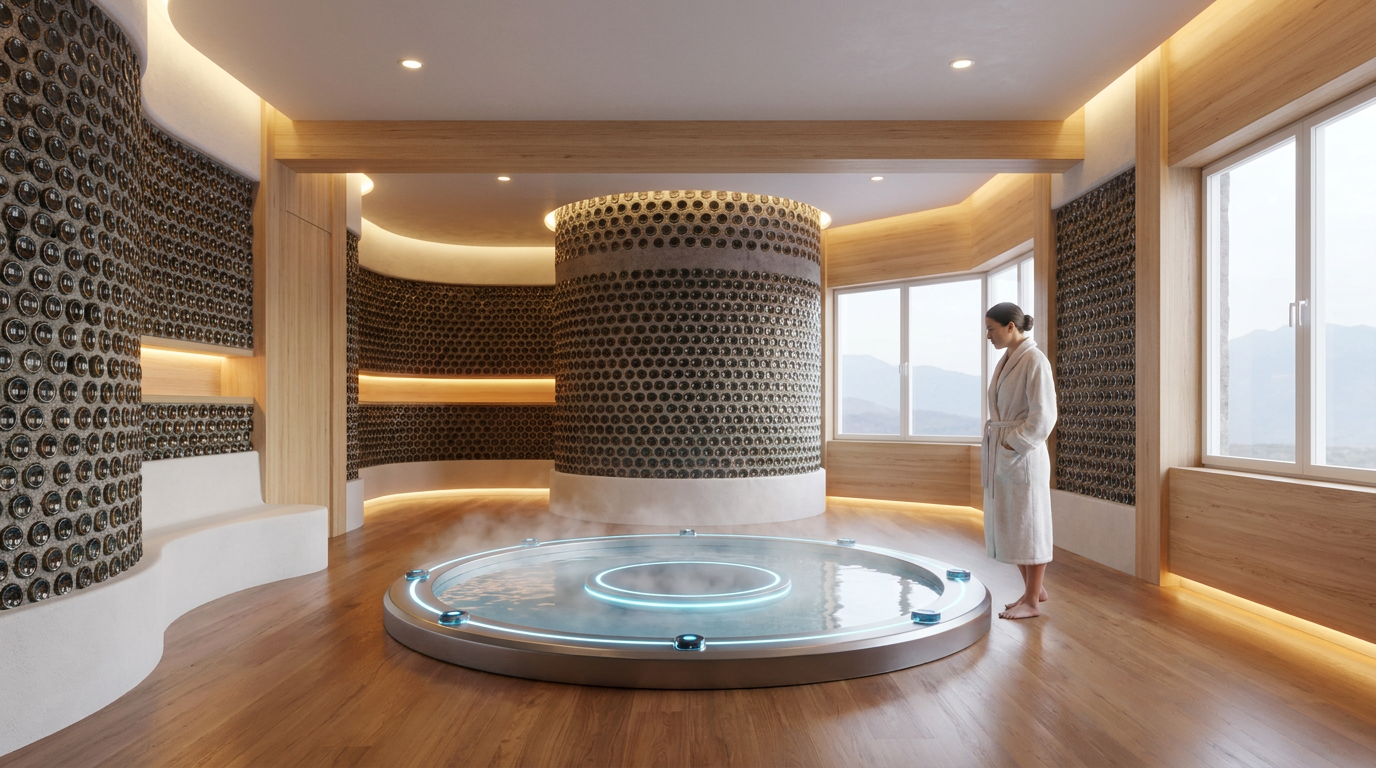
The facility is designed to feel "as casual as a trip to the spa," featuring hot tubs, saunas, cold plunges, and 10 of the new scanners. The goal is to normalize frequent, even daily, body composition tracking, allowing users to see exactly how diet, exercise, and aging affect their internal biology over time.[2][3][4]
Midjourney is deliberately starting with "body composition maps" rather than diagnostic medical imaging. By framing the initial output as wellness and fitness tracking, the company can bypass the immediate need for stringent Food and Drug Administration (FDA) diagnostic approvals.[2][5]
However, the company has stated that FDA approval for diagnostic capabilities is the next major hurdle for its subsequent hardware generations. Proving that an ultrasound-based system can reliably detect tumors or anomalies with the same fidelity as an MRI will require extensive clinical trials.[2][8]

Medical imaging experts note significant physical limitations to ultrasound technology. While sound waves excel at imaging soft tissue, they struggle to penetrate dense bone or image structures trapped behind air pockets, such as the lungs. Whether Midjourney's computational reconstruction can fully overcome these acoustic shadows remains unproven in peer-reviewed literature.[8]
Furthermore, the economic viability of the spa model is untested. While the hardware avoids the massive cooling and shielding costs of an MRI, maintaining a fleet of water-based robotic scanners and the required server farms will carry substantial overhead.[4]
Despite the hurdles, Midjourney's roadmap is aggressive. The company aims to release a second-generation scanner by the end of 2026, followed by a third-generation system utilizing custom silicon in 2028.[2]

By 2031, Holz envisions deploying 50,000 scanners worldwide, capable of performing a billion full-body scans every month. If realized, this infrastructure could shift the paradigm of medical imaging from a rare, reactive diagnostic tool into a continuous, proactive health monitor for the general population.[3][4][6]
How we got here
November 2025
Midjourney signs a licensing agreement with Butterfly Network for exclusive rights to its Ultrasound-on-Chip technology.
June 2026
Midjourney Medical is officially announced, alongside the prototype Midjourney Scanner.
Late 2026
Target release window for the second-generation scanner hardware.
Late 2027
Planned opening of the flagship "Midjourney Spa" in San Francisco.
2028
Anticipated launch of the third-generation scanner utilizing custom silicon.
2031
Midjourney's stated goal to have 50,000 scanners deployed globally.
Viewpoints in depth
Consumer Health Optimizers
Advocates who view the scanner as a breakthrough for proactive, data-driven personal wellness.
This camp argues that modern medicine is too reactive, relying on expensive MRIs only after symptoms appear. By framing the scanner as a "spa" experience and focusing initially on body composition, they believe Midjourney can democratize internal health tracking. If users can see real-time changes in visceral fat, muscle density, and organ health, it could drive massive behavioral shifts in diet and exercise.
Medical Imaging Skeptics
Clinicians and physicists who caution that ultrasound has fundamental limits that compute cannot entirely solve.
Skeptics point out that while "Ultrasonic CT" is a fascinating engineering feat, physics dictates that high-frequency sound waves cannot easily penetrate dense cortical bone or image through the air-filled cavities of the lungs. They argue that claiming "MRI-like quality" is premature until peer-reviewed clinical trials prove the AI reconstruction can accurately infer structures hidden in acoustic shadows without hallucinating details.
AI & Hardware Technologists
Engineers fascinated by the sheer scale of the data processing and the pivot from generative models to physical sensors.
For the tech community, the story is about the "inverse problem." Capturing 17 gigabytes of raw acoustic data per second and using 21 servers to reconstruct a millimeter-accurate 3D map is a monumental computational challenge. They view Midjourney's move as a signal that the next frontier for AI labs isn't just generating synthetic media, but using machine learning to interpret complex, high-bandwidth signals from the physical world.
What we don't know
- Whether the AI reconstruction can accurately image structures hidden behind dense bone or air-filled lungs.
- How quickly the FDA will approve the device for actual diagnostic medical use, rather than just body composition tracking.
- The true cost per scan for consumers once the San Francisco spa opens.
Key terms
- Ultrasonic CT
- A computed tomography technique that uses ultrasound waves, rather than X-rays, to create cross-sectional images of the body.
- Transducer
- A device that converts electrical energy into high-frequency sound waves and vice versa, serving as the core sensor in ultrasound machines.
- Inverse Problem
- A mathematical framework used to calculate the causal factors that produced a set of observations—in this case, using the scattered echoes of sound waves to deduce the shape of internal organs.
- Acoustic Shadow
- An area where ultrasound waves fail to penetrate (often behind dense bone or air), resulting in a lack of echo data for the structures behind it.
Frequently asked
Does the Midjourney Scanner use radiation?
No. Unlike X-rays or traditional CT scans, the device uses high-frequency sound waves (ultrasound) to map the body, which does not expose the user to ionizing radiation.
Why does the scanner use water?
Ultrasonic waves travel much more efficiently through liquids than through air. Submerging the user in water allows the sensors to capture clear, uninterrupted acoustic reflections from the body.
Is the scanner FDA approved for medical diagnosis?
Not yet. Midjourney is initially launching the device for "body composition maps" (tracking fat and muscle), which bypasses the strict FDA approvals required for diagnostic medical equipment.
How long does a scan take?
The company claims a full-body scan will take approximately 60 seconds, compared to the 60 to 90 minutes typically required for a full-body MRI.
Sources
Source coverage
8 outlets
3 viewpoints surfaced








[1]The VergeConsumer Health Optimizers
Midjourney Medical goes from generating 'cat images' to full-body ultrasound scans
Read on The Verge →[2]EngadgetAI & Hardware Technologists
Midjourney, the AI image generator, is developing a full-body ultrasonic scanner
Read on Engadget →[3]BloombergConsumer Health Optimizers
AI Startup Midjourney Pivots to Health With Ultrasound Machine
Read on Bloomberg →[4]Latent SpaceAI & Hardware Technologists
Midjourney's Medical Pivot
Read on Latent Space →[5]Times NowMedical Imaging Skeptics
The Midjourney Scanner: David Holz Announces AI-Powered Ultrasound Technology
Read on Times Now →[6]LetsDataScienceAI & Hardware Technologists
Midjourney announced a medical imaging project, calling it the Midjourney Scanner
Read on LetsDataScience →[7]Butterfly NetworkAI & Hardware Technologists
Ultrasound-on-Chip Technology
Read on Butterfly Network →[8]Journal of Ultrasound in MedicineMedical Imaging Skeptics
Advances in Whole-Body Ultrasound Tomography
Read on Journal of Ultrasound in Medicine →

Every angle. Every day.
Get technology stories with full source coverage and perspective breakdowns delivered to your inbox.