
The Science of the Maillard Reaction: How Heat and Chemistry Transform Home Cooking
The Maillard reaction is the chemical engine behind the savory flavors of seared steaks, roasted coffee, and baked bread. Understanding how to manipulate temperature, moisture, and pH allows home cooks to unlock restaurant-quality depth in everyday meals.
By Factlen Editorial Team
- Professional Chefs
- Focus on practical kitchen applications, emphasizing moisture control, pan spacing, and sensory cues to achieve the perfect sear.
- Culinary Scientists
- Focus on the molecular pathways, pH manipulation, and precise temperature thresholds that govern flavor synthesis.
- Public Health Researchers
- Monitor the high-heat byproducts of browning, warning that excessive pyrolysis can generate potentially harmful compounds.
What's not represented
- · Vegetarian and vegan cooks adapting Maillard techniques specifically for plant-based proteins
- · Industrial food flavorists who synthesize isolated Maillard compounds for processed snacks
Why this matters
Mastering the Maillard reaction shifts cooking from guesswork to applied science. By understanding the physical rules of heat and moisture, anyone can dramatically elevate the flavor of their food without buying expensive ingredients.
Key points
- The Maillard reaction is a chemical process between proteins and sugars that creates savory flavors.
- It requires temperatures between 280°F and 330°F to occur rapidly.
- Surface moisture prevents browning because water boils at 212°F, capping the temperature.
- Alkaline environments, like adding baking soda, significantly accelerate the browning process.
- Cooking above 350°F leads to pyrolysis, which burns food and destroys flavor compounds.
Have you ever wondered why a seared steak delivers a profoundly more satisfying flavor than one that has been boiled? Or why the golden-brown crust of a freshly baked baguette is infinitely more complex than its soft, pale interior? The answer lies not in the quality of the ingredients alone, but in a microscopic chemical dance that occurs when heat meets food. This phenomenon, responsible for the savory, nutty, and toasted flavors we associate with high-quality cooking, is known as the Maillard reaction. For home cooks, understanding this process is the crucial bridge between blindly following recipes and deliberately manipulating chemistry to achieve restaurant-quality flavor.[1][5]
First described in 1912 by French chemist Louis-Camille Maillard, the reaction is a form of non-enzymatic browning. Maillard was originally attempting to reproduce biological protein synthesis when he observed that amino acids and reducing sugars, when heated together, produced a distinct brown color and complex aromas. Today, chemistry Nobel Prize winner Jean-Marie Lehn refers to the Maillard reaction as "by far, the most widely practiced chemical reaction in the world." It is the engine behind the browning of roasted coffee, the dark crust of malted barley in beer, the golden exterior of French fries, and the savory depth of fried dumplings.[2][3]
To harness this reaction effectively, cooks must first understand the specific thermal conditions it requires. The Maillard reaction typically accelerates and becomes significant at temperatures between 280°F and 330°F (140°C to 165°C). At a microscopic level, the process begins when heat prompts a reactive carbonyl group of a sugar to interact with a nucleophilic amino group of an amino acid. This initial handshake forms an unstable intermediate called an Amadori compound. From there, a cascading series of chemical transformations occurs, breaking down these initial compounds into hundreds of new, highly aromatic flavor molecules.[2][4]

As the reaction progresses, these newly formed flavor compounds continue to break down and recombine, creating an exponential web of savory complexity. In the final stages of the reaction, large, complex polymer molecules called melanoidins are synthesized. These melanoidins are the pigments directly responsible for the appetizing brown color that coats perfectly seared meats and baked goods. It is important to distinguish this process from caramelization. While caramelization also produces browning and complex flavors, it is strictly the thermal breakdown of sugars. The Maillard reaction is uniquely defined by the mandatory presence of proteins—specifically amino acids—interacting with those sugars.[3][4]
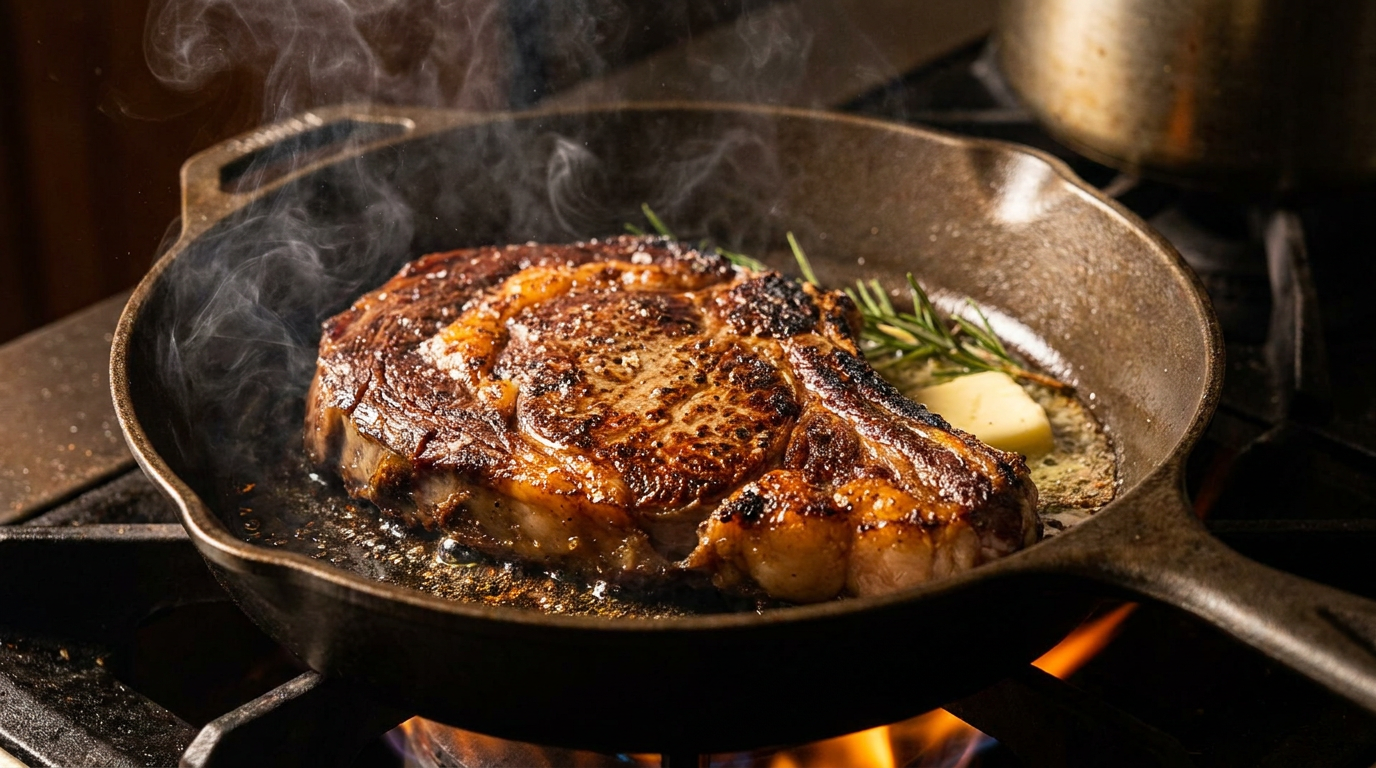
Because the Maillard reaction requires temperatures well above 280°F, surface moisture is the single greatest obstacle to achieving a proper sear. Water boils and evaporates at 212°F (100°C). If the surface of a steak, mushroom, or scallop is wet when it hits a hot pan, the thermal energy is entirely consumed by the process of evaporating that water. Until the moisture is completely gone, the surface temperature of the food cannot rise above 212°F. Consequently, the food effectively steams or boils in its own juices, resulting in a grey, unappealing exterior and a distinct lack of savory depth.[5][6]
Because the Maillard reaction requires temperatures well above 280°F, surface moisture is the single greatest obstacle to achieving a proper sear.
Overcoming this moisture barrier requires deliberate preparation. Culinary scientists and professional chefs universally recommend thoroughly drying the surface of meats and vegetables with paper towels before cooking. For an even more pronounced effect, cooks can employ a technique known as dry-brining. By salting a piece of meat and leaving it uncovered in the refrigerator overnight, the salt draws moisture to the surface where the circulating air evaporates it. This leaves the meat with a deeply seasoned interior and a perfectly desiccated exterior, primed to trigger the Maillard reaction the moment it makes contact with a hot skillet.[5][6]

Pan crowding is another common pitfall that stifles flavor development. When a cook fills a skillet to the brim with cold ingredients, the temperature of the pan plummets. Simultaneously, the sheer volume of food releases a massive amount of cellular moisture. The weakened heat source cannot evaporate the water fast enough, trapping the ingredients in a pool of simmering liquid. To maximize the Maillard reaction, experts advise cooking in batches, ensuring that at least twenty percent of the cooking surface remains visible. This maintains high heat and allows escaping steam to dissipate instantly.[6]
Beyond temperature and moisture, the speed of the Maillard reaction is heavily influenced by the pH level of the cooking environment. The chemical bonding between sugars and amino acids happens significantly faster in alkaline, or basic, conditions. Conversely, acidic environments actively inhibit the browning process. This principle is famously exploited in the creation of traditional Bavarian pretzels. Before baking, the raw dough is briefly submerged in a highly alkaline lye solution. This extreme pH spike on the dough's surface triggers an explosive Maillard reaction in the oven, resulting in the pretzel's signature dark, glossy brown crust and distinct alkaline flavor.[7][8]
Home cooks can utilize this pH trick to drastically reduce cooking times for notoriously slow recipes. Caramelizing onions—a process that relies heavily on both caramelization and the Maillard reaction—traditionally takes up to 45 minutes of constant stirring. However, adding just a fractional pinch of baking soda (an alkaline powder) to the pan alters the pH of the onions. This alkaline environment breaks down the cellular structure faster and accelerates the browning reactions, allowing cooks to achieve deep, jammy, deeply savory onions in a mere ten to fifteen minutes.[5][8]

Cooks can also manipulate the reaction by strategically introducing additional proteins or reducing sugars to the surface of their food. This is the scientific rationale behind applying an egg wash to pastries and breads before they enter the oven. The dough itself is primarily carbohydrate-based; by brushing it with protein-rich egg, the baker provides the exact chemical fuel needed to jumpstart the Maillard reaction, ensuring a rich, golden crust. Similarly, glazing a ham with a sweet, sugar-based marinade during the final stages of roasting provides the reducing sugars necessary to react with the meat's abundant proteins.[7][8]
While maximizing the Maillard reaction is generally desirable, there is a strict thermal limit. When temperatures exceed 330°F to 355°F (165°C to 179°C), the delicate browning process gives way to pyrolysis, or burning. At this stage, the complex flavor compounds are destroyed, replaced by acrid, bitter, and harsh flavors. Furthermore, pushing the reaction too far at excessively high temperatures can lead to the formation of acrylamide, a chemical compound that is a probable carcinogen. Managing the heat to stay within the sweet spot is essential for both flavor and health.[2][3]

Ultimately, the kitchen is a laboratory, and cooking is an exercise in applied chemistry. The Maillard reaction proves that achieving exceptional flavor is not about relying on expensive ingredients or secret family recipes; it is about understanding the physical laws that govern food. By controlling surface moisture, managing pan temperatures, and occasionally tweaking pH levels, any home cook can unlock the profound, savory complexities hidden within their everyday ingredients, transforming routine meals into masterful culinary experiences.[1][8]
How we got here
1912
French chemist Louis-Camille Maillard first describes the chemical reaction between amino acids and sugars.
1953
Chemist John E. Hodge publishes the definitive mechanism outlining the complex pathways of the Maillard reaction.
Early 2000s
The rise of molecular gastronomy brings precise chemical manipulation, like pH adjustment, into mainstream culinary education.
Viewpoints in depth
Culinary Scientists
Focus on the molecular breakdown and precise environmental manipulation to optimize flavor synthesis.
For food scientists and chemists, the Maillard reaction is a predictable equation. They view cooking as an exercise in manipulating variables—specifically temperature, moisture, and pH. By understanding that alkaline environments accelerate the breakdown of cellular structures and speed up the bonding of amino acids and sugars, scientists advocate for precise interventions, like using baking soda to cut onion caramelization times by seventy percent. Their focus remains on the microscopic pathways that turn basic proteins into complex melanoidins.
Professional Chefs
Focus on the practical, sensory application of heat and moisture control to achieve the perfect sear.
In the high-pressure environment of a professional kitchen, chefs rely on sensory cues and practical techniques rather than thermometers and pH strips. Their approach to the Maillard reaction centers on rigorous moisture control—obsessively patting proteins dry and utilizing dry-brining techniques to ensure a desiccated surface. They emphasize pan real estate, warning that overcrowding traps steam and ruins the sear. For chefs, the reaction is measured by the sound of the sizzle and the aroma of developing flavor compounds.
Public Health Researchers
Monitor the high-heat byproducts of browning, warning against the dangers of excessive pyrolysis.
While culinary professionals chase the deepest brown crust possible, public health researchers caution against crossing the line from browning to burning. They point out that when the Maillard reaction is pushed past 350°F, it enters pyrolysis. This extreme heat not only destroys delicate flavor compounds but also generates acrylamide, a chemical byproduct classified as a probable carcinogen. Their perspective emphasizes moderation, advocating for lower cooking temperatures and avoiding heavily charred foods to balance flavor with long-term health safety.
What we don't know
- The exact composition of all the hundreds of distinct flavor molecules generated during the reaction, as they vary wildly based on the specific food.
- How to completely eliminate the formation of acrylamide in high-heat industrial food processing without compromising flavor.
Key terms
- Maillard reaction
- A chemical reaction between amino acids and reducing sugars that gives browned food its distinctive flavor.
- Amino acids
- The fundamental building blocks of proteins, which provide the necessary nitrogen for the browning reaction.
- Reducing sugars
- Simple carbohydrates, like glucose and fructose, that easily interact and bond with other molecules under heat.
- Melanoidins
- Large, complex polymer molecules formed at the end of the Maillard reaction that give seared foods their brown color.
- Pyrolysis
- The chemical breakdown of organic materials at excessively high temperatures, resulting in burning and acrid flavors.
- Amadori compound
- An unstable intermediate molecule formed in the early stages of the Maillard reaction before breaking down into flavor compounds.
Frequently asked
What is the difference between caramelization and the Maillard reaction?
Caramelization is the thermal breakdown of pure sugars. The Maillard reaction is more complex, requiring the interaction of both sugars and amino acids (proteins) to create savory flavors.
Why does wet meat fail to brown in a pan?
Water evaporates at 212°F. If food is wet, the pan's heat energy is used to boil off the water, preventing the surface temperature from reaching the 280°F required to trigger the Maillard reaction.
Is the Maillard reaction dangerous to health?
The reaction itself is safe and creates desirable flavors, but pushing it too far into burning (pyrolysis) at temperatures above 350°F can produce acrylamide, a probable carcinogen.
Sources
Source coverage
8 outlets
3 viewpoints surfaced







[1]Factlen Editorial TeamCulinary Scientists
Synthesis by Factlen editorial team
Read on Factlen Editorial Team →[2]MasterClassProfessional Chefs
What Is the Maillard Reaction?
Read on MasterClass →[3]WikipediaPublic Health Researchers
Maillard reaction
Read on Wikipedia →[4]HowStuffWorksPublic Health Researchers
The Maillard Reaction and the Science of Browning Foods
Read on HowStuffWorks →[5]Otto ChefProfessional Chefs
The Science of Searing: Mastering the Maillard Reaction
Read on Otto Chef →[6]MÄNNKITCHENProfessional Chefs
Top 5 Maillard Reaction Tips from MÄNNKITCHEN
Read on MÄNNKITCHEN →[7]KhymosCulinary Scientists
Maximizing the Maillard reaction
Read on Khymos →[8]NTI SchoolCulinary Scientists
Kitchen as Laboratory: The Maillard Reaction
Read on NTI School →



Every angle. Every day.
Get lifestyle stories with full source coverage and perspective breakdowns delivered to your inbox.