
How Lab-Grown Materials Are Redefining Luxury Fashion in 2026
High-end fashion houses are increasingly turning to bio-fabricated materials like mycelium leather and algae fibers to meet climate goals without sacrificing quality. As production scales, these lab-grown alternatives are moving from experimental prototypes to commercial staples.
By Factlen Editorial Team
- Material Innovators
- Biotech startups and researchers arguing that lab-grown materials offer superior traceability, lower environmental impact, and unprecedented design flexibility.
- Heritage Luxury Houses
- Established brands viewing bio-materials as a necessary expansion of their craftsmanship and a vital tool for meeting corporate climate targets, rather than a total replacement for traditional leather.
- Sustainability Advocates
- Environmental watchdogs pushing for the complete elimination of synthetic polyurethane coatings in bio-leathers to ensure true circularity and biodegradability.
What's not represented
- · Garment workers in traditional textile supply chains
- · Conventional leather tanners and agricultural producers
Why this matters
The materials used in our clothing and accessories account for a massive portion of global carbon emissions and water use. The commercialization of bio-fabricated textiles proves that sustainable, cruelty-free alternatives can meet the exacting standards of the world's most exclusive brands, paving the way for broader industry adoption.
Key points
- Luxury fashion is rapidly adopting bio-fabricated materials, such as mycelium and algae, to meet aggressive climate and sustainability goals.
- Mycelium leather is grown from fungal root networks in just 7 to 14 days, offering a 90% reduction in global warming potential compared to traditional materials.
- Major conglomerates like LVMH and Kering have established dedicated innovation labs to integrate these lab-grown textiles into their supply chains.
- While scaling and cost remain challenges, brands view next-gen materials as an expansion of luxury craftsmanship rather than a complete replacement for heritage leather.
The definition of luxury is evolving. Exotic animal skins and resource-heavy silks are no longer the sole markers of high-end fashion. In 2026, the ultimate luxury is innovation—specifically, materials grown in a laboratory.[8]
The shift is being driven by a convergence of climate urgency, shifting consumer values, and impending regulations like the European Union's Digital Product Passport, which will soon require brands to disclose the exact environmental footprint of their garments.[1][7]
To meet these demands without compromising on quality, fashion powerhouses are turning to "bio-fabrication." This process uses biotechnology to grow textiles from living organisms such as fungi, algae, and microbes, bypassing the need for animal agriculture or petroleum extraction.[2][8]
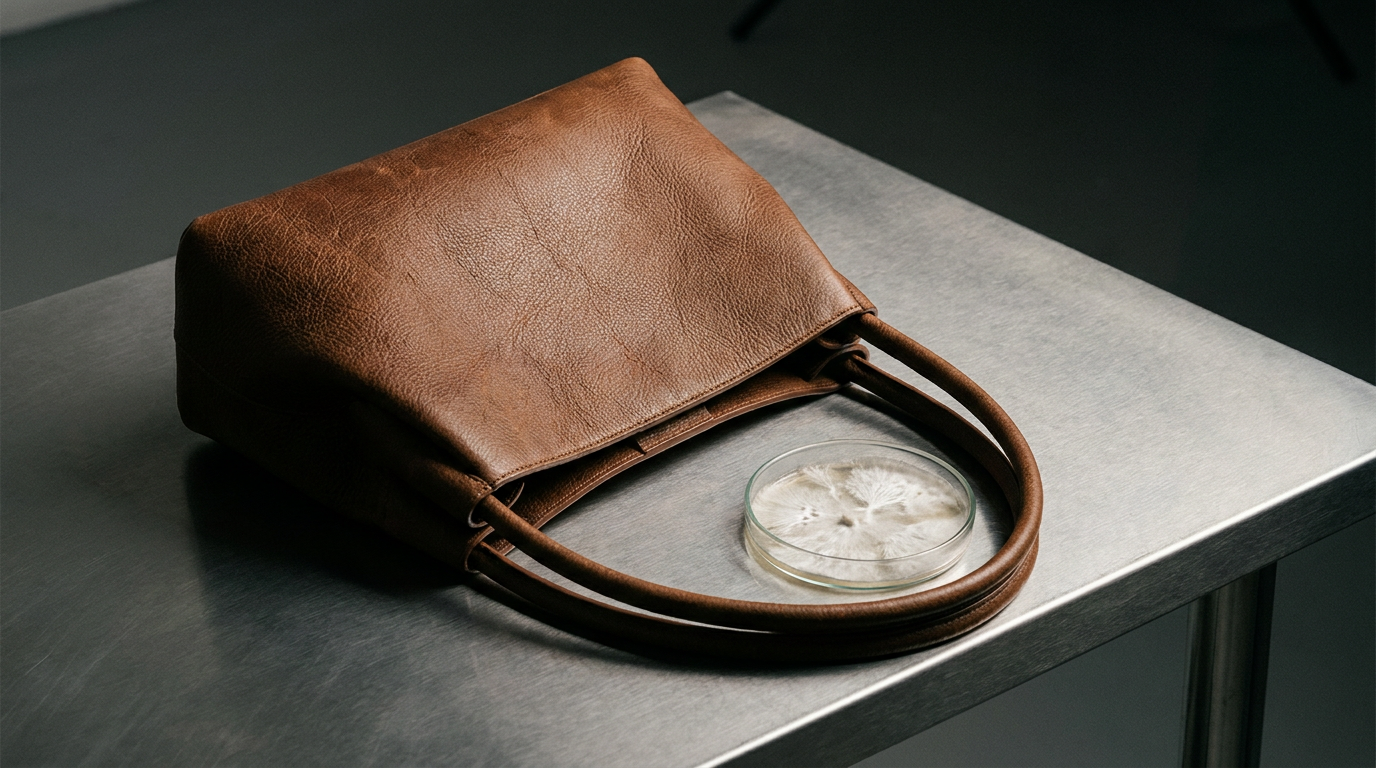
The undeniable star of this material revolution is mycelium leather. While often colloquially called "mushroom leather," the material is actually cultivated from the underground root-like network of fungi, known as hyphae.[1][8]
The production mechanism is a masterclass in biological efficiency. Biotech companies feed agricultural waste—such as sawdust or hemp hurds—to mycelium cells in a controlled, dark, and warm vertical farming environment.[2][8]

Within just seven to fourteen days, the microscopic threads knit themselves together into a dense, interlocking mat. This raw material is then harvested and treated using chromium-free, low-impact tanning processes to achieve the supple texture and durability of premium calfskin.[2][8]
The environmental math is compelling. Next-generation materials like mycelium offer greater than a 90 percent reduction in global warming potential compared to their conventional counterparts. They require a fraction of the water and land needed for cattle farming and avoid the toxic chemical runoff associated with traditional leather tanning.[4]
Beyond fungi, innovators are tapping into marine ecosystems. Algae-based materials are emerging as a highly scalable alternative to water-intensive crops like cotton. Derived from red algae or marine biomass, these fibers can be spun into flexible, breathable textiles.[2][3]
Beyond fungi, innovators are tapping into marine ecosystems.
Because algae grows rapidly and requires no agricultural land or freshwater, it represents a crucial upstream diversification for an industry heavily reliant on a narrow basket of traditional fibers.[2]

The transition from experimental prototypes to commercial reality has accelerated dramatically. In 2023, the Material Innovation Initiative tracked over 380 collaborations between next-gen material startups and major brands. By 2026, these partnerships have matured into scalable supply chains.[4]
Heritage luxury houses are leading the charge. Hermès set an early benchmark by partnering with California-based biotech firm MycoWorks to develop "Sylvania," a luxury-grade mycelium material that has been integrated into the brand's iconic travel bags.[3][8]
Similarly, Stella McCartney and Kering—the parent company of Gucci and Balenciaga—have invested heavily in Bolt Threads' "Mylo" material. Kering's dedicated Material Innovation Lab in Milan now houses thousands of sustainable fabric samples, actively working to integrate bio-fabricated options across its portfolio.[3][6]
LVMH has also embedded these innovations into its core strategy. Through its "LIFE 360" environmental program, the conglomerate aims to have 100 percent of its strategic raw materials certified for ecosystem preservation by 2026, driving massive investments into circular design and regenerative agriculture.[5]

Despite the rapid progress, the bio-fabrication sector faces legitimate hurdles. Scaling production to meet global demand remains a complex logistical challenge, and the cost of lab-grown textiles still positions them strictly within the premium market.[1][8]
Furthermore, sustainability advocates point out a critical technical compromise: to achieve the abrasion resistance required for footwear and outerwear, some early bio-leathers still rely on thin polyurethane coatings.[2][8]
While these coatings improve durability, they significantly reduce the material's biodegradability at the end of its lifecycle, complicating the industry's promise of a fully circular economy. Innovators are currently racing to develop entirely bio-based finishing treatments to solve this bottleneck.[2][8]
Interestingly, the rise of bio-fabricated textiles is not currently viewed as a zero-sum game against traditional materials. Industry analysts note that luxury brands are approaching next-gen materials as an expansion of their creative palette rather than an immediate substitution for heritage leather.[1][8]

Traditional leather still commands deep cultural trust for its longevity and repairability—qualities that distribute its environmental impact over decades of use. Bio-materials, meanwhile, offer a new narrative of progress, ethical alignment, and technological mastery.[1]
Ultimately, the integration of bio-fabricated materials signals a profound shift in how value is communicated in luxury fashion. A garment's worth is no longer measured solely by its rarity or the labor required to extract it, but by the ingenuity required to grow it in harmony with the planet.[1][8]
How we got here
2013
Kering launches the Material Innovation Lab in Milan to source and test sustainable fabrics.
2020
LVMH launches the LIFE 360 environmental initiative to drive circular design and ecosystem preservation.
2021
Hermès debuts a prototype Victoria bag using Sylvania, a luxury-grade mycelium leather.
2023
Over 380 collaborations are recorded globally between next-gen material startups and major fashion brands.
2026
The impending EU Digital Product Passport accelerates the commercial adoption of traceable, low-impact bio-materials.
Viewpoints in depth
Material Innovators
Biotech startups argue that lab-grown materials represent the inevitable future of textiles.
Companies pioneering bio-fabrication view traditional agriculture and petroleum extraction as outdated, inefficient methods for producing textiles. By growing materials in controlled, vertical farming environments, they argue that the fashion industry can achieve unprecedented traceability and a massive reduction in carbon emissions. For these innovators, the goal is not just to mimic animal leather, but to engineer materials that eventually surpass it in performance, customization, and environmental safety.
Heritage Luxury Houses
Established brands view bio-materials as an expansion of their craftsmanship.
For centuries, luxury houses have built their reputations on the mastery of rare, natural materials. Rather than viewing bio-fabricated textiles as a threat to their heritage, major conglomerates are embracing them as a new medium for high-end craftsmanship. These brands argue that traditional leather will remain a foundational material due to its proven longevity and repairability, but that next-generation materials are essential for meeting corporate climate targets and satisfying the ethical demands of younger consumers.
Sustainability Advocates
Environmental watchdogs push for complete circularity without synthetic compromises.
While celebrating the shift away from animal agriculture and virgin plastics, sustainability advocates remain cautious about the technical compromises currently required to bring bio-materials to market. They point out that many "plant-based" or "lab-grown" leathers still rely on thin polyurethane (PU) coatings to achieve the abrasion resistance necessary for commercial footwear and handbags. These advocates argue that until these materials are 100 percent bio-based and fully compostable, the industry's promise of a truly circular economy remains unfulfilled.
What we don't know
- When the cost of bio-fabricated materials will reach parity with mass-market synthetic leathers.
- Whether innovators can completely phase out polyurethane coatings without sacrificing the abrasion resistance required for footwear.
- How traditional leather artisans and tanneries will adapt their generational skills to work with lab-grown materials at scale.
Key terms
- Bio-fabrication
- The process of using living organisms like bacteria, yeast, algae, or fungi to grow materials and textiles in a controlled environment.
- Mycelium
- The underground, root-like network of fungi, consisting of microscopic branching threads called hyphae that can be grown into dense mats.
- Polyurethane (PU)
- A synthetic plastic polymer often used as a coating on artificial leathers to improve durability and water resistance, though it reduces biodegradability.
- Circularity
- An economic and design model aimed at eliminating waste by ensuring materials can be continuously reused, recycled, or safely composted at the end of their life.
Frequently asked
Is mushroom leather exactly the same as animal leather?
While it mimics the texture, flexibility, and durability of animal leather, mycelium leather is entirely vegan. It is grown from fungal root networks in a lab over a few weeks, rather than raised on a farm over several years.
Are bio-fabricated materials 100% biodegradable?
Most raw bio-materials are fully compostable. However, some commercial versions currently use thin synthetic polyurethane coatings to improve durability for footwear, which can hinder complete biodegradability.
Why are these materials mostly found in luxury brands?
The research, development, and scaling of bio-fabricated textiles are highly capital-intensive. Luxury brands have the profit margins and investment capital required to pioneer these materials before they become cheap enough for mass-market fashion.
Sources
Source coverage
8 outlets
3 viewpoints surfaced








[1]APLF LimitedHeritage Luxury Houses
How Next-Gen Fashion Materials Rise to Power
Read on APLF Limited →[2]World CollectiveMaterial Innovators
Next-Gen Materials in Fashion: A Practical Guide for Brands
Read on World Collective →[3]TrellisSustainability Advocates
Fashion innovators turn to these next-gen climate-friendly materials
Read on Trellis →[4]Fashion UnitedSustainability Advocates
Brands flock to next-gen materials, new report shows
Read on Fashion United →[5]LVMHHeritage Luxury Houses
Our commitment for Environment - LVMH
Read on LVMH →[6]KeringHeritage Luxury Houses
Innovation Labs to reduce environmental footprint
Read on Kering →[7]HeuritechMaterial Innovators
Fabric innovation: Top textile trends & technologies for 2026
Read on Heuritech →[8]Factlen Editorial TeamMaterial Innovators
Synthesis by Factlen editorial team
Read on Factlen Editorial Team →

Every angle. Every day.
Get lifestyle stories with full source coverage and perspective breakdowns delivered to your inbox.