
Why Creatine Is Moving From the Weight Room to the Medicine Cabinet
Once known strictly as a muscle-building supplement, creatine is gaining recognition among scientists for its ability to support brain energy, improve memory, and promote healthy aging.
By Factlen Editorial Team
- Longevity and Aging Researchers
- Viewing creatine as a fundamental tool for cellular energy and neuroprotection.
- Sports Nutritionists
- Focusing on muscle mass, power output, and traditional athletic applications.
- Clinical Skeptics
- Cautioning against overstating the cognitive benefits until larger trials are completed.
- Plant-Based Advocates
- Highlighting creatine as a necessary addition to vegetarian and vegan diets.
What's not represented
- · Pediatric Neurologists
Why this matters
Understanding creatine's cognitive and longevity benefits offers readers a safe, extensively researched, and inexpensive tool to protect their brain health and preserve physical independence as they age.
Key points
- Creatine monohydrate is increasingly recognized for its ability to support brain energy, not just muscle growth.
- The brain consumes 20% of the body's energy, and creatine helps rapidly regenerate its primary fuel source, ATP.
- Recent meta-analyses show creatine supplementation improves memory and processing speed, particularly in older adults.
- Vegetarians, vegans, and women often see the most pronounced benefits due to naturally lower baseline creatine stores.
- Combined with resistance training, creatine helps combat age-related muscle loss, which indirectly supports cognitive health.
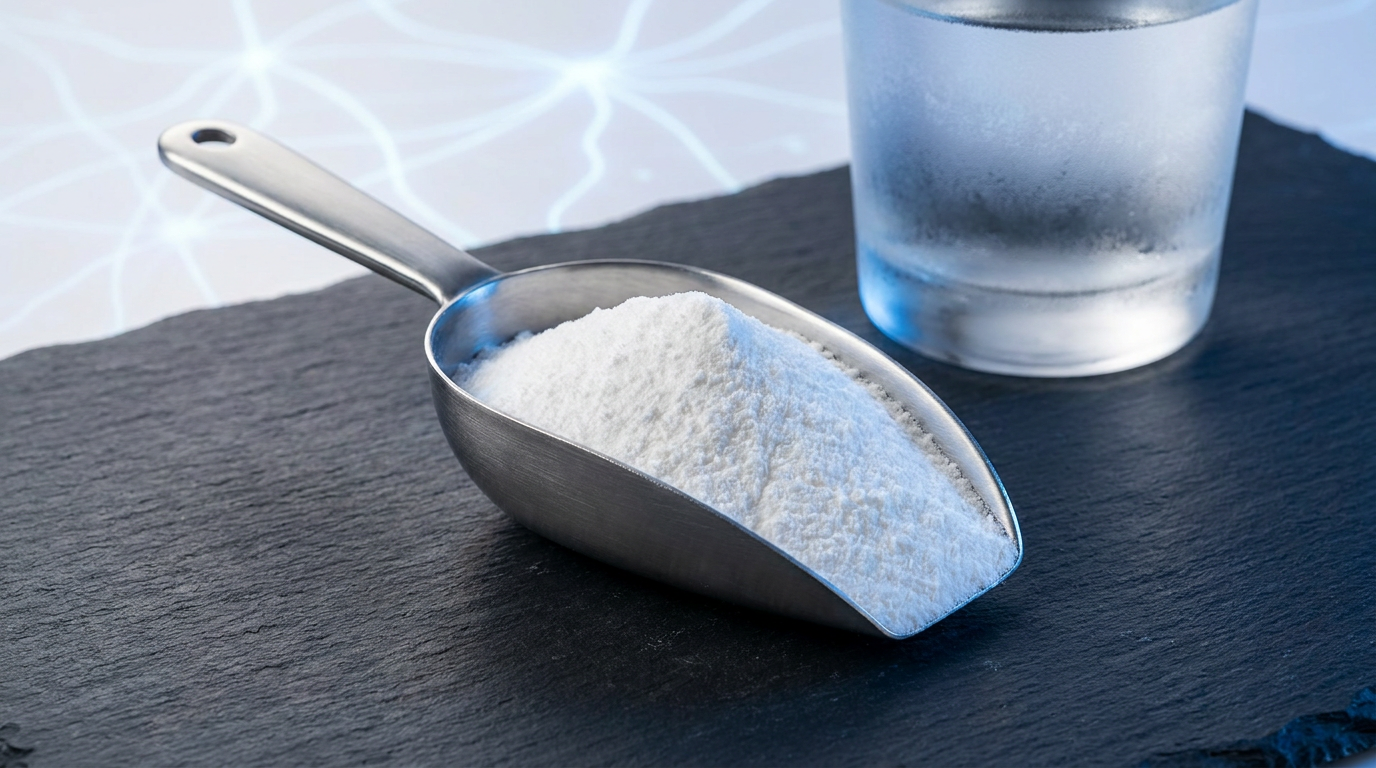
For decades, creatine monohydrate has been synonymous with the weight room. Sold in bulky plastic tubs, it was the undisputed king of sports supplements, prized by bodybuilders and sprinters for its ability to squeeze out one more repetition or shave a fraction of a second off a sprint.[3]
But in 2026, the conversation around this humble white powder has fundamentally shifted. Creatine is quietly moving from locker rooms to longevity clinics, neurology labs, and the daily routines of older adults. Scientists are increasingly viewing it not just as a muscle builder, but as a critical tool for neuroenergetics—the science of how the brain fuels itself.[4][6]
To understand why a sports supplement is making waves in cognitive research, you have to look at cellular energy. Every cell in the human body runs on a molecule called adenosine triphosphate, or ATP. The brain is an exceptionally energy-hungry organ; despite accounting for only about 2% of total body weight, it consumes roughly 20% of the body's resting energy.[6]
When neurons fire, they break ATP apart to release energy, leaving behind a depleted molecule called ADP. The brain's reserve of ATP is tiny, meaning it must be constantly regenerated. This is where creatine steps in. Stored in the body as phosphocreatine, it acts as a rapid-response phosphate donor, snapping its phosphate onto ADP to instantly create fresh ATP.[3]

By buffering the brain's energy supply, creatine helps neurons maintain their demanding workload. A comprehensive 2024 meta-analysis published in Frontiers in Nutrition, which reviewed 16 randomized controlled trials involving nearly 500 participants, found that creatine supplementation yielded statistically significant improvements in memory and information processing speed.[1]
These cognitive benefits appear most pronounced when the brain is under metabolic stress. Studies show that during periods of sleep deprivation, mental fatigue, or the natural energetic declines associated with aging, a larger reserve of brain creatine helps maintain clarity and executive function by smoothing out dips in cellular power.[2]
These cognitive benefits appear most pronounced when the brain is under metabolic stress.
The effects are not uniform across the population. Because humans obtain a significant portion of their baseline creatine from eating meat and fish, vegetarians and vegans typically have lower natural stores. Consequently, plant-based eaters often experience the most dramatic cognitive and physical improvements when they begin supplementing.[3]
Women also appear to be hyper-responders. Research indicates that women naturally possess lower baseline creatine stores in their muscles and brains compared to men. Supplementation has been shown to offer pronounced benefits for women, particularly in counteracting the muscle and bone density losses associated with menopause.[3]

Beyond the brain, creatine's traditional role in muscle preservation is taking on new importance in the context of healthy aging. Sarcopenia—the age-related loss of muscle mass and strength—is a primary driver of frailty and falls in older adults. A wealth of clinical data confirms that creatine, especially when combined with resistance training, significantly increases lean tissue and functional strength in aging populations.[5]
This physical preservation feeds directly back into cognitive health through what researchers call the "muscle-brain axis." Maintaining muscle mass allows older adults to stay physically active, which in turn promotes neuroplasticity and the release of brain-derived neurotrophic factor (BDNF), a compound that helps neurons grow and connect.[2]
The supplement industry has taken notice of this dual action. In 2026, manufacturers are increasingly formulating creatine with other longevity compounds, positioning it as an adjunct therapy for older adults and individuals taking GLP-1 weight-loss drugs, who are at high risk of losing lean muscle mass alongside fat.[4]

Emerging animal research also points to potential neuroprotective properties. Recent preclinical studies suggest that creatine may help reduce microglial activation—a marker of brain inflammation—and mitigate the oxidative stress that accumulates in aging neurons like biological rust.[2][6]
Despite the promising data, researchers caution that creatine is not a miracle cure for neurodegenerative diseases. While it supports healthy cognitive aging, evidence regarding its ability to improve global executive function in severe clinical populations remains mixed, and it is not a treatment for Alzheimer's disease or dementia.[1][2]

What scientists can say with confidence is that creatine monohydrate remains one of the most extensively studied, safe, and cost-effective supplements available. For those looking to support their cellular energy, a standard daily dose of 3 to 5 grams appears to offer a unique bridge between physical resilience and mental acuity.[3][6]
How we got here
1992
Creatine gains mainstream popularity in sports nutrition following the Barcelona Olympics.
2003
Early studies begin exploring creatine's potential neuroprotective effects in animal models.
2019
Comprehensive reviews establish creatine's role in preventing age-related muscle loss (sarcopenia).
2024
Major meta-analyses confirm statistically significant improvements in memory and processing speed in humans.
2026
The supplement industry shifts focus, marketing creatine alongside GLP-1 drugs for longevity and brain health.
Viewpoints in depth
Longevity and Aging Researchers
Viewing creatine as a fundamental tool for cellular energy and neuroprotection.
This camp argues that aging is fundamentally an energy problem. As mitochondria become less efficient, tissues with high energy demands—like the brain and skeletal muscle—suffer. By providing a backup pool of phosphocreatine, researchers believe supplementation can smooth out these energetic deficits, reducing the oxidative stress that leads to cognitive decline and physical frailty.
Clinical Skeptics
Cautioning against overstating the cognitive benefits until larger trials are completed.
While acknowledging the robust data on muscle mass, this group points out that the brain synthesizes its own creatine and is largely protected by the blood-brain barrier. They argue that while memory improvements in sleep-deprived or elderly individuals are statistically significant, the evidence does not yet support creatine as a treatment for complex executive dysfunction or neurodegenerative diseases like Alzheimer's.
Plant-Based Advocates
Highlighting creatine as a necessary addition to vegetarian and vegan diets.
Because the primary dietary sources of creatine are meat and fish, individuals on plant-based diets naturally exhibit lower intramuscular and cerebral creatine stores. This perspective emphasizes that for vegans and vegetarians, creatine isn't just an enhancement—it is a restorative supplement that brings their cellular energy buffers up to an optimal baseline, often resulting in dramatic improvements in both physical and mental fatigue.
What we don't know
- Whether long-term creatine supplementation can meaningfully delay the onset of age-related cognitive decline.
- The exact dosing protocols required to maximize brain saturation, as the brain absorbs creatine differently than skeletal muscle.
- How effective creatine is at improving complex executive function, as current data primarily shows benefits for memory and processing speed.
Key terms
- Adenosine Triphosphate (ATP)
- The primary molecule that stores and transfers energy within cells, essential for both muscle contractions and brain function.
- Phosphocreatine
- The stored form of creatine in the body, which acts as a rapid reserve of phosphate to quickly regenerate ATP during times of high energy demand.
- Sarcopenia
- The natural, age-related loss of skeletal muscle mass and strength, which can lead to frailty and a loss of independence.
- Muscle-Brain Axis
- The biological communication network between skeletal muscle and the brain, where physical activity and muscle health directly influence cognitive function and neuroplasticity.
Frequently asked
Does creatine cause hair loss?
There is no strong scientific evidence that creatine causes hair loss. This persistent myth stems from a single 2009 study showing a slight increase in DHT (a hormone linked to hair loss) in rugby players, but subsequent extensive research has failed to replicate this finding or link creatine to baldness.
Do I need to do a 'loading phase'?
No. While taking 20 grams a day for a week will saturate your muscles faster, taking a standard maintenance dose of 3 to 5 grams daily will achieve the exact same cellular saturation over the course of about 28 days.
Is creatine safe for my kidneys?
Yes, for healthy individuals. Decades of clinical trials have shown that creatine supplementation is safe and does not cause renal damage in people with healthy kidneys, though those with pre-existing kidney disease should consult a doctor.
Will creatine prevent Alzheimer's disease?
No. While creatine supports general brain energy and may improve memory in healthy older adults, there is currently no evidence that it can prevent, treat, or cure Alzheimer's disease or other severe neurodegenerative conditions.
Sources
Source coverage
6 outlets
4 viewpoints surfaced





[1]Frontiers in NutritionClinical Skeptics
Effects of creatine supplementation on cognitive function of healthy individuals: A systematic review of randomized controlled trials
Read on Frontiers in Nutrition →[2]National Institutes of HealthLongevity and Aging Researchers
Creatine Supplementation and Brain Health in Aging
Read on National Institutes of Health →[3]ScienceDailyPlant-Based Advocates
Creatine isn't just for muscles—it's a powerful energy booster with surprising brain and health potential
Read on ScienceDaily →[4]Nutritional OutlookSports Nutritionists
From sports performance to healthy aging, creatine finds new momentum
Read on Nutritional Outlook →[5]Journal of Clinical MedicineSports Nutritionists
Effect of Creatine Supplementation during Resistance Training on Muscle Accretion in the Elderly
Read on Journal of Clinical Medicine →[6]Factlen Editorial TeamLongevity and Aging Researchers
Synthesis by Factlen editorial team
Read on Factlen Editorial Team →


Every angle. Every day.
Get health stories with full source coverage and perspective breakdowns delivered to your inbox.