
How Midjourney's New Full-Body Ultrasound Scanner Actually Works
The AI company famous for generating digital art has unveiled a massive water-based ultrasound scanner, promising 60-second, radiation-free body mapping.
By Factlen Editorial Team
- Preventive Health Advocates
- View the scanner as a breakthrough that could make routine, radiation-free body tracking cheap and accessible.
- Medical Skeptics
- Demand rigorous clinical validation and FDA clearance before accepting claims that the device can rival MRI quality.
- Tech & AI Analysts
- Focus on the staggering compute requirements and the strategic significance of a generative AI lab pivoting to hardware.
What's not represented
- · Radiologists
- · FDA Regulators
Why this matters
If successful, this technology could democratize preventive healthcare by making full-body scans as fast, cheap, and accessible as a spa visit, potentially catching diseases long before symptoms appear.
Key points
- Midjourney has launched a medical division to build a full-body ultrasound scanner.
- The device uses water and sound waves to map the body in 60 seconds without radiation.
- The system generates 17 gigabytes of acoustic data per second, requiring massive computing power.
- Midjourney plans to open a wellness spa in San Francisco by late 2027 to debut the technology.
- The scanner has not yet undergone clinical validation or received FDA clearance for diagnostic use.
Midjourney, the artificial intelligence laboratory famous for generating surreal digital art from text prompts, has unveiled a dramatic pivot into the physical world. On June 17, CEO David Holz announced the launch of Midjourney Medical and its first hardware product: a full-body ultrasound scanner.[1][2]
The device, dubbed the Midjourney Scanner, promises to map the human body's internal structure—including muscle, fat, bone, and organs—in just 60 seconds. It represents a radical departure from the company's core software business, aiming to transform preventive health monitoring by making medical imaging as casual as a trip to a wellness spa.[1][3]
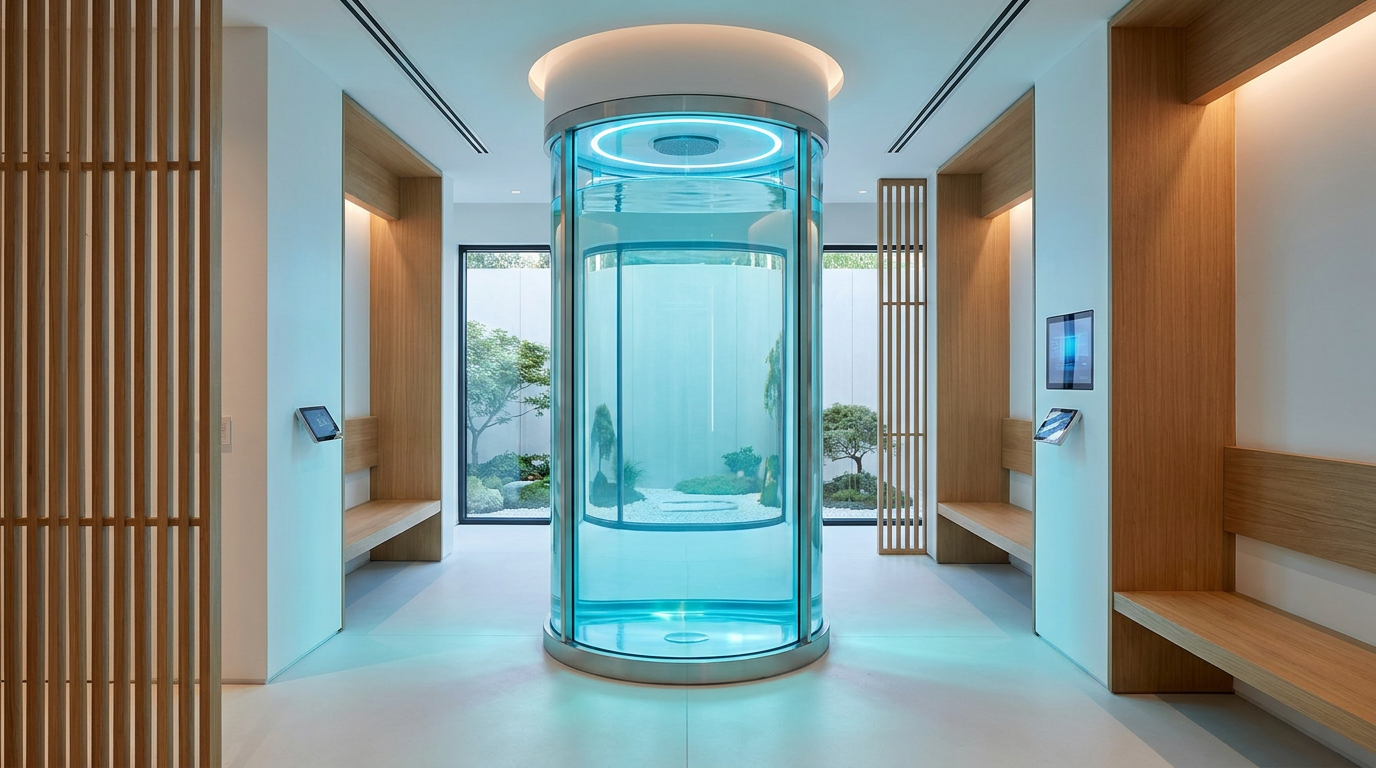
Unlike traditional X-rays or CT scans, the Midjourney Scanner does not use ionizing radiation. Unlike MRI machines, it does not rely on massive, supercooled magnets. Instead, it uses "Ultrasonic Computational Tomography," relying entirely on high-frequency sound waves traveling through water to map the body's interior.[1][4][8]

The scanning experience is designed to be immersive rather than clinical. A patient steps onto a platform and is slowly lowered into a cylindrical tank of water at a rate of roughly two inches per second. As they descend, they pass through a ring embedded with hundreds of thousands of tiny acoustic sensors.[1][4]
These sensors act as both microscopic speakers and microphones. They emit ultrasonic pulses up to 100 million times per second and listen for the echoes that bounce back from internal tissues. Midjourney compares the mechanism to the echolocation used by dolphins, but scaled up to capture a millimeter-precise 3D map of human anatomy.[5][7]
Building this hardware required a strategic partnership. Midjourney quietly signed a licensing and co-development agreement with Butterfly Network, a company known for pioneering semiconductor-based ultrasound devices. The $15 million upfront deal gives Midjourney exclusive rights to Butterfly's "Ultrasound-on-Chip" technology for this specific application.[6][8]

Midjourney quietly signed a licensing and co-development agreement with Butterfly Network, a company known for pioneering semiconductor-based ultrasound devices.
The sheer scale of the acoustic hardware is staggering. The current prototype ring houses 8,960 individual transducers, comprising roughly 358,000 ultrasonic elements in total. When operating, the system generates an overwhelming 17 gigabytes of raw acoustic data every single second.[5][8]
This massive data throughput explains why an artificial intelligence company is tackling this problem. Reconstructing a single cross-sectional slice of the body requires processing 40 gigabytes of data. Midjourney claims the system requires two petaflops of computing power—spread across 21 servers—just to translate the acoustic echoes into a coherent 3D image.[6][8]
The company's claims regarding speed and quality are highly ambitious. Holz stated that the scanner could eventually rival the image quality of an MRI machine, but at nearly one hundred times the speed. A standard full-body MRI can take between 60 and 90 minutes and requires the patient to lie perfectly still in a claustrophobic tube; Midjourney aims to compress that into a one-minute dip in a pool.[1][3]

Rather than selling these machines to traditional hospitals, Midjourney is pursuing a direct-to-consumer rollout. The company plans to open its first "Midjourney Spa" near Union Square in San Francisco by the end of 2027. The multi-story facility is slated to feature ten scanners alongside conventional wellness amenities like saunas, hot tubs, and cold plunges.[2][6]
The long-term vision is even more aggressive. Midjourney hopes to deploy a third-generation scanner featuring custom silicon by 2028, and aims to have 50,000 units operating globally by 2031. At full capacity, the company claims a fleet of this size could perform one billion scans per month, theoretically enabling routine, preventive body-composition tracking for a massive segment of the population.[1][7][8]

However, the gap between the engineering prototype and a globally deployed medical device remains vast. The scanner has not yet undergone rigorous clinical validation, and its diagnostic claims have not been independently verified by the broader medical community.[3][4]
Regulatory hurdles also loom large. While Midjourney plans to focus initially on wellness and body composition tracking—which faces lighter regulatory scrutiny—any diagnostic applications will require clearance from the U.S. Food and Drug Administration. The company has stated it intends to submit regular test results to the FDA to eventually secure medical-grade approval.[3][7]
How we got here
2010
David Holz co-founds Leap Motion, gaining extensive experience in specialized sensing hardware.
November 2025
Midjourney signs a $15 million licensing agreement with Butterfly Network for its ultrasound chips.
June 2026
Midjourney Medical is publicly announced alongside the first scanner prototype.
Late 2027
Planned opening of the first 'Midjourney Spa' in San Francisco.
2031
Midjourney's target date to deploy 50,000 scanners globally.
Viewpoints in depth
Preventive Health Advocates
View the scanner as a breakthrough that could make routine, radiation-free body tracking cheap and accessible.
Advocates for preventive medicine see the Midjourney Scanner as a potential paradigm shift. By removing the radiation risks of CT scans and the high costs and claustrophobia of MRIs, the technology could allow individuals to track their body composition, organ health, and internal changes on a monthly or even weekly basis. Proponents argue that making imaging as casual as a spa visit could lead to the early detection of diseases long before physical symptoms manifest, fundamentally shifting healthcare from reactive treatment to proactive monitoring.
Medical Skeptics
Demand rigorous clinical validation and FDA clearance before accepting claims that the device can rival MRI quality.
The medical community remains highly cautious about Silicon Valley's promises in the healthcare space. Skeptics point out that while the engineering prototype is impressive, ultrasound technology traditionally struggles with penetrating bone and imaging deep tissues compared to MRI. Critics emphasize that the device has not yet undergone peer-reviewed clinical trials or secured FDA clearance for diagnostic use. Until independent radiologists can verify the accuracy and clinical utility of the 3D maps, many view the project as an unproven consumer wellness gadget rather than a true medical breakthrough.
Tech & AI Analysts
Focus on the staggering compute requirements and the strategic significance of a generative AI lab pivoting to hardware.
For technology analysts, the story is less about medicine and more about the evolution of artificial intelligence companies. Reconstructing 17 gigabytes of acoustic data per second requires an immense two petaflops of compute—a challenge that plays directly to the strengths of a well-funded AI lab. Analysts view this pivot as a signal that generative AI companies are beginning to apply their massive computational resources and algorithmic expertise to solve complex, physical-world engineering problems, moving beyond digital media generation into real-world infrastructure.
What we don't know
- Whether the scanner can consistently produce images of sufficient quality to be used for medical diagnoses.
- How long it will take for the device to receive FDA clearance.
- The exact cost to consumers for a scan at a Midjourney Spa.
Key terms
- Ultrasonic Computational Tomography
- An imaging technique that uses sound waves from multiple angles to reconstruct a 3D map of the body's interior.
- Transducer
- A device that converts electrical energy into sound waves and vice versa, acting as both a speaker and a microphone.
- Echolocation
- The use of sound waves and their echoes to determine where objects are in space, similar to how dolphins navigate.
- Petaflop
- A measure of a computer's processing speed, equal to one quadrillion floating-point operations per second.
- Ultrasound-on-Chip
- A technology that replaces traditional crystal-based ultrasound sensors with programmable semiconductor chips.
Frequently asked
What is the Midjourney Scanner?
It is a full-body ultrasound device designed to map the human body's internal structure in about 60 seconds while the patient is submerged in water.
Does the scanner use radiation?
No. Unlike X-rays or traditional CT scans, it relies entirely on high-frequency sound waves (ultrasound) to generate images.
When will it be available to the public?
Midjourney plans to open its first consumer-facing wellness spa featuring the scanners in San Francisco by the end of 2027.
Why is an AI company building medical hardware?
Processing the 17 gigabytes of acoustic data generated every second requires massive computing power and advanced algorithms, playing directly to the strengths of a well-funded AI laboratory.
Sources
Source coverage
8 outlets
3 viewpoints surfaced








[1]EngadgetPreventive Health Advocates
Midjourney, the AI image generator, is developing a full-body ultrasonic scanner
Read on Engadget →[2]The VergePreventive Health Advocates
Midjourney Medical goes from generating 'cat images' to full-body ultrasound scans
Read on The Verge →[3]BloombergMedical Skeptics
AI Startup Midjourney Pivots to Health With Ultrasound Machine
Read on Bloomberg →[4]Startup FortuneMedical Skeptics
Midjourney’s first hardware bet is not another image model
Read on Startup Fortune →[5]ShacknewsTech & AI Analysts
Midjourney Scanner is a new medical diagnostic device from the AI image generation company
Read on Shacknews →[6]GlitchwireTech & AI Analysts
Midjourney quietly signed a co-development and licensing agreement with Butterfly
Read on Glitchwire →[7]GigazineTech & AI Analysts
Midjourney establishes medical division to develop 3D body scanner
Read on Gigazine →[8]Latent SpaceTech & AI Analysts
A technical dive inside our new 'Midjourney Scanner'
Read on Latent Space →


Every angle. Every day.
Get technology stories with full source coverage and perspective breakdowns delivered to your inbox.