
UK to Ban Social Media for Under-16s in Landmark Push Against Big Tech
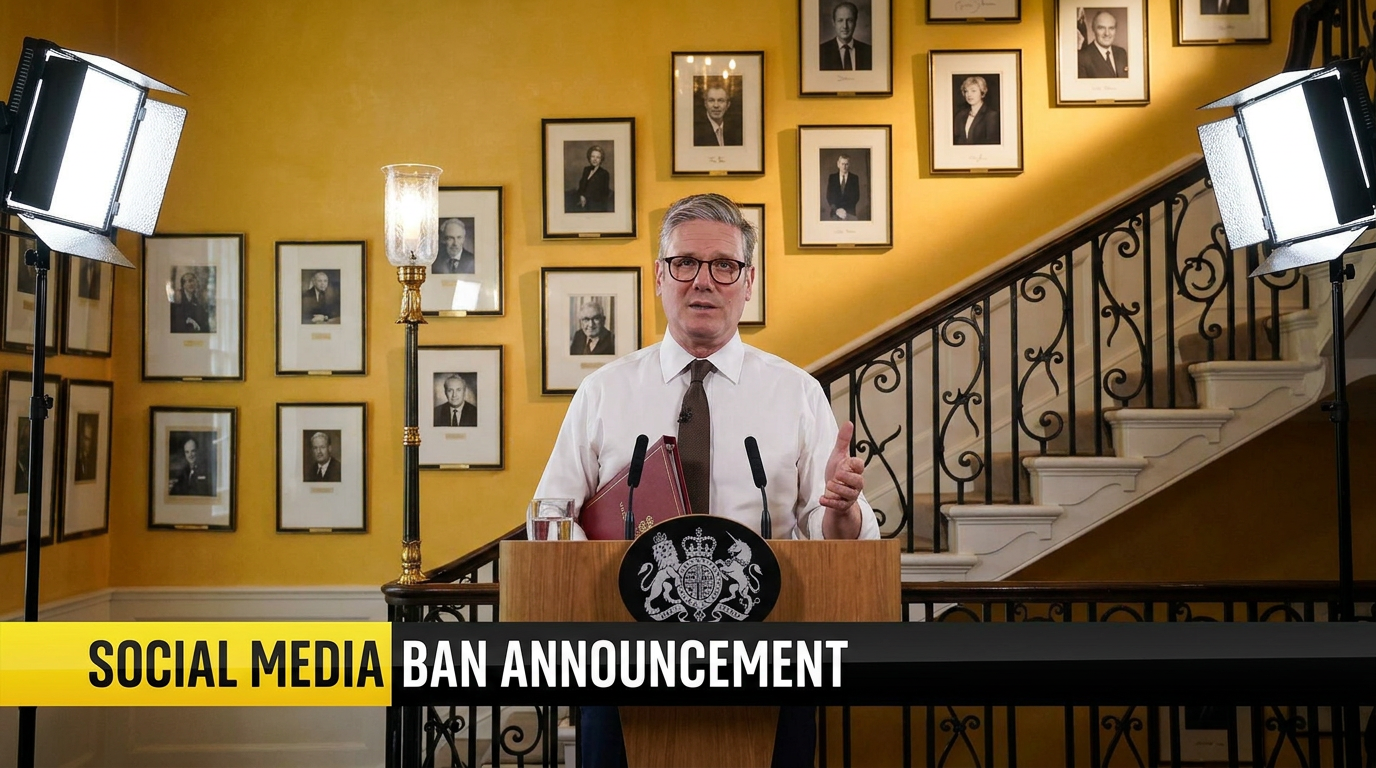
Prime Minister Keir Starmer announced a sweeping ban on social media for children under 16, alongside restrictions on livestreaming and stranger communication. The legislation, expected to take effect in spring 2027, has drawn overwhelming support from parents but fierce criticism from tech companies and human rights groups.
By Factlen Editorial Team
- UK Government & Parents
- Argues that a blanket ban is necessary to protect children from addictive algorithms and severe mental health harms.
- Human Rights Advocates
- Believes the ban infringes on youth rights and fails to address the root cause of unsafe platform design.
- Technology Companies
- Warns that age-gating will drive teenagers to unregulated, dangerous corners of the internet.
What's not represented
- · Mental health professionals detailing the clinical impact of social media withdrawal versus continued use.
- · Educators discussing how the ban will affect digital literacy and classroom dynamics.
Why this matters
This legislation fundamentally alters how millions of teenagers will interact with the internet, placing the legal burden on tech giants to enforce age gates. It signals a growing global consensus—following Australia's lead—that governments, rather than parents, must regulate the digital environments shaping children's mental health.
Key points
- The UK will ban children under 16 from using major social media platforms like TikTok, Instagram, and YouTube.
- Messaging apps such as WhatsApp and Signal are exempt from the ban.
- Livestreaming and stranger communication will be restricted for under-16s, including on gaming sites.
- The legislation places the legal burden on tech companies, threatening multimillion-pound fines for non-compliance.
- Amnesty International and tech firms argue the ban will push kids to unsafe platforms and ignores core design flaws.
- The regulations are expected to pass Parliament by late 2026 and take effect in spring 2027.
The United Kingdom government has officially announced a sweeping, nationwide ban on social media access for children under the age of 16, marking one of the most aggressive regulatory crackdowns on Big Tech by any Western democracy to date. The landmark policy represents a fundamental shift in how the state approaches digital safety, moving away from relying on parental controls and instead placing hard legal boundaries on technology companies. By targeting the core business models of the world's largest platforms, the UK is signaling that it considers the current digital landscape fundamentally unsafe for youth development.[1][2]
Prime Minister Keir Starmer unveiled the comprehensive policy framework during a press conference on Monday, declaring that the forthcoming legislation is designed to "give kids their childhood back." He argued forcefully that the state must intervene to shield vulnerable youth from algorithmic feeds and content explicitly designed to be addictive. Starmer emphasized that the offline world has strict rules protecting children from harm, and the digital sphere should be no exception, framing the ban as a necessary moral imperative to combat a growing youth mental health crisis.[1][7]
The proposed ban specifically targets major "feed-and-scroll" platforms that rely on algorithmic content delivery, including industry giants like TikTok, Instagram, Snapchat, YouTube, Facebook, and X. However, the government has drawn a clear distinction between public broadcasting platforms and private communication tools. Messaging services such as WhatsApp and Signal will remain entirely exempt from the ban, ensuring that children can still maintain private, direct communications with their friends, family members, and school groups without being exposed to the broader algorithmic internet.[2][3][5][8]
Beyond the blanket access ban for under-16s, the government is introducing what it describes as "world-leading blocks" on specific high-risk functionalities across the broader web. Livestreaming capabilities and the ability for strangers to initiate communication with children will be heavily restricted across a much wider range of online services. Crucially, this includes multiplayer gaming sites and interactive digital environments, which have increasingly become spaces where children are exposed to unvetted adults and potential grooming risks.[5][7]

To prevent a sudden "cliff-edge" effect when a teenager turns 16, the government has designed a tiered approach to digital independence. While 16- and 17-year-olds will retain their legal access to core social media platforms, the new high-risk functionality restrictions—such as livestreaming and stranger communication—will be enabled by default on their accounts. Furthermore, the government has confirmed it is actively considering additional measures for all users under 18, including mandatory overnight curfews and forced breaks in infinite scrolling to disrupt addictive behavioral loops.[3][5][7][8]
A central pillar of the new legislation is that the legal onus will fall entirely on the technology companies, completely removing the burden of enforcement from parents or the children themselves. Platforms operating in the UK will be legally required to take "reasonable steps" to exclude under-16s from their services and to rigorously enforce the new safety features for older teenagers. Companies that fail to comply with these strict mandates will face severe, multimillion-pound fines that could significantly impact their global revenue streams.[1][2]
During his announcement, Starmer directly addressed the widespread skepticism regarding the technical feasibility of strict age verification. He dismissed arguments that tech-savvy teenagers would inevitably bypass the ban using virtual private networks (VPNs) or fake IDs, arguing that imperfect enforcement is not a valid reason to abandon regulation. "We don't say: 'Oh, look, a teenager managed to get a drink somehow, so let's not bother banning drinks from children,'" he told reporters, insisting that establishing a legal baseline is the crucial first step in changing societal norms.[2]
During his announcement, Starmer directly addressed the widespread skepticism regarding the technical feasibility of strict age verification.
To tackle the complex logistics of implementation, the UK's communications regulator, Ofcom, has been tasked with conducting a rapid, comprehensive study to determine the most effective methods for age assurance. The regulator must find technological solutions that accurately verify a user's age without compromising broader user privacy or requiring millions of adults to hand over sensitive government identification to private tech companies—a balance that has historically proven incredibly difficult to strike in digital policy.[3][8]
The legislative push follows a massive national consultation period that ran earlier in the year, gathering over 116,000 responses from citizens, educators, and industry experts. According to the government's published data, the results demonstrated overwhelming public demand for decisive state intervention. An estimated 90 percent of parents who participated in the consultation backed the establishment of a minimum age of 16 for social media access, reflecting deep-seated anxieties about cyberbullying, exposure to self-harm content, and the erosion of traditional childhood activities.[1][5]

Despite the strong parental support, the policy has faced fierce pushback from human rights organizations and digital privacy advocates who view the ban as a blunt instrument. Amnesty International released a scathing critique of the legislation, characterizing the ban as the "right diagnosis but the wrong prescription." The organization argued that by banning children, the government is treating young people as the problem, rather than addressing the fundamentally unsafe, profit-driven design of the platforms themselves.[6]
"You cannot solve a design problem with an access ban," stated Kerry Moscogiuri, Chief Executive of Amnesty International UK, following the Prime Minister's announcement. She urged the government to pivot its focus toward ending invasive data profiling, dismantling hyper-personalized recommendation systems, and banning manipulative algorithms entirely. Advocates warn that excluding youth from the digital public square infringes on their fundamental rights to information, expression, and community participation in the modern era.[6]
Technology companies have echoed these civil liberties concerns, warning that a blanket ban could ultimately backfire and put children in greater danger. A spokesperson for YouTube cautioned that barring teenagers from supervised, heavily moderated platforms might inadvertently drive them toward anonymous, less safe corners of the internet. Industry representatives argue that these unregulated alternative platforms completely lack the built-in safety protections, reporting tools, and parental oversight mechanisms that major companies have spent billions developing.[3][7]

Teenagers themselves have expressed profound frustration with the government's sweeping approach, feeling entirely sidelined in a debate about their own digital lives. Interviews with 16- and 17-year-olds across the UK revealed deep concerns that the ban completely ignores the positive, vital aspects of social media. For many marginalized youth, these platforms serve as crucial lifelines for finding supportive communities, accessing educational content, discovering their identities, and staying connected with peers in an increasingly isolated world.[4]
The United Kingdom is not acting in isolation, as the legislation reflects a rapidly accelerating global consensus against Big Tech's influence over children. The UK's move closely mirrors Australia's world-first social media ban for under-16s, which was successfully enacted in December 2025 despite similar industry protests. Other nations, including Canada, Brazil, and Malaysia, are currently advancing their own stringent age-based restrictions, algorithmic curbs, and mandatory parental linkage laws, signaling a coordinated international retreat from the era of unregulated digital access.[2][7]
Looking ahead, the UK government plans to formally introduce the finalized regulations to Parliament before the Christmas recess, utilizing new regulatory powers created by the Children's Wellbeing and Schools Act 2026. If the legislation passes as expected, the sweeping protections and access bans are slated to come into force by spring 2027. This timeline gives families, educators, and technology companies roughly a year to prepare for a radically altered digital reality that will redefine what it means to grow up in Britain.[1][5]
How we got here
December 2025
Australia passes a world-first law banning social media for children under 16, setting a global precedent.
March - May 2026
The UK government runs a national consultation on children's online safety, receiving over 116,000 responses.
June 15, 2026
Prime Minister Keir Starmer officially announces the UK's plan to ban social media for under-16s.
Late 2026
The government expects to introduce the formal regulations to Parliament before Christmas.
Spring 2027
The target date for the social media ban and functionality restrictions to come into force.
Viewpoints in depth
The UK Government's view
The ban is a necessary intervention to protect children's mental health and give them their childhood back.
Prime Minister Keir Starmer and his cabinet argue that social media platforms are fundamentally designed to be addictive and are exposing children to dangerous content, bullying, and mental health crises. By placing the legal burden on tech companies and restricting features like livestreaming and stranger communication, the government believes it is stepping in where parental controls have failed, prioritizing child wellbeing over corporate profits.
Human Rights & Privacy Advocates
Banning children treats the symptom rather than the underlying disease of algorithmic design.
Organizations like Amnesty International argue that a blanket ban is the wrong approach. They contend that the real issue is the invasive profiling, infinite scrolling, and hyper-personalized algorithms built by Big Tech. By excluding children from the digital sphere, advocates warn the government is infringing on young people's rights to information and community, while letting tech companies off the hook for fixing their fundamentally unsafe platform architectures.
Technology Companies
Age-based bans will drive teenagers to unregulated, unsafe alternatives.
Representatives from major platforms like Meta and YouTube warn that cutting teenagers off from mainstream social media will not stop them from going online. Instead, they argue it will push youth toward darker, anonymous corners of the internet that lack the safety tools, moderation, and parental controls currently available on major apps. They also raise concerns about the privacy implications of implementing strict age-verification systems for all users.
What we don't know
- How Ofcom will mandate age verification without compromising user privacy or requiring adults to submit government IDs to access social media.
- Whether tech-savvy teenagers will easily bypass the restrictions using VPNs or alternative app stores, as seen in Australia.
- The exact finalized list of platforms that will fall under the ban's scope.
Key terms
- Age Verification
- Technological methods used to confirm a user's age before granting access to a platform, which can range from document uploads to biometric estimation.
- Ofcom
- The UK's government-approved regulatory and competition authority for the broadcasting, telecommunications, and postal industries.
- Infinite Scrolling
- A design feature that continuously loads new content as a user scrolls down a page, designed to keep users engaged for longer periods.
- Algorithmic Feed
- A stream of content curated by artificial intelligence based on a user's past behavior, rather than a simple chronological list of posts from friends.
Frequently asked
Will messaging apps be banned for under-16s?
No. The government has explicitly exempted private messaging services like WhatsApp and Signal, allowing children to stay in touch with family and friends.
What happens to 16- and 17-year-olds?
Older teenagers will still be able to access social media platforms, but high-risk features like livestreaming and communicating with strangers will be turned off by default.
Will parents be punished if their kids use social media?
No. The legal responsibility and potential multimillion-pound fines fall entirely on the technology companies to enforce the age limits, not on parents or children.
When does the ban actually start?
The government plans to pass the legislation by the end of 2026, with the rules expected to take effect in the spring of 2027.
Sources
Source coverage
8 outlets
3 viewpoints surfaced








[1]ReutersUK Government & Parents
Britain announces sweeping social media ban for under-16s
Read on Reuters →[2]CBS NewsUK Government & Parents
U.K. announces plan to ban social media for children under 16
Read on CBS News →[3]TIMETechnology Companies
U.K. to Ban Social Media for Under-16s
Read on TIME →[4]The GuardianHuman Rights Advocates
'It makes no sense': 16- and 17-year-olds on UK social media ban
Read on The Guardian →[5]UK GovernmentUK Government & Parents
Social media to be banned for under-16s in landmark government move
Read on UK Government →[6]Amnesty InternationalHuman Rights Advocates
UK: Social media ban for under 16s 'right diagnosis, wrong prescription'
Read on Amnesty International →[7]Al JazeeraTechnology Companies
Britain announces sweeping social media ban for under-16s
Read on Al Jazeera →[8]BBC NewsTechnology Companies
UK to ban social media platforms for under-16s
Read on BBC News →


Every angle. Every day.
Get news politics stories with full source coverage and perspective breakdowns delivered to your inbox.