
The 2026 Guide to OLED and Mini-LED Television Technologies
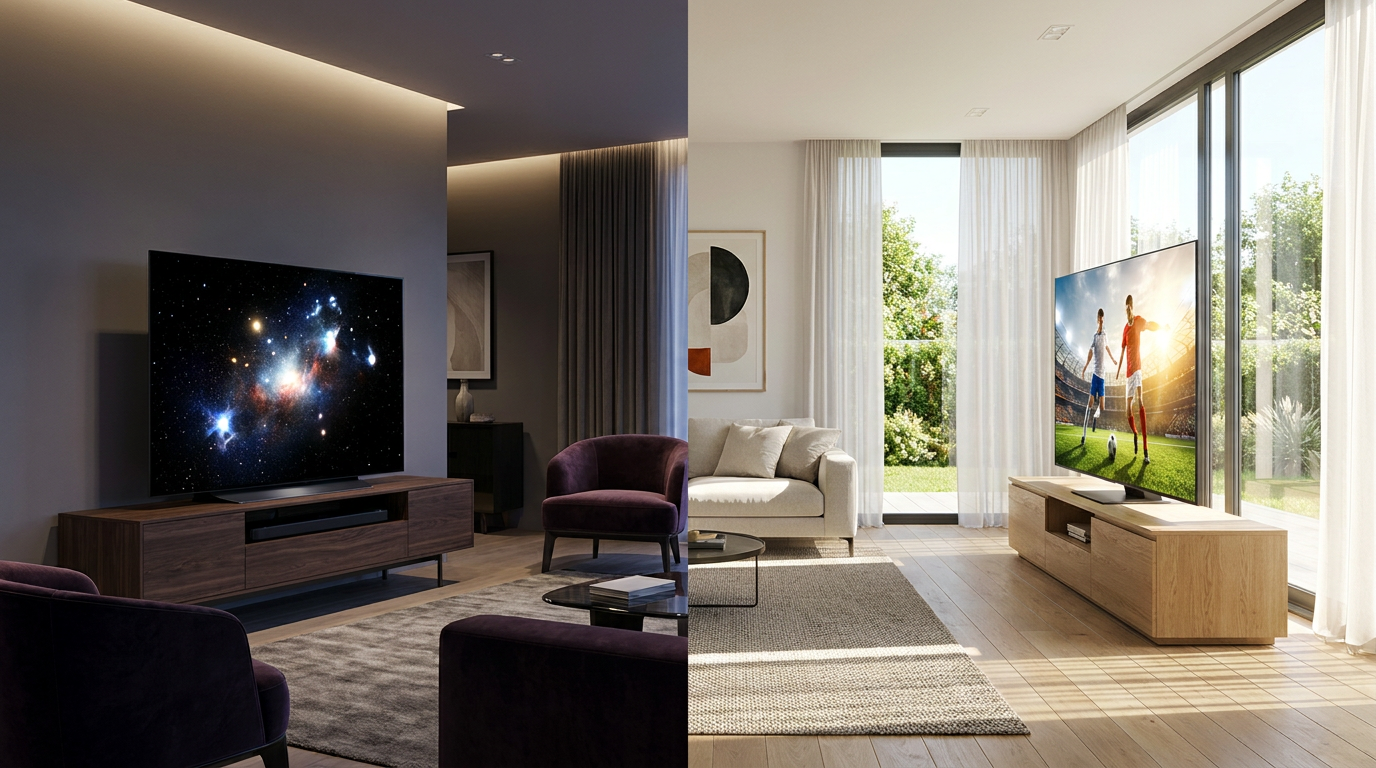
Recent advancements in television panels have narrowed the performance gap, making the choice between emissive and transmissive displays highly dependent on room lighting and viewing habits.
By Factlen Editorial Team
- Cinematic Purists
- Advocates for perfect black levels, infinite contrast, and pixel-level precision for movies and dark-room gaming.
- Bright-Room Pragmatists
- Prioritizes sheer brightness, burn-in immunity, and large-screen value for daytime viewing and productivity.
- Longevity & Productivity Testers
- Focuses on long-term panel degradation, static UI performance, and sustained output over thousands of hours.
What's not represented
- · Budget-conscious buyers looking for sub-$500 standard LED TVs.
- · Projector enthusiasts who prioritize massive scale over peak brightness.
Why this matters
Choosing the wrong television technology can leave you struggling with window glare during daytime sports or distracted by glowing artifacts during movie nights. Understanding these trade-offs ensures your investment perfectly matches your living room's lighting and your daily viewing habits.
Key points
- The 2026 TV market is defined by the fierce competition between OLED and Mini-LED, with both receiving major architectural upgrades.
- OLED remains the undisputed champion of dark-room viewing, offering infinite contrast and perfect pixel-level precision.
- Mini-LED dominates in bright, sunlit rooms, sustaining massive full-screen brightness without triggering automatic dimming limiters.
- Burn-in remains a cumulative risk for OLEDs displaying static content over thousands of hours, while Mini-LED is completely immune.
- Mini-LED offers significantly better value at massive screen sizes (75 inches and above), where OLED panels carry a steep premium.
The television market in 2026 has reached a golden age of display technology, transforming what used to be a straightforward purchase into a highly technical debate. Just a few years ago, the advice was simple: buy an OLED if you could afford it, or settle for a standard LCD if you could not. Today, the landscape is entirely different. The battle between OLED (Organic Light-Emitting Diode) and Mini-LED has reached a fever pitch, with both technologies receiving fundamental architectural upgrades that blur their historical boundaries.[1][2]
To make an informed decision, buyers must understand the core mechanical differences. The argument for OLED is built on emissive technology: every single microscopic pixel generates its own light and color. When an OLED pixel needs to show black, it simply turns off, emitting zero light. The evidence for this approach is an infinite contrast ratio and absolute image precision, making it the undisputed champion of dark-room viewing.[4][6]
The argument against OLED, historically, has been its brightness ceiling and the risk of permanent image retention, or "burn-in." However, 2026 has introduced Tandem OLED and fourth-generation QD-OLED panels. By stacking organic light-emitting layers or utilizing advanced quantum dot color conversion, flagship OLEDs like the LG G5 and Samsung S95F can now hit peak highlights of 2,000 nits.[4][7]
Conversely, the argument for Mini-LED centers on sheer, brute-force illumination and durability. Mini-LED is a transmissive technology; it relies on a liquid crystal display (LCD) illuminated by a backlight. Instead of one large backlight, modern Mini-LEDs pack thousands of microscopic LEDs divided into thousands of independent dimming zones. The evidence for this approach is its ability to overpower sunlit rooms and sustain massive full-screen brightness without degrading the panel.[2][4]

In 2026, Mini-LED took a massive leap forward with the adoption of RGB Mini-LED architecture. For the last decade, LED TVs relied on blue or white lights shining through color filters, which inherently reduced efficiency. New flagship models from brands like Hisense and TCL have removed the traditional color filter entirely, using clusters of independent red, green, and blue LEDs as the direct light source.[3][8]
This RGB evolution allows premium Mini-LEDs to achieve staggering brightness levels, with some models capable of hitting between 4,000 and 10,000 nits in HDR highlights. When comparing the two side-by-side in a brightly lit living room, the evidence heavily favors Mini-LED. The extra luminance cuts through window glare and makes daytime sports or vibrant video games pop with an intensity that organic pixels physically cannot match.[3][7]
However, the argument against Mini-LED remains its handling of extreme contrast. Because a 4K television has over 8.2 million pixels but only a few thousand dimming zones, a single zone must illuminate thousands of pixels at once. If a bright object—like a white subtitle or a glowing spaceship—moves across a pitch-black background, the backlight zone must turn on, creating a faint halo of light known as "blooming."[4][6]
However, the argument against Mini-LED remains its handling of extreme contrast.
While 2026 dimming algorithms have drastically minimized blooming, it is still visible, particularly when viewing the screen from an angle. OLED's pixel-level control means a brilliantly bright star can sit directly next to a perfectly black pixel with zero light bleed. For cinematic purists watching moody, high-contrast films in a dark room, this absolute precision makes OLED the superior visual experience.[1][8]

Another critical point of comparison is full-screen brightness and the Auto Brightness Limiter (ABL). To protect organic materials from overheating, OLED panels aggressively dim the entire screen when a large portion of the image turns white—such as a snowy landscape or a bright web browser. Mini-LEDs do not suffer from ABL, allowing them to sustain blindingly bright full-screen images indefinitely, which is a major advantage for PC productivity and bright HDR gaming.[4][5]
The most persistent anxiety surrounding OLED is burn-in. After 10,000 hours of heavy daily use in independent testing, 2026 OLED panels show strong mechanical reliability, aided by Micro Lens Array (MLA 3.0) thermal management and pixel-shifting algorithms. However, the evidence shows they still carry a cumulative risk of visible image retention under prolonged static workloads.[5][8]
For users who play HUD-heavy video games, watch news channels with scrolling tickers all day, or use their display as a primary PC monitor with a static taskbar, OLED remains a calculated risk. Mini-LED, utilizing robust inorganic materials, delivers exceptional brightness stability with effectively zero burn-in risk. It is essentially a "forever display" for static content.[3][5]
Viewing angles present another stark contrast. The argument for OLED includes its near-perfect off-axis viewing; colors and contrast remain completely intact whether you are sitting dead center or off to the side of a wide sectional couch. Mini-LED panels, particularly those using VA (Vertical Alignment) LCD technology, lose color saturation and exhibit worse blooming as you move away from the center seat.[1][8]

Motion clarity is a battleground where OLED continues to hold the crown. Because OLED pixels change state almost instantaneously, the technology boasts a near-zero response time. This results in perfect motion clarity with no smearing or blur behind fast-moving objects, making it the holy grail for competitive gamers and fast-paced action scenes.[1][7]
Mini-LEDs have closed the gaming gap significantly by offering 144Hz and even 240Hz refresh rates, alongside Variable Refresh Rate (VRR) and Auto Low Latency Mode (ALLM). While their pixel response times cannot defy the physical limitations of liquid crystals, the motion handling on 2026 premium Mini-LEDs is more than fast enough for the vast majority of console and PC gamers.[1][4]
Finally, pricing and sizing dynamics heavily influence the decision. Manufacturing massive OLED panels remains incredibly expensive. If a buyer is looking for a cinematic 77-inch or 83-inch display, OLED carries a steep premium. Mini-LED offers vastly superior value in the large-format space, allowing consumers to purchase an 85-inch or even 100-inch television for the price of a much smaller OLED.[2][8]

Ultimately, the 2026 display market no longer forces consumers to choose between "good" and "bad" technology. Instead, buyers are choosing between two distinct flavors of excellence. The decision should not be driven by marketing hype, but by a brutally honest assessment of the room's lighting conditions, the primary type of content being consumed, and the budget available for large screen sizes.[1][4]
How we got here
Early 2010s
OLED technology enters the consumer TV market, establishing a new benchmark for perfect black levels and contrast.
2019
The first Mini-LED televisions launch, shrinking traditional backlights to offer hundreds of local dimming zones.
2022
Quantum Dot OLED (QD-OLED) is introduced, combining OLED's perfect blacks with improved color brightness.
2024
Mini-LED zone counts cross the 2,000 mark, drastically reducing the 'blooming' effect that plagued earlier LCDs.
CES 2026
Tandem OLED and RGB Mini-LED architectures debut, pushing both technologies to unprecedented levels of peak brightness.
Viewpoints in depth
The OLED Use Case
Fits well when prioritizing cinematic contrast in controlled lighting; does not fit when watching static news channels all day.
OLED technology is the definitive choice for dedicated home theaters and dark-room gaming. Because each pixel emits its own light, the panel achieves an infinite contrast ratio, making starfields and shadowy movie scenes look perfectly deep without any light bleed. However, it does not fit well in sun-drenched living rooms or for users who leave sports tickers and PC taskbars on screen for eight hours a day, as organic materials still carry a cumulative risk of image retention over thousands of hours.
The Mini-LED Use Case
Fits well when combating bright ambient light or displaying static interfaces; does not fit when absolute pixel-level black depth is required.
Mini-LED is the superior tool for bright, open-concept living rooms and heavy desktop productivity. With 2026 models pushing past 2,500 nits of sustained brightness and utilizing thousands of dimming zones, these panels overpower window glare effortlessly while completely eliminating burn-in anxiety. Conversely, it does not fit well for purists who are highly sensitive to 'blooming'—the slight halo effect around bright objects on dark backgrounds—or for wide seating arrangements where the LCD panel loses color accuracy off-axis.
What we don't know
- Whether Micro-LED, the eventual successor to both technologies, will reach consumer-friendly pricing before the end of the decade.
- Exactly how long Tandem OLED panels will last in real-world living rooms compared to accelerated laboratory testing.
Key terms
- Blooming
- A visual artifact where light spills over from a bright object into the surrounding dark areas of the screen, creating a faint halo effect.
- Auto Brightness Limiter (ABL)
- A protective feature in OLED TVs that automatically dims the entire screen when a large portion of the image is bright white, preventing the organic pixels from overheating.
- Nits
- A unit of measurement for the brightness of a display. A standard laptop screen is around 300 nits, while premium 2026 TVs can exceed 2,000 nits.
- Local Dimming Zones
- Specific areas of a Mini-LED backlight that can independently turn on, dim, or turn off completely to improve the contrast of the image.
- Tandem OLED
- A 2026 panel architecture that stacks multiple organic light-emitting layers on top of each other to increase overall brightness and lifespan.
Frequently asked
Will an OLED TV burn in if I watch sports?
Modern OLEDs have built-in protections like pixel shifting to prevent burn-in from score bugs during normal viewing. However, if you leave the same sports channel on for 8+ hours every single day, the cumulative risk remains.
Is Mini-LED just an LCD TV?
Yes, Mini-LED is an evolution of LCD technology. It uses a liquid crystal panel for color, but replaces the standard backlight with thousands of microscopic LEDs for vastly superior contrast control.
Which TV is better for a bright living room?
Mini-LED is significantly better for bright rooms. Its ability to sustain massive full-screen brightness (often over 2,000 nits) allows it to cut through window glare much more effectively than OLED.
Do I need Tandem OLED or RGB Mini-LED?
These 2026 advancements represent the premium tier. While they offer the highest brightness and color volume, standard OLEDs and quantum-dot Mini-LEDs from 2025 still provide excellent performance for most viewers at a lower cost.
Sources
Source coverage
8 outlets
3 viewpoints surfaced








[1]RtingsCinematic Purists
OLED vs Mini LED: Which is better in 2025/2026?
Read on Rtings →[2]PCWorldBright-Room Pragmatists
Why Mini-LED is fast catching up to OLED in 2026
Read on PCWorld →[3]XDA DevelopersBright-Room Pragmatists
RGB mini-LED is the future of TVs and displays
Read on XDA Developers →[4]Data Wire SolutionsBright-Room Pragmatists
Best TVs for 2026: 10 OLED and Mini-LED Picks by Room, Brightness, and Install Reality
Read on Data Wire Solutions →[5]KTC PlayLongevity & Productivity Testers
OLED for Long-Term Productivity: A 10,000-Hour Burn-In Update
Read on KTC Play →[6]CurrysLongevity & Productivity Testers
OLED vs Mini LED TV tech explained
Read on Currys →[7]EcoPicksGoCinematic Purists
LG G5 OLED vs LG QNED9M Mini LED Comparison (2026 Buyer's Guide)
Read on EcoPicksGo →[8]Home Cine SolutionsCinematic Purists
OLED or Mini LED, how to choose
Read on Home Cine Solutions →

Every angle. Every day.
Get shopping stories with full source coverage and perspective breakdowns delivered to your inbox.