
The Library of Things: How Public Libraries Are Transforming Into Modern Community Hubs
Public libraries are evolving beyond books to offer 3D printers, power tools, seed banks, and social services, becoming vital resilience hubs for modern communities.
By Factlen Editorial Team
- Digital Inclusion Advocates
- Focus on bridging the digital divide and providing equitable access to technology.
- Sharing Economy Proponents
- Focus on sustainability, reducing consumer waste, and community borrowing.
- Civic Infrastructure Analysts
- Focus on the structural evolution of the library system and the changing role of librarians.
What's not represented
- · Local Government Budget Committees
- · Commercial Tool Rental Businesses
Why this matters
As the cost of living rises and the digital divide widens, the modern public library is stepping in to democratize access to expensive technology and physical tools. By transforming into active community hubs, libraries are providing essential economic relief, fostering local sustainability, and serving as critical social safety nets.
Key points
- Public libraries are evolving into 'Libraries of Things,' allowing patrons to borrow power tools, electronics, and recreational equipment.
- Makerspaces equipped with 3D printers and design software are democratizing access to expensive technology for adults and entrepreneurs.
- Initiatives like the EU's DigLib project are training librarians to serve as digital community moderators to bridge the digital divide.
- By anchoring the local sharing economy, libraries are promoting environmental sustainability and providing economic relief to residents.
- The expanded mandate requires new logistical solutions and specialized training for library staff to handle complex social issues.
The quiet, dusty repository of books is rapidly becoming a relic of the past. Walk into a modern public library in 2026, and you are just as likely to hear the rhythmic hum of a 3D printer or the whir of a sewing machine as you are the rustle of turning pages. Across the globe, public libraries are undergoing a radical transformation, evolving from passive storehouses of knowledge into active, vibrant community hubs.[1]
This shift is driven by a simple but profound realization: the core mission of a library—to provide equal access to information and resources—now extends far beyond the printed word. As the cost of living rises and technological advancement accelerates, communities are demanding more dynamic support systems. Libraries are answering that call by reimagining their physical spaces and expanding their definitions of what constitutes a resource.[1][5]
At the forefront of this evolution is the "Library of Things" movement. This concept positions the library as a central node in the local sharing economy, allowing patrons to borrow physical objects just as easily as they would check out a paperback novel. The offerings are designed to be highly practical, targeting items that are useful occasionally but cumbersome or expensive to own permanently.[1][2]
The collections are as diverse as the communities they serve. In Brunswick, Maine, the Curtis Memorial Library boasts a catalog of over 600 non-traditional items. Patrons can walk out the door with stargazing backpacks, ukuleles, and even fermenting crocks complete with weights for making homemade pickles. In West Chicago, the local library district has expanded its collection to include power tools, digital cameras, and sewing machines.[4][7]

The goal of these collections is twofold: economic relief and environmental sustainability. By allowing residents to explore new hobbies, complete home repairs, or test out expensive technology without the financial burden of purchasing it, libraries are democratizing access to experiences. Simultaneously, this model encourages the reuse of items that might otherwise sit idle in a garage or end up in a landfill, anchoring the sharing economy in a trusted civic institution.[4][7]
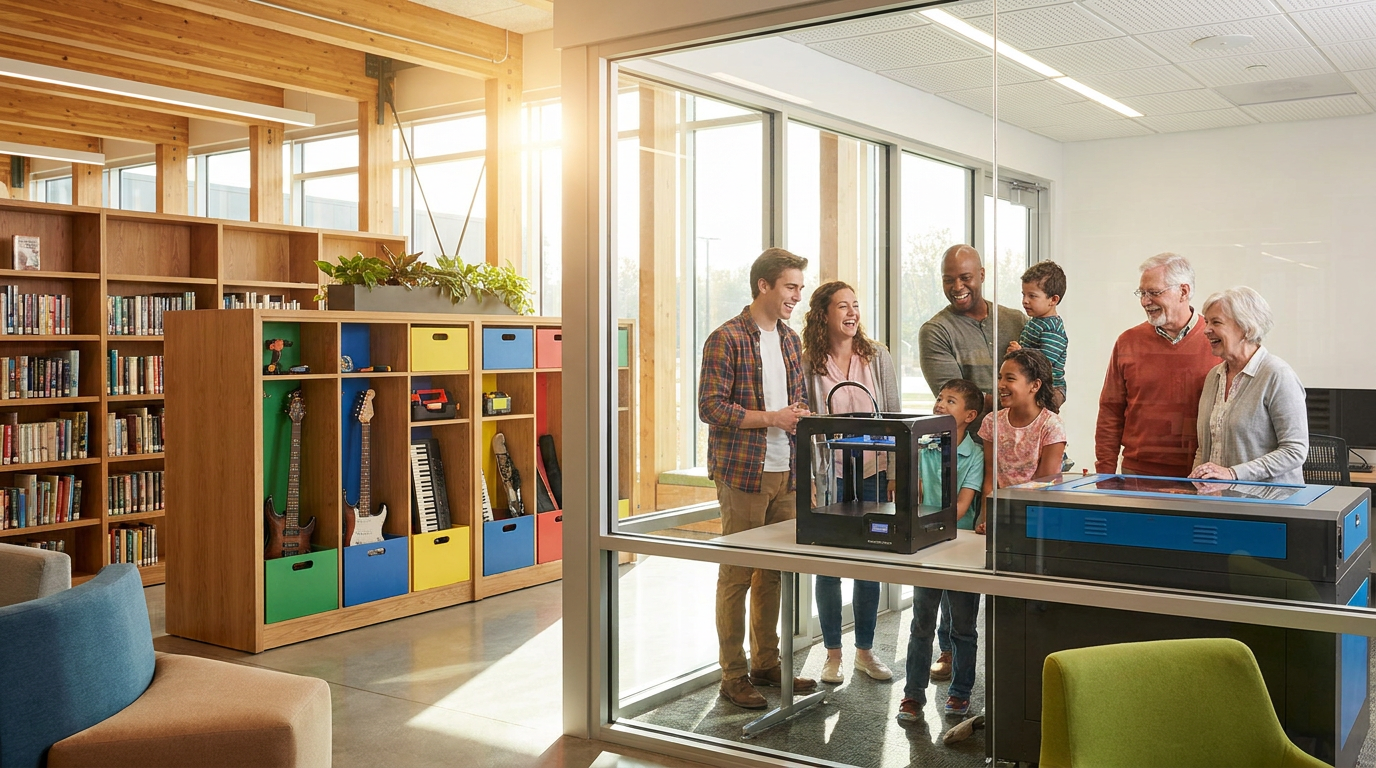
But the transformation goes much deeper than lending out physical objects. Libraries are increasingly serving as high-tech makerspaces and digital inclusion centers. In Saint Paul, Minnesota, the George Latimer Central Library operates an Innovation Lab equipped with laser engravers, full Adobe Creative Cloud software, and 3D printers.[3]
Initially designed to give adults access to the same maker technology available to youth, the lab has evolved into a crucial resource for a diverse demographic. It serves mobile workers, aspiring entrepreneurs, the unemployed, and people experiencing homelessness. By providing free access to advanced design software and charging only a nominal fee for 3D printing materials, the library empowers individuals to build job skills regardless of their economic status.[3]

Initially designed to give adults access to the same maker technology available to youth, the lab has evolved into a crucial resource for a diverse demographic.
The need for this kind of digital literacy infrastructure is a global challenge, and libraries are stepping up to bridge the divide. In Europe, the Digital Libraries (DigLib) project, running from 2025 to 2027, is actively training librarians across four countries to become "community moderators." The initiative recognizes that rapid digital transformation has marginalized those who lack technical competencies.[6]
By mapping the digital skills of both staff and adult users, and creating immersive learning environments, the DigLib project aims to foster social inclusion. Librarians are no longer just curators of information; they are active educators helping citizens navigate an increasingly complex digital landscape, from accessing online government services to identifying misinformation.[6]
Academic researchers note that this evolution, while seemingly modern, actually marks a return to the library's foundational values. A recent study in the International Journal of Educational Knowledge and Science highlights that public libraries have always been pillars of civic education and social advancement. Their strength has always resided in their commitment to equality of access.[5]
Today, that civic duty involves providing neutral spaces for public discussion, offering vocational training, and even supporting healthcare initiatives. Libraries frequently host workshops on renewable energy, host social workers to assist vulnerable populations, and provide safe, climate-controlled environments during extreme weather events.[1][5]

However, this expanded mandate brings significant logistical and financial challenges. Housing a diverse array of physical objects—from bulky telescopes to delicate science kits—requires innovative storage solutions. Libraries are investing in modular tote shelving systems and flexible architecture to keep items safe, organized, and easily accessible to both staff and patrons.[2]
Furthermore, the changing role of the librarian requires new skill sets and emotional resilience. Staff members are increasingly tasked with responsibilities that border on social work, requiring them to navigate complex interpersonal dynamics and assist patrons in acute distress. Ensuring that library workers receive adequate training and support is a growing priority within the profession.[1][5]

Despite these hurdles, the trajectory of the modern library is clear and overwhelmingly positive. The public library of the 21st century has proven itself to be a dynamic, adaptable ecosystem of learning, creation, and community support.[1]
By democratizing access to both physical tools and digital technologies, these institutions are proving that their relevance has not diminished in the digital age. Instead, they have cemented their status as the most vital, inclusive, and resilient civic infrastructure available to the public today.[1][5]
How we got here
2013
The term 'Library of Things' gains traction after a Sacramento public library launches a borrowing program for non-traditional items.
2015
The Saint Paul Public Library opens a dedicated makerspace for adults, signaling a shift toward advanced tech access for all ages.
2024
Statewide library databases, such as Maine's Minerva system, begin listing hundreds of physical objects like ukuleles and telescopes for standard checkout.
2025
The European Union launches the DigLib project to formally train librarians as digital community moderators to combat social exclusion.
Viewpoints in depth
Digital Inclusion Advocates
Focus on bridging the digital divide and providing equitable access to technology.
This camp argues that libraries must serve as the primary bridge over the digital divide. They point to programs like the EU's DigLib and St. Paul's Innovation Lab as evidence that free access to technology—from basic internet to advanced 3D modeling—is essential for modern workforce participation and social equity. For these advocates, the library is the last truly accessible public space where citizens can learn to navigate an increasingly complex digital landscape.
Sharing Economy Proponents
Focus on sustainability, reducing consumer waste, and community borrowing.
These proponents view the 'Library of Things' as a crucial tool for environmental sustainability and economic relief. By allowing communities to share rarely used items like power tools, telescopes, and specialized cookware, libraries reduce consumer waste and lower the barrier to entry for new hobbies and home maintenance. They argue that shifting from an ownership model to a borrowing model is essential for building resilient, eco-conscious communities.
Civic Infrastructure Analysts
Focus on the structural evolution of the library system and the changing role of librarians.
Analysts in this camp highlight the logistical and operational challenges of the library's expanded mandate. They focus on the need for innovative storage solutions for non-traditional items and the changing role of librarians, who now frequently act as social workers and community moderators. They argue that while this transformation is necessary, robust municipal funding and specialized staff training are required to sustain these critical civic hubs.
What we don't know
- Whether municipal budgets will expand sufficiently to cover the rising costs of maintaining high-tech makerspaces and replacing broken physical items.
- How the role of the librarian will be formally redefined in academic programs to include social work and technical troubleshooting.
Key terms
- Library of Things
- A collection of non-book objects, such as tools, electronics, and recreational equipment, that patrons can borrow from a public library.
- Makerspace
- A collaborative workspace inside a school, library, or separate facility for making, learning, exploring, and sharing, often equipped with high-tech tools like 3D printers.
- Digital Divide
- The gap between demographics and regions that have access to modern information and communications technology, and those that do not.
- Sharing Economy
- An economic system in which assets or services are shared between private individuals, either free or for a fee, often facilitated by community institutions.
Frequently asked
What is a 'Library of Things'?
A collection of non-traditional items available for checkout at a public library, such as power tools, musical instruments, baking equipment, and science kits.
Do I have to pay to use a library's makerspace?
Most library makerspaces are free to use with a library card, though some may charge a nominal fee for consumable materials, such as the plastic filament used in 3D printers.
Why are libraries offering social services?
As community hubs, libraries are often the most accessible safe spaces for vulnerable populations. They provide internet access, job search assistance, and sometimes partner with social workers to help patrons navigate housing and healthcare.
Are books being phased out of libraries?
No. Books and digital media remain the core of library collections, but physical objects and technology access are being added to meet the evolving needs of modern communities.
Sources
Source coverage
7 outlets
3 viewpoints surfaced



[1]Factlen Editorial TeamCivic Infrastructure Analysts
Synthesis by Factlen editorial team
Read on Factlen Editorial Team →[2]American Libraries MagazineCivic Infrastructure Analysts
Spacesaver's Totes in 4-Post Shelving: The Growing Trend of the Library of Things
Read on American Libraries Magazine →[3]Public Libraries OnlineDigital Inclusion Advocates
Does your library offer makerspace programming?
Read on Public Libraries Online →[4]Green & Healthy MaineSharing Economy Proponents
Libraries of Things: A growing trend in Maine
Read on Green & Healthy Maine →[5]International Journal of Educational Knowledge and ScienceCivic Infrastructure Analysts
Public Libraries: Digital Transformation and Community Engagement
Read on International Journal of Educational Knowledge and Science →[6]Digital Libraries ProjectDigital Inclusion Advocates
About the DigLib Project: Empowering Librarians as Community Moderators
Read on Digital Libraries Project →[7]West Chicago Public Library DistrictSharing Economy Proponents
The Library of Things Collection
Read on West Chicago Public Library District →

More in culture
See all 5 stories →

Every angle. Every day.
Get culture stories with full source coverage and perspective breakdowns delivered to your inbox.