
Choosing the Right Handheld Gaming PC: A Trade-Off Analysis of the Market Leaders
The portable PC market has matured into a two-device race, forcing buyers to choose between the frictionless console experience of SteamOS and the unconstrained power of Windows 11.
By Factlen Editorial Team
- Console-First Gamers
- Players who prioritize a frictionless, pick-up-and-play experience over raw performance.
- Power-User Enthusiasts
- Gamers who demand maximum performance and unrestricted access to all PC storefronts.
- Hardware Analysts
- Tech reviewers focused on engineering efficiency, thermal management, and display technology.
What's not represented
- · Game Developers optimizing for handhelds
- · Cloud Gaming Advocates
Why this matters
Choosing the right handheld gaming PC in 2026 means navigating a $500 to $800 investment. Understanding the stark trade-offs between SteamOS convenience and Windows 11 power ensures you buy the device that actually fits your gaming habits, rather than fighting against an operating system that doesn't suit your needs.
Key points
- The Steam Deck OLED offers a frictionless, console-like experience via SteamOS.
- The ASUS ROG Ally X provides raw Windows 11 power and compatibility with all game launchers.
- Valve's handheld wins on battery efficiency for lighter games and features a stunning HDR OLED screen.
- ASUS's device features a massive 80Whr battery, 24GB of RAM, and a VRR display for smoother AAA gaming.
- The Steam Deck OLED starts at $549, making it $250 cheaper than the $799 ROG Ally X.
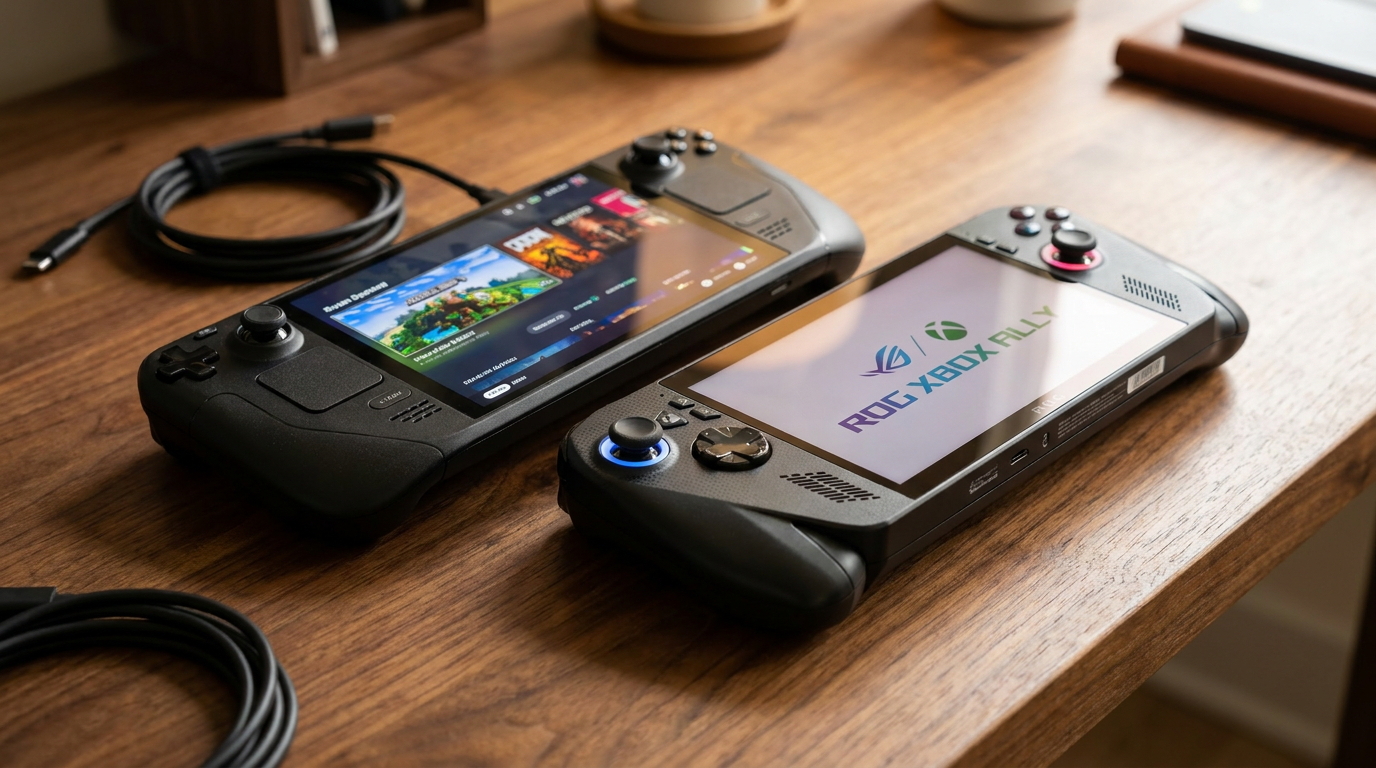
The handheld gaming PC market has matured past its experimental phase, leaving consumers in 2026 with two definitive flagship devices: Valve’s Steam Deck OLED and ASUS’s ROG Ally X. While earlier iterations of portable PCs demanded significant compromises, this current generation delivers legitimate, high-fidelity gaming in form factors that can be played on a commute or a couch. Choosing between them is no longer a question of which device is inherently better, but rather which philosophy of portable gaming aligns with a buyer's specific habits.[4][6]
At the core of this comparison is a fundamental divide in operating systems. Valve’s Steam Deck OLED operates on SteamOS, a custom Linux-based platform designed specifically to mimic a traditional console experience. ASUS, conversely, built the ROG Ally X around Windows 11, transforming the device into a fully unconstrained, albeit sometimes unwieldy, miniature desktop computer. This software divergence dictates almost every other trade-off between the two machines, from battery efficiency to game compatibility.[2][5]
The case for the Steam Deck OLED rests heavily on its frictionless user experience. Pressing the power button immediately drops players into a streamlined interface where games launch without the need to navigate secondary launchers or update disparate drivers. The system’s sleep and wake functionality is nearly instantaneous, allowing users to pause a demanding game, put the device to sleep, and resume days later with minimal battery drain. For players whose entire library resides on Steam, this integration is unparalleled in the handheld space.[1][3]
The case against the Steam Deck OLED centers on the inherent limitations of its Linux architecture. Because it does not run Windows natively, the device cannot easily play titles that rely on kernel-level anti-cheat software. Popular competitive shooters like Valorant, Fortnite, and Call of Duty are functionally locked out of the ecosystem. Furthermore, accessing subscription services like Xbox Game Pass requires complex workarounds or cloud streaming, stripping away the native performance benefits of the hardware.[4][5][7]

The evidence for the Steam Deck OLED’s dominance lies in its remarkable battery efficiency. Valve paired a 50Whr battery with an aggressively optimized operating system and a highly efficient custom AMD Zen 2 processor. In real-world testing, this combination yields marathon gaming sessions, stretching up to six hours on lighter indie titles and comfortably clearing two to three hours on demanding games. At lower wattages, the Steam Deck OLED simply outlasts its competitors, remaining cooler to the touch and significantly quieter under load.[1][2][3]
The case for the ROG Ally X is built entirely on raw, unadulterated horsepower. ASUS equipped the device with the AMD Ryzen Z1 Extreme processor and a massive 24GB of LPDDR5X RAM, providing a substantial memory advantage over the Steam Deck’s 16GB. This translates to a baseline performance boost of 10 to 15 percent, which can scale up to 50 percent better frame rates in modern AAA titles when the device is plugged into a wall and pushed to its maximum 30-watt thermal limit.[1][5]
The case against the ROG Ally X is the friction introduced by Windows 11. Navigating a desktop operating system on a 7-inch touchscreen remains a clunky experience, often requiring users to interact with tiny close buttons, unexpected background updates, and multiple conflicting game launchers. While ASUS has significantly improved its proprietary Armoury Crate software to mask these issues, it still lacks the seamless, pick-up-and-play reliability of SteamOS.[2][4]
The case against the ROG Ally X is the friction introduced by Windows 11.
The evidence for the ROG Ally X’s engineering prowess is its massive 80Whr battery, which ASUS implemented to brute-force its way past Windows' inherent power inefficiencies. In highly demanding games like Cyberpunk 2077, the Ally X can actually outlast the Steam Deck OLED by roughly an hour when both are set to matched high-performance profiles. However, if pushed to its maximum Turbo mode, that massive battery drains rapidly, tethering the device to a charger for extended sessions.[1][4][7]

Display technology presents another stark trade-off. The Steam Deck OLED features a 7.4-inch HDR OLED panel running at a 90Hz refresh rate with an 800p resolution. The visual impact of this screen cannot be overstated; the inky blacks, infinite contrast ratio, and vibrant HDR colors make games look stunningly rich, particularly in darker environments. It sets a visual standard that traditional LCD panels struggle to match.[2][5]
As a counterpoint, the ROG Ally X utilizes a 7-inch IPS LCD panel with a higher 1080p resolution and a 120Hz refresh rate. While it lacks the deep blacks of OLED, it includes a crucial feature: Variable Refresh Rate (VRR). VRR dynamically syncs the screen’s refresh rate to the game’s frame rate, meaning that performance dips in demanding titles feel incredibly smooth and tear-free. For players pushing the limits of handheld hardware, VRR is often considered a mandatory feature.[1][5][6]
Ergonomics and thermal management further differentiate the two devices. The ROG Ally X features deep, comfortable handgrips and an upgraded dual-fan cooling system that effectively dissipates heat away from the user's hands, even when drawing 30 watts of power. The Steam Deck OLED, while physically larger, distributes its weight perfectly and utilizes highly customizable trackpads that make strategy games and desktop navigation viable. Valve's device also charges faster and generates less heat during the charging process.[2][3][7]

Pricing remains the final, and often most decisive, factor. The Steam Deck OLED starts at $549 for the 512GB model, representing an aggressive value proposition subsidized by Valve’s storefront sales. The ROG Ally X commands a premium price tag of $799. This $250 delta forces prospective buyers to carefully evaluate whether the additional RAM, larger battery, and native Windows compatibility justify the steep increase in cost.[4][5][6]
Ultimately, the Steam Deck OLED fits well when a buyer prioritizes a seamless, console-like experience above all else. It is the definitive choice for gamers whose libraries are heavily concentrated on Steam, who value maximum battery life during travel, and who prefer a device that requires zero troubleshooting. Its lower entry price and stunning HDR display make it the most accessible entry point into high-end portable PC gaming.[2][4]
Conversely, the Steam Deck OLED does not fit when a player’s primary rotation includes competitive multiplayer shooters that utilize kernel-level anti-cheat software. It is also a poor fit for users who rely heavily on PC Game Pass or who want to use their handheld as a fully functional desktop replacement without navigating the complexities of Linux workarounds.[5]

The ROG Ally X fits well when raw performance and platform flexibility are the highest priorities. It is the ideal machine for power users who want to push frame rates in AAA titles, who need native access to every PC storefront, and who value the smoothness of a VRR display. The massive 80Whr battery ensures that even the most demanding Windows games remain playable on long flights.[1][4]
The ROG Ally X does not fit when budget is a strict constraint, or when the user has zero tolerance for the quirks of Windows 11. It is not the right choice for players who want to instantly wake their device from sleep and jump back into a game without occasional software hitches. For those users, the simplicity of SteamOS remains undefeated, leaving the handheld market beautifully divided between convenience and unbridled power.[2][7]
How we got here
February 2022
Valve launches the original LCD Steam Deck, proving the viability of the modern handheld PC market.
June 2023
ASUS releases the original ROG Ally, introducing a powerful Windows 11 alternative with a 120Hz VRR screen.
November 2023
Valve releases the Steam Deck OLED, featuring a vastly improved HDR display, better battery life, and refined thermals.
July 2024
ASUS launches the ROG Ally X, doubling the battery capacity and increasing the RAM to address the original model's shortcomings.
Early 2026
The Steam Deck OLED and ROG Ally X solidify their positions as the two definitive tier-leaders in the matured handheld space.
Viewpoints in depth
Console-First Gamers
Players who prioritize a frictionless, pick-up-and-play experience over raw performance.
This camp argues that a handheld device should feel like a dedicated gaming console, not a miniature desktop computer. They point to SteamOS's ability to instantly suspend and resume gameplay without battery drain or software crashes as the defining feature of the Steam Deck OLED. For these users, the inability to play a handful of anti-cheat shooters is a worthwhile trade-off for an operating system that never asks them to update a Windows driver or navigate a clunky third-party launcher.
Power-User Enthusiasts
Gamers who demand maximum performance and unrestricted access to all PC storefronts.
Enthusiasts view the ROG Ally X as the ultimate portable powerhouse, arguing that the $250 premium is easily justified by the hardware upgrades. They emphasize that Windows 11, despite its UI quirks on a 7-inch screen, is the only way to natively access Xbox Game Pass, Epic Games, and competitive titles like Valorant. To this camp, the inclusion of 24GB of RAM and a Variable Refresh Rate (VRR) display makes the Ally X a true desktop replacement that can handle modern AAA gaming without compromise.
Hardware Analysts
Tech reviewers focused on engineering efficiency, thermal management, and display technology.
Analysts tend to split their praise between the two devices based on engineering philosophy. They laud Valve for achieving incredible battery life through the sheer efficiency of SteamOS and the custom Zen 2 chip, noting that the OLED screen's HDR capabilities remain unmatched in the handheld space. Conversely, they praise ASUS for brute-forcing a solution to Windows' power drain by cramming a massive 80Whr battery into the Ally X, alongside a superior dual-fan cooling system that keeps the high-powered Z1 Extreme chip from overheating.
What we don't know
- When Valve will announce a true next-generation Steam Deck 2 with upgraded processing power.
- How future Windows 11 handheld UI updates from Microsoft might close the software convenience gap.
Key terms
- SteamOS
- A Linux-based operating system developed by Valve, designed to provide a console-like, controller-friendly interface for playing PC games.
- VRR (Variable Refresh Rate)
- A display technology that syncs the screen's refresh rate with the game's frame rate, eliminating screen tearing and making performance dips feel smoother.
- TDP (Thermal Design Power)
- A measure of the maximum power (in watts) a processor is allowed to draw, which directly impacts both gaming performance and battery drain.
- Anti-Cheat Software
- Security programs used by competitive multiplayer games to prevent hacking; many require deep Windows integration and block Linux-based devices.
Frequently asked
Can the Steam Deck OLED play Xbox Game Pass games?
Not natively without significant workarounds. You can stream Game Pass titles via the cloud, or install Windows on the Deck, but out of the box, it is designed strictly for Steam games.
Does the ROG Ally X run hotter than the Steam Deck?
Yes, because the ROG Ally X draws more power (up to 30 watts) to achieve higher performance. However, its upgraded dual-fan cooling system effectively keeps the heat away from the handgrips.
Which device is better for competitive shooters?
The ROG Ally X is the clear winner for competitive shooters. Its Windows 11 OS supports the kernel-level anti-cheat software required by games like Valorant and Call of Duty, which are blocked on the Steam Deck's Linux OS.
Is the ROG Ally X's LCD screen worse than the Steam Deck's OLED?
It depends on your priorities. The Steam Deck OLED offers superior contrast, deeper blacks, and vibrant HDR. The ROG Ally X's IPS LCD lacks those deep blacks but offers a sharper 1080p resolution and a Variable Refresh Rate (VRR) for smoother motion.
Sources
Source coverage
7 outlets
3 viewpoints surfaced







[1]Pocket TacticsPower-User Enthusiasts
Steam Deck OLED vs ASUS ROG Ally X: which handheld is best?
Read on Pocket Tactics →[2]Rock Paper ShotgunConsole-First Gamers
Asus ROG Ally X vs Steam Deck OLED: which portable PC is better?
Read on Rock Paper Shotgun →[3]Boiling SteamConsole-First Gamers
Steam Deck OLED vs ROG Ally: The Ultimate Showdown
Read on Boiling Steam →[4]Switchblade GamingPower-User Enthusiasts
Steam Deck vs ROG Ally X in 2026: which should I buy?
Read on Switchblade Gaming →[5]Pocket-LintHardware Analysts
ROG Ally X vs Steam Deck OLED: Which handheld gaming PC is right for you?
Read on Pocket-Lint →[6]The VergeHardware Analysts
The best handheld gaming PCs in 2026
Read on The Verge →[7]PC GamerHardware Analysts
Steam Deck OLED vs ROG Ally X: The definitive comparison
Read on PC Gamer →

Every angle. Every day.
Get shopping stories with full source coverage and perspective breakdowns delivered to your inbox.