
How Trackless Trams Are Bridging the Gap Between Buses and Light Rail
Autonomous Rapid Transit (ART) systems are deploying globally, offering the high capacity of a train at a fraction of the cost by using rubber tires and virtual tracks.
By Factlen Editorial Team
- Transit Innovators
- Argue that trackless trams provide the high-quality ride of light rail at a fraction of the cost, enabling rapid decarbonization.
- Economic Developers
- Focus on the technology's ability to provide fixed-route assurance, which unlocks land value and spurs Transit-Oriented Development.
- Technical Skeptics
- Warn that the vehicles are essentially proprietary buses that cause severe road wear and require more energy than steel-wheeled trains.
What's not represented
- · Traditional rail manufacturers
- · Disability advocates assessing low-floor boarding gaps on rubber tires
Why this matters
As cities struggle with traffic congestion and the astronomical costs of building rail networks, trackless trams offer a viable, zero-emission alternative. This technology could rapidly expand high-quality public transit to suburban neighborhoods that have historically been left behind.
Key points
- Trackless trams, or Autonomous Rapid Transit (ART), are multi-carriage electric vehicles that run on rubber tires instead of steel rails.
- They use optical sensors and LiDAR to follow painted lines on the road, allowing for millimeter-precise steering in tight urban corridors.
- Proponents estimate ART systems can be built for roughly one-tenth the cost of traditional light rail transit.
- The fixed nature of the routes encourages Transit-Oriented Development, boosting local real estate values.
- Critics warn that the heavy vehicles cause severe road rutting, often requiring expensive concrete reinforcement that offsets initial savings.
For decades, urban planners and municipal governments have faced a stubborn, expensive dilemma when trying to upgrade their public transportation networks. Traditional diesel buses are relatively cheap to deploy, but they frequently get bogged down in mixed traffic, suffer from a stigma of poor ride quality, and struggle to attract choice riders who have the option to drive. On the other end of the spectrum, light rail transit (LRT) offers a smooth, high-capacity ride that reliably spurs economic development along its corridors. However, laying steel tracks and erecting overhead power lines costs hundreds of millions of dollars per mile, takes years of disruptive construction, and is financially out of reach for many mid-sized cities and sprawling suburbs.[1]
This persistent "mid-tier transit" gap has left growing metropolitan areas paralyzed by congestion, unable to afford comprehensive steel-rail networks but rapidly outgrowing their traditional bus routes. Enter the Autonomous Rapid Transit (ART) system, increasingly known in urban planning circles as the "trackless tram." Developed over the last decade and now rapidly expanding from pilot testing to revenue service across Asia, the Middle East, and Australia, this emerging technology promises a tantalizing compromise: the sleek ride quality, aesthetic appeal, and high passenger capacity of a modern train, delivered at a fraction of the infrastructure cost and deployment time.[1][2]
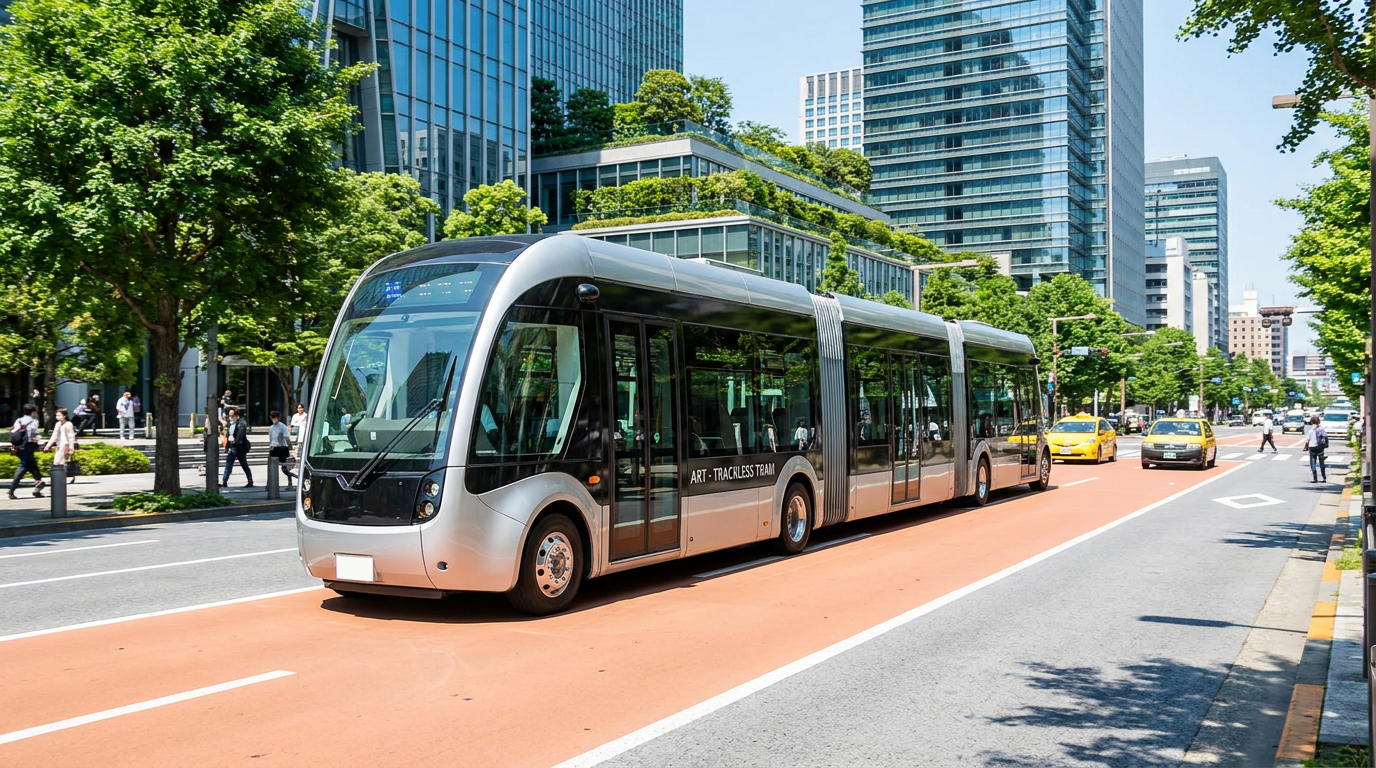
At first glance, an Autonomous Rapid Transit vehicle looks virtually indistinguishable from a state-of-the-art light rail carriage. It features a low-floor design for accessible boarding, multiple articulated passenger sections connected by flexible gangways, and a streamlined, aerodynamic nose. However, a look beneath the chassis reveals the system's defining departure from traditional rail: there are no steel bogies. Instead, trackless trams run on heavy-duty rubber tires and are powered entirely by onboard battery packs or hydrogen fuel cells, eliminating the need for embedded steel rails in the street and overhead catenary wires in the sky.[2][4]
The "autonomous" element of the ART system relies on a sophisticated array of optical sensors, LiDAR (Light Detection and Ranging), radar, and GPS technology. Rather than being physically guided by a track, the tram's onboard computers read dashed lines painted directly onto the road surface—often referred to as "virtual tracks." The vehicle steers itself along these lines with millimeter precision, though a human operator remains in the cab to monitor the systems and take manual control in the event of an emergency or an unexpected obstacle in the dedicated transit lane.[1][4]

This optical guidance precision allows the massive multi-carriage vehicles—which can stretch over 100 feet in length and carry upwards of 300 passengers—to navigate tight urban corridors with surprising agility. Because the trailing carriages are electronically and mechanically coordinated to perfectly trace the exact path of the lead carriage, the trackless tram requires significantly less lane width than a standard articulated bus, which tends to swing wide on corners. This "swept path" efficiency makes it easier to retrofit ART systems into existing city streets without requiring massive right-of-way acquisitions.[3][4]
The primary economic claim driving the global interest in trackless trams is striking: proponents and early adopters estimate that an ART corridor can be deployed for as little as one-tenth the capital cost of a traditional light rail network. By completely eliminating the need to dig up roads, relocate complex underground utilities, and install heavy electrical infrastructure, cities can theoretically launch a trackless tram route in a matter of months rather than enduring years of traffic-snarling construction. This dramatically lowers the barrier to entry for municipalities looking to decarbonize their transit fleets.[1][2]

This dramatically lowers the barrier to entry for municipalities looking to decarbonize their transit fleets.
The technology is already moving aggressively from closed-track prototypes to active revenue service in several global markets. In late 2024, Dubai announced ambitious plans to deploy an all-electric trackless tram network to alleviate its worsening urban congestion, aiming to support the emirate's broader goal of making 25 percent of all transportation fully autonomous by 2030. This initiative follows similar rollouts in neighboring Abu Dhabi, where ART vehicles are already connecting key commercial and residential hubs.[3][5]
Beyond the Middle East, the technology is gaining traction in Southeast Asia and Australia. In Malaysia, the city of Kuching has been actively testing hydrogen-powered ART vehicles, aiming to create a zero-emission backbone for its public transit network without the massive capital expenditure of a subway. Meanwhile, local governments in Perth, Australia, have explored trackless trams as a way to connect middle-ring suburbs to the central business district, providing a high-quality transit option to neighborhoods that currently rely heavily on private automobiles.[2]
Beyond simply moving people from point A to point B, trackless trams are proving to be powerful engines for real estate and economic development. Traditional bus routes rarely spur what urban planners call "Transit-Oriented Development" (TOD) because bus stops can be moved or eliminated overnight, making developers hesitant to invest millions in adjacent high-density housing. Trackless trams, however, require dedicated stations, specialized charging infrastructure, and painted corridors, providing the market with the "fixed route assurance" necessary to unlock new land value.[1][6]
Real estate markets are already responding to this dynamic. In regions planning ART corridors, properties located within walking distance of proposed stations are beginning to command a "feeder premium." Investors and developers recognize that these stations offer residents a guaranteed, traffic-free connection to major employment centers, boosting rental yields and making suburban living far more viable for daily commuters. This economic ripple effect helps municipalities justify the investment, as the resulting increase in property taxes can offset the operational costs of the transit system.[6]

Despite the widespread enthusiasm from politicians and real estate developers, transport engineers and transit advocates have raised significant technical concerns. Some critics have dismissively labeled the technology a "gadgetbahn"—a derogatory term for a proprietary, over-engineered transit mode that solves problems already addressed by existing technology. They argue that an ART system is essentially just a high-end Bus Rapid Transit (BRT) vehicle masquerading as a train to appeal to wealthier riders and developers who harbor a cultural bias against buses.[4]
A primary technical hurdle that cities must navigate is the issue of severe road wear. Because trackless trams are exceptionally heavy and their optical guidance systems force the rubber tires to follow the exact same millimeter-precise wheel path on every single trip, they can quickly cause deep rutting in standard asphalt roads. Researchers have found that to prevent this structural damage, cities often must reinforce the ART lanes with thick, specialized concrete, which eats into the initial cost savings and extends the construction timelines that make the system so appealing.[4]

Furthermore, the physics of rubber tires present an ongoing efficiency challenge. Rubber tires rolling on asphalt have a significantly higher rolling resistance than steel wheels gliding on steel rails. This means that trackless trams require substantially more energy to propel themselves forward than a traditional light rail vehicle of the same weight. While advances in lithium-titanate batteries and hydrogen fuel cells are helping to bridge this gap, the fundamental energy penalty of rubber tires remains a factor in the long-term operational costs of the system.[4]
Ultimately, while trackless trams may not be the frictionless, zero-compromise miracle that some manufacturers market them as, they represent a vital and highly adaptable new tool for urban mobility. By bridging the vast financial and psychological divide between the humble city bus and the billion-dollar train network, Autonomous Rapid Transit systems are giving mid-sized cities a realistic, achievable pathway to decarbonize their transport networks, spur economic regeneration, and reclaim their streets from gridlock.[1][2][3]
How we got here
June 2017
The Chinese rail manufacturer CRRC unveils the first Autonomous Rapid Transit (ART) vehicle in Zhuzhou.
2018
The first commercial ART line enters revenue service in downtown Zhuzhou, China.
August 2023
Sarawak Metro introduces a prototype hydrogen-powered trackless tram in Kuching, Malaysia.
Late 2024
Dubai announces plans to build an autonomous, all-electric trackless tram network to reduce urban congestion.
Viewpoints in depth
Transit Innovators & Planners
Viewing ART as a revolutionary middle-ground for urban mobility.
For urban planners facing tight municipal budgets, trackless trams represent a breakthrough. They argue that the technology delivers the two most important features of light rail—high passenger capacity and a smooth, attractive ride—without the crippling infrastructure costs. By utilizing battery and optical guidance technology, cities can rapidly roll out zero-emission transit corridors in months rather than years, making it feasible to connect sprawling suburbs that would never qualify for federal rail funding.
Real Estate Developers
Valuing the permanence of ART corridors for long-term investment.
The real estate sector views trackless trams through the lens of land value. Traditional bus routes are easily altered, making developers hesitant to build high-density housing around a bus stop that might disappear. Because ART systems require dedicated lanes, painted virtual tracks, and specialized charging stations, they offer 'fixed route assurance.' This permanence signals to developers that the corridor is a long-term civic priority, unlocking millions in transit-oriented development and driving up property values near the stations.
Technical Skeptics
Questioning the long-term viability and true costs of the technology.
Transit engineers and skeptics argue that the 'trackless tram' is a brilliant marketing exercise for what is essentially an articulated bus. They point out that the millimeter-precise optical guidance forces the heavy rubber tires to travel over the exact same strip of asphalt repeatedly, causing severe road rutting. To prevent this, cities must pour heavily reinforced concrete along the route, which erodes the initial cost savings. Furthermore, they note that rubber tires will always require more energy to move than steel wheels, making the system fundamentally less efficient than traditional rail.
What we don't know
- The true lifecycle costs of trackless trams over a 30-year period, particularly regarding battery replacement and road maintenance.
- How the optical guidance systems will perform in cities with severe winter weather, where snow and ice obscure the painted virtual tracks.
- Whether the proprietary nature of the technology will lead to vendor lock-in, making cities dependent on a single manufacturer for parts and upgrades.
Key terms
- Autonomous Rapid Transit (ART)
- A high-capacity public transit system using multi-carriage, electric vehicles that run on rubber tires and steer themselves using optical sensors.
- Virtual Track
- Painted dashed lines on the road surface that a trackless tram's optical cameras follow to steer the vehicle with millimeter precision.
- Transit-Oriented Development (TOD)
- Urban planning that clusters high-density housing, retail, and jobs within walking distance of a major public transit station.
- Gadgetbahn
- A critical term used by transit experts to describe proprietary, overly complex transportation technologies that offer little practical advantage over standard buses or trains.
- Rolling Resistance
- The friction and energy loss that occurs when a tire rolls over a surface; rubber tires on asphalt have higher resistance than steel wheels on steel rails.
Frequently asked
Do trackless trams have drivers?
Yes. While they use autonomous optical guidance to steer along virtual tracks, a human operator remains in the cab to monitor systems and take manual control during emergencies.
How are trackless trams powered?
They are fully electric, powered either by onboard lithium-titanate battery packs that fast-charge at stations, or by hydrogen fuel cells.
Why not just build traditional light rail?
Light rail requires digging up streets to lay steel tracks and install overhead wires, which can cost up to ten times more and take years longer to build than a trackless tram system.
Can they drive outside their dedicated lanes?
Yes. Because they run on rubber tires and have steering wheels, they can manually detour around accidents or road blockages, offering more flexibility than fixed-rail trains.
Sources
Source coverage
6 outlets
3 viewpoints surfaced






[1]World Economic ForumTransit Innovators
What are trackless trams and how could they transform city transport?
Read on World Economic Forum →[2]WSPTransit Innovators
Examining the Emerging Potential of Trackless Rapid Transit
Read on WSP →[3]The NationalEconomic Developers
How Dubai's trackless trams will cut costs and travel times
Read on The National →[4]WikipediaTechnical Skeptics
Autonomous rapid transit
Read on Wikipedia →[5]Scoop EmpireTransit Innovators
Dubai Announces Autonomous, Trackless Trams To Tackle Traffic
Read on Scoop Empire →[6]MyMalaysiaPropEconomic Developers
The Ripple Effect: Why Investors are Targeting ART Stations
Read on MyMalaysiaProp →
Every angle. Every day.
Get automotive stories with full source coverage and perspective breakdowns delivered to your inbox.