
Why Science is Telling Gardeners to Put Away Their Spades
The 'no-dig' gardening movement is transforming backyards by prioritizing undisturbed soil microbiomes over traditional tilling. Research shows the method dramatically reduces weeds, saves labor, and increases crop yields by letting fungal networks thrive.
By Factlen Editorial Team
- Soil Scientists & Extension Educators
- Focuses on the microscopic biological networks that sustain plant health and soil structure.
- Organic Practitioners & Advocates
- Prioritizes yield, efficiency, and the practical reduction of physical labor.
- Horticultural Institutions
- Values historical cultivation methods but is gradually adapting to new soil science.
What's not represented
- · Large-scale conventional agriculture farmers
- · Fertilizer and chemical herbicide manufacturers
Why this matters
By adopting no-dig methods, home gardeners can drastically reduce the physical labor of weeding and tilling while producing healthier, more abundant food. It also transforms the backyard into a carbon sink, making it a practical step for local environmental conservation.
Key points
- No-dig gardening avoids tilling to preserve the delicate ecosystem of bacteria, fungi, and earthworms in the soil.
- Tilling destroys mycorrhizal fungal networks that help plants absorb water and nutrients.
- Leaving the soil undisturbed drastically reduces weeds by keeping dormant weed seeds buried away from sunlight.
- Long-term trials show that no-dig beds consistently produce higher crop yields than traditionally dug beds.
For generations, the quintessential image of a dedicated gardener involved a sturdy spade, a strong back, and hours spent turning over the earth each spring. Tilling the soil was considered an essential chore to aerate the ground, break up clods, and prepare a clean slate for planting. Today, however, a quiet revolution is taking root in backyards and market farms alike. Soil scientists and horticultural experts are urging growers to put away their spades and embrace 'no-dig' or 'no-till' gardening.[1][2]
The premise of no-dig gardening is elegantly simple: leave the soil undisturbed. Instead of churning the earth, gardeners layer organic matter—such as compost, leaf mold, or well-rotted manure—directly on top of the soil surface. This mimics the natural processes of a forest floor, where fallen leaves and organic debris slowly decompose from the top down. By feeding the soil surface, growers allow natural organisms to do the heavy lifting of incorporation and aeration.[3][6]
The shift away from tilling is driven by a growing understanding of the soil microbiome. Beneath the surface lies a complex, bustling ecosystem of bacteria, protozoa, nematodes, and earthworms. When a gardener drives a spade or a rototiller into the earth, it acts as a localized earthquake. Tilling bulldozes the microscopic architecture that these organisms have painstakingly built, disrupting the delicate balance required for optimal plant health.[4][7]
Perhaps the most critical casualties of traditional digging are mycorrhizal fungi. These beneficial fungi form symbiotic relationships with plant roots, creating vast, invisible networks of white strands that stretch far beyond the plant's own root zone. The fungi feed on plant sugars, and in exchange, their expansive webs scavenge for water and essential nutrients, delivering them back to the host plant. Because these fungal threads grow slowly and cannot tolerate prolonged exposure to air, turning the soil effectively severs a plant's natural life-support system.[2][6]

Beyond the microscopic level, tilling also destroys the physical structure of the soil. Earthworms are nature's premier aerators, tunneling through the dirt to create drainage channels while leaving behind nutrient-rich castings. Digging not only bisects the worms themselves but collapses their tunnels. The Royal Horticultural Society notes that undisturbed soil naturally maintains its porosity, allowing water to sink in slowly and remain accessible at the root level, rather than pooling on a compacted surface or draining away entirely.[2]
The benefits of the no-dig method extend beyond subterranean health; they directly impact the gardener's workload. One of the most celebrated advantages is a drastic reduction in weeds. Weed seeds can lie dormant deep in the soil for years, waiting for a flash of sunlight to trigger germination. Tilling brings these hidden seeds to the surface. By contrast, layering compost over undisturbed soil smothers existing weeds and keeps dormant seeds buried in the dark.[3][7]
The benefits of the no-dig method extend beyond subterranean health; they directly impact the gardener's workload.
But does abandoning the spade actually produce more food? The evidence points to a resounding yes. Charles Dowding, a pioneering British horticulturist widely considered the guru of the no-dig movement, has spent decades putting the method to the test. In side-by-side trial beds at his Somerset market garden, Dowding grew identical crops using equal amounts of compost—one bed was dug annually, the other was not. Over an eight-year period, the no-dig bed consistently outperformed the traditional plot, yielding 855 kilograms of produce compared to 755 kilograms from the dug soil.[2][3][7]

University extension programs across the United States are increasingly echoing these findings, adapting no-till principles for home growers. The University of Minnesota Extension highlights that no-till beds are particularly effective in regions with heavy clay soils, which are prone to severe compaction when worked with machinery. Rather than trying to mechanically force air into dense clay, layering organic matter encourages soil life to naturally break down the dense particles over time.[4]
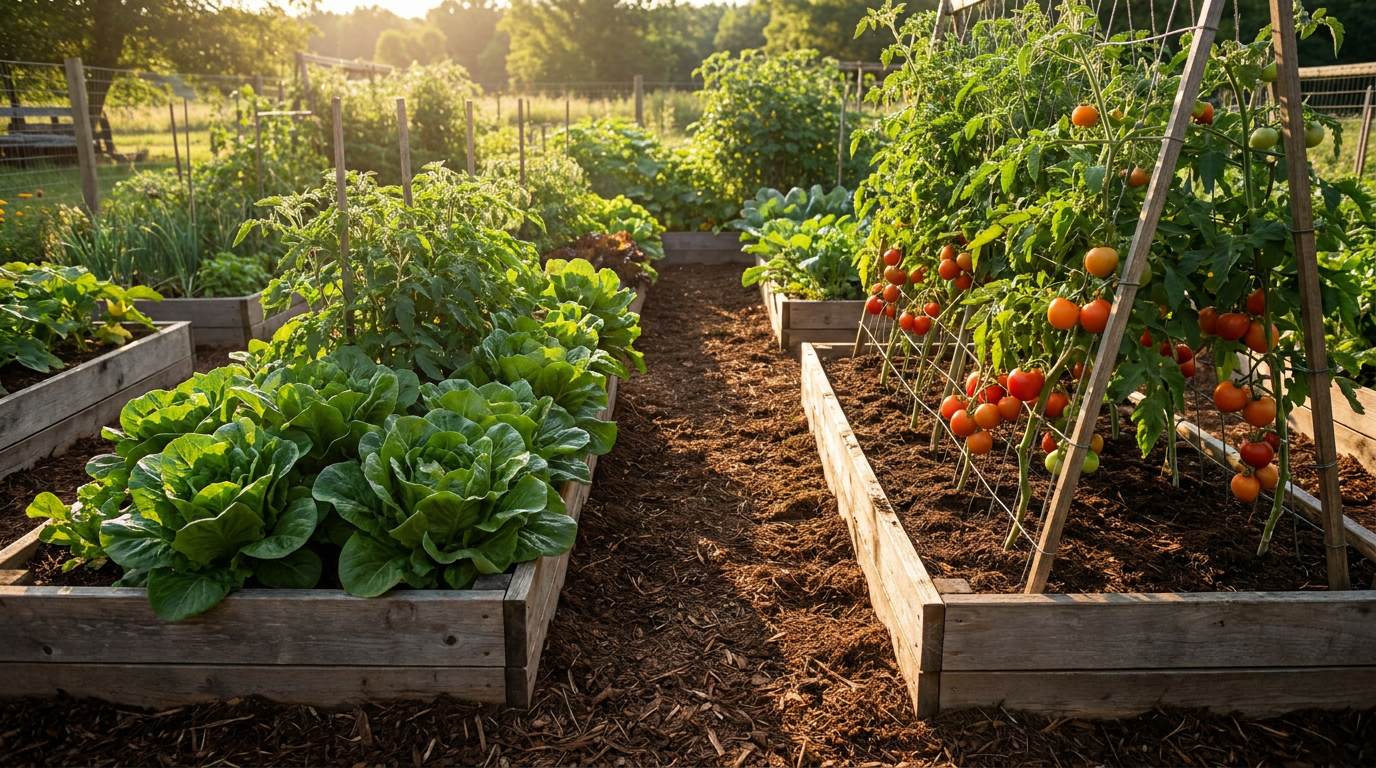
Similarly, the University of Vermont Extension advocates for no-till practices in raised beds. Because raised beds function more like large containers, maintaining their nutrient profile can be challenging. By simply top-dressing the beds with an inch or two of compost each spring and leaving crop roots in the ground to decompose over the winter, gardeners can continuously build fertility without destroying the soil structure they have worked to establish.[5][8]
Starting a no-dig garden is surprisingly straightforward, often utilizing a technique known as 'sheet mulching' or 'lasagna gardening.' If converting a patch of lawn or a weedy area, growers begin by laying down a barrier of plain, unwaxed cardboard. This layer blocks sunlight, effectively smothering the grass and weeds below. A thick layer of compost—typically 6 to 10 inches—is then piled directly on top of the cardboard.[2][7][8]

Because the compost provides an immediate, nutrient-rich growing medium, gardeners can plant seeds or seedlings straight into the top layer on the very first day. Over the course of a few months, the cardboard breaks down, and the roots of the new crops penetrate into the native soil below, which has been softened by the activity of earthworms migrating upward to feed on the decomposing layers.[3][7]
The environmental implications of this shift are profound. Tilled soil, exposed to the elements, rapidly oxidizes and releases stored carbon dioxide into the atmosphere. No-dig gardening acts as a carbon sink, locking organic matter safely underground. Furthermore, the thick layer of surface mulch acts as an insulating blanket, regulating soil temperatures and dramatically reducing water evaporation during hot summer months.[2][4]
Despite the overwhelming benefits, transitioning to a no-dig system requires a shift in mindset. It demands patience, as the soil ecosystem takes time to fully establish its fungal networks and worm populations. Gardeners must also resist the ingrained urge to clean up the garden by ripping out every root at the end of the season, learning instead to cut plants at the base and let the subterranean biology handle the decomposition.[1][8]
Ultimately, the no-dig movement represents a fundamental change in how we view our gardens. Rather than treating the soil as an inert medium to be manipulated and chemically fertilized, science is teaching us to view it as a living, breathing organism. By putting away the spade, gardeners are finding that when they step back and let nature do the work, the earth responds with unprecedented abundance.[1][3][6][7]
How we got here
1949
A. Guest publishes 'Gardening Without Digging', sparking early interest in minimal-disturbance cultivation.
1981
Charles Dowding begins his no-dig market garden experiments in Somerset, pioneering the modern movement.
2013–2020
Dowding's side-by-side trials definitively prove higher yields for undisturbed, compost-fed soil.
2020s
Major horticultural institutions and university extensions formally endorse no-till methods for home gardens.
Viewpoints in depth
Soil Scientists' view
Focuses on the microscopic biological networks that sustain plant health.
For ecologists and microbiologists, the garden is primarily a habitat for bacteria, fungi, and invertebrates. They argue that mechanical tilling is akin to a natural disaster for this ecosystem, destroying the delicate mycorrhizal fungal networks that plants rely on for nutrient uptake. From this perspective, leaving the soil undisturbed is the only way to build long-term resilience, sequester carbon, and prevent topsoil erosion.
Market Gardeners' view
Prioritizes yield, efficiency, and labor reduction.
Commercial organic growers and homesteaders champion the no-dig method for its practical economic benefits. By eliminating the need for heavy tilling machinery and drastically reducing the hours spent weeding, farmers can manage larger plots with less physical strain. Proponents like Charles Dowding point to decades of yield data proving that undisturbed, compost-fed beds consistently produce heavier, healthier harvests than traditionally dug plots.
Traditional Horticulturists' view
Values historical cultivation methods but is gradually adapting to new science.
Historically, double-digging and deep tilling were taught as the gold standard for preparing garden beds, particularly for breaking up compacted clay or incorporating amendments. While many traditionalists initially viewed the no-dig approach with skepticism—fearing that unworked soil would become hard and impenetrable—the overwhelming success of no-till demonstration gardens at institutions like the Royal Horticultural Society has prompted a widespread shift in conventional horticultural education.
What we don't know
- The exact timeline for how long it takes a severely degraded, chemically-treated plot of land to fully regenerate its native microbiome using only no-dig methods.
- How large-scale commercial grain operations can fully adapt these hand-scale no-dig compost methods without relying on synthetic herbicides to terminate cover crops.
Key terms
- No-dig gardening
- A cultivation method that avoids turning or tilling the soil, relying instead on surface mulches to feed soil life and suppress weeds.
- Soil microbiome
- The complex community of microorganisms, including bacteria, fungi, and protozoa, living within the soil.
- Mycorrhizal fungi
- Beneficial fungi that form a symbiotic network with plant roots, aiding in water and nutrient absorption in exchange for plant sugars.
- Sheet mulching
- A technique of layering cardboard and compost over weeds or grass to create a new, weed-free planting bed without digging.
- Soil compaction
- The densification of soil that reduces pore space, making it difficult for roots, air, and water to penetrate.
Frequently asked
Can I start a no-dig garden over existing grass?
Yes. Using a method called sheet mulching, you can lay unwaxed cardboard directly over the grass to smother it, then pile 6 to 10 inches of compost on top. You can plant immediately into the compost.
Do I need to buy massive amounts of compost?
An initial thick layer is helpful to establish the bed and suppress weeds, but in subsequent years, you only need to add a thin 1-to-2-inch top dressing of organic matter annually.
How do I handle heavy clay soil without tilling?
Layering organic matter on top of clay soil encourages earthworms and microbes to migrate upward. Over time, their tunneling naturally aerates and breaks up the dense clay without the compaction caused by heavy machinery.
What do I do with plant roots at the end of the season?
Instead of pulling plants out by the roots, cut them off at the soil line. Leaving the roots in the ground allows them to decompose over the winter, adding organic matter and preserving the soil's structure.
Sources
Source coverage
8 outlets
3 viewpoints surfaced







[1]Factlen Editorial TeamSoil Scientists & Extension Educators
Synthesis by Factlen editorial team
Read on Factlen Editorial Team →[2]Royal Horticultural SocietyHorticultural Institutions
No-dig gardening: RHS Advice Guide
Read on Royal Horticultural Society →[3]Charles DowdingOrganic Practitioners & Advocates
What is no dig gardening?
Read on Charles Dowding →[4]University of Minnesota ExtensionSoil Scientists & Extension Educators
Healthier soil, less work with no-till gardening
Read on University of Minnesota Extension →[5]University of Vermont ExtensionSoil Scientists & Extension Educators
No-till Gardening in Raised Beds
Read on University of Vermont Extension →[6]Soil AssociationOrganic Practitioners & Advocates
What is no-dig gardening?
Read on Soil Association →[7]Science FocusSoil Scientists & Extension Educators
Why 'no-dig' gardening is the secret to a greener, easier plot
Read on Science Focus →[8]University of New Hampshire ExtensionSoil Scientists & Extension Educators
Low and No-Till Gardening
Read on University of New Hampshire Extension →
Every angle. Every day.
Get home stories with full source coverage and perspective breakdowns delivered to your inbox.