
How Self-Driving Labs and Agentic AI Are Automating Scientific Discovery
Autonomous laboratories combining AI and robotics are compressing decades of chemical and materials research into days. By operating in closed loops, these systems are accelerating breakthroughs in energy, medicine, and materials science.
By Factlen Editorial Team
- Automation Advocates
- Focus on the unprecedented speed and efficiency gains of removing human latency from the laboratory.
- Mechanistic Chemists
- Emphasize that speed must not come at the expense of fundamental scientific understanding and interpretability.
- Regulatory & Quality Assurance
- Prioritize safety, compliance, and human oversight in the deployment of autonomous systems.
What's not represented
- · Bench scientists facing role transitions
- · Open-source hardware developers
Why this matters
The ability to discover new materials and drugs 100 times faster fundamentally changes how humanity responds to crises. From developing next-generation battery components to synthesizing new pharmaceuticals, autonomous labs remove the physical bottlenecks of human research.
Key points
- Self-driving labs (SDLs) combine AI decision-making with robotic hardware to run continuous, closed-loop experiments.
- Systems like NC State's Rainbow lab can conduct 1,000 experiments per day, accelerating discovery by up to 100 times.
- New gray-box AI models are solving the interpretability problem by explaining the chemical mechanisms behind their discoveries.
- Regulatory guidelines require human oversight for quality decisions, ensuring AI acts as a powerful recommender rather than an autonomous decision-maker.
For over a century, the core mechanics of chemical synthesis and materials discovery have remained remarkably human-dependent. Brilliant scientists spending hours at the lab bench manually pipetting fluids, monitoring temperature profiles, and adjusting physical valves has long been the gold standard of research and development. But the physical limitations of human hands and human latency have created a bottleneck in the face of urgent global challenges, from climate change to emerging diseases.[1]
As we advance through 2026, a quiet revolution has reached maturity on the laboratory floor: the advent of Self-Driving Labs (SDLs). Driven by the convergence of cloud computing, advanced robotics, and specialized artificial intelligence, these autonomous laboratories are transitioning from experimental academic concepts into industrial infrastructure.[1][6]
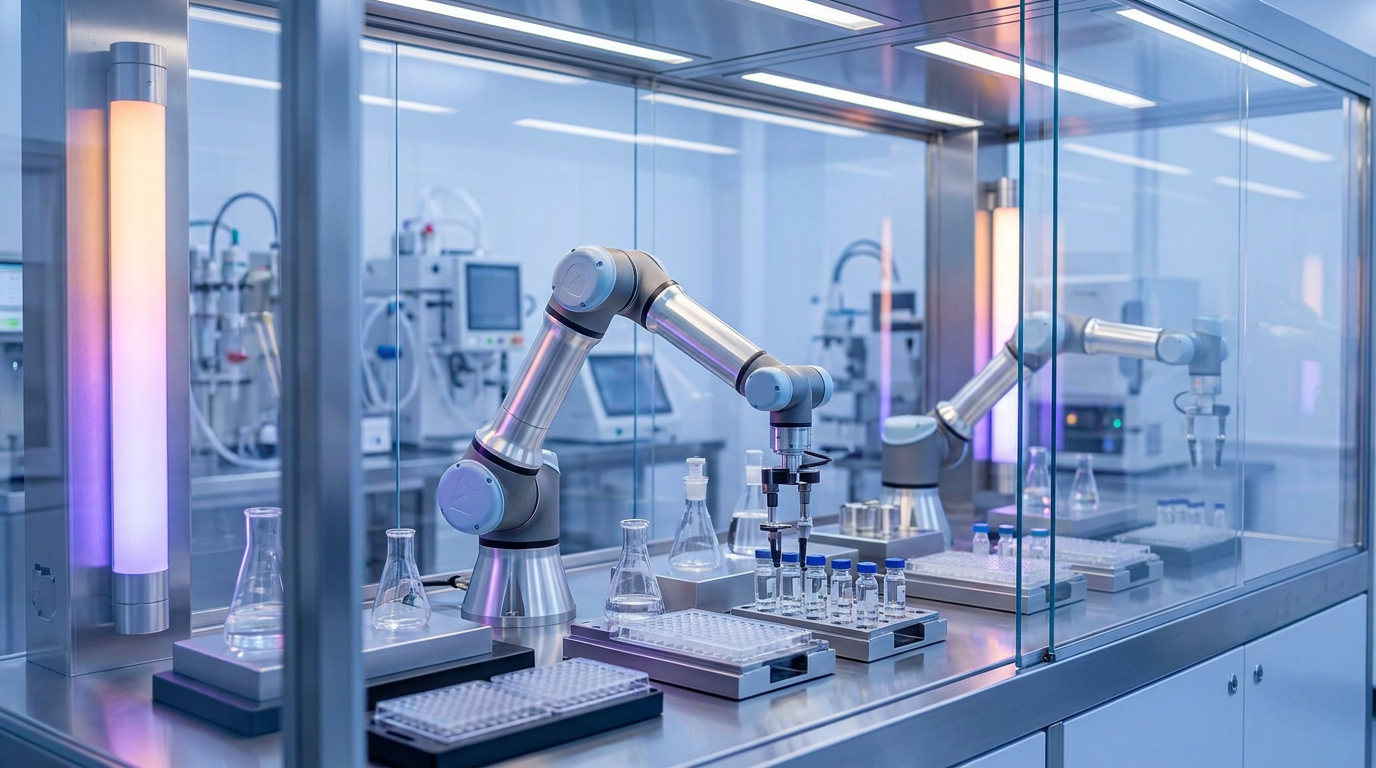
An SDL is not merely a traditional lab outfitted with robotic arms; it is an entirely closed-loop, decision-making ecosystem. It operates on a continuous Design-Build-Test-Learn cycle, executing high-throughput experiments without human intervention.[1][2][5]

The process begins with the AI Brain, where active learning algorithms and Bayesian optimization models explore high-dimensional parameter spaces to generate a mathematically optimal formulation recipe. Instead of relying on human intuition, the AI calculates the most promising chemical pathways from millions of possibilities.[1]
Once a recipe is designed, the system translates it into machine code for the Robotic Body. Automated fluid-handlers and multi-axis mechanical hardware physically blend precursors, synthesize mixtures, and manage the physical environment of the reaction.[1]
The loop closes with automated analytical instruments—such as spectrometers and rheometers—that run real-time material characterization checks. The AI ingests these analytical outputs, updates its primary machine learning models, and immediately triggers the next optimized run, operating around the clock.[1][2]
The acceleration achieved by removing human latency is staggering. At North Carolina State University, a self-driving lab named Rainbow is currently optimizing next-generation quantum dots. The compact system can conduct and analyze up to 1,000 experiments per day.[2]
The acceleration achieved by removing human latency is staggering.
According to researchers at NC State, a single day of autonomous experimentation by Rainbow is equivalent to roughly seven years of traditional human-centered academic research. Across various applications, SDLs are accelerating the discovery of new molecules and materials by up to 100 times compared to conventional methods.[2]

This speed is being supercharged by massive, AI-ready datasets. The Materials Project at Berkeley Lab, which serves over 650,000 registered users, is now connecting its simulation pipelines directly to autonomous facilities like the A-Lab. This allows the AI to draw upon a vast history of computational simulations to guide its physical experiments.[4]
However, as these systems have gained traction, they have faced criticism for operating as black boxes. Early autonomous systems excelled at identifying the best-performing materials but failed to explain the underlying chemical mechanisms, limiting scientific insight and trust.[3]
A recent breakthrough published in ACS Catalysis addresses this by shifting to a gray-box AI model. Researchers designed an AI to explore chemical space in a way that simultaneously uncovers the mechanisms behind a material's performance.[3]

Testing the system on the conversion of propane into propylene—a crucial industrial reaction—the gray-box AI navigated a design space of more than 10 trillion possible promoter combinations in fewer than 50 experiments. Crucially, it translated its outputs into chemically meaningful insights, uncovering synergistic interactions that human scientists had previously overlooked.[3]
As the technology matures, the regulatory landscape is adapting to the realities of autonomous science. In early 2026, global regulatory bodies aligned on guidelines for AI in pharmaceutical and life sciences environments.[5]
The core regulatory principle for SDLs operating in Good Practice (GxP) environments is that AI outputs remain recommendations, not final decisions. Under current frameworks, a human expert must still approve any AI-driven action that ultimately affects product quality, safety, or efficacy.[5]

Ultimately, the integration of artificial intelligence with hardware robotics does not replace the ingenuity of human chemists. Instead, it liberates scientists from the manual routine of physical pipetting and data transcription, allowing them to focus entirely on high-level strategy, mechanistic understanding, and molecule selection.[1][6]
How we got here
2011
The Materials Project launches, beginning the curation of massive AI-ready datasets for materials science.
2023
Berkeley Lab launches the A-Lab, a fully automated facility guided by artificial intelligence.
Early 2026
Global regulatory bodies align on the first guidelines for AI in pharmaceutical and life sciences environments.
April 2026
Researchers publish a breakthrough gray-box AI model that explains chemical mechanisms alongside discovering new catalysts.
Viewpoints in depth
Automation Advocates
Focus on the unprecedented speed and efficiency gains of removing human latency from the laboratory.
Researchers and platform developers argue that the physical limitations of human scientists are the primary bottleneck in solving urgent challenges like climate change and disease. By combining active learning algorithms with robotic execution, they emphasize that decades of traditional R&D timelines can be compressed into mere days, fundamentally changing the pace of scientific innovation.
Mechanistic Chemists
Emphasize that speed must not come at the expense of fundamental scientific understanding and interpretability.
While acknowledging the power of high-throughput automation, this camp warns against relying on black-box AI that simply spits out an optimized recipe without explaining why it works. They advocate for gray-box systems that map chemical pathways and uncover synergistic interactions, ensuring that AI acts as an interpretable partner that advances human knowledge rather than just an optimization engine.
Regulatory & Quality Assurance
Prioritize safety, compliance, and human oversight in the deployment of autonomous systems.
For industries bound by strict quality standards, such as pharmaceuticals, this perspective stresses that AI cannot be delegated ultimate authority. They focus on maintaining a human-in-the-loop architecture where AI systems generate highly optimized recommendations, but human experts retain the final sign-off on any actions that impact product safety, efficacy, or regulatory compliance.
What we don't know
- How quickly smaller academic institutions will be able to afford and adopt fully autonomous closed-loop systems.
- The long-term impact on the training and education of early-career chemists who traditionally learned through manual bench work.
- Whether gray-box interpretability can scale to the most complex biological and pharmaceutical macromolecules.
Key terms
- Self-Driving Lab (SDL)
- A research facility where AI autonomously designs, executes, and learns from physical experiments in a continuous loop.
- Active Learning
- A machine learning approach where the AI actively queries the system to select the most informative next experiment.
- Gray-Box AI
- An artificial intelligence model designed to provide interpretable, mechanistic explanations for its outputs, rather than just a final answer.
- High-Throughput Experimentation
- The use of automated equipment to rapidly conduct thousands of simultaneous or sequential chemical tests.
- GxP
- Good Practice quality guidelines and regulations used in highly regulated fields like pharmaceuticals to ensure product safety.
Frequently asked
Will self-driving labs replace human chemists?
No. SDLs automate the manual labor of pipetting and running routine tests, freeing human scientists to focus on high-level strategy and interpreting complex results.
How much faster is an autonomous lab?
Systems like NC State's Rainbow lab can conduct 1,000 experiments a day, achieving in 24 hours what would take roughly seven years of traditional human-led research.
Can the AI explain why a new material works?
Yes, newer gray-box AI models are designed not only to find the best materials but to uncover and explain the underlying chemical mechanisms behind their performance.
Are these autonomous labs regulated?
Yes. In regulated industries like pharmaceuticals, current guidelines dictate that AI can only make recommendations; a human must approve any decisions affecting product safety or quality.
Sources
Source coverage
6 outlets
3 viewpoints surfaced





[1]ChemCopilotAutomation Advocates
Self-Driving Labs: The Rise of Autonomous Chemical Discovery in 2026
Read on ChemCopilot →[2]NC State UniversityAutomation Advocates
Self-driving labs are accelerating the discovery of new molecules and materials
Read on NC State University →[3]ACS CatalysisMechanistic Chemists
AI-powered self-driving labs move beyond discovery to explain catalyst performance
Read on ACS Catalysis →[4]Berkeley LabAutomation Advocates
Connecting to autonomous labs: The Materials Project
Read on Berkeley Lab →[5]QPillarsRegulatory & Quality Assurance
The Regulatory Reality - GxP and Autonomous Labs
Read on QPillars →[6]Factlen Editorial Team
Synthesis by Factlen editorial team
Read on Factlen Editorial Team →

Every angle. Every day.
Get ai stories with full source coverage and perspective breakdowns delivered to your inbox.