
How AI Tools Are Enabling Solo Creators to Build Studio-Quality Games and Animations
The 2026 maturation of generative AI has collapsed traditional production pipelines, allowing independent developers to generate complex code, 3D assets, and cinematic video without a studio budget.
By Factlen Editorial Team
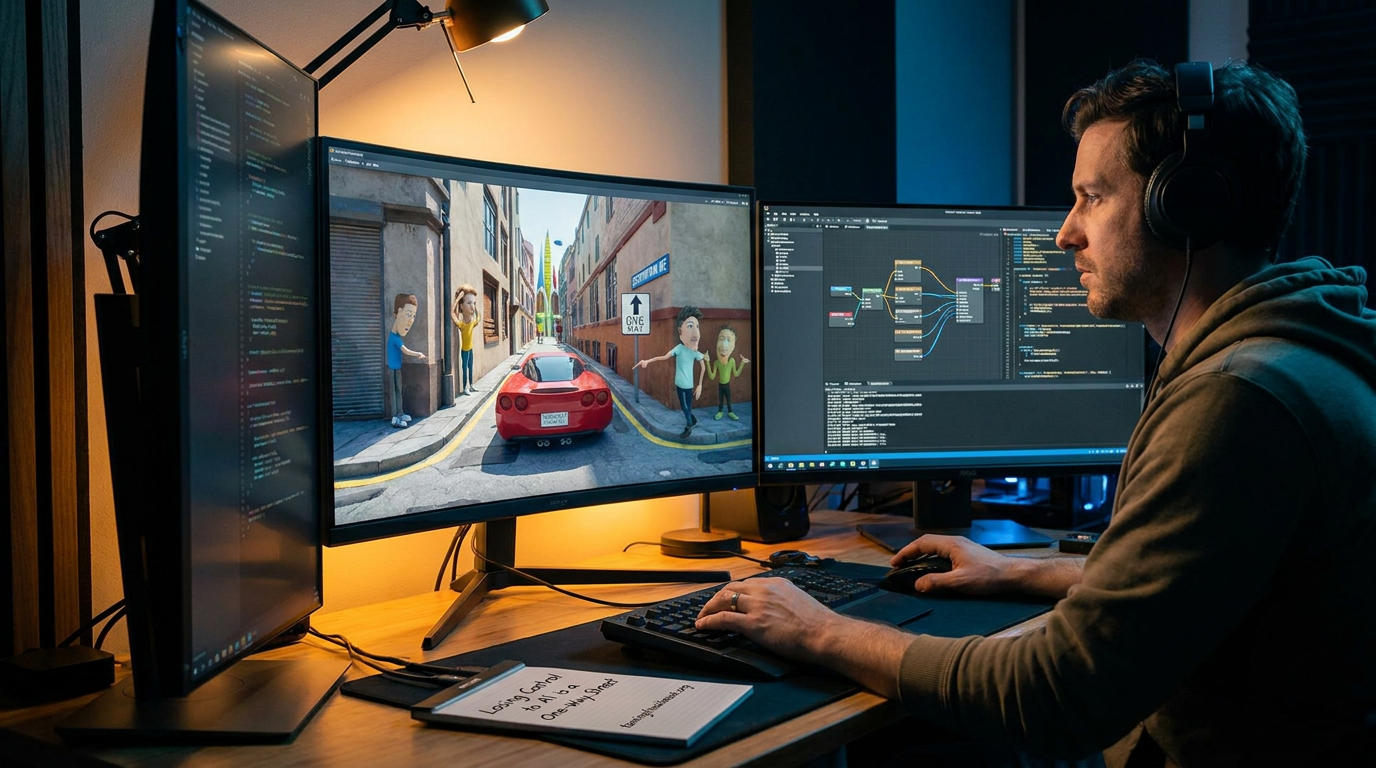
- Solo Indie Developers
- Argue that AI tools are essential equalizers that allow single creators to compete with AAA studios by automating code and asset generation.
- Animation Technologists
- Emphasize the rapid improvement in temporal consistency, physics, and rendering that makes AI viable for cinematic storytelling.
- Academic Researchers
- Focus on the structural impact of generative AI, highlighting both the democratization of access and the ethical/playability challenges.
- Skeptics & Traditionalists
- Caution against content homogenization, loss of narrative originality, and the limitations of AI in fine motion control.
What's not represented
- · Voice Actors
- · Traditional 3D Riggers and Animators
Why this matters
For decades, building a high-quality video game or animated film required a massive budget and a team of specialists, locking out independent voices. The 2026 maturation of generative AI has entirely removed this bottleneck, allowing a single person with a vision to produce studio-quality interactive and cinematic experiences from their bedroom.
Key points
- Generative AI has reduced the cost of a 30-second animated sequence from tens of thousands of dollars to under $300.
- Solo developers can now use multimodal AI to translate crude sketches into functional C# game code and logic.
- Specialized AI tools generate fully rigged 3D models and usable 2D sprite sheets, eliminating major art bottlenecks.
- Frame-to-frame consistency in AI video has improved by 85%, making cinematic storytelling viable for single creators.
- Experts warn of potential 'content homogenization' and advise creators to use a hybrid workflow that preserves human narrative design.
For decades, the barrier to entry in video game development and cinematic animation was defined by a simple, unforgiving metric: human hours. Building a feature-rich indie game or a studio-quality animated short required either a massive budget or years of grueling, unpaid labor. A single 30-second animated commercial traditionally demanded a team of eight to fifteen specialists working for up to eight weeks, costing anywhere from $15,000 to $75,000. Today, that paradigm has fundamentally fractured. In 2026, the proliferation of generative artificial intelligence tools has collapsed the production pipeline, enabling solo creators to produce comparable results in a matter of days for under $300.[6]
This shift represents one of the most significant democratizations of creative technology in modern history. Rather than replacing human vision, the current generation of AI acts as a multiplier for individual ambition. Solo developers are no longer bottlenecked by their inability to write complex C# code, rig 3D character models, or animate fluid sprite sheets. Instead, they operate as directors of their own virtual studios, orchestrating a suite of specialized AI agents that handle the heavy lifting of digital asset creation.[2][8]
The transformation is not merely anecdotal; it is reshaping the economics of the creator economy. According to a 2026 report by Cybernews, nearly 60% of independent YouTube creators now utilize at least one AI-driven video tool to maintain their production schedules. The global AI video generation market reached $946 million in 2026, reflecting this massive adoption. The barrier to high-end animation and game design has effectively been removed, allowing solo entrepreneurs and small teams to compete for audience attention alongside established AAA studios.[5][7]
The foundation of this new workflow begins with code generation and rapid prototyping. In the past, a solo developer with a brilliant game design concept might abandon the project if they lacked the programming expertise to execute it. Now, tools like Google AI Studio and GitHub Copilot serve as technical co-founders. Developers can leverage multimodal prompting—uploading a crude pencil sketch of a boss character alongside a text description of its attack patterns—and receive a comprehensive design document complete with ability logic, balance suggestions, and narrative hooks.[3]

For actual implementation, the integration of AI directly into development environments has eliminated the friction of boilerplate coding. GitHub Copilot, particularly following its 2026 updates tailored for game-specific APIs, excels at translating natural language game logic into functional C# scripts for engines like Unity. A developer can photograph a hand-drawn user interface layout, and the AI will automatically generate the canvas hierarchy and event handlers required to make it functional.[3]
Beyond logic, the most visually striking advancement has occurred in the realm of 2D and 3D asset generation. Historically, generic AI art generators produced static images that were virtually useless for game development, which requires dynamic, animatable assets. The 2026 ecosystem has solved this with specialized tools. Platforms like PixelLab now generate fully usable sprite sheets with skeleton-based animation, allowing a creator to type 'walking knight with sword' and instantly receive a game-ready asset.[2]
In the 3D space, the leap has been even more profound. Platforms such as Meshy AI lead the market by offering text-to-3D and image-to-3D generation complete with full Physically Based Rendering (PBR) texture maps. These tools include smart remeshing to control polygon counts and libraries of auto-rigged animations, seamlessly integrating into industry-standard engines like Unreal, Unity, and Blender. What once took a 3D artist a week to model, texture, and rig can now be generated and imported in minutes.[2]
This acceleration extends deeply into cinematic animation. The best AI tools of 2026 can take a creator from a blank text prompt to a fully animated scene without requiring drawing skills or a studio budget. The workflow has been radically compressed. A short promotional video that previously required five distinct tools—a footage generator, voiceover software, music licensing, lip-syncing, and a non-linear editor—now collapses into a two-step process of generation and light editing.[4]

Temporal consistency—the ability of an AI model to keep a character or environment looking exactly the same from one frame to the next—was the Achilles' heel of early generative video. Characters would morph, backgrounds would flicker, and physics would behave erratically. However, the current generation of AI animation tools has improved frame-to-frame consistency by over 85% compared to previous iterations.[5]
Characters would morph, backgrounds would flicker, and physics would behave erratically.
Models like Kling 2.1 have driven this growth by producing physically believable motion. Bodies, cloth, water, and camera movements now feel grounded rather than floaty, solving a major pain point for stylized 3D animation. With the addition of native 4K output, cinematic camera controls, and multi-element prompting, creators can now direct complex scenes involving multiple characters with precise instructions.[4]
For long-form narrative storytelling, purpose-built platforms have emerged to maintain continuity. Tools like LongStories.ai are designed specifically for animated episodes, allowing creators to establish a 'Universe' and save character profiles to ensure visual consistency across dozens of scenes. Creators can choose from built-in styles—ranging from Pixar-esque 3D to Studio Ghibli-inspired painterly aesthetics—and generate videos up to 15 minutes long.[4]
The academic community has begun to analyze the structural impact of this technological shift. A 2025 narrative review published in the Journal of Ecohumanism examined the integration of generative AI in game design, concluding that these tools significantly enhance development efficiency and foster creativity. The researchers noted that by reducing production costs and democratizing access, AI empowers a wider, more diverse range of indie developers to contribute to the medium.[1]

Furthermore, the study highlighted how the integration of generative AI with immersive technologies, such as Virtual Reality (VR) and Augmented Reality (AR), is creating more responsive and emotionally engaging gameplay experiences. As the technology matures, video games are increasingly elevated into powerful platforms for cultural expression, driven by voices that were previously priced out of the industry.[1]
Despite the overwhelming optimism, the technology is not without its limitations and uncertainties. AI CGI animation still has clear boundaries that creators must navigate. While temporal consistency has improved dramatically, maintaining exact facial features and subtle details across long, complex sequences remains challenging. A character's appearance may still shift slightly from one shot to the next, requiring manual touch-ups or clever editing to hide the seams.[6]
Fine motion control is another persistent hurdle. While AI handles broad movements and dynamic action shots exceptionally well, complex character performances that require precise lip-syncing and nuanced body language are still difficult to generate purely from text prompts. Most AI video generators also face length constraints, typically producing clips of only four to fifteen seconds, which forces creators to stitch multiple generations together to form a cohesive narrative.[6]
There are also broader ethical and artistic concerns. The Journal of Ecohumanism study warned of the risk of 'content homogenization,' where the reliance on similar underlying AI models could lead to a convergence of art styles and gameplay mechanics, diluting narrative originality. Additionally, the industry continues to grapple with ethical questions surrounding algorithmic bias and the intellectual property rights of the data used to train these massive models.[1]

To mitigate these risks, experts advocate for a hybrid workflow. The most successful solo creators in 2026 do not simply push a button and accept whatever the AI outputs. Instead, they use AI for ideation, boilerplate coding, and initial asset generation, while reserving their human judgment for narrative design, emotional resonance, and final polish.[1][8]
This pipeline approach mirrors broader industry trends. Rather than relying on a single omnipotent AI, developers chain specialized tools together: one agent for coding, another for 3D modeling, and a third for cinematic rendering. This modular strategy allows creators to swap out tools as better models are released, maintaining a flexible and cutting-edge tech stack.[3]
The democratization of game development and animation is ultimately a story of leverage. By stripping away the repetitive, labor-intensive aspects of digital creation, AI allows solo developers to focus entirely on what actually matters: the player's experience and the story being told. The barrier to entry has fallen, but the ceiling for quality has never been higher.
As these tools continue to evolve, the distinction between a 'solo indie project' and a 'AAA studio release' will increasingly blur. The next generation of defining video games and animated films may not emerge from massive corporate campuses, but from the bedrooms of individual creators armed with nothing more than a powerful vision and the AI tools to realize it.[8]
How we got here
2024
Early generative video models struggle with severe temporal consistency, making them largely unusable for narrative animation.
2025
AI coding assistants like GitHub Copilot gain widespread adoption among indie developers for boilerplate code reduction.
Early 2026
Specialized game asset generators launch, capable of producing usable 2D sprite sheets and auto-rigged 3D models with PBR textures.
Mid 2026
Video generation models achieve an 85% improvement in frame-to-frame consistency, enabling solo creators to produce studio-quality cinematic shorts.
Viewpoints in depth
Solo Indie Developers
AI tools are essential equalizers that allow single creators to compete with AAA studios.
For independent creators, the primary value of AI is workflow compression. By automating the most labor-intensive aspects of development—such as C# boilerplate coding, 3D rigging, and sprite sheet animation—solo developers can focus entirely on game design and narrative. They view these tools not as replacements for creativity, but as technical co-founders that eliminate the financial barriers to entry.
Animation Technologists
Rapid improvements in temporal consistency and physics make AI viable for cinematic storytelling.
Technologists point to the massive leaps in model architecture in 2026, specifically the 85% improvement in frame-to-frame consistency. With tools now capable of native 4K output, physically believable motion, and multi-element prompting, they argue that the technology has crossed the threshold from experimental novelty to production-ready utility, collapsing a five-tool pipeline into a two-step process.
Academic Researchers
Generative AI democratizes access but introduces new ethical and structural challenges.
Researchers highlight the dual nature of this technological shift. While celebrating the democratization of the medium and the empowerment of diverse voices, they warn of the risks of 'content homogenization'—where games and animations begin to look and feel identical due to shared training data. They advocate for hybrid workflows and the establishment of ethical standards regarding intellectual property.
What we don't know
- How traditional AAA studios will adjust their hiring and production pipelines in response to the efficiency of AI-assisted solo creators.
- Whether upcoming copyright legislation will impact the availability of the training data used by these generative models.
- How digital storefronts like Steam and the App Store will curate the impending flood of AI-assisted indie games.
Key terms
- Temporal Consistency
- The ability of an AI video model to keep a character, object, or environment looking exactly the same from one frame to the next without morphing or flickering.
- Physically Based Rendering (PBR)
- A method of shading and rendering 3D models that accurately simulates how light interacts with real-world materials, essential for modern game graphics.
- Multimodal Prompting
- The ability to interact with an AI using a combination of different input types, such as uploading a sketch alongside a text description to generate code.
- Sprite Sheet
- A single image file containing multiple smaller graphics (sprites) arranged in a grid, used by 2D games to create animations by rapidly cycling through the frames.
- Rigging
- The process of creating a digital skeleton for a 3D model so that it can be animated and moved realistically.
Frequently asked
Can I build a complete game using only free AI tools?
Yes. In 2026, solo creators can chain together free tiers of tools like Google AI Studio for prototyping, Windsurf for coding, and Meshy AI for basic 3D assets to build early-stage projects at zero monthly cost.
Does AI animation still suffer from flickering and morphing?
While not entirely eliminated, the 'flickering' issue has been drastically reduced. Current generation models have improved frame-to-frame consistency by over 85%, making them viable for long-form storytelling.
Can AI generate usable 2D sprite sheets for games?
Yes. Specialized tools like PixelLab now generate fully usable, skeleton-based animated sprite sheets (e.g., a walking character) rather than just static 2D images.
How long of an animation can AI generate?
Most raw video generators produce clips of 4 to 15 seconds. However, purpose-built narrative platforms like LongStories.ai allow creators to stitch these together into consistent episodes up to 15 minutes long.
Sources
Source coverage
8 outlets
4 viewpoints surfaced








[1]Journal of EcohumanismAcademic Researchers
Generative Artificial Intelligence in Game Design: A Narrative Review
Read on Journal of Ecohumanism →[2]GameDev AI HubSolo Indie Developers
AI Tools for Solo Game Developers in 2026
Read on GameDev AI Hub →[3]Browse AI ToolsSolo Indie Developers
Best Free AI Tools for Indie Game Developers in 2026
Read on Browse AI Tools →[4]LongStoriesAnimation Technologists
The Best AI Tools for Animation in 2026
Read on LongStories →[5]Digen AIAnimation Technologists
Best AI Animation Generators for Creators in 2026
Read on Digen AI →[6]DrawStoryAnimation Technologists
AI CGI Animation Tools in 2026
Read on DrawStory →[7]Grand View ResearchAnimation Technologists
AI Video Generation Market Size, Share & Trends Analysis Report
Read on Grand View Research →[8]Factlen Editorial TeamSkeptics & Traditionalists
Synthesis by Factlen editorial team
Read on Factlen Editorial Team →



Every angle. Every day.
Get ai stories with full source coverage and perspective breakdowns delivered to your inbox.