
Grassroots 'Repair Cafés' Hit Major Milestones as Communities Embrace the Right to Repair
Volunteer-led repair hubs across the globe are celebrating significant milestones in 2026, diverting tonnes of waste from landfills and saving millions of kilograms of carbon emissions. The movement is fostering local connections while tackling the climate crisis one broken item at a time.
By Factlen Editorial Team
- Community Organizers
- Focus on the social cohesion, skill-sharing, and intergenerational connections fostered by the events.
- Environmental Advocates
- Focus on the quantifiable reduction in carbon emissions and the diversion of e-waste from landfills.
- Consumer Rights Advocates
- Focus on empowering individuals to bypass planned obsolescence and save money on replacement goods.
What's not represented
- · Consumer Electronics Manufacturers
- · Municipal Waste Management Authorities
Why this matters
In an era of disposable consumer goods, these community hubs offer a practical, free alternative that saves households money and reduces e-waste. Beyond the environmental impact, they combat social isolation by bringing neighbors together to share skills and rebuild local resilience.
Key points
- The global Repair Café movement is hitting major milestones in 2026, including 1 million kilograms of carbon saved in Wales.
- Local hubs operate by pairing skilled volunteers with residents to fix broken items for free.
- Success rates are exceptionally high, with some chapters reporting a 93% success rate for repairs and diagnostics.
- The movement actively combats social isolation by creating intergenerational community spaces.
- Grassroots success is bolstering the broader legislative push for 'Right to Repair' laws globally.
The modern consumer economy has long been built on a simple, highly wasteful premise: when an appliance sputters or a seam tears, you throw the item away and purchase a replacement. But in community halls, church basements, and public libraries across the globe, a quiet, hands-on rebellion is gathering remarkable momentum. The "Repair Café" movement—a decentralized, grassroots network of volunteer fixers—is reaching unprecedented milestones in the first half of 2026. By transforming how neighborhoods approach broken electronics, torn textiles, and malfunctioning household goods, these local hubs are diverting massive amounts of waste from landfills while simultaneously rebuilding frayed community ties. It is a localized solution to a global crisis, proving that the throwaway culture is not an inevitability, but a choice that communities can actively unmake.[1][2]
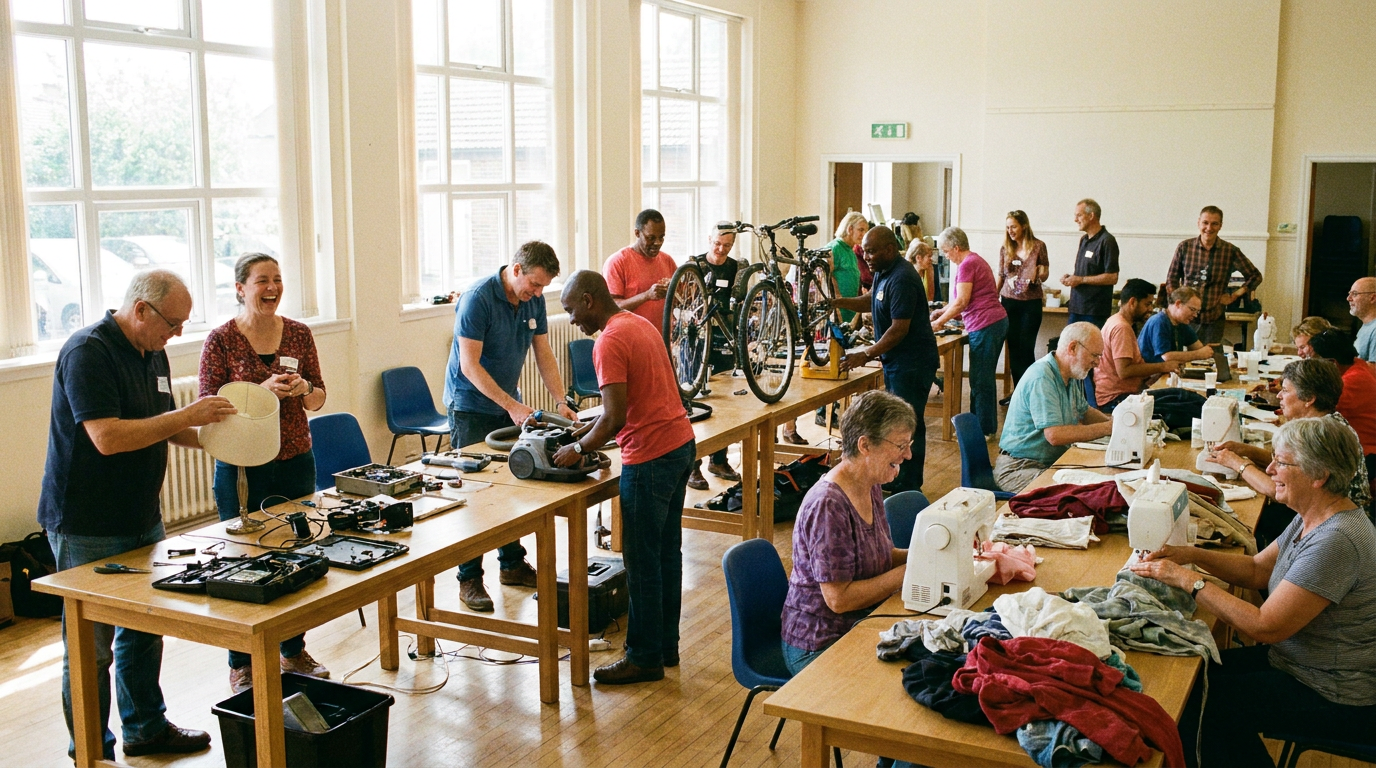
The operational concept behind a repair café is straightforward, yet it represents a radical departure from standard consumer behavior. Residents bring their damaged or non-functioning household items to a scheduled pop-up event, where a team of skilled volunteers—ranging from retired electrical engineers and professional tailors to enthusiastic teenage tinkerers—diagnoses the problem and attempts a fix, completely free of charge. Crucially, this is not a drop-off service. Visitors are required to sit with the volunteers, watch the diagnostic process, and actively learn how to maintain and repair their own belongings. This collaborative environment demystifies the inner workings of everyday technology, empowering consumers who have been conditioned to view their appliances as impenetrable black boxes.[3][4]
This year, the collective environmental impact of these localized efforts has reached a staggering, quantifiable scale. In Wales, the national repair café network recently celebrated a massive milestone: one million kilograms of carbon dioxide emissions saved simply by diverting repairable items from local landfills and avoiding the manufacturing of replacement goods. The achievement was significant enough to prompt the Welsh Government to officially launch a "Fix it February" initiative. State officials publicly urged citizens to embrace community repair as a primary, accessible tool in tackling the broader climate and nature crisis, noting that the simple act of fixing a kettle or a bicycle has a direct, measurable impact on the nation's carbon footprint.[1]

The environmental math driving this movement is highly compelling. Manufacturing a single new toaster, vacuum cleaner, or smartphone requires mining raw materials, energy-intensive factory production, and global shipping networks that burn fossil fuels. By extending the functional life of existing products, communities are directly cutting into that massive carbon footprint. In Australia, the Repair Cafe Surf Coast recently celebrated its 3,000th visitor, a major benchmark for the regional volunteer group. Organizers noted that their local efforts had successfully diverted nearly two tonnes of solid waste from municipal landfills in just a single year—the equivalent weight of a small car, saved entirely through weekend tinkering.[2]
The success rates at these community hubs are remarkably high, challenging the assumption that modern goods are inherently unfixable. The Surf Coast chapter reported that seven out of every ten items brought through their doors were successfully repaired on the spot and given a new lease on life. When factoring in items where volunteers provided expert diagnostic advice that allowed the owner to source a specific replacement part for a later fix, the combined success rate soared to an impressive 93 percent. Throughout 2025 and into 2026, hundreds of items—from erratic space heaters to jammed sewing machines—were saved from the scrap heap by volunteers armed with little more than screwdrivers, multimeters, and patience.[2]
The success rates at these community hubs are remarkably high, challenging the assumption that modern goods are inherently unfixable.
But the movement is not solely about waste reduction and carbon metrics; it is fundamentally about community resilience and social connection. In an era marked by digital isolation and declining civic participation, repair cafés offer a rare, tangible space for intergenerational mingling. In the United Kingdom, organizers in Greater Manchester hosted "RepairFest 2026," an ambitious event that brought together nine different regional repair cafés under the soaring roof of a historic local monastery. The festival functioned as much as a social mixer as a repair hub, featuring live demonstrations, shared meals, and dedicated networking spaces designed to help residents from other neighborhoods launch their own local chapters.[4]

For many of the volunteers, the work is a labor of love that preserves mechanical history and sparks joy. At the South Surrey White Rock Repair Café in British Columbia, volunteers and residents recently gathered to celebrate their 1,000th successfully fixed item during a special Earth Day event. The milestone object was a vintage 1950s toaster, a heavy, chrome-plated appliance completely devoid of modern electronic levers. Instead, it utilized a purely mechanical system that slowly lowered and raised the bread using thermal expansion. The successful restoration of the toaster drew crowds of curious onlookers, serving as a masterclass in the durability of older, repairable engineering compared to today's planned obsolescence.[3]
Organizers on the ground note a stark cultural divide that the movement is actively trying to bridge. In many developing nations, fixing things remains a standard, necessary practice, but in highly industrialized Western countries, consumers have been heavily conditioned to view minor malfunctions as terminal events. The repair café model actively unteaches this learned helplessness. By providing a supportive environment where making mistakes is part of the learning process, these hubs empower everyday people to open up a plastic casing, clean a corroded battery contact, or sew a reinforced patch onto a favorite jacket.[3]

This grassroots momentum is also dovetailing perfectly with broader legislative pushes for the "Right to Repair" across North America and Europe. As consumers grow increasingly frustrated with glued-together smartphones, software-locked tractors, and appliances that require proprietary diagnostic tools, the visible, undeniable success of community fixers provides powerful lobbying evidence. Lawmakers are increasingly pointing to repair cafés to argue that products should be legally required to be designed for longevity, with accessible manuals and standardized parts. The volunteers are proving that the public has an appetite for repair; the bottleneck is often corporate design.[1][4]
Looking ahead, the primary challenge for the global repair movement is scaling its infrastructure without losing its intimate, community-driven soul. Some local governments and city councils are beginning to step in, providing stable funding, liability insurance, and permanent venues, recognizing that these volunteer hubs are providing a vital municipal service that reduces waste management costs. As the milestones of 2026 clearly demonstrate, the public appetite for this work is vast. Across the world, people are proving that they are eager to fix not just their broken appliances, but the throwaway culture itself, one screw at a time.[1][2][3]
How we got here
2009
The first official Repair Café is organized in Amsterdam by Martine Postma.
2017
The movement expands globally, with hundreds of chapters opening across Europe, North America, and Australia.
2024
Right to Repair legislation gains significant traction in the EU and US, bolstered by grassroots advocacy.
Feb 2026
The Welsh repair network officially surpasses one million kilograms of carbon emissions saved.
Apr 2026
Local chapters in Canada and Australia celebrate major milestones in items fixed and waste diverted.
Viewpoints in depth
Community Organizers
Focusing on the social cohesion and skill-sharing benefits of the movement.
For organizers on the ground, the environmental benefits are almost a secondary byproduct of the primary goal: rebuilding local community fabric. They argue that modern society has siloed people into isolated consumer units, and repair cafés serve as a rare 'third space' where intergenerational mingling occurs naturally. By centering the experience around a shared task, these hubs break down social barriers and combat the epidemic of loneliness, particularly among retired tradespeople who find renewed purpose in sharing their expertise.
Environmental Advocates
Viewing repair as a critical frontline defense against the climate crisis and e-waste.
Climate advocates point to the staggering carbon footprint of manufacturing and shipping new goods. They argue that transitioning to a circular economy—where products are maintained rather than replaced—is non-negotiable for meeting global emissions targets. From their perspective, the success of grassroots repair cafés provides undeniable proof of concept that consumers are willing to participate in a circular economy, placing the onus back on corporations to design products that are actually repairable rather than glued shut.
Right-to-Repair Legislators
Using grassroots momentum to push for systemic changes in product design.
Policymakers and consumer rights advocates view the massive turnout at repair cafés as a clear mandate for legislative action. They argue that volunteer fixers are currently subsidizing corporate planned obsolescence. By highlighting the sheer volume of items that could be fixed if manuals and parts were made available, these advocates are pushing for laws that mandate standardized components, ban software locks on hardware, and force manufacturers to support their products long after the initial sale.
What we don't know
- How local governments will formalize funding and liability protections for these volunteer-run spaces as they scale.
- Whether major electronics manufacturers will voluntarily adapt their designs to be more repairable, or if strict legislation will be required.
- The exact global aggregate of waste diverted by all independent repair cafés, as many operate without formal tracking systems.
Key terms
- Repair Café
- A free, community-organized meeting place where people bring broken household items to be fixed by skilled volunteers.
- Circular Economy
- An economic model focused on minimizing waste and making the most of resources by repairing, reusing, and recycling products.
- Right to Repair
- A legislative and social movement advocating for consumers' ability to repair their own electronic devices and appliances without manufacturer restrictions.
- Planned Obsolescence
- A policy of designing a product with an artificially limited useful life, forcing the consumer to purchase a replacement.
Frequently asked
How much does it cost to get an item fixed at a Repair Café?
Repairs are generally completely free, though most cafés welcome voluntary donations to help cover the cost of venue rentals and communal tools.
Do I just drop my broken item off?
No. The core philosophy of a Repair Café is skill-sharing. Visitors are expected to sit with the volunteer, watch the process, and learn how the repair is done.
What kinds of items can be brought in?
While it varies by the skills of local volunteers, common items include small electrical appliances, clothing, bicycles, toys, and small pieces of furniture.
What happens if an item cannot be fixed?
If an item is truly beyond repair, volunteers will often help diagnose exactly what failed and advise the owner on how to properly recycle the components.
Sources
Source coverage
5 outlets
3 viewpoints surfaced





[1]Welsh GovernmentEnvironmental Advocates
Deputy First Minister Launches Fix it February at a Pop-Up Repair Café in Cardiff
Read on Welsh Government →[2]Times News GroupEnvironmental Advocates
Repair Cafe Surf Coast kicks off 2026 season
Read on Times News Group →[3]Peace Arch NewsConsumer Rights Advocates
South Surrey Repair Café celebrates 2 milestones at Earth Day event
Read on Peace Arch News →[4]Manchester Friends of the EarthCommunity Organizers
RepairFest 2026: Discover Greater Manchester's Repair Café Movement
Read on Manchester Friends of the Earth →[5]Hanham & Longwell Green VoiceCommunity Organizers
Repair cafe's milestone
Read on Hanham & Longwell Green Voice →
Every angle. Every day.
Get community stories with full source coverage and perspective breakdowns delivered to your inbox.