
How Regenerative Tourism and Indigenous Guides Are Rewriting the Travel Playbook
As destinations grapple with the environmental and cultural toll of overtourism, a new model called "regenerative tourism" is empowering local communities to heal ecosystems and preserve heritage.
By Factlen Editorial Team
- Indigenous & Local Stewards
- Focuses on tourism as a tool for cultural survival, land sovereignty, and community empowerment.
- Regenerative Travel Advocates
- Argues that doing 'less harm' is no longer sufficient, pushing for travel that actively heals ecosystems.
- National Tourism Boards
- Views regenerative and dispersed tourism as strategic tools to manage overcrowding and distribute economic gains.
- Conscious Travelers
- Seeks authentic, meaningful connections and is willing to invest in community-owned experiences.
What's not represented
- · Multinational hotel chains and cruise lines facing pressure to adapt to regenerative models.
- · Residents of over-touristed cities who want tourism halted entirely, rather than just dispersed.
Why this matters
Travelers are increasingly seeking authentic experiences that leave destinations better than they found them, shifting billions of dollars toward community-owned enterprises and away from extractive mass tourism.
Key points
- Regenerative tourism goes beyond sustainability by actively seeking to heal and improve local ecosystems and communities.
- Community-Based Tourism (CBT) ensures that local residents retain ownership, management, and the economic benefits of travel experiences.
- Indigenous guides use tourism as a powerful tool for cultural revitalization, preserving languages and traditions.
- Destinations like Japan are using 'dispersed tourism' to move travelers away from crowded urban centers into rural areas.
- Major travel operators and national tourism boards are increasingly adopting regenerative frameworks to combat overtourism.
The traditional model of global travel is fundamentally extractive. Millions of visitors descend upon a destination, consume its resources, crowd its infrastructure, and leave, while the bulk of the profits are funneled back to multinational hotel chains and foreign booking platforms. But as the environmental and cultural toll of overtourism reaches a breaking point, a profound shift is quietly reshaping the industry.[7]
Enter "regenerative tourism," a framework that asks a fundamentally different question: What if travel could heal a place rather than deplete it? While sustainable tourism focuses on doing no harm and maintaining the status quo, regenerative travel actively seeks to leave a destination ecologically, socially, and economically better than it was before. It is a transition from merely minimizing footprints to actively planting seeds.[1][7]
At the heart of this movement is Community-Based Tourism (CBT). In this model, local residents hold full ownership and management of the travel experience. Instead of large corporations dictating the narrative, the community decides how their home is shared, ensuring that the economic benefits remain localized and that cultural preservation takes precedence over mass commercialization.[3]

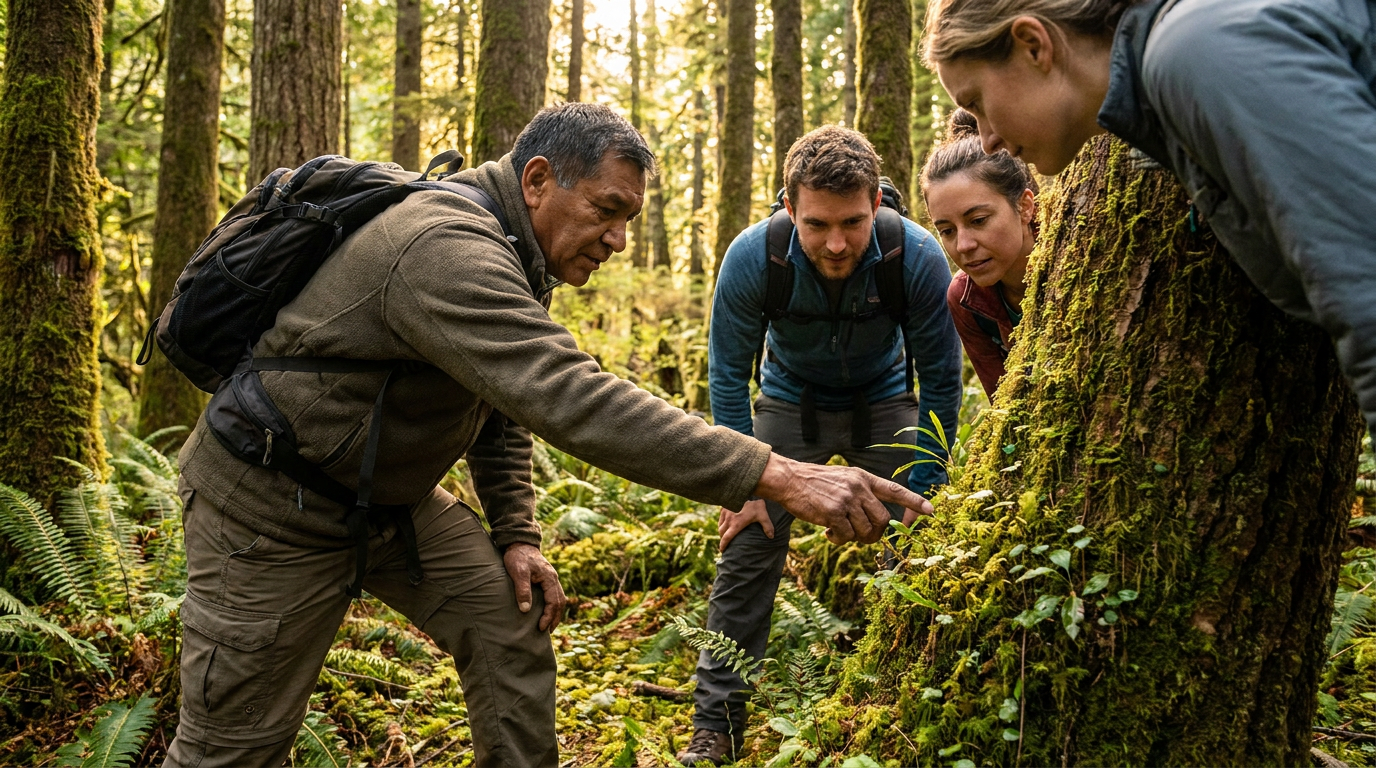
The linchpin of CBT is the local or Indigenous guide. Far from being mere narrators reciting memorized facts, these guides act as stewards, educators, and translators of the landscape. They possess deep, generational ecological knowledge that cannot be replicated by an app or a guidebook, transforming a standard sightseeing trip into an immersive, educational exchange that fosters genuine respect between host and guest.[6]
In Canada, the Indigenous tourism sector provides a powerful blueprint for this approach. Prior to recent pandemic disruptions, the sector employed approximately 40,000 workers across 1,900 businesses, contributing $1.9 billion directly to the national GDP. These enterprises are majority-owned and operated by First Nations, Métis, or Inuit peoples, ensuring that the stories shared are authentic and controlled by the communities themselves.[4]
For many Indigenous guides, tourism has become a vehicle for cultural revitalization. By sharing traditional practices—from identifying medicinal plants in the boreal forest to teaching the history of the Syilx people in British Columbia—guides are preserving languages and customs that were historically suppressed. The landscape itself becomes a classroom, and the act of guiding becomes an act of profound resilience.[5]

The economic mechanics of community-based tourism are equally transformative. When travelers book a homestay or hire a local cooperative, the funds circulate within the community, creating a powerful multiplier effect. This revenue funds local infrastructure, supports conservation efforts, and provides alternative livelihoods that reduce reliance on environmentally destructive industries like logging or mining.[3]
The economic mechanics of community-based tourism are equally transformative.
Major travel operators are beginning to recognize the value of this localized approach. Companies like Intrepid Travel and G Adventures are increasingly partnering directly with community cooperatives in places like Nepal and the Ecuadorian Amazon. By integrating these local enterprises into their global itineraries, they provide a steady stream of conscious travelers while allowing the communities to retain operational control.[3]
Beyond rural and wilderness settings, regenerative principles are being applied to combat urban overtourism. In Japan, cities like Kyoto are aggressively promoting "dispersed tourism." Rather than funneling millions of visitors into the already overwhelmed Gion district or Kiyomizu-dera temple, local authorities and guides are redirecting travelers to lesser-known surrounding areas like Ohara and Fushimi.[7]
This dispersal strategy relies heavily on specialized local guides who can unlock the value of these off-the-beaten-path neighborhoods. By curating experiences around regional crafts, evening temple illuminations, and rural farm stays, guides help distribute the economic benefits of tourism across a wider geographic area while giving exhausted urban centers a chance to breathe.[7]

Governments and national tourism boards are also codifying these practices. VisitEngland recently launched a comprehensive Regenerative Tourism Handbook, signaling a top-down shift from merely counting visitor arrivals to measuring the holistic impact of tourism on local ecosystems and residents. The goal is to transition the industry from a volume-based metric to a value-based one.[2]
However, the transition is not without friction. As "regenerative" becomes the new buzzword in travel marketing, the risk of greenwashing is high. Multinational resorts may adopt the terminology without fundamentally changing their extractive financial models or ceding any real decision-making power to local communities.[1]
To combat this, academic researchers and industry watchdogs emphasize that true regenerative tourism requires a radical shift in power dynamics. It is not enough to simply hire a local guide as a frontline employee; the community must have a seat at the table in planning, development, and profit-sharing.[6]

For the modern traveler, this shift demands a new level of intentionality. It requires asking harder questions before booking: Who owns this tour? Where does the money go? Does this experience respect the ecological limits of the destination? The answers to these questions determine whether a trip contributes to a destination's decline or its flourishing.[7]
Ultimately, the rise of regenerative tourism and the empowerment of local guides represent a hopeful evolution in how we explore the world. By treating destinations not as products to be consumed, but as living ecosystems to be respected, travel can fulfill its highest promise: fostering deep human connection while actively repairing the planet.[1][3]
How we got here
2000
The APEC Tourism Charter formally recognizes the role of Community-Based Tourism in dispersing economic benefits.
2019
Indigenous tourism in Canada reaches a peak, contributing $1.9 billion to the national GDP before pandemic disruptions.
2021
Japan accelerates its 'dispersed tourism' strategy to manage the anticipated post-pandemic return of international visitors.
2024
Major European tourism boards, including VisitEngland, begin publishing official regenerative tourism frameworks.
2026
Traveler demand for authentic, community-owned experiences continues to outpace traditional mass-market tourism growth.
Viewpoints in depth
Indigenous and Local Stewards
Focuses on tourism as a tool for cultural survival, land sovereignty, and community empowerment.
For Indigenous communities and local cooperatives, regenerative tourism is fundamentally about reclaiming control over their own narratives. Historically, mass tourism has commodified local cultures, turning sacred traditions into performances for foreign audiences while siphoning profits out of the community. By owning the tour companies and acting as the primary guides, these stewards ensure that cultural sharing happens on their own terms. They view tourism not just as an economic engine, but as a vital mechanism for funding language revitalization, protecting ancestral lands, and providing future generations with viable livelihoods that don't require leaving their home regions.
Regenerative Travel Advocates
Argues that doing 'less harm' is no longer sufficient, pushing for travel that actively heals ecosystems.
This camp, composed of environmental scientists, sustainable tourism researchers, and eco-conscious operators, believes the traditional 'sustainable' model is fundamentally flawed because it merely seeks to sustain a degraded baseline. They advocate for a paradigm shift where tourism is used as a restorative force. In their view, every visitor should leave a destination measurably better—whether through funding conservation projects, participating in citizen science, or supporting regenerative agriculture. They are highly critical of 'greenwashing' by major hotel chains and insist that true regeneration requires systemic changes to how tourism revenue is distributed.
National Tourism Boards
Views regenerative and dispersed tourism as strategic tools to manage overcrowding and distribute economic gains.
For government agencies and destination marketing organizations, the embrace of regenerative tourism is often driven by the urgent need to solve the crisis of overtourism. Cities like Kyoto, Venice, and Amsterdam have seen intense resident backlash against the sheer volume of visitors. By promoting community-based tourism in rural or lesser-known areas, these boards aim to disperse the physical footprint of travelers. Their primary goal is to maintain the macroeconomic benefits of the tourism sector—job creation and foreign exchange—while mitigating the infrastructural strain and political friction caused by hyper-concentrated crowds.
What we don't know
- How effectively the travel industry can police 'greenwashing' as multinational corporations co-opt regenerative terminology.
- Whether mass-market tourists are willing to pay the premium often required for small-scale, community-led experiences.
- How climate change will impact the viability of nature-based community tourism in highly vulnerable regions.
Key terms
- Regenerative Tourism
- A travel model that aims to leave a destination ecologically and socially better than it was before, going beyond mere sustainability.
- Community-Based Tourism (CBT)
- Tourism owned and managed by the local community, ensuring economic benefits remain within the destination.
- Dispersed Tourism
- A strategy used by crowded destinations to redirect visitors to lesser-known, surrounding regions to alleviate overtourism.
- Greenwashing
- The deceptive practice of marketing a business or product as environmentally friendly when it is not.
- Extractive Tourism
- The traditional travel model where resources and profits are drawn out of a destination by outside corporations, leaving locals with the negative impacts.
Frequently asked
What is the difference between sustainable and regenerative tourism?
Sustainable tourism aims to minimize negative impacts and maintain the status quo. Regenerative tourism actively seeks to improve, heal, and restore the local environment and culture.
How can I ensure my travel is community-based?
Look for tours and accommodations that are majority-owned and operated by local residents or Indigenous groups, rather than international chains.
Does regenerative tourism cost more?
Not necessarily, though experiences led by specialized local guides can carry a premium. However, the money spent goes directly into the local economy rather than to multinational corporations.
Sources
Source coverage
7 outlets
4 viewpoints surfaced







[1]Centre for the Promotion of ImportsRegenerative Travel Advocates
Core features of regenerative tourism
Read on Centre for the Promotion of Imports →[2]VisitBritainNational Tourism Boards
Regenerative Tourism Handbook
Read on VisitBritain →[3]Intrepid TravelConscious Travelers
What is community-based tourism?
Read on Intrepid Travel →[4]Canada West FoundationIndigenous & Local Stewards
What is Indigenous tourism?
Read on Canada West Foundation →[5]Future of GoodIndigenous & Local Stewards
Indigenous tourism organizations are preserving and sharing hundreds of unique Indigenous cultures
Read on Future of Good →[6]Emerald InsightRegenerative Travel Advocates
Tour guides and barriers to regenerative tourism
Read on Emerald Insight →[7]Factlen Editorial TeamConscious Travelers
Synthesis by Factlen editorial team
Read on Factlen Editorial Team →


Every angle. Every day.
Get travel stories with full source coverage and perspective breakdowns delivered to your inbox.