
The Science of the 'Fifth Stroke': How Biomechanics and AI Are Redefining Swimming
Elite swimmers are using computational fluid dynamics and augmented-reality wearables to perfect the underwater dolphin kick, the fastest and most crucial phase of a modern race.
By Factlen Editorial Team
- Sports Biomechanists
- Focus on the mathematical perfection of the stroke, using fluid dynamics to map vortices and minimize drag.
- Competitive Coaches
- View the science through a practical lens, emphasizing core strength, flexibility, and race-day execution.
- Sports Technologists
- Believe that real-time AR feedback and AI analysis will democratize elite training for everyday swimmers.
What's not represented
- · Recreational Swimmers
- · Olympic Rulemakers
Why this matters
The fusion of fluid dynamics and wearable AI is democratizing elite sports science, allowing everyday athletes to access laboratory-grade biomechanical feedback that was once reserved for Olympic champions.
Key points
- Elite swimmers can reach speeds of 10 km/h underwater, significantly faster than surface freestyle.
- The 'fifth stroke' relies on a full-body whip effect to generate propulsive water vortices.
- Swimmers must stay at least 0.5 meters below the surface to avoid the braking force of wave drag.
- New Augmented Reality (AR) goggles project real-time biomechanical data into the swimmer's line of sight.
- AI algorithms are replacing expensive lab equipment by analyzing stroke efficiency directly in the pool.
The fastest part of any competitive swimming race does not happen on the surface of the water. It happens completely submerged, in the quiet, high-pressure environment beneath the waves.[6]
While the world's best freestyle sprinters max out at surface speeds of roughly 8 kilometers per hour, their velocity underwater can reach up to 10 kilometers per hour.[4]
This dramatic difference in speed is driven by a highly technical movement known as underwater undulatory swimming (UUS), universally referred to by coaches and athletes as swimming's "fifth stroke."[5]
The fifth stroke is so overwhelmingly efficient that the sport's governing body, World Aquatics, had to intervene. To prevent athletes from swimming entire races completely submerged, rules strictly limit the use of the underwater dolphin kick to the first 15 meters following a dive or a turn.[4]

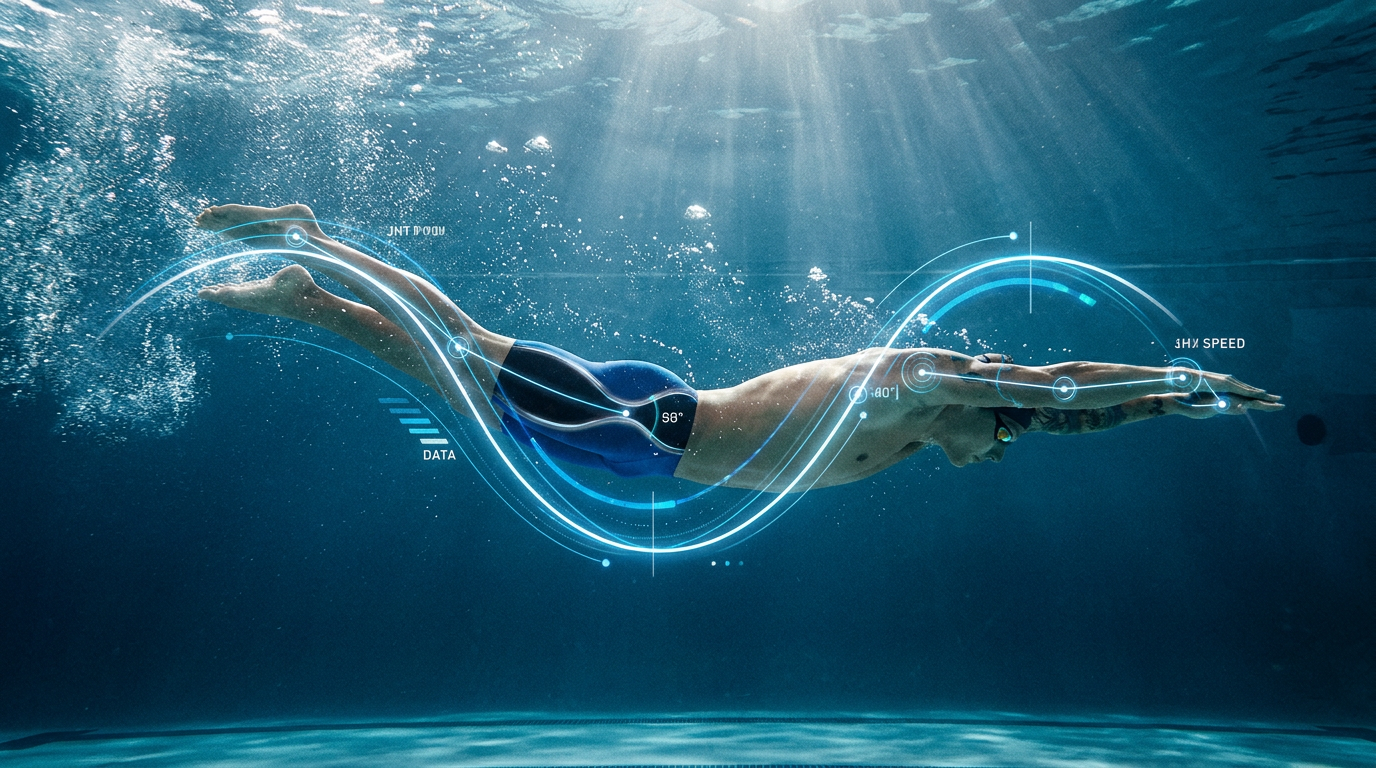
Mastering those critical 15 meters requires a profound understanding of biomechanics. The movement is designed to mimic the locomotion of cetaceans—dolphins and whales—by turning the human body into a propulsive, undulating sine wave.[1]
The technique relies on what sports scientists call the "whip effect." Power does not originate in the knees; it begins in the core and hip flexors, transferring kinetic energy down the legs and culminating in a violent, whip-like snap of the feet and ankles.[4]
To understand exactly how this whip effect translates to forward speed, researchers have increasingly turned to Computational Fluid Dynamics (CFD), a branch of physics that uses applied mathematics to model how water flows around complex shapes.[1]
CFD analysis reveals that the secret to the fifth stroke lies in vortex generation. When a highly skilled swimmer executes a dolphin kick, they create large, powerful vortices of water on the ventral (front) side of their trunk.[1]
These specific vortices act as liquid starting blocks, allowing the swimmer to push off the swirling water to generate massive forward thrust. Unskilled swimmers, by contrast, create smaller, chaotic vortices that actually produce a braking force, slowing them down.[1]

These specific vortices act as liquid starting blocks, allowing the swimmer to push off the swirling water to generate massive forward thrust.
However, generating the perfect vortex is only half the equation; the swimmer must also avoid the physics of the surface. Because water is roughly 800 times denser than air, moving through it requires immense energy, and disturbing the surface creates a phenomenon known as "wave drag."[2]
A comprehensive hydrodynamic study demonstrated that to effectively eliminate this wave drag, a swimmer must execute their dolphin kicks at least 0.5 meters below the surface of the water.[2]
If an athlete undulates too close to the surface, the violent interaction between their limbs and the air-water boundary offsets the propulsive force of the kick, drastically reducing their overall efficiency.[2]

Historically, capturing this level of biomechanical data required millions of dollars in laboratory equipment, including underwater force plates and multi-camera motion capture systems.[3]
Today, the landscape of swim training is being radically transformed by an explosion in wearable technology, bringing laboratory-grade insights directly into the local lap pool.[6]
The most visible leap forward is the advent of smart swim goggles. Devices engineered by companies like FORM and HoloSwim utilize Augmented Reality (AR) to project real-time performance metrics directly into the swimmer's line of sight without obstructing their vision.[4]
Tracking movement underwater presents unique engineering hurdles, primarily because standard GPS and Bluetooth signals cannot easily penetrate water to communicate with external devices.[3]

To bypass this limitation, modern aquatic wearables rely on highly sensitive internal accelerometers, gyroscopes, and magnetometers positioned on the head or lower back to map the body's exact position in three-dimensional space.[3]
These sensors track a multitude of data points, including stroke rate, distance per stroke, and SWOLF—a golf-like efficiency score calculated by adding the time and stroke count of a specific lap.[4]
Artificial Intelligence algorithms then process this raw kinematic data, providing athletes with personalized feedback on the amplitude and frequency of their dolphin kicks, highlighting exactly where their technique breaks down as fatigue sets in.[6]
While a systematic review by the National Institutes of Health notes that measuring exact underwater velocity with commercial wearables still has a slight margin of error, the technology is advancing rapidly. The fusion of fluid dynamics and real-time AI feedback ensures that the fifth stroke will continue to evolve, pushing the boundaries of human aquatic potential.[3]
Viewpoints in depth
Sports Biomechanists
Focus on the mathematical perfection of the stroke, using fluid dynamics to map vortices and minimize drag.
For biomechanists, the pool is a fluid dynamics laboratory. They utilize Computational Fluid Dynamics (CFD) to map the exact flow of water over a swimmer's body, proving that efficiency is not just about kicking hard, but about creating the right kind of water vortices. Their research dictates the precise angles and depths required to minimize wave drag, treating the human body as a hydrodynamic vessel that must be perfectly calibrated to the physics of water.
Competitive Coaches
View the science through a practical lens, emphasizing core strength, flexibility, and race-day execution.
While coaches value the data provided by biomechanists, their primary focus is translating those numbers into physical reality. They emphasize that the 'whip effect' requires immense core strength, ankle flexibility, and cardiovascular endurance. For a coach, the challenge is not just teaching a swimmer how to execute the perfect dolphin kick, but training them to maintain that perfect, undulating rhythm when their lungs are burning at the end of a grueling race.
Sports Technologists
Believe that real-time AR feedback and AI analysis will democratize elite training for everyday swimmers.
Technologists see the historical barrier to elite sports science—expensive lab equipment—and aim to dismantle it. By packing gyroscopes, accelerometers, and AR displays into standard-sized swim goggles, they are bringing real-time kinematic feedback to the masses. They argue that the future of swimming lies in Artificial Intelligence, where machine learning algorithms act as a personalized coach, instantly correcting a swimmer's amplitude and stroke rate mid-lap.
What we don't know
- Whether future iterations of wearable technology will be able to perfectly calculate horizontal velocity without the aid of external pool cameras.
- If World Aquatics will ever adjust the 15-meter rule as athletes become even faster and more efficient underwater.
Key terms
- Underwater Undulatory Swimming (UUS)
- A whole-body, wave-like movement used underwater after starts and turns, commonly referred to as the dolphin kick.
- Computational Fluid Dynamics (CFD)
- The use of applied mathematics and software to model and analyze how fluids, like pool water, flow around an object.
- SWOLF
- A measure of swimming efficiency calculated by adding the time it takes to swim a lap and the number of strokes taken during that lap.
- Whip Effect
- The transfer of kinetic energy from the core through the legs, culminating in a powerful snap of the feet to generate forward propulsion.
- Vortex
- A mass of whirling fluid or air; in swimming, skilled athletes create specific vortices to push against for forward thrust.
Frequently asked
Why is the underwater dolphin kick called the fifth stroke?
It is a distinct, highly efficient method of propulsion used across multiple traditional strokes (freestyle, butterfly, backstroke) during the start and turn phases of a race.
Why are swimmers limited to 15 meters underwater?
Because underwater swimming is significantly faster than surface swimming, World Aquatics enforces a 15-meter limit to ensure the sport remains focused on traditional surface strokes.
What is wave drag?
Wave drag is the resistance caused by the creation of waves when a swimmer moves at or near the surface of the water, which slows them down.
How do smart swim goggles work without GPS?
Because GPS signals cannot easily travel through water, modern swim wearables use internal accelerometers and gyroscopes to track the body's movement and calculate metrics.
Sources
Source coverage
6 outlets
3 viewpoints surfaced






[1]Journal of Experimental BiologySports Biomechanists
Near-body flow dynamics in swimming fish and human applications
Read on Journal of Experimental Biology →[2]MDPISports Biomechanists
Hydrodynamic Characteristics of Undulatory Underwater Swimming
Read on MDPI →[3]National Institutes of HealthSports Biomechanists
Accuracy of Wearables Providing Real-Time Feedback in Swimming
Read on National Institutes of Health →[4]MySwimProSports Technologists
How to Optimize Your Underwater Dolphin Kick
Read on MySwimPro →[5]Swimming World MagazineCompetitive Coaches
Fluid Dynamics and the Fifth Stroke
Read on Swimming World Magazine →[6]Factlen Editorial TeamSports Technologists
Synthesis by Factlen editorial team
Read on Factlen Editorial Team →

More in sports
See all 5 stories →


Every angle. Every day.
Get sports stories with full source coverage and perspective breakdowns delivered to your inbox.