
The Quantum Computing Breakthrough Making Logical Qubits a Reality
In 2026, quantum computing crossed a critical threshold as multiple teams demonstrated "sub-threshold" error correction, proving that adding more qubits now reduces errors rather than amplifying them. This engineering milestone shifts quantum computers from fragile physics experiments to scalable, fault-tolerant machines.
By Factlen Editorial Team
- Superconducting Developers
- Proponents of superconducting circuits emphasize their speed and reliance on established semiconductor fabrication techniques.
- Neutral Atom Developers
- Developers using neutral atoms highlight superior qubit connectivity and room-temperature scalability.
- Industry Analysts
- Observers focused on the commercial timeline and the shift from physics research to engineering execution.
What's not represented
- · Cryptographers and Security Experts
- · Materials Science End-Users
Why this matters
Until now, quantum computers were too noisy to solve real-world problems. By successfully grouping unstable physical qubits into reliable "logical" qubits, researchers have unlocked the path to simulating complex molecules, discovering new materials, and revolutionizing cryptography within the next decade.
Key points
- Quantum computers have historically been too noisy and fragile for commercial use.
- Engineers use 'logical qubits' to group noisy physical qubits into stable, error-corrected units.
- In 2026, multiple teams proved that adding more qubits now successfully suppresses errors.
- Google demonstrated this with superconducting chips, while Atom Computing used neutral atoms.
- The industry is now shifting its focus from raw physical qubit counts to logical qubit performance.
For decades, the promise of quantum computing has been tempered by a stubborn physical reality: quantum states are incredibly fragile. In what the industry calls the Noisy Intermediate-Scale Quantum (NISQ) era, machines have been limited to a few hundred "physical qubits" that lose their information—a process known as decoherence—in fractions of a second. Even the slightest environmental interference, from stray magnetic fields to thermal fluctuations, can cause a qubit to flip or scramble its data. This fragility meant that while quantum computers could perform highly specialized, short-duration calculations, they were too unreliable to execute the millions of sequential operations required for transformative applications like drug discovery or cryptography. The industry knew that to unlock true quantum advantage, they had to stop treating noise as an unavoidable nuisance and start actively correcting it.[4][5]
The theoretical solution to this fragility has long been known as Quantum Error Correction (QEC). Because the laws of quantum mechanics forbid the direct copying of unknown quantum states—a principle known as the no-cloning theorem—engineers cannot simply back up data the way classical computers do. Instead, QEC relies on a concept called the "logical qubit." By entangling multiple noisy, error-prone physical qubits together, the system can collectively store the information of a single, highly stable virtual qubit. If one physical qubit in the cluster suffers an error, the surrounding qubits can detect the anomaly and correct it without measuring or destroying the underlying quantum information. This collective redundancy is the foundation of fault-tolerant quantum computing.[2][4]
However, for years, quantum error correction faced a brutal paradox. The hardware required to monitor and correct errors introduced its own noise. Adding more physical qubits to a logical cluster often created so much additional complexity and interference that the overall system became worse, not better. Researchers were trapped above what is known as the "fault-tolerant threshold." In order for error correction to actually work, the underlying physical qubits had to reach a baseline level of reliability. Only then would adding more qubits exponentially suppress the error rate rather than amplifying it. Crossing this threshold was widely considered the most daunting engineering challenge in modern physics.[1][3]

In 2026, the quantum computing industry finally shattered that barrier, marking the dawn of the "fault-tolerant foundation era." Multiple organizations, using entirely different hardware architectures, demonstrated that they had successfully crossed the sub-threshold line. For the first time at scale, researchers proved that increasing the size and redundancy of an error-correcting system actually reduced logical error rates. This milestone fundamentally shifts quantum computing from a theoretical physics research project into a scalable engineering discipline. The machines are no longer just demonstrating isolated logical operations; they are actively detecting and correcting problems while computations continue to run.[1][4]
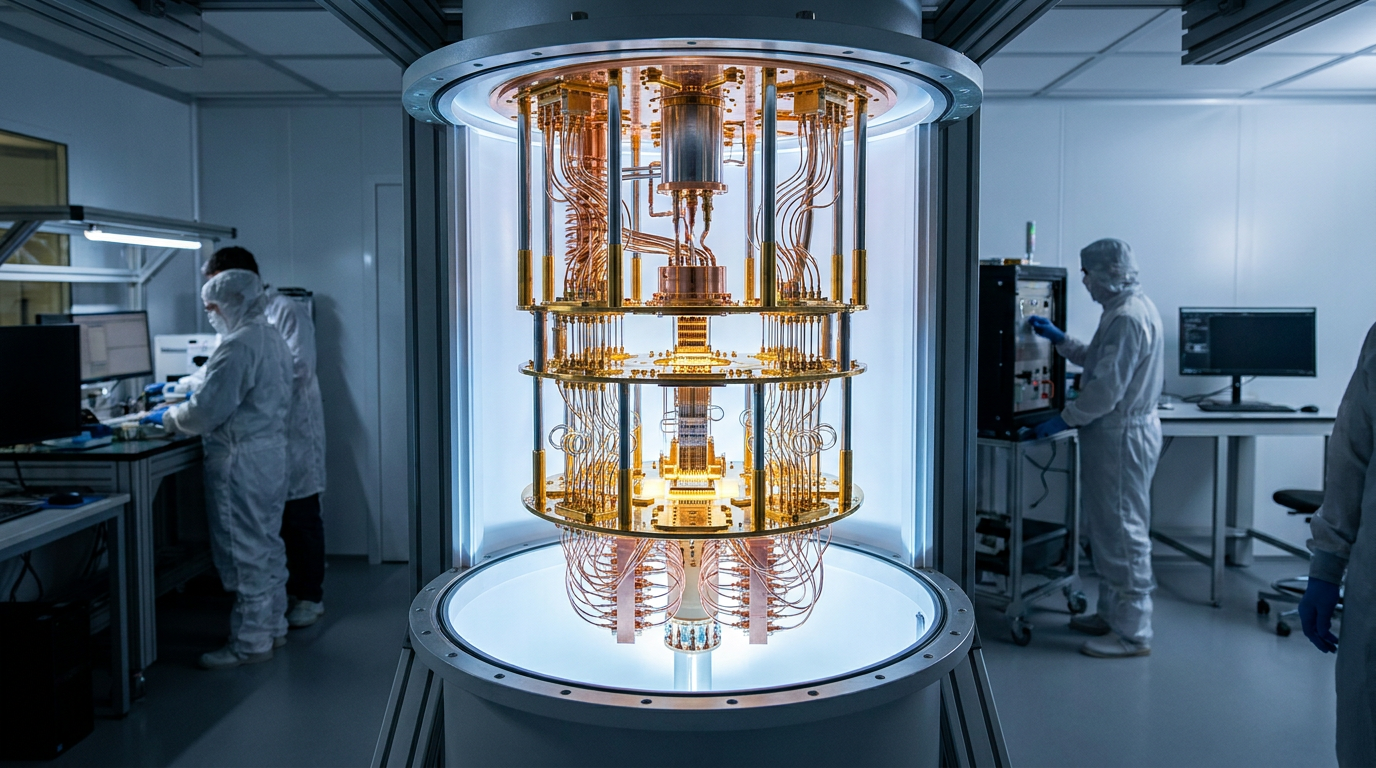
Google Quantum AI delivered one of the most significant breakthroughs with its "Willow" processor, a chip featuring 105 superconducting physical qubits. Superconducting architectures, which rely on circuits chilled to near absolute zero, have historically struggled with scaling due to cross-talk between adjacent qubits. But with Willow, Google demonstrated below-threshold error correction using a surface code architecture. As they increased the number of physical qubits encoding a single logical qubit, the overall error rate decreased exponentially—dropping by a factor of roughly 2.14 with each increase in the surface-code lattice size. The chip successfully performed a benchmark calculation in just five minutes that would take classical supercomputers over a decade, validating the feasibility of large-scale, error-corrected systems.[2][5]

Google Quantum AI delivered one of the most significant breakthroughs with its "Willow" processor, a chip featuring 105 superconducting physical qubits.
While Google advanced superconducting technology, Atom Computing achieved an equally monumental milestone using neutral-atom hardware. Unlike superconducting circuits, neutral-atom systems use highly focused lasers to trap and manipulate individual atoms in a vacuum. Atom Computing successfully created and entangled 24 logical qubits built from a foundation of 112 physical qubits. More importantly, they ran complex computations—specifically the Bernstein–Vazirani algorithm—while continuously operating their error correction cycles. This involved true mid-circuit measurement, resetting, and replacing of qubits on the fly. It was the first complete demonstration of continuously operating quantum error correction in a neutral atom system, proving that logical qubits can serve as the primary computational abstraction.[1]
The efficiency of these error-correcting codes is also seeing dramatic improvements, which drastically alters the timeline for commercial viability. Historically, researchers estimated that it might take hundreds or even thousands of physical qubits to create just one reliable logical qubit. Scaling up to the millions of logical qubits needed for complex chemistry simulations seemed decades away. However, a joint research team spanning QuEra, Harvard, and MIT recently published a breakthrough demonstrating ultra-high-rate quantum error correction. Building on new theoretical models, they showed that advanced codes could achieve error rates as low as one error per trillion steps using just over two physical qubits per logical qubit. This means a system of tens of thousands of physical qubits could soon deliver the computational power that previously required millions.[3]
As the industry coalesces around logical qubits, hardware diversity remains a key strength. Microsoft, for instance, is pursuing an entirely different path with its Majorana 1 processor. Rather than relying heavily on software-based error correction to fix fragile qubits, Microsoft is developing topological qubits based on exotic Majorana fermions. These particles offer inherent, hardware-level resistance to environmental noise. By building stability directly into the physical material, Microsoft aims to bypass the massive redundancy overhead required by other architectures. In early 2026, they successfully created 12 highly accurate logical qubits in partnership with Quantinuum, proving that multiple hardware paths are converging on the same fault-tolerant threshold.[2][4][5]

The strategic focus of major players has noticeably shifted in response to these milestones. Companies like IBM have explicitly pivoted their roadmaps away from simply chasing raw physical qubit counts. Instead, IBM's upcoming Quantum Starling system, targeted for 2029, is designed specifically around logical qubit performance, aiming for 200 fully error-corrected logical qubits. This industry-wide pivot confirms that the metric for success is no longer how many qubits a chip holds, but how reliably those qubits can sustain deep, complex circuits. The era of noisy, error-prone demonstrations is ending, replaced by a rigorous focus on logical fidelity and continuous operation.[2][5]
The implications of these 2026 breakthroughs extend far beyond academic laboratories. For engineering-intensive industries, fault-tolerant quantum computing unlocks capabilities that classical supercomputers simply cannot match. In materials science and chemistry, researchers will soon be able to simulate molecular interactions with perfect accuracy, accelerating the discovery of new battery materials, efficient fertilizers, and targeted pharmaceuticals. Because quantum computers operate using the same quantum mechanical rules that govern molecules, they can model chemical reactions natively, bypassing the approximations that limit classical algorithms.[4][5]
In the near term, the commercialization of these systems will rely heavily on hybrid quantum-classical architectures. Quantum computers will not replace classical laptops or data centers; rather, they will act as highly specialized co-processors. Classical infrastructure will handle data orchestration, user interfaces, and routine calculations, while handing off specific, exponentially complex optimization or simulation tasks to the quantum processor. Cloud platforms like Azure Quantum are already standardizing these hybrid workflows, allowing enterprise engineering teams to integrate logical-qubit hardware directly into their existing high-performance computing pipelines.[1][4]
We are witnessing the birth of a new technological paradigm. The transition from physical to logical qubits is analogous to the shift from fragile vacuum tubes to reliable silicon transistors in the mid-20th century. While challenges remain in scaling these systems to thousands of logical qubits, the fundamental physics risk has been retired. The path forward is now an engineering roadmap. By proving that errors can be suppressed faster than they accumulate, the quantum computing industry has laid the indestructible foundation for the next century of computational discovery.[2][6]
How we got here
2023-2025
Quantum systems remained in the NISQ era, limited by high error rates and decoherence.
Late 2025
Google's Willow processor demonstrated exponential error suppression in superconducting qubits.
Early 2026
Microsoft and Quantinuum created 12 highly accurate logical qubits using topological architectures.
April 2026
QuEra, Harvard, and MIT published research showing ultra-high-rate encoding, drastically reducing the physical qubits needed.
June 2026
Atom Computing demonstrated continuous quantum error correction on 24 logical qubits using neutral atoms.
Viewpoints in depth
Superconducting Advocates
Proponents of superconducting circuits emphasize their speed and reliance on established semiconductor fabrication techniques.
Organizations like Google and IBM champion superconducting qubits because they can be manufactured using existing silicon fabrication infrastructure. These qubits operate at incredibly fast gate speeds, allowing for rapid computation. While they require massive dilution refrigerators to reach near absolute zero and suffer from limited connectivity between neighboring qubits, advocates argue that surface-code error correction has now proven capable of overcoming these hurdles, as demonstrated by Google's Willow chip.
Neutral Atom Pioneers
Developers using neutral atoms highlight superior qubit connectivity and room-temperature scalability.
Companies like Atom Computing and QuEra argue that trapping individual atoms with lasers offers fundamental advantages over printed circuits. Neutral atoms are identical by nature, eliminating manufacturing defects, and they can be dynamically moved around during computation to interact with distant qubits. This high connectivity allows for much more efficient error-correcting codes, drastically reducing the number of physical qubits needed to create a logical qubit. Furthermore, the core processing zone operates in a room-temperature vacuum, avoiding the complex cryogenics of superconducting systems.
Topological Innovators
Researchers pursuing topological qubits seek to build error resistance directly into the hardware physics.
Microsoft's approach with the Majorana 1 processor represents a fundamentally different philosophy: rather than building massive software-based error correction systems to fix fragile qubits, why not make the qubits inherently stable? By utilizing exotic Majorana fermions, topological qubits store information globally across the particle, making them highly resistant to local environmental noise. While this technology has been the hardest to engineer initially, its advocates believe it will ultimately provide the most scalable path to millions of qubits by bypassing the massive redundancy overhead required by other methods.
What we don't know
- Which hardware architecture (superconducting, neutral atom, or topological) will ultimately scale most cost-effectively to millions of qubits.
- Exactly when the first commercially viable quantum advantage will be achieved for a non-benchmark, real-world industrial problem.
Key terms
- Qubit
- The fundamental unit of quantum information, capable of existing in multiple states simultaneously, unlike classical bits which are strictly 0 or 1.
- Logical Qubit
- A highly stable, 'virtual' qubit created by grouping multiple noisy physical qubits together using error-correcting codes.
- Decoherence
- The process by which a quantum system loses its fragile quantum state due to interference from the outside environment.
- Fault Tolerance
- The ability of a quantum computer to continue operating accurately even when individual physical components fail or experience errors.
- Sub-threshold
- A critical engineering milestone where adding more physical qubits to an error-correcting system decreases the overall error rate rather than increasing it.
Frequently asked
Will quantum computers replace my laptop?
No. Classical computers are perfectly suited for general-purpose tasks like web browsing and word processing. Quantum computers will act as specialized co-processors for highly complex simulations and optimizations.
What is the difference between a physical and logical qubit?
A physical qubit is the actual hardware component (like a trapped atom or superconducting circuit) which is prone to errors. A logical qubit is a stable, virtual unit of computation made by grouping many physical qubits together.
Why did adding qubits used to make systems worse?
The hardware required to monitor and correct errors introduced its own noise. Until the underlying physical qubits reached a baseline level of reliability, the extra complexity caused more errors than it fixed.
When will quantum computers be commercially useful?
With the 2026 breakthroughs in logical qubits, hybrid quantum-classical systems are expected to begin solving real-world problems in materials science and chemistry within the next 3 to 5 years.
Sources
Source coverage
6 outlets
3 viewpoints surfaced






[1]Substack (Ethan Batraski)Neutral Atom Developers
The Quantum Computing Breakthrough We've Been Waiting For
Read on Substack (Ethan Batraski) →[2]MediumSuperconducting Developers
Below Threshold Error Correction: The Quantum Leap with Google's Willow Chip
Read on Medium →[3]QuEraNeutral Atom Developers
Ultra-high rate quantum error correction
Read on QuEra →[4]SpinQuantaIndustry Analysts
2026 Qubit Breakthroughs: Quantum Computing Enters the Fault-Tolerant Foundation Era
Read on SpinQuanta →[5]Institute of Analysts and ProgrammersSuperconducting Developers
Quantum Computing in 2026
Read on Institute of Analysts and Programmers →[6]Factlen Editorial TeamIndustry Analysts
Synthesis by Factlen editorial team
Read on Factlen Editorial Team →

Every angle. Every day.
Get technology stories with full source coverage and perspective breakdowns delivered to your inbox.