
US and Iran Sign 14-Point Peace Memorandum, Triggering Market Rally and Political Backlash
President Trump and Iranian leadership have signed a 14-point memorandum of understanding to end hostilities, prompting a drop in global oil prices but drawing sharp criticism from US allies and some Republican lawmakers.
By Factlen Editorial Team
- US Administration
- Frames the agreement as a major diplomatic victory that prevents a wider regional war and stabilizes global markets.
- Iranian Leadership
- Views the memorandum as a successful resistance against US pressure, securing new leverage over the Strait of Hormuz.
- Conservative & Israeli Critics
- Argues the deal is a dangerous concession that leaves Iran's regional influence unchecked and abandons the goal of total victory.
- Global Markets
- Focused purely on the de-escalation of risk, welcoming the drop in oil prices and the stabilization of shipping routes.
What's not represented
- · Commercial shipping conglomerates
- · European Union diplomats
Why this matters
The agreement halts a conflict that has severely disrupted global shipping and energy markets, immediately lowering oil prices. However, the political fallout in Washington and Israel introduces new diplomatic uncertainties for the Middle East's future security architecture.
Key points
- The US and Iran signed a 14-point memorandum of understanding to end their conflict.
- The Trump administration called the deal a major win, while Iranian leaders framed it as a US failure.
- Global oil prices dropped 1.6% as markets reacted positively to the de-escalation.
- Iran plans to implement a toll system in the Strait of Hormuz after a 60-day window.
- The agreement faces severe backlash from Israeli officials and some Republican lawmakers.
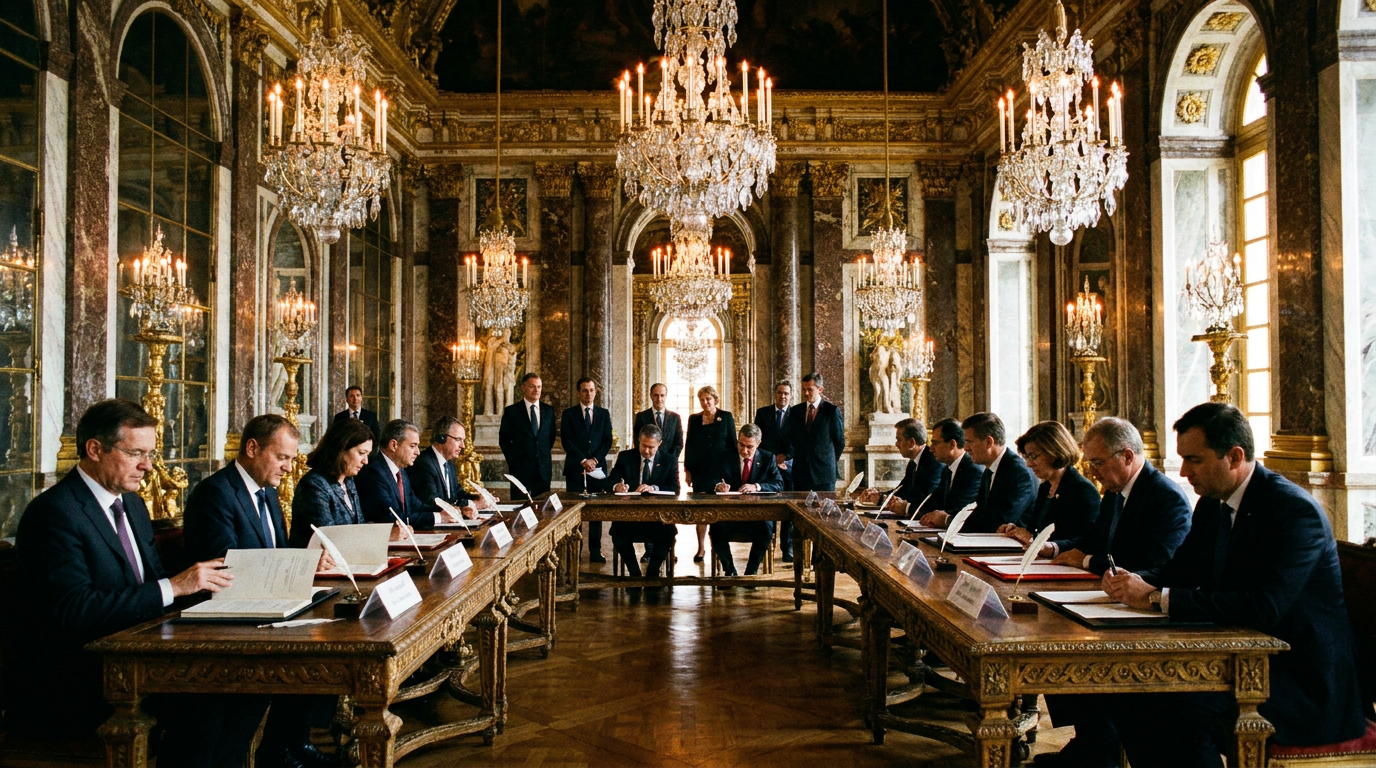
President Donald Trump and Iranian leadership have officially signed a 14-point memorandum of understanding (MoU) aimed at ending the ongoing military and economic conflict between the two nations. The historic agreement, signed at the Palace of Versailles, establishes a framework for a truce and outlines a path toward stabilizing the heavily contested Strait of Hormuz, a critical artery for global commerce.[2][6]
The Trump administration immediately heralded the agreement as a "major win" for global stability and American diplomatic leverage. Administration officials argue that the deal successfully de-escalates a volatile war that had threatened to engulf the broader Middle East, while simultaneously securing commitments from Tehran regarding maritime security and regional de-escalation.[2][5]
In Tehran, the narrative differs sharply. Iranian chief negotiator Mohammad Bagher Ghalibaf publicly characterized the agreement as a "record of US failure," asserting that the terms validate Iran's resilience against Western military and economic pressure. Hezbollah leadership echoed this sentiment, with Naim Qassem proclaiming the truce a "great victory" for the region's resistance axis.[2][6]
A critical component of the 14-point MoU addresses the Strait of Hormuz, through which a significant portion of the world's oil supply flows. According to Iranian officials, the waterway will "not return to prewar conditions." Instead, Tehran has announced a 60-day transitional window, after which it plans to implement a new toll system for commercial vessels transiting the strait.[2]

A critical component of the 14-point MoU addresses the Strait of Hormuz, through which a significant portion of the world's oil supply flows.
Global financial markets reacted swiftly and positively to the cessation of hostilities. Brent crude oil prices dropped by as much as 1.6 percent in early trading, reflecting profound relief that the immediate threat to Middle Eastern energy infrastructure has subsided. Key stock indices across Asia, including in Japan, South Korea, and Taiwan, rallied significantly on the news.[4]
The conflict had previously forced severe energy realignments worldwide. In regions heavily dependent on imported oil, such as Southeast Asia, the soaring costs associated with the Iran war had driven a massive surge in rooftop solar panel installations as businesses and homeowners sought relief from the energy crisis. The new truce is expected to stabilize these volatile energy costs, though the long-term shift toward renewables may be permanent.[7]

Despite the administration's victory lap, the MoU has ignited fierce pushback from within Trump's own party. Several prominent Republicans have voiced alarm over the concessions made to Tehran. Louisiana Senator Bill Cassidy publicly blasted the framework, labeling it the "worst foreign policy blunder in decades" and questioning the enforceability of the 14-point plan.[3]
The diplomatic fallout extends to America's closest Middle Eastern ally. Israeli Prime Minister Benjamin Netanyahu remained conspicuously silent in the immediate aftermath of the signing, but Israeli officials have privately described the deal as a "strategic and political disaster." Netanyahu, who had promised the Israeli public "total victory" over Iran, now faces a radically altered regional security landscape.[1]
Attention now turns to the implementation phase of the 60-day window. International shipping conglomerates and maritime insurers are closely analyzing the proposed Strait of Hormuz toll system, while US lawmakers are expected to demand congressional hearings to scrutinize the specific enforcement mechanisms embedded within the Versailles memorandum.[2][4]
How we got here
Pre-2026
Military and economic hostilities escalate between the US and Iran, disrupting global energy markets.
Early June 2026
Secret negotiations accelerate as the economic toll of the conflict mounts globally.
June 17, 2026
The 14-point memorandum of understanding is finalized and signed at the Palace of Versailles.
June 18, 2026
Global markets rally and oil prices drop, while political backlash begins in Washington and Israel.
Viewpoints in depth
The US Administration
Frames the agreement as a major diplomatic victory that prevents a wider regional war and stabilizes global markets.
Administration officials argue that the 14-point memorandum successfully achieves what years of military posturing could not: a formal de-escalation that secures American interests without committing to an endless, untenable war. By bringing Iran to the table, the administration claims it has stabilized global energy markets and protected American lives, framing the concessions as necessary pragmatism rather than surrender.
Iranian Leadership
Views the memorandum as a successful resistance against US pressure, securing new leverage over the Strait of Hormuz.
In Tehran, the narrative is one of vindication. Iranian officials, including chief negotiator Mohammad Bagher Ghalibaf, point to the survival of their regime and their new ability to dictate terms in the Strait of Hormuz as proof that their 'axis of resistance' strategy worked. They view the 60-day window and subsequent toll system not as a compromise, but as an assertion of sovereignty over a vital global waterway.
Conservative & Israeli Critics
Argues the deal is a dangerous concession that leaves Iran's regional influence unchecked and abandons the goal of total victory.
Critics in Washington and Jerusalem view the MoU as a capitulation that rewards Iranian aggression. Lawmakers like Senator Bill Cassidy argue that the framework fails to dismantle Iran's proxy networks or its nuclear ambitions. In Israel, the agreement is seen as a strategic disaster that leaves the country vulnerable, directly contradicting previous promises of achieving 'total victory' over the Iranian threat.
What we don't know
- How exactly Iran will enforce its proposed toll system in the Strait of Hormuz after 60 days.
- Whether the US Congress will attempt to block or alter the implementation of the memorandum.
- How Israel will adjust its regional security strategy in light of the new US-Iran framework.
Key terms
- Memorandum of Understanding (MoU)
- A formal agreement between two or more parties that outlines the terms and details of an understanding, often serving as the foundation for a binding treaty.
- Strait of Hormuz
- A narrow, strategically vital waterway between the Persian Gulf and the Gulf of Oman through which a massive portion of the world's oil supply is transported.
- Brent Crude
- A major trading classification of sweet light crude oil that serves as a benchmark price for purchases of oil worldwide.
Frequently asked
What does the agreement mean for oil prices?
The immediate cessation of hostilities reduced the risk premium on Middle Eastern oil, causing Brent crude prices to drop by 1.6 percent shortly after the announcement.
Will ships have to pay to use the Strait of Hormuz?
Iran has announced that after a 60-day transitional window, it intends to implement a new toll system for commercial vessels transiting the strait, though the exact mechanics remain unclear.
How did Israel react to the deal?
Israeli Prime Minister Benjamin Netanyahu has not publicly commented, but Israeli officials have privately called the deal a 'strategic and political disaster' that falls short of defeating Iran.
Sources
Source coverage
7 outlets
4 viewpoints surfaced






[1]AxiosConservative & Israeli Critics
Netanyahu fumes, allies rage over Trump's Iran deal
Read on Axios →[2]The GuardianIranian Leadership
Middle East crisis live: Tehran says it will charge ships in strait of Hormuz after 60 days; US-Iran presidents sign peace deal
Read on The Guardian →[3]Al JazeeraConservative & Israeli Critics
Trump’s MoU with Iran draws backlash from some Republicans
Read on Al Jazeera →Oil prices fall, stocks rally as US, Iran sign framework to end war
Read on Al Jazeera →[5]Fox NewsUS Administration
Trump administration declares 'major win' as US and Iran sign historic Memorandum of Understanding
Read on Fox News →[6]ReutersIranian Leadership
Text of the 14-point US-Iran memorandum of understanding released
Read on Reuters →[7]NYTGlobal Markets
In Southeast Asia, Switching to Solar Offers Relief from Energy Crisis Caused by Iran War
Read on NYT →
Every angle. Every day.
Get news politics stories with full source coverage and perspective breakdowns delivered to your inbox.