
Retail Investors Pour Record Capital Into SpaceX, Reshaping Wall Street's Tech Hierarchy
SpaceX's record-breaking $75 billion IPO has triggered a massive capital migration, with retail investors buying more shares of the rocket company than the entire 'Magnificent Seven' combined.
By Factlen Editorial Team
- Retail Investors
- Everyday buyers view SpaceX as a rare opportunity to access frontier technology.
- Market Analysts
- Financial strategists warn that the stock's current valuation is detached from near-term fundamentals.
- Institutional Gatekeepers
- Traditional investment firms are adjusting to a market where retail demand dictates tech valuations.
What's not represented
- · Traditional Aerospace Competitors
- · Early Private Equity Backers
Why this matters
For years, everyday investors were locked out of the most lucrative frontier technology companies until their growth had already peaked. The unprecedented retail access to the SpaceX IPO signals a structural shift in how regular people can participate in the space and AI economy.
Key points
- Retail investors bought $369.8 million of SpaceX stock in its first three days, outpacing the Magnificent Seven combined.
- SpaceX accounted for 56% of all U.S. retail stock purchases on its debut day.
- Approximately 20% of the $75 billion IPO was allocated to retail buyers, far above the typical 5% to 10%.
- The stock's surge was amplified by a restricted 'free float,' with only about 5% of shares available to trade.
- Analysts are proposing the 'FAB 10' index to replace the Magnificent Seven, adding SpaceX, OpenAI, and Anthropic.
- Venture capitalist Roelof Botha has joined SpaceX's board of directors to serve on its audit committee.
The public market debut of SpaceX has triggered a historic capital migration, fundamentally rewriting the rules of how everyday investors access frontier technology. In the first three days of trading following the company's record-breaking $75 billion initial public offering, retail investors poured $369.8 million into the rocket manufacturer's stock.[1][6]
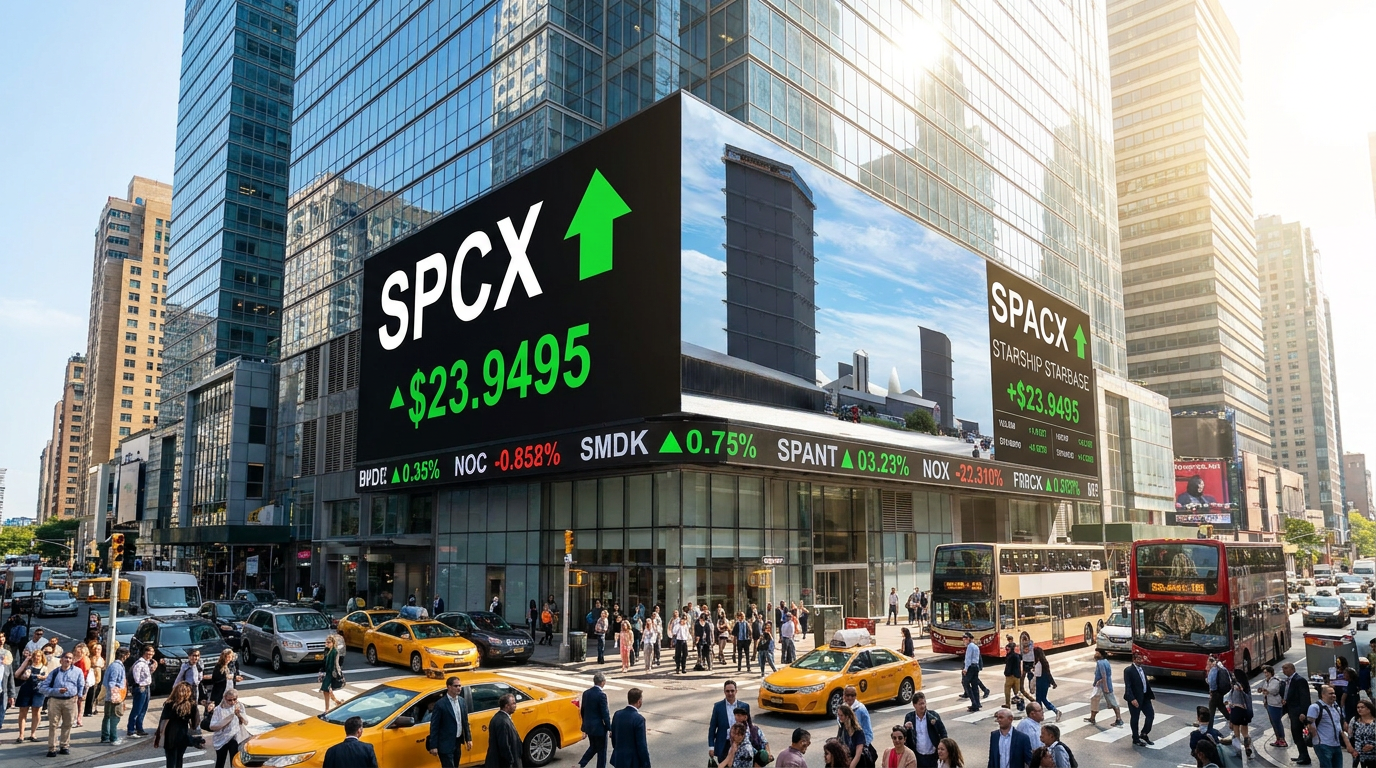
The sheer volume of this influx has eclipsed the rest of the technology sector. According to data from Vanda Research, individual investors bought more shares of SpaceX in those three sessions than they did of the entire "Magnificent Seven"—Apple, Amazon, Nvidia, Microsoft, Alphabet, Meta, and Tesla—combined. On its debut day alone, SpaceX accounted for a staggering 56% of all single-stock retail equity purchases in the United States.[1][3][6]
This level of retail participation is highly unusual for a mega-cap IPO, which are traditionally tightly guarded by Wall Street gatekeepers. In a typical hot offering, roughly 95% of shares are allocated to large institutional clients like pension funds and investment banks. Everyday investors are usually forced to wait until the stock begins trading on the open market, often at a significantly marked-up price.[4]

SpaceX deliberately inverted this model. The company set aside approximately 20% of its global IPO allocation specifically for retail buyers. Brokerages including Robinhood, Charles Schwab, Fidelity, and SoFi ensured that every eligible customer who requested shares received at least one, though massive demand meant few received their full requested allocation.[4][5]
The combination of intense retail enthusiasm and a tightly restricted supply of shares created a volatile opening week. SpaceX offered 555.6 million shares in the IPO, representing only about 5% of the company's total outstanding stock. This narrow "free float" meant that a massive wave of buyers was chasing a very limited pool of available equity.[6]
As a result, the stock surged. Priced initially at $135, shares quickly climbed above $190, briefly pushing the company's market capitalization past both Amazon and Microsoft to roughly $2.7 trillion. While the stock has since experienced a slight pullback, it remains more than 40% above its offering price, cementing its status as one of the five largest publicly traded companies in the world.[3][6]
Priced initially at $135, shares quickly climbed above $190, briefly pushing the company's market capitalization past both Amazon and Microsoft to roughly $2.7 trillion.
The frenzy has prompted financial analysts to rethink how they categorize market leaders. For years, the "Magnificent Seven" have dictated the direction of major indices. Now, research firms are proposing new frameworks. Vanda Research recently introduced the "FAB 10"—the Frontier AI & Big Tech 10—which suggests replacing the old paradigm with a new cohort that includes SpaceX alongside yet-to-be-public artificial intelligence giants like OpenAI and Anthropic.[5][6]

This narrative shift highlights a broader market rotation. Investors appear increasingly willing to pivot capital away from mature, cash-flow-generating tech companies and toward the infrastructure of the next decade: space exploration and advanced computing models. Analysts note that this migration is already draining some retail momentum from previously red-hot semiconductor stocks.[3][5]
As SpaceX transitions from a tightly controlled private fiefdom to a massive public entity, it is also restructuring its governance. The company announced this week that Roelof Botha, a prominent venture capitalist and former managing partner at Sequoia Capital, has joined its board of directors as an independent member of the audit committee.[2][7]
Botha's appointment deepens the influence of the so-called "PayPal Mafia" within SpaceX's leadership. Botha served as PayPal's chief financial officer in the early 2000s alongside Elon Musk and Peter Thiel. He joins fellow PayPal alumnus Luke Nosek on the SpaceX board, bringing extensive public-company audit experience to a firm that will now face intense regulatory scrutiny.[2][7]

Despite the euphoria, market strategists are urging caution. Several analysts have warned that the stock's current price action is heavily driven by momentum and sentiment rather than near-term business fundamentals. The restricted float is amplifying gains now, but that dynamic will eventually shift.[6]
A critical test for the stock will arrive in December 2026, when the standard 180-day lockup period expires. At that point, company insiders and early institutional backers will be permitted to sell their shares, drastically increasing the public float and potentially putting downward pressure on the price.[6]
For now, however, the SpaceX IPO stands as a landmark moment in financial democratization. By forcing open the doors to one of the most highly anticipated public offerings in history, retail investors have proven they possess the collective capital to dictate the terms of the modern tech market.[1][4][5]
How we got here
June 12, 2026
SpaceX completes its record-breaking $75 billion IPO, pricing shares at $135.
June 12, 2026
Retail investors account for 56% of all U.S. retail equity purchases on the stock's debut day.
June 16, 2026
Vanda Research proposes the 'FAB 10' framework to account for the massive capital shift toward frontier tech.
June 17, 2026
SpaceX announces the appointment of venture capitalist Roelof Botha to its board of directors.
December 2026
The 180-day lockup period is scheduled to expire, allowing insiders to sell their shares.
Viewpoints in depth
Retail Investors
Everyday buyers view SpaceX as a rare opportunity to access frontier technology.
For retail investors, the SpaceX IPO represents a break from the traditional Wall Street model where the most lucrative gains are captured by private equity before a company goes public. By securing 20% of the allocation, individual buyers are treating the stock as a foundational asset for the next decade, willingly rotating capital out of mature tech giants to fund stakes in the space and AI economy.
Market Analysts
Financial strategists warn that the stock's current valuation is detached from near-term fundamentals.
While acknowledging the company's transformative potential, analysts point out that the post-IPO price surge is largely a product of market mechanics. Because only about 5% of the company's shares are currently available for public trading, massive retail demand has artificially inflated the price. Strategists caution that when the insider lockup period expires in late 2026, a flood of new shares could test the stock's resilience.
Institutional Gatekeepers
Traditional investment firms are adjusting to a market where retail demand dictates tech valuations.
Institutional investors, who typically hoard 95% of hot IPOs, are grappling with a new paradigm. The sheer volume of retail capital flowing into SpaceX has forced research firms to rethink their market indices, proposing new groupings like the 'FAB 10' to account for companies that capture the public's imagination. Institutions are now having to compete more directly with retail momentum for access to frontier assets.
What we don't know
- How the stock price will react when the 180-day insider lockup period expires in December 2026.
- Whether the retail rotation out of traditional semiconductor and tech stocks into frontier assets will be permanent.
- How much regulatory scrutiny SpaceX will face as a public company with a highly concentrated voting structure.
Key terms
- Initial Public Offering (IPO)
- The process by which a private company offers shares to the public for the first time, allowing general investors to buy in.
- Free Float
- The portion of a company's shares that are available for trading by the public, excluding locked-in shares held by insiders.
- Lockup Period
- A predetermined window after an IPO during which company insiders and early investors are restricted from selling their shares.
- Magnificent Seven
- A popular Wall Street grouping of the seven largest tech stocks (Apple, Microsoft, Alphabet, Amazon, Nvidia, Meta, Tesla) that have dominated market returns.
- FAB 10
- A newly proposed market grouping ('Frontier AI & Big Tech 10') that adds emerging giants like SpaceX, OpenAI, and Anthropic to the traditional tech leaders.
Frequently asked
How much of the SpaceX IPO went to retail investors?
Approximately 20% of the $75 billion offering was allocated to retail investors, significantly higher than the 5% to 10% typical for large IPOs.
Why did the stock price jump so quickly after the IPO?
A combination of massive retail demand and a restricted 'free float'—meaning only about 5% of the company's total shares were available to trade—created intense upward price pressure.
Who is Roelof Botha and why did he join the board?
Botha is a prominent venture capitalist and former PayPal executive who brings extensive financial and audit experience to SpaceX's board as it transitions to a public company.
What is the FAB 10?
The FAB 10 is a proposed market index that expands the 'Magnificent Seven' tech giants to include frontier technology companies like SpaceX, OpenAI, and Anthropic.
Sources
Source coverage
7 outlets
3 viewpoints surfaced






[1]MarketWatchInstitutional Gatekeepers
Retail investors have been buying more SpaceX shares than all of the 'Magnificent Seven' combined
Read on MarketWatch →SpaceX adds a third 'PayPal Mafia' member to its board
Read on MarketWatch →[3]Los Angeles TimesRetail Investors
SpaceX has been the most-bought stock by retail investors each day since its IPO
Read on Los Angeles Times →[4]MoneywiseRetail Investors
Retail investors got at least one SpaceX IPO share, but not all they wanted
Read on Moneywise →[5]TechFlowMarket Analysts
SpaceX's debut on the public markets is reshaping how Wall Street labels technology stocks
Read on TechFlow →[6]InvezzMarket Analysts
We're running out of superlatives to describe retail enthusiasm for SpaceX
Read on Invezz →[7]MorningstarInstitutional Gatekeepers
SpaceX is bulking up its board after last week's IPO
Read on Morningstar →
Every angle. Every day.
Get finance stories with full source coverage and perspective breakdowns delivered to your inbox.