
The AI Copyright Liability Trap: Evidence Pack on the 2026 Supreme Court Fallout
Following the Supreme Court's March 2026 refusal to grant copyright to AI-generated works, businesses face a new landscape of intellectual property risks. This evidence pack evaluates the legal consensus on authorship, corporate liability, and the threshold for human creativity.
By Factlen Editorial Team
- Strict Human Authorship Advocates
- Argue that copyright exists exclusively to incentivize human creativity and that machine output should remain in the public domain.
- Corporate AI Adopters
- Deeply concerned about the lack of legal safe harbors and the sudden liability risks associated with commercializing AI-generated assets.
- AI Technologists & Creators
- Believe the legal system misunderstands the iterative, highly creative nature of modern prompt engineering and model steering.
What's not represented
- · Open-source AI developers who rely on public domain data
- · Independent artists whose copyrighted works were used in AI training datasets
Why this matters
The legal vacuum surrounding AI-generated content has shifted from a theoretical debate to a direct financial liability for businesses. Companies using AI to generate marketing, code, or media are now operating without copyright protection and bear full responsibility if those outputs infringe on existing human works.
Key points
- The Supreme Court's March 2026 denial of certiorari cemented the rule that pure AI-generated works cannot be copyrighted.
- The US Copyright Office explicitly rejects complex prompt engineering as a valid form of human authorship.
- Businesses using AI tools face direct liability if the generated output infringes on existing copyrighted material.
- Because AI output is uncopyrightable, companies cannot protect synthetic marketing assets or code from being copied by competitors.
- The exact amount of human editing required to make an AI-assisted work copyrightable remains legally undefined.
While the technology industry remains fixated on the expanding capabilities of generative artificial intelligence models, a quiet but profound legal reality has set in across the corporate landscape in mid-2026. Following a pivotal Supreme Court decision earlier this year, the legal vacuum surrounding synthetic media has shifted from a theoretical academic debate into a direct financial and operational liability for businesses. Companies that rapidly integrated AI into their content pipelines are now discovering that the legal protections they assumed existed are entirely absent, leaving them exposed to unprecedented intellectual property risks.[7]
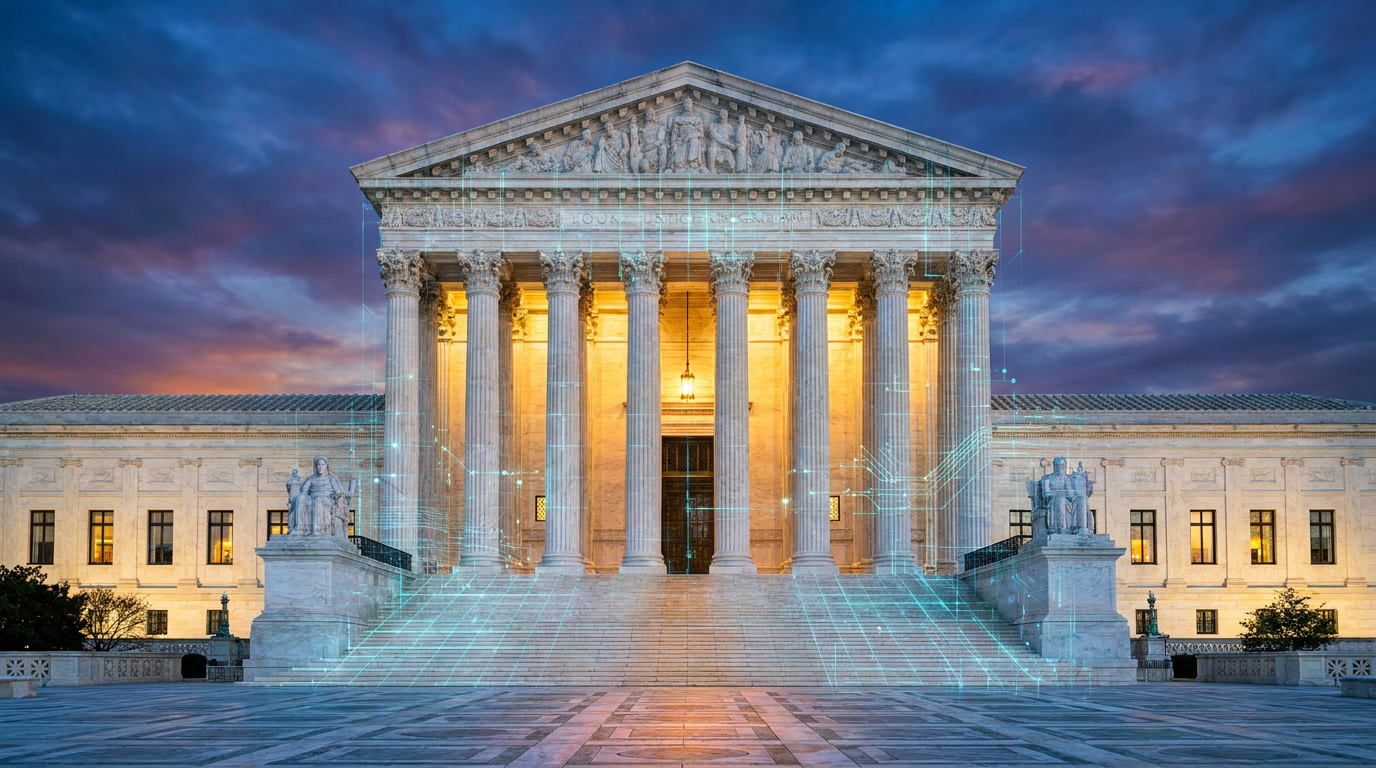
The catalyst for this shift occurred on March 2, 2026, when the United States Supreme Court officially denied certiorari in the landmark case of Thaler v. Perlmutter. By refusing to hear the appeal, the highest court in the nation left intact a sweeping decision from the D.C. Circuit Court of Appeals, which affirmed the US Copyright Office's refusal to register a piece of visual art generated autonomously by an AI system. The denial of certiorari effectively cemented the lower court's ruling as the controlling legal standard for the foreseeable future.[2][3]
In evaluating the first major claim of this evidence pack—that pure AI output is definitively uncopyrightable—the legal consensus is now overwhelmingly strong. The judicial system has firmly affirmed that artificial intelligence cannot be recognized as an author under current statutes. This interpretation aligns directly with historical readings of the Copyright Act of 1976, which mandates that copyright protection is strictly reserved for creative expression originating from human intellect. Consequently, any image, video, or text generated exclusively by a machine immediately enters the public domain, entirely devoid of proprietary protection.[4][6]
When assessing the second claim, which suggests that complex prompt engineering constitutes a valid form of human authorship, federal authorities and courts have consistently rejected the premise. Many creators and businesses assumed that crafting highly specific, multi-paragraph prompts to guide an AI model would satisfy the legal requirement for originality. However, the US Copyright Office has explicitly stated that prompting is legally analogous to giving instructions to a commissioned artist. The human prompter dictates the underlying idea or concept, but the machine executes the actual creative expression.[5][6]

To secure copyright protection for an AI-assisted work, the evidence shows that a human must meaningfully select, arrange, or substantially edit the machine's output. Merely generating a batch of images and selecting the most aesthetically pleasing one does not cross the threshold of human authorship. Creators operating faceless YouTube channels, AI music streams, or automated marketing blogs are finding that without substantial human modification, their core assets cannot be registered, defended, or monetized through traditional intellectual property enforcement mechanisms like DMCA takedowns.[5]
To secure copyright protection for an AI-assisted work, the evidence shows that a human must meaningfully select, arrange, or substantially edit the machine's output.
The third and perhaps most consequential claim for the corporate sector is that businesses utilizing AI tools bear direct liability for infringement. The evidence supporting this claim is emerging rapidly, representing a severe risk for enterprise adopters. Intellectual property lawyers from major law firms are increasingly warning clients that the liability shield for end-users is virtually nonexistent. If an AI tool generates content that infringes on a pre-existing human-authored work—whether due to the model's training data or the specific output generated—the business deploying that content can be held directly liable.[1][7]
Because the AI-generated work cannot be copyrighted, the business has no proprietary claim to the asset, yet they remain the responsible legal party for publishing or commercializing the infringing material. Legal analysts emphasize that companies are no longer just passive users of a software tool; they are the active publishers of unprotectable, potentially infringing media. This dual impact—lacking ownership while holding full liability—has forced corporate legal departments to urgently audit their marketing, coding, and content generation workflows.[1]
Finally, evaluating the claim that the exact threshold of meaningful human input remains legally undefined reveals a significant and highly contested gray area. Because Dr. Stephen Thaler explicitly disclaimed any human creative input in his Supreme Court petition—arguing solely for the machine's inherent right to authorship—the courts were not forced to draw a precise line on how much human editing is actually required to transform an AI output into a copyrightable work.[3][7]

This leaves a massive evidentiary gap for hybrid workflows. It remains legally ambiguous how much Photoshop manipulation of an AI-generated image, or how much line-editing of an AI-drafted article, is necessary to cross the threshold into human authorship. Pending lower court cases, such as Allen v. Colorado, are currently testing this exact boundary, but until a new binding precedent is established, the exact percentage of human intervention required remains a matter of legal speculation.[3][7]
Until the courts provide definitive guidance on hybrid authorship, law firms are advising companies to meticulously document the human creative process involved in any AI-assisted project. The ultimate takeaway from the 2026 legal landscape is that the judicial system has firmly rejected the concept of machine authorship, shifting the burden of proof—and the entirety of the legal risk—squarely onto the human operators. As AI integration becomes ubiquitous, the gap between technological capability and legal protection will force a fundamental rethinking of how synthetic media is commercialized.[2][7]
The software development industry is particularly vulnerable to this shifting legal standard. Engineering teams utilizing AI coding assistants to generate boilerplate code, optimize algorithms, or draft documentation are operating in a legally ambiguous zone. If a substantial portion of a commercial software product is generated by an AI model, competitors could theoretically copy those specific AI-generated modules without violating copyright law. This forces technology companies to implement strict internal tracking systems to delineate exactly which lines of code were authored by human engineers versus machine assistants.[7]

Similarly, the entertainment and marketing sectors are facing a profound operational reckoning. Advertising agencies that transitioned to generative AI for rapid campaign ideation and asset creation are discovering that their deliverables cannot be exclusively licensed to clients. If an agency delivers an ad campaign built entirely on AI-generated visuals, the client has no legal mechanism to prevent a rival company from using the exact same images. Consequently, the value of pure AI generation is plummeting in commercial contexts, while the premium on verifiable, human-authored creative work is experiencing an unexpected resurgence.[1][7]
How we got here
1976
The US Copyright Act is established, anchoring protection to 'original works of authorship.'
August 2023
A federal judge in Washington D.C. rules that AI-generated art cannot be copyrighted in the initial Thaler v. Perlmutter decision.
March 2, 2026
The US Supreme Court denies certiorari, cementing the human authorship requirement as controlling law.
June 2026
Legal and corporate consensus solidifies around the severe liability risks for businesses deploying unprotected AI content.
Viewpoints in depth
Strict Human Authorship Advocates
Defending the traditional boundaries of intellectual property.
This camp, anchored by the US Copyright Office and traditional legal scholars, maintains that the fundamental purpose of copyright law is to incentivize human innovation. They argue that extending proprietary rights to machines would fundamentally devalue human artistry and flood the legal system with automated registrations. By keeping pure AI output in the public domain, they believe the law correctly preserves the premium on genuine human expression.
Corporate AI Adopters
Navigating a new landscape of unprotectable assets and high liability.
For businesses and marketing agencies, the Supreme Court's refusal to intervene has created an operational nightmare. This camp argues that the current legal framework fails to account for the commercial realities of modern content production. Without the ability to copyright AI-generated assets, companies cannot protect their investments in synthetic media, yet they remain fully exposed to infringement lawsuits if those tools inadvertently replicate protected training data.
AI Technologists & Creators
Advocating for the recognition of prompt engineering as a creative act.
Technologists and AI-native creators argue that the legal system fundamentally misunderstands how generative models are used in practice. They contend that crafting multi-layered prompts, iterating through hundreds of generations, and steering a model's output requires a high degree of creative vision and intellectual effort. This camp believes that dismissing prompt engineering as mere 'instructions' relies on an outdated analogy that fails to capture the nuances of human-machine collaboration.
What we don't know
- The exact percentage or degree of human editing required to transform an AI-generated output into a copyrightable work.
- How lower courts will rule in pending cases involving hybrid AI-assisted workflows, such as Allen v. Colorado.
- Whether Congress will eventually intervene to create a new, distinct category of intellectual property protection specifically for synthetic media.
Key terms
- Certiorari
- A formal request for the Supreme Court to review a decision of a lower court; denying it leaves the lower court's ruling in place.
- Human Authorship Requirement
- The legal doctrine stipulating that only works created by a human being can be protected by US copyright law.
- Prompt Engineering
- The process of structuring text phrases to instruct a generative AI model to produce a specific output.
- Public Domain
- Creative materials that are not protected by intellectual property laws and can be freely used or modified by anyone.
Frequently asked
Can I copyright an image I generated with an AI tool?
No, not if it was generated purely by a text prompt. You must substantially edit or modify the image yourself to claim copyright on your specific human additions.
What did the Supreme Court decide in March 2026?
The Court denied certiorari in Thaler v. Perlmutter, refusing to hear the case. This left the lower court's ruling intact, affirming that AI cannot be an author.
Can my business be sued for using AI-generated content?
Yes. If the AI output infringes on existing copyrighted material, the business utilizing and publishing that content can be held directly liable for infringement.
Does writing a very detailed prompt count as authorship?
The US Copyright Office has explicitly stated that prompting is akin to giving instructions to a commissioned artist, which does not qualify as human authorship.
Sources
Source coverage
7 outlets
3 viewpoints surfaced







[1]ForbesCorporate AI Adopters
The Supreme Court Made A Little-Noticed Ruling On AI Copyright. Here Is What It Means For Your Business.
Read on Forbes →[2]Morgan LewisStrict Human Authorship Advocates
Supreme Court Declines to Review AI Copyright Case, Leaving Human Authorship Requirement Intact
Read on Morgan Lewis →[3]Baker DonelsonStrict Human Authorship Advocates
Supreme Court Denies Certiorari in Thaler v. Perlmutter: AI Cannot Be an Author Under the Copyright Act
Read on Baker Donelson →[4]Startup StashCorporate AI Adopters
Supreme Court Denies Copyright For AI-Generated Art: Key Implications For Business Owners And Creators
Read on Startup Stash →[5]Outlier KitAI Technologists & Creators
Supreme Court Denies Certiorari: What YouTube Creators Using AI Need to Know
Read on Outlier Kit →[6]US Copyright OfficeStrict Human Authorship Advocates
Copyright Registration Guidance: Works Containing Material Generated by Artificial Intelligence
Read on US Copyright Office →[7]Factlen Editorial TeamAI Technologists & Creators
Synthesis by Factlen editorial team
Read on Factlen Editorial Team →
Every angle. Every day.
Get ai stories with full source coverage and perspective breakdowns delivered to your inbox.