
How Mushroom Leather and Grown Biomaterials Are Rewiring the Fashion Industry
Next-generation biomaterials grown from fungi and agricultural waste are moving from experimental labs to commercial scale, offering the fashion industry a viable alternative to animal hides and fossil-fuel plastics.
By Factlen Editorial Team
- Biomaterial Innovators
- Argue that biotechnology can completely replace extractive industries by engineering materials at the cellular level.
- Luxury & Apparel Brands
- Emphasize that sustainability cannot compromise performance or aesthetics, viewing biomaterials as a way to future-proof supply chains.
- Sustainability Advocates
- Stress that true circularity requires materials to safely return to the earth, cautioning against plastic-blended 'greenwashing'.
What's not represented
- · Traditional cattle ranchers
- · Garment workers in conventional tanneries
Why this matters
The apparel and footwear industries are among the world's heaviest polluters, heavily reliant on water-intensive animal agriculture and non-biodegradable plastics. The commercial scaling of lab-grown biomaterials provides a blueprint for decoupling everyday consumer goods from fossil fuels and toxic manufacturing processes.
Key points
- Mycelium leather is grown from the root structure of fungi using agricultural waste in just 7 to 14 days.
- The material uses up to 99% less water and emits 95% less carbon than traditional bovine leather.
- Major luxury and athletic brands, including Hermès and Adidas, are now releasing commercial products made from mycelium.
- Unlike synthetic 'vegan' leathers made from plastic, pure mycelium leather is fully biodegradable.
- Scaling production to meet global demand and lowering costs remain the primary challenges for the industry.
For decades, the fashion industry has faced a binary and deeply flawed choice when it comes to leather. Brands could either rely on animal agriculture, which carries a massive carbon and water footprint, or pivot to synthetic "vegan" leathers made from polyurethane (PU) and polyvinyl chloride (PVC)—fossil-fuel derivatives that take centuries to decompose. Neither option aligns with the urgent need to decarbonize global supply chains.[1][3]
In 2026, a third paradigm has moved from the fringes of biotechnology into the mainstream luxury market: grown materials. At the forefront of this shift is mycelium, the underground root-like network of fungi, which is proving to be one of the most disruptive material innovations in modern fashion. By harnessing the natural growth patterns of fungi, biotech companies are producing textiles that mimic the exact properties of animal hide without the environmental toll.[2][7][8]
To understand mycelium leather, one must look beyond the mushroom. The mushroom itself is merely the fruiting body of a much larger organism. Beneath the surface lies the mycelium, a sprawling network of microscopic branching threads called hyphae. In nature, these threads act as the earth's recycling system, breaking down organic matter and returning nutrients to the soil.[1][7]
In a controlled laboratory or vertical farm, however, these hyphae can be coaxed into forming dense, interlocking structures that closely mirror the collagen fibers found in animal skin. The cultivation mechanism is remarkably efficient and entirely circular. The process begins with a nutrient-rich substrate made from agricultural waste, such as sawdust, hemp hurd, or corn stalks, which provides the food source for the fungi.[6][7]
Mushroom spores are introduced to this substrate in shallow trays and placed in a dark, climate-controlled environment. Over the course of just seven to fourteen days, the mycelium consumes the organic waste, knitting itself into a thick, uniform mat. This rapid growth cycle stands in stark contrast to the years of land and water use required to raise cattle for bovine leather.[2][6][7]

Once the mycelium mat reaches the desired thickness, it is harvested and undergoes a specialized tanning process. Unlike traditional leather tanning, which often relies on toxic heavy metals like chromium to prevent the animal skin from rotting, mycelium tanning utilizes bio-based, chromium-free treatments. This ensures that the material remains safe for both the artisans handling it and the environment.[3][6][7]
The environmental claims surrounding this new material are staggering. Industry data indicates that mycelium leather requires 90 to 99 percent less water than bovine leather and generates up to 95 percent fewer carbon emissions. Because it is grown from organic waste and tanned without toxic chemicals, the final product is fully biodegradable and compostable at the end of its lifecycle, returning safely to the earth.[4][6]
The environmental claims surrounding this new material are staggering.
For years, the primary hurdle for biomaterials was performance: could a lab-grown fungus truly replicate the buttery hand-feel and durability of premium calfskin? The answer, increasingly, is yes. Mycelium leather has recently surpassed stringent industry benchmarks for flexibility, crease resistance, and abrasion, proving it can withstand the daily wear and tear expected of high-end accessories.[2][3]
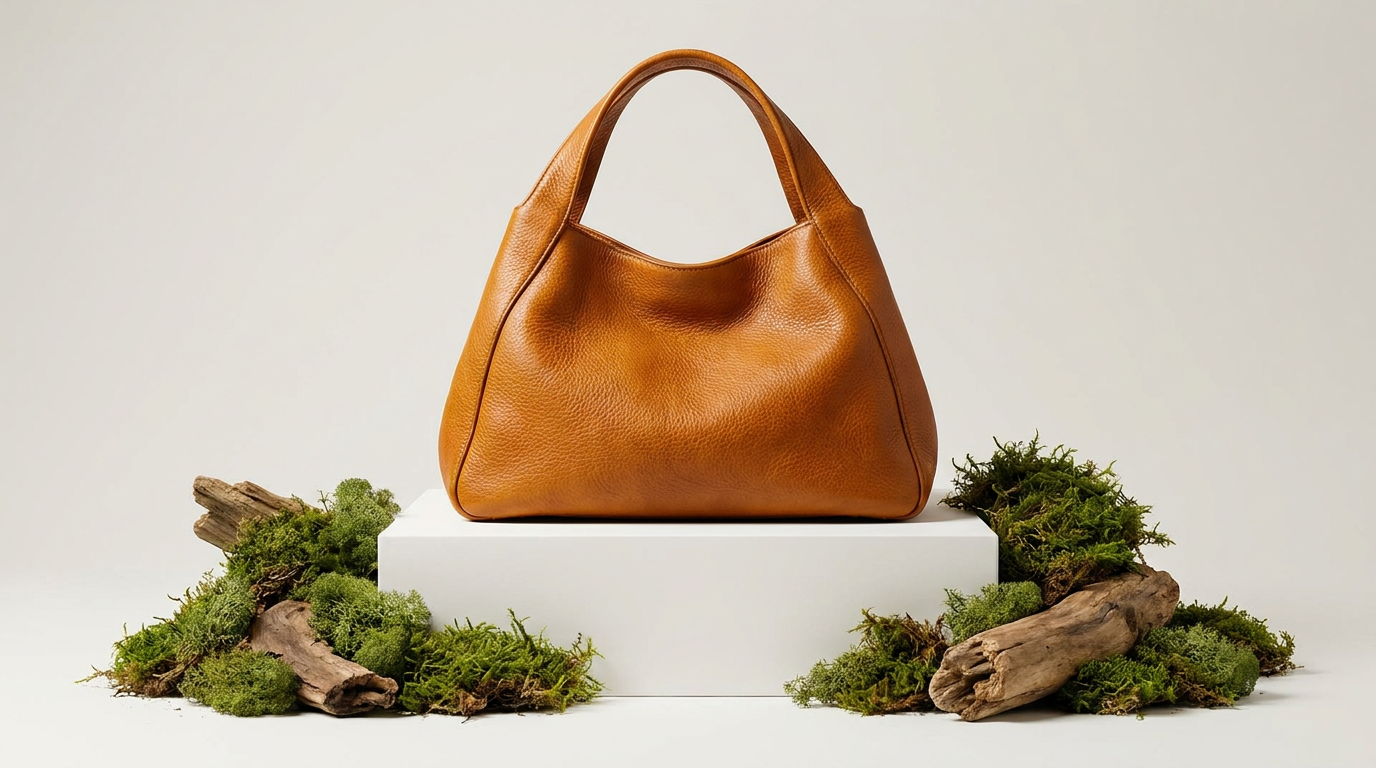
This leap in quality has triggered a wave of adoption among the world's most exacting luxury houses. Hermès, a brand synonymous with uncompromising leather craftsmanship, recently partnered with California-based startup MycoWorks to reimagine its classic Victoria travel bag. The new edition utilizes Sylvania, an exclusive amber-hued mycelium material that Hermès finishes in its own historic tanneries in France.[2]
The broader apparel market is following suit. Bolt Threads, another pioneer in the space, has scaled its Mylo material through partnerships with Stella McCartney, Adidas, and Lululemon. McCartney has already debuted garments and handbags made from the fungal fabric on Paris Fashion Week runways, while Adidas has integrated it into versions of its iconic Stan Smith sneakers, signaling a shift toward mass-market viability.[6]
The innovation extends beyond fungi. The push for next-generation biomaterials has also accelerated the development of algae and seaweed-based fibers. Companies are processing marine biomass into flexible textile sheets and yarns, offering a renewable alternative to water-intensive crops like cotton. Because algae can be cultivated in the ocean without arable land or freshwater, it represents a massive opportunity for upstream supply chain diversification.[4][8]
Similarly, startups like Polybion are utilizing bacterial cellulose to create entirely new categories of textiles. By feeding agro-industrial fruit waste to specific strains of bacteria, they trigger a natural fermentation process that spins out a premium leather alternative called Celium. Together, these technologies represent a fundamental rewiring of how humans produce the materials that clothe them.[3][4]

Despite the rapid progress, significant uncertainties remain regarding scale. The global leather industry produces an estimated 23 billion square feet of material annually to feed the footwear, apparel, automotive, and furniture sectors. Current mycelium production facilities, while expanding rapidly, still measure their output in the millions of square feet—a mere fraction of global demand.[2][6]
Cost is another limiting factor. As of early 2026, mycelium leather remains two to four times more expensive than conventional leather, restricting its use primarily to luxury goods and limited-edition capsule collections. However, industry analysts project that as vertical farming techniques improve and economies of scale take hold, these biomaterials will reach price parity with animal leather by the end of the decade.[5][6]

Aesthetic limitations also persist. The color palette for fungal leathers is currently dominated by natural earth tones—browns, tans, and blacks—as bio-friendly dyeing techniques that do not compromise the material's compostability are still being perfected. Bright, synthetic colors remain difficult to achieve without resorting to the very petrochemical dyes the industry is trying to escape.[6]
Nevertheless, the trajectory is clear. Driven by incoming regulations like the European Union's Digital Product Passport, which will require brands to disclose exact material footprints, the fashion industry is being forced to internalize its environmental costs. In this new landscape, materials grown from the earth, rather than extracted from it, are poised to become the new standard for luxury and everyday wear alike.[1][5][6][8]
How we got here
2018
Biotech startups begin successfully prototyping small swatches of leather-like material grown from mycelium.
2021
Hermès announces a partnership with MycoWorks to prototype a Victoria travel bag using Sylvania mycelium.
2024
Stella McCartney debuts garments made from Kelsun seaweed fibers and Mylo mushroom leather on the Paris runway.
2025–2026
Commercial-scale vertical farming facilities for mycelium open, allowing brands to move from prototypes to retail drops.
Viewpoints in depth
Biomaterial Innovators
Argue that biotechnology can completely replace extractive industries by engineering materials at the cellular level.
Founders of biotech startups view the current fashion supply chain as an antiquated, inefficient system. They argue that raising a cow for three years just to harvest its skin—or extracting oil to create plastic faux leather—is technologically obsolete. By utilizing vertical farming and cellular agriculture, they believe they can engineer materials that are not only more sustainable but objectively superior in performance, allowing for bespoke thickness, texture, and strength tailored to a brand's exact specifications.
Luxury & Apparel Brands
Emphasize that sustainability cannot compromise performance or aesthetics, viewing biomaterials as a way to future-proof supply chains.
For heritage fashion houses and global sportswear giants, the adoption of biomaterials is driven by a mix of consumer demand and regulatory pressure. However, these brands stress that their customers will not accept a drop in quality just because a product is eco-friendly. They view the recent breakthroughs in mycelium's abrasion resistance and tensile strength as the tipping point that finally allows them to meet their aggressive carbon-reduction targets without diluting their brand equity.
Sustainability Advocates
Stress that true circularity requires materials to safely return to the earth, cautioning against plastic-blended 'greenwashing'.
Environmental watchdogs and circular-economy advocates celebrate the rise of grown materials but maintain a critical eye on how they are processed. They frequently point out that early generations of 'vegan leather' were simply polyurethane plastics that shed microplastics and sat in landfills for centuries. This camp advocates strictly for 100% bio-based solutions, warning that if a brand blends mycelium with synthetic resins to cut costs or improve durability, it defeats the purpose of using a biodegradable material in the first place.
What we don't know
- Whether mycelium production can scale rapidly enough to capture a meaningful percentage of the 23-billion-square-foot global leather market.
- How quickly the cost of grown biomaterials will reach parity with heavily subsidized animal agriculture.
- If bio-friendly dyeing techniques will advance enough to offer the bright, vibrant color palettes that fast fashion demands.
Key terms
- Mycelium
- The vegetative part of a fungus, consisting of a dense network of fine white filaments that grow underground or within a substrate.
- Substrate
- The surface or material on which an organism lives and grows; in this case, agricultural waste like sawdust used to feed the fungi.
- Polyurethane (PU)
- A synthetic plastic polymer derived from fossil fuels, commonly used to make conventional faux or "vegan" leather.
- Biomimicry
- The design and production of materials, structures, and systems that are modeled on biological entities and processes found in nature.
- Circular Economy
- An economic system aimed at eliminating waste by ensuring materials can be continually reused, recycled, or safely composted back into the earth.
Frequently asked
What exactly is mycelium?
Mycelium is the underground, root-like network of fungi, consisting of microscopic branching threads called hyphae that break down organic matter.
Is mushroom leather as durable as real leather?
Yes. When cultivated and tanned correctly, commercial mycelium leather meets or exceeds luxury industry benchmarks for flexibility, crease resistance, and abrasion.
Does mushroom leather use toxic tanning chemicals?
No. Unlike conventional animal leather, which often uses heavy metals like chromium to prevent rotting, mycelium leather utilizes bio-based, chromium-free tanning processes.
Is mushroom leather biodegradable?
Yes. Because it is grown from natural fungal networks and tanned organically without plastic coatings, it can safely compost at the end of its lifecycle.
Sources
Source coverage
8 outlets
3 viewpoints surfaced







[1]Factlen Editorial TeamSustainability Advocates
Synthesis by Factlen editorial team
Read on Factlen Editorial Team →[2]MycoWorksBiomaterial Innovators
The Future of Fashion Is Fungi: Reishi and Hermès Collaboration
Read on MycoWorks →[3]Fashion for GoodSustainability Advocates
Scaling Next-Gen Materials in Fashion
Read on Fashion for Good →[4]World CollectiveSustainability Advocates
What Are Next-Gen Materials in Fashion?
Read on World Collective →[5]Data InteloSustainability Advocates
Mushroom Derived Leather Market Outlook 2025-2034
Read on Data Intelo →[6]California Fashion WeekLuxury & Apparel Brands
Mushroom Leather Is Having a Moment – And It Might Just Save Fashion
Read on California Fashion Week →[7]BSL AssociationBiomaterial Innovators
Mycelium Leather: How Grown Materials Are Redefining the Future
Read on BSL Association →[8]Smart Fashion NewsLuxury & Apparel Brands
A Global Update (2025): Biomaterials Take Center Stage
Read on Smart Fashion News →

Every angle. Every day.
Get lifestyle stories with full source coverage and perspective breakdowns delivered to your inbox.