
The Science of Emulsions: How Chemistry Creates Perfect Sauces and Dressings
Understanding the molecular mechanics of emulsifiers can help home cooks master everything from silky mayonnaise to stable vinaigrettes without fear of separation.
By Factlen Editorial Team
- Food Scientists
- Focus on the molecular mechanics, thermodynamics, and precise ratios required for stability.
- Culinary Traditionalists
- Rely on classical techniques, intuition, and natural ingredients to build sauces.
- Culinary Educators
- Bridge the gap between complex chemistry and practical home cooking applications.
What's not represented
- · Industrial food manufacturers
- · Dairy scientists
Why this matters
Mastering emulsions transforms home cooking from a game of chance into a predictable science, allowing anyone to create restaurant-quality sauces, dressings, and marinades without fear of them separating.
Key points
- Oil and water naturally repel each other due to their polar and non-polar molecular structures.
- Emulsifiers act as molecular bridges, featuring one water-loving end and one fat-loving end.
- Mechanical force, such as whisking, is required to break oil into microscopic droplets so the emulsifier can coat them.
- Adding oil too quickly or exposing the sauce to extreme temperatures are the primary reasons emulsions break.
A creamy hollandaise sauce draped over eggs Benedict, a rich béarnaise served alongside a pan-seared steak, or a perfectly glossy vinaigrette clinging to crisp lettuce—these are the hallmarks of elevated cooking. Yet, for many home cooks, achieving these silky, luxurious textures feels like a culinary roll of the dice. The difference between a restaurant-quality sauce and a greasy, separated mess is not a matter of innate talent or expensive ingredients. It is entirely a matter of chemistry, specifically a process known as emulsification.[1]
At the heart of every great sauce is a fundamental conflict: oil and water absolutely refuse to mix. You can place them in a jar and shake them with all your might, creating a temporary, cloudy mixture known as a colloidal suspension. But the moment you stop applying force, the two liquids will inevitably separate, leaving a layer of oil floating stubbornly on top of the water. To conquer this separation is to master one of the most essential techniques in the culinary arts.[1][2]
The incompatibility of oil and water is rooted in their molecular structures. Water molecules are polar, meaning they have a slight positive charge on one end and a slight negative charge on the other. Because opposites attract, water molecules bond tightly to one another. Oil molecules, on the other hand, are non-polar and lack this charge differential. When forced together, the water molecules simply bypass the oil to bond with each other, effectively squeezing the oil out of the mixture.[4]
In the kitchen, fighting this molecular reality means fighting the second law of thermodynamics. An emulsion—a mixture of two immiscible liquids—is inherently unstable because it requires constant energy to maintain. Without intervention, the mixture will always seek its lowest energy state, which is complete separation. To force these enemies into a stable, peaceful coexistence, cooks must introduce a molecular mediator.[2]
This is where emulsifiers step in. Emulsifiers, also known in the scientific community as surfactants, are the peacekeepers of the culinary world. They are unique molecules possessing a dual personality: one end of the molecule is hydrophilic, meaning it loves water, while the other end is lipophilic, meaning it loves fat. This amphiphilic nature allows the emulsifier to serve as a bridge between the two opposing liquids.[4][5]

When an emulsifier is introduced to a mixture of oil and water, its molecules automatically arrange themselves at the interface between the two liquids. The lipophilic tails embed themselves into the microscopic droplets of oil, while the hydrophilic heads face outward, interacting with the surrounding water. This creates a protective, water-friendly cocoon around each oil droplet, preventing them from coalescing back into a single, separate layer of fat.[1][4]
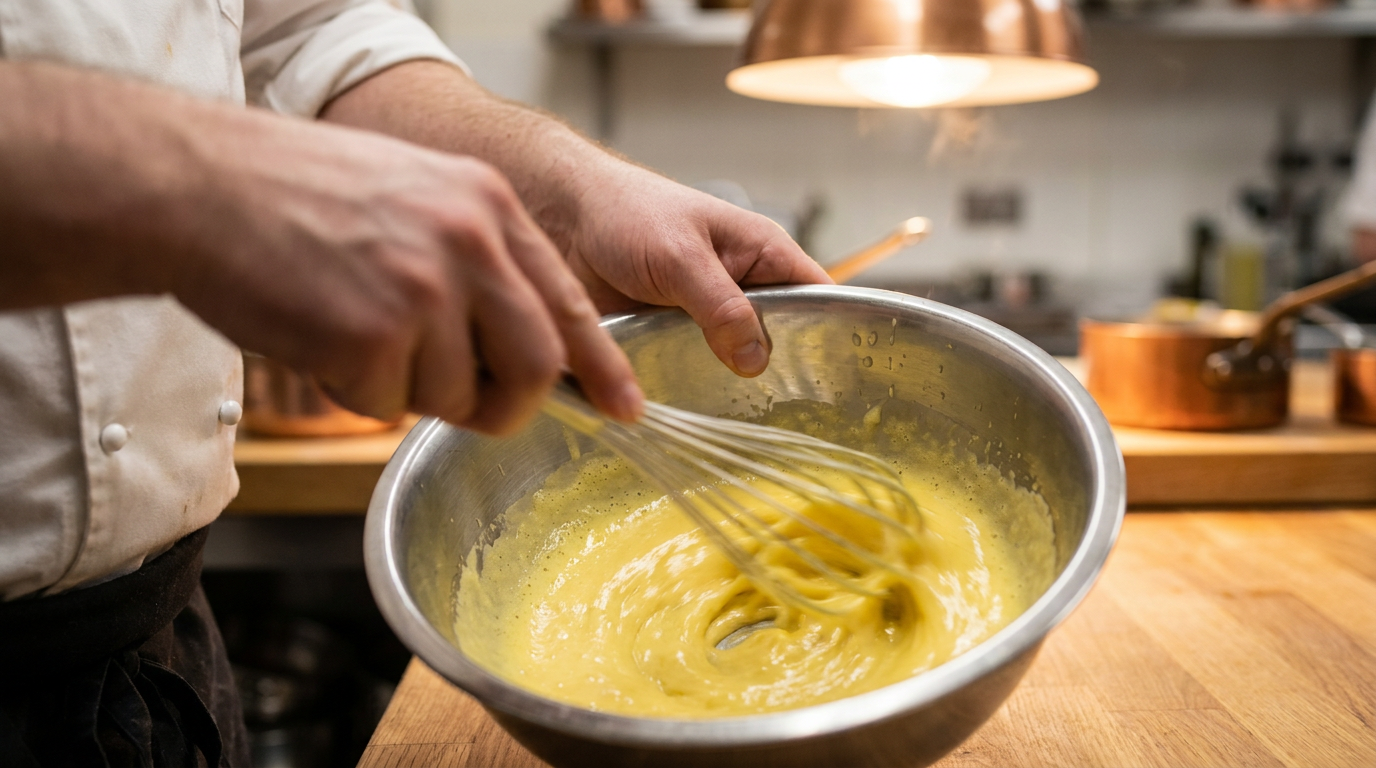
However, simply adding an emulsifier is not enough; mechanical force is required to create the emulsion. Whether through vigorous whisking, blending, or shaking, this force is necessary to physically break the oil down into millions of microscopic droplets. The smaller the droplets, the more stable the emulsion will be. As the force disperses the oil, the emulsifier rapidly coats the newly formed droplets, locking them into suspension.[1][2]
In the culinary world, emulsions generally fall into two categories. The first is the oil-in-water emulsion, where tiny droplets of oil are dispersed throughout a continuous phase of water. Mayonnaise is the classic example of this structure, alongside hollandaise, milk, and cream. Because the continuous phase is water-based, these emulsions can be diluted with additional water or acid without breaking, and they tend to have a thick, creamy texture.[2][5]
In the culinary world, emulsions generally fall into two categories.
The second category is the water-in-oil emulsion, where the roles are reversed. In this structure, tiny droplets of water are suspended within a continuous phase of oil. Vinaigrettes are the most common culinary example of a water-in-oil emulsion, alongside butter and margarine. Because the continuous phase is oil, these mixtures tend to be runnier and are better suited for coating the large surface area of salad greens.[2][5]

To achieve these structures, cooks rely on a variety of natural emulsifiers found in everyday ingredients. The most powerful and widely used is the egg yolk. Egg yolks contain a protein called lecithin, a highly effective phospholipid that has held together centuries of French sauces. When making mayonnaise, the lecithin in a single egg yolk can theoretically stabilize several cups of oil, provided the oil is added correctly.[1][4]
For vinaigrettes, where eggs are rarely used, mustard is the traditional emulsifier of choice. Mustard seeds contain a complex carbohydrate called mucilage, which swells in water and helps stabilize the suspension of oil and vinegar. Other common kitchen emulsifiers include honey, garlic paste, and even the natural starches found in pasta water, which is why tossing pasta in its cooking liquid creates a glossy, cohesive sauce.[1][4]
Food scientists quantify the effectiveness of these emulsifiers using the Hydrophilic-Lipophilic Balance (HLB) scale. Developed in 1949, the HLB scale ranges from 0 to 20. Emulsifiers with low HLB values are more lipophilic and are ideal for stabilizing water-in-oil emulsions like vinaigrettes. Conversely, emulsifiers with high HLB values are more hydrophilic and are used to stabilize oil-in-water emulsions like mayonnaise.[7]

Even with the right emulsifier, things can go wrong. The most common reason a sauce breaks—reverting to a greasy, separated state—is adding the dispersed phase too quickly. If you dump all the oil into a mayonnaise base at once, the emulsifier cannot coat the droplets fast enough, and the oil simply coalesces. This is why recipes universally demand that oil be added in a slow, steady stream while whisking continuously.[1]
Temperature also plays a critical role in emulsion stability. Emulsions are most stable when all ingredients are at room temperature. If a hollandaise sauce gets too hot, the egg proteins will denature and scramble, instantly breaking the emulsion. Conversely, if a cream-based sauce gets too cold, the water phase can freeze and expand, rupturing the protective cocoons and causing the fat to separate.[2][4]
Fortunately, a broken emulsion is rarely a lost cause. Because the ingredients are still perfectly good, the sauce can almost always be rescued. The scientifically sound method for fixing a broken mayonnaise or hollandaise is to start fresh with a small amount of water or a new egg yolk in a clean bowl. By slowly whisking the broken, greasy mixture into the new base, the cook can re-establish the continuous phase and restore the emulsion.[1]

In recent years, the modernist cuisine movement has expanded the home cook's emulsification toolkit. Ingredients once reserved for industrial food production, such as soy lecithin and xanthan gum, are now widely available. Xanthan gum, while technically a thickener rather than a true emulsifier, dramatically increases the viscosity of the water phase, making it incredibly difficult for oil droplets to move and coalesce, resulting in near-indestructible vinaigrettes.[2]
Soy lecithin, extracted from soybeans, is a pure form of the same emulsifier found in egg yolks. Modernist chefs use it to create delicate, stable foams—essentially air-in-water emulsions—that can carry concentrated flavors without the heavy texture of a traditional sauce. By understanding the HLB scale and the properties of these extracted ingredients, cooks can engineer textures that were previously impossible.[6]
Ultimately, mastering culinary emulsions is about shifting one's mindset. When a recipe instructs you to whisk vigorously or add oil drop by drop, it is not an arbitrary culinary tradition; it is a specific instruction designed to manipulate molecular physics. By understanding the invisible forces at play, home cooks can approach the stove not with blind hope, but with scientific certainty.[8]
The kitchen is, after all, a laboratory, and every meal is an experiment in applied chemistry. Whether you are whisking a simple mustard vinaigrette for a weeknight salad or carefully tempering a hollandaise for a holiday brunch, you are acting as a chemist. Armed with the knowledge of hydrophilic heads, lipophilic tails, and the power of mechanical shear, any cook can conquer the fundamental divide between oil and water.[8]
How we got here
18th Century
Mayonnaise is popularized in French cuisine, relying on the natural lecithin in egg yolks to stabilize oil and acid.
1949
Chemical engineer William C. Griffin introduces the HLB scale, revolutionizing the scientific understanding of surfactants.
Late 20th Century
The modernist cuisine movement brings industrial emulsifiers like soy lecithin and xanthan gum into restaurant kitchens.
Present Day
Food science democratizes advanced emulsification techniques, allowing home cooks to engineer perfectly stable sauces.
Viewpoints in depth
Food Scientists
Focus on the molecular mechanics, thermodynamics, and precise ratios required for stability.
From a scientific perspective, cooking is an exercise in applied chemistry. Food scientists view emulsions through the lens of the Hydrophilic-Lipophilic Balance (HLB) scale and thermodynamic stability. They emphasize that a successful sauce is not about culinary intuition, but about selecting the correct surfactant to lower interfacial tension and applying the exact amount of mechanical shear required to disperse the droplets.
Culinary Traditionalists
Rely on classical techniques, intuition, and natural ingredients to build sauces.
Traditional chefs approach emulsions as an artisanal craft honed over centuries of French culinary history. Rather than calculating HLB values, they rely on the natural emulsifying properties of egg yolks, mustard, and garlic. For the traditionalist, the secret to a perfect hollandaise or vinaigrette lies in the physical technique—the rhythm of the whisk, the temperature of the bowl, and the patience to add oil in a painstakingly slow stream.
Modernist Chefs
Utilize extracted hydrocolloids to create novel textures and push culinary boundaries.
The modernist movement views traditional emulsions as just the starting point. By isolating specific emulsifiers like soy lecithin or utilizing stabilizers like xanthan gum, modernist chefs can create textures that defy traditional physics. This approach allows for the creation of delicate, airy foams that carry intense flavor without the heavy mouthfeel of a butter- or oil-based sauce, separating the concept of flavor from the necessity of fat.
What we don't know
- Whether new plant-based emulsifiers can fully replicate the specific mouthfeel and stability of egg-yolk lecithin in commercial applications.
- The exact thermodynamic limits of emulsion stability when combining multiple synthetic surfactants in extreme culinary environments.
Key terms
- Emulsifier
- A molecule that acts as a bridge between oil and water, preventing them from separating.
- Surfactant
- A surface-active agent that lowers the tension between two liquids; in cooking, this is synonymous with an emulsifier.
- Amphiphilic
- A molecule possessing both water-loving (hydrophilic) and fat-loving (lipophilic) properties.
- Continuous Phase
- The liquid in an emulsion that surrounds and suspends the droplets of the other liquid.
- Dispersed Phase
- The liquid in an emulsion that is broken down into microscopic droplets and suspended within the continuous phase.
- HLB Scale
- The Hydrophilic-Lipophilic Balance, a 0-20 scale used by food scientists to determine how an emulsifier will behave.
Frequently asked
What is the difference between an emulsion and a suspension?
A suspension is a temporary mixture where particles will eventually settle or separate, like shaking oil and water. An emulsion uses a stabilizing agent to keep the liquids mixed indefinitely.
Why does my homemade vinaigrette separate in the fridge?
Cold temperatures can cause the oil in the vinaigrette to solidify and the water to freeze slightly, which disrupts the emulsifier's bonds and causes the mixture to break.
Can I fix a mayonnaise that has turned into a greasy liquid?
Yes. Start with a fresh egg yolk or a teaspoon of water in a clean bowl, then slowly whisk the broken, greasy mayonnaise into the new base drop by drop to re-establish the emulsion.
Is milk considered an emulsion?
Yes, milk is a natural oil-in-water emulsion where microscopic droplets of butterfat are suspended in a water-based liquid, stabilized by milk proteins.
Sources
Source coverage
8 outlets
3 viewpoints surfaced







[1]Food52Culinary Traditionalists
How to Make Emulsions: The Science of Mayonnaise and Vinaigrettes
Read on Food52 →[2]SciFood BlogFood Scientists
The Science of Emulsions: Defying the Second Law of Thermodynamics
Read on SciFood Blog →[3]Marley SpoonCulinary Traditionalists
How to Make Sauces: Emulsifying, Béchamel, and Pan Sauce
Read on Marley Spoon →[4]Mendocino Food ConsultingFood Scientists
How Do Emulsifiers Keep Mayonnaise Intact?
Read on Mendocino Food Consulting →[5]Biolin ScientificFood Scientists
Emulsifiers as Surfactants: Lowering Surface Tension
Read on Biolin Scientific →[6]National Institutes of HealthFood Scientists
Surfactants and Emulsions in Food Science
Read on National Institutes of Health →[7]ChemsinoFood Scientists
Lipophilic vs Hydrophilic Emulsifiers: Understanding the HLB Scale
Read on Chemsino →[8]Factlen Editorial TeamCulinary Educators
Synthesis by Factlen editorial team
Read on Factlen Editorial Team →
Every angle. Every day.
Get lifestyle stories with full source coverage and perspective breakdowns delivered to your inbox.