
How North America is Reconnecting its Fragmented Ecosystems
A surge in wildlife crossing infrastructure across North America is dramatically reducing vehicle collisions and restoring vital genetic diversity to isolated animal populations.
By Factlen Editorial Team
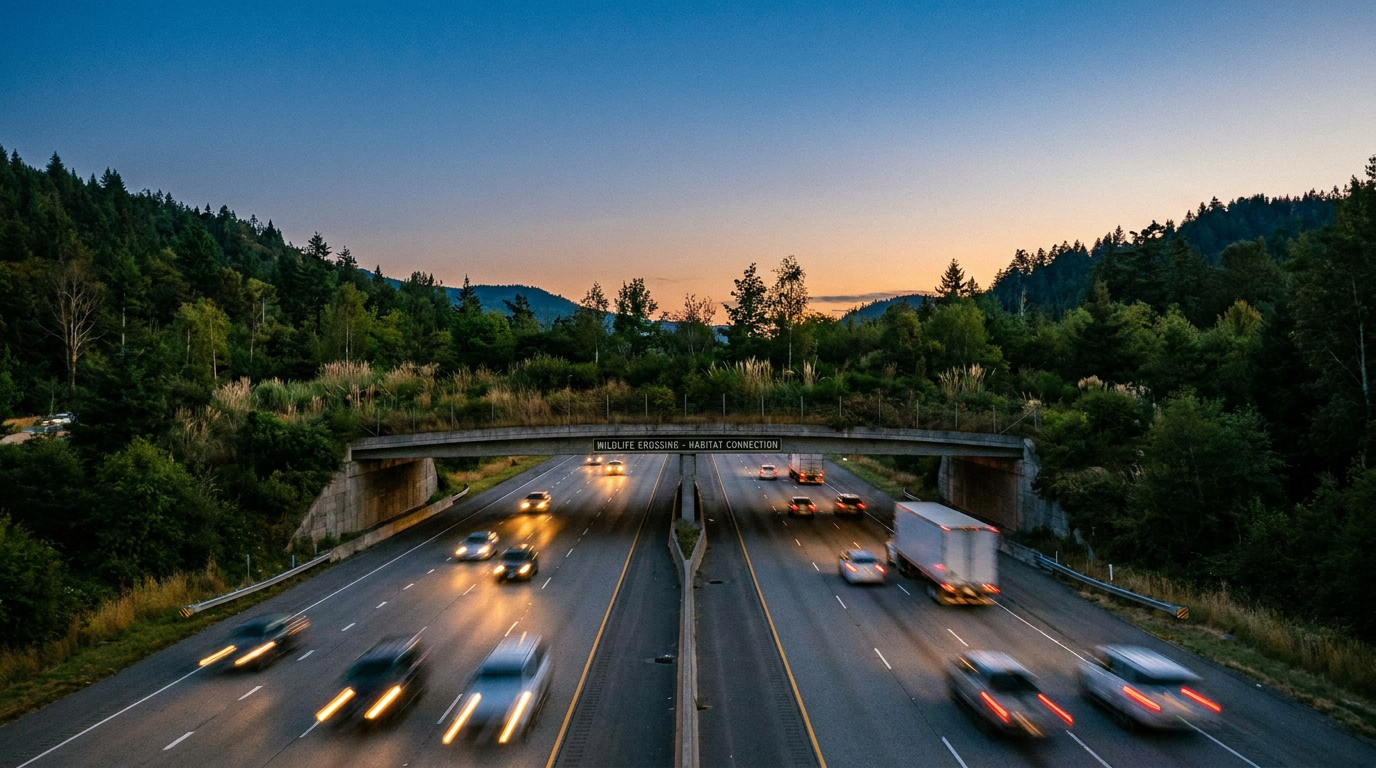
- Conservation Biologists
- Focus on restoring genetic diversity and preventing localized extinctions.
- Transportation Planners
- Focus on motorist safety and the long-term economic return on infrastructure.
- Local Communities
- Focus on reducing dangerous highway collisions and preserving local wildlife.
What's not represented
- · Insurance Companies
- · Indigenous Land Stewards
Why this matters
Wildlife-vehicle collisions cost Americans $8 billion annually and cause hundreds of fatalities. This new wave of infrastructure proves that we can engineer our way out of this crisis, saving taxpayer money, protecting drivers, and preserving local ecosystems all at once.
Key points
- Wildlife collisions cost the US $8 billion annually and kill up to 2 million large animals.
- Dedicated wildlife overpasses and underpasses reduce vehicle collisions by up to 80 percent.
- DNA studies prove these structures successfully restore vital genetic diversity to isolated animal populations.
- Different species require different designs; elk prefer open bridges, while cougars prefer enclosed tunnels.
- Despite high upfront costs, the infrastructure typically pays for itself within a decade through reduced accident costs.
- The world's largest wildlife crossing is nearing completion in 2026 over a 10-lane freeway in California.
Every 26 seconds, a driver in the United States hits an animal. The resulting highway collisions kill between one and two million large animals annually, cause hundreds of human fatalities, and generate more than $8 billion in property damages, insurance claims, and emergency response costs. For decades, this staggering toll was widely accepted as the inevitable friction of modern transportation infrastructure. But a quiet, evidence-based revolution in road ecology is rapidly shifting that paradigm across the continent, treating habitat fragmentation not as an unavoidable tragedy, but as a highly solvable engineering challenge.[1][8]
Across North America, state transportation agencies and environmental conservationists are actively retrofitting the continent's sprawling highways with dedicated wildlife crossings. These massive vegetated overpasses and tunneled underpasses are designed exclusively for animal transit, keeping wildlife entirely separated from high-speed traffic. The movement is reaching a historic, highly visible milestone in 2026 with the completion of the Wallis Annenberg Wildlife Crossing in Southern California. Spanning ten lanes of the heavily trafficked US-101 freeway near Los Angeles, the 210-foot-long structure is officially the largest of its kind in the world.[2][4]
The ambitious Annenberg project perfectly highlights the dual mandate of these modern structures: protecting human motorists while simultaneously saving local species from impending genetic collapse. The US-101 freeway has long acted as an impenetrable concrete river, effectively trapping a localized population of mountain lions within the Santa Monica Mountains. Without the physical ability to roam outward and mate with neighboring populations, the big cats faced severe inbreeding depression, physical abnormalities, and the very real threat of localized extinction within a matter of decades.[1][4]

While the California megaproject currently captures international headlines, the rigorous scientific foundation for wildlife crossings was actually laid hundreds of miles to the north. In Canada's breathtaking Banff National Park, the Trans-Canada Highway bisects one of the continent's richest and most diverse ecosystems. Over the past three decades, Parks Canada has systematically constructed 44 distinct wildlife crossings—comprising 38 underpasses and six massive overpasses—creating the world's longest-running and most closely studied road ecology experiment. This pioneering effort transformed a deadly stretch of pavement into a global model for coexistence, proving that heavy human transit and thriving wilderness do not have to be mutually exclusive.[7]
The empirical results gathered from the Banff experiment are nothing short of staggering. Continuous, year-round monitoring using trail cameras and track pads has shown that the combination of crossing structures and high funnel fencing has reduced wildlife-vehicle collisions by more than 80 percent overall. For specific large ungulates like elk and deer, which are particularly hazardous to drivers, the collision rate has plummeted by an astonishing 96 percent. The structures have effectively neutralized the highway as a source of mass mortality, saving thousands of animals and preventing countless human injuries.[7]

But the mechanism of success extends far beyond simply keeping animals off the asphalt and out of windshields. The deeper, arguably more significant biological victory is the restoration of 'gene flow'—the vital transfer of genetic material between previously separated populations. When multi-lane roads fragment habitats, isolated animal groups suffer from drastically reduced genetic diversity. This bottleneck makes them highly vulnerable to disease outbreaks, environmental shifts, and congenital defects that can quietly doom a population even if no animals are ever struck by cars.[1][6]
A landmark study published in the peer-reviewed journal Proceedings of the Royal Society B provided the definitive, DNA-based proof that crossings solve this invisible crisis. Researchers from Montana State University spent three years meticulously collecting genetic material from bear hair snagged on specialized wires at the Banff crossings. They discovered that both grizzly and black bears were not only using the structures to migrate safely, but were successfully breeding with populations on the opposite side of the highway. This data transformed the scientific understanding of what these bridges can actually achieve.[6][7]
Researchers from Montana State University spent three years meticulously collecting genetic material from bear hair snagged on specialized wires at the Banff crossings.
The comprehensive genetic analysis identified clear bidirectional gene flow, proving beyond a doubt that the crossings allow sufficient mixing to prevent long-term genetic isolation. 'We documented gene flow by showing migration, reproduction and genetic admixture,' the researchers noted in their findings, confirming that the structures function exactly as intended from a demographic standpoint. By facilitating this natural exchange, the crossings act as a critical life-support system, ensuring that the broader regional ecosystem remains resilient and genetically robust. This breakthrough finding silenced early skeptics who argued the bridges would merely serve as expensive novelties rather than functional ecological corridors.[6]
Designing an effective crossing, however, requires understanding that different species possess highly distinct architectural preferences. The decades of data reveal that grizzly bears, moose, and elk strongly prefer the wide-open sightlines and natural lighting of vegetated overpasses, which allow them to scan for predators. In stark contrast, more secretive animals like cougars and black bears gravitate toward the enclosed, cozy coverage provided by underpasses and culverts. A successful, landscape-level mitigation strategy therefore requires a diverse mix of both structure types to accommodate the full spectrum of local biodiversity.[7]

The undeniable success documented in Banff has catalyzed a massive, continent-wide scaling of the concept. The Yellowstone to Yukon (Y2Y) Conservation Initiative, an ambitious bi-national effort to connect habitats along the entire spine of the Rocky Mountains, recently reported that 204 wildlife crossings are now fully operational across their region. These strategically placed structures are actively shrinking the dangerous gaps between isolated grizzly populations, reducing the distance between viable breeding groups from 150 miles down to less than 45 miles today.[5]
Remarkably, local animals often adapt to the new infrastructure much faster than biologists initially anticipated. At a recently constructed wildlife overpass in Siskiyou County, California, motion-activated trail cameras captured a small herd of mule deer utilizing the bridge just 15 hours after construction crews had wrapped up their work for the day. This rapid, almost immediate adoption underscores how desperately these safe migration corridors are needed by wildlife navigating increasingly fragmented landscapes. Animals possess an innate drive to follow historic migration routes, and when a safe path is finally provided, they instinctively take it.[3]
Despite the overwhelming ecological benefits, the primary hurdle to universal adoption remains the steep upfront capital requirement. The Wallis Annenberg crossing, for instance, carries an estimated price tag of $114 million—a figure driven up by recent inflation, complex engineering requirements over a live, ten-lane freeway, and the sheer scale of the native landscaping required to mimic the surrounding hillsides. Critics and fiscal conservatives often point to these staggering figures as prohibitive for widespread public infrastructure, questioning whether the environmental benefits justify the taxpayer expense.[2][4]
However, transportation economists and civil engineers argue that the structures are highly cost-effective when viewed over their actual lifespan. Research consistently demonstrates that wildlife crossings typically pay for themselves within a decade. By drastically reducing the $8 billion annual burden of vehicle damage, medical bills, and emergency response costs, the infrastructure functions as a high-yield public investment. In many high-collision corridors, the societal and economic cost of doing nothing frequently exceeds the expense of building the crossings in the first place.[5][8]

Federal and state governments are increasingly recognizing this compelling mathematical reality. The United States government recently allocated hundreds of millions of dollars in federal infrastructure grants specifically earmarked for wildlife crossing projects across 17 different states. From the snowy passes of Colorado to the desert highways of Nevada, state transportation departments are fundamentally shifting their approach, moving away from reactive roadkill cleanup and toward proactive, science-based corridor engineering. This influx of funding is transforming road ecology from a niche environmental concern into a core pillar of modern civil engineering.[8]
As the global climate continues to warm and habitats inevitably shift, the ability of species to migrate safely across the continent will only become more critical to their survival. Wildlife crossings represent a rare, unambiguous win-win in modern conservation and public policy: they make human transportation significantly safer while actively repairing the deep ecological fractures of the past century. By building bridges for nature, North America is finally learning to share the road. The concrete barriers that once divided the natural world are slowly being transformed into the very lifelines that will sustain it.[1][5]
How we got here
1996
Banff National Park constructs its first two wildlife overpasses, launching a decades-long road ecology experiment.
2014
A landmark DNA study proves that the Banff crossings successfully facilitate gene flow between grizzly and black bear populations.
2022
Ground is broken on the Wallis Annenberg Wildlife Crossing in Southern California, designed to save the local mountain lion population.
2025
The Yellowstone to Yukon Conservation Initiative reports that 204 wildlife crossings are now operational across their corridor.
2026
The Wallis Annenberg Wildlife Crossing, the largest of its kind in the world, nears completion over the US-101 freeway.
Viewpoints in depth
Conservation Biologists
Focus on restoring genetic diversity and preventing localized extinctions.
For biologists, the primary metric of success isn't just a reduction in roadkill, but the restoration of 'gene flow.' They argue that isolated populations inevitably suffer from inbreeding depression, making them susceptible to disease and environmental changes. By proving that animals successfully breed across these structures, biologists view crossings as essential life-support systems for fragmented ecosystems.
Transportation Planners
Focus on motorist safety and the long-term economic return on infrastructure.
Highway engineers and state planners view wildlife crossings through a cost-benefit lens. While acknowledging the steep upfront capital required—often tens of millions of dollars per structure—they emphasize that the infrastructure pays for itself. By eliminating the majority of the $8 billion annual cost of vehicle repairs, medical responses, and highway cleanups, planners argue these structures are highly efficient public investments.
Local Communities
Focus on reducing dangerous highway collisions and preserving local wildlife.
For drivers living in high-collision corridors, the crossings represent a massive quality-of-life improvement. Striking a 1,000-pound elk at highway speeds is frequently fatal for motorists. Communities advocate for these structures to make their daily commutes safer, while also expressing pride in coexisting safely with iconic local species like mountain lions and bears.
What we don't know
- How shifting climate zones will force animals to migrate to new areas, potentially bypassing existing crossing structures.
- The long-term maintenance costs of keeping large vegetated overpasses structurally sound and ecologically viable over several decades.
- How effectively these massive structures serve smaller, less-studied species like amphibians, reptiles, and insects.
Key terms
- Habitat Fragmentation
- The process by which large, continuous areas of habitat are divided into smaller, isolated patches, often by human infrastructure like highways.
- Gene Flow
- The transfer of genetic material from one population to another, which maintains genetic diversity and prevents inbreeding.
- Inbreeding Depression
- The reduced biological fitness and health of a population caused by mating between closely related individuals in an isolated group.
- Road Ecology
- The scientific study of the ecological effects of roads and highways on local environments and wildlife populations.
- Ungulate
- A diverse group of large, primarily herbivorous, hooved mammals, including deer, elk, and moose.
Frequently asked
Do animals actually know to use the bridges?
Yes. Research shows that animals quickly learn to use the structures, often guided by funnel fencing along the highway. Some species, like elk, have even been documented using overpasses while they are still under construction.
Why are some crossings bridges and others tunnels?
Different species have different architectural preferences. Prey animals like elk and moose prefer wide-open overpasses with clear sightlines, while predators like cougars and black bears often prefer the enclosed cover of underpasses.
How much does a wildlife crossing cost?
Costs vary wildly based on scale and location. A simple underpass might cost a few million dollars, while the massive Wallis Annenberg crossing over a 10-lane Los Angeles freeway is estimated at $114 million.
Do these structures actually save money?
Yes. Studies indicate that wildlife crossings typically pay for themselves within a decade by drastically reducing the costs associated with vehicle damage, insurance claims, and emergency medical responses.
Sources
Source coverage
8 outlets
3 viewpoints surfaced








[1]Factlen Editorial TeamConservation Biologists
Synthesis by Factlen editorial team
Read on Factlen Editorial Team →[2]Los Angeles TimesLocal Communities
The Wallis Annenberg Wildlife Crossing to open this December
Read on Los Angeles Times →[3]Smithsonian MagazineConservation Biologists
Mule Deer Are Already Using California's First Wildlife Crossing—and It's Not Even Finished Yet
Read on Smithsonian Magazine →[4]CaltransTransportation Planners
US-101 – Wallis Annenberg Wildlife Crossing at Liberty Canyon
Read on Caltrans →[5]Yellowstone to Yukon Conservation InitiativeConservation Biologists
One big tent: Y2Y's 2025 impact report is here
Read on Yellowstone to Yukon Conservation Initiative →[6]Proceedings of the Royal Society BConservation Biologists
Genetic connectivity for two bear species at wildlife crossing structures in Banff National Park
Read on Proceedings of the Royal Society B →[7]Western Transportation InstituteTransportation Planners
Banff Wildlife Crossings Project
Read on Western Transportation Institute →[8]Center for Large Landscape ConservationTransportation Planners
Wildlife Crossing Success Stories in the Western States
Read on Center for Large Landscape Conservation →
Every angle. Every day.
Get world stories with full source coverage and perspective breakdowns delivered to your inbox.